
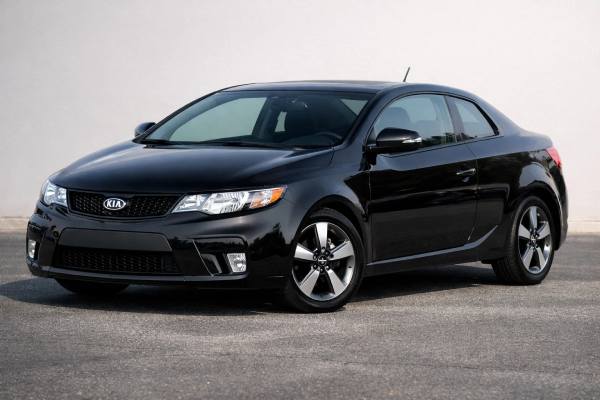
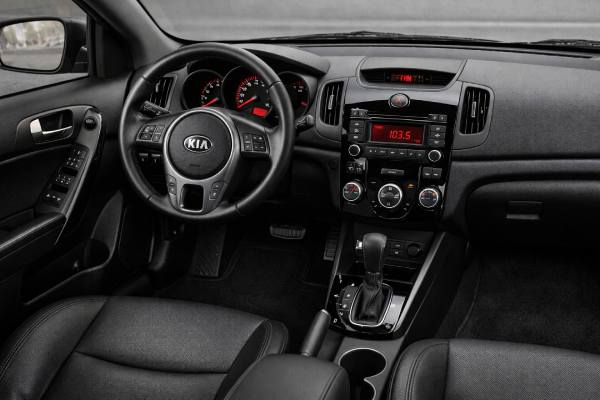
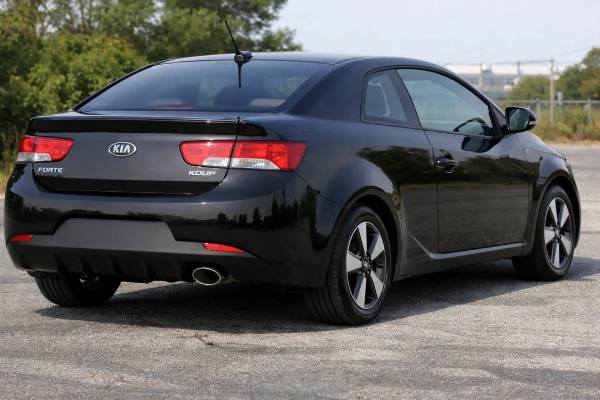
The 2010–2011 Kia Forte Koup (TD) with the 2.4-liter Theta II is the “warm” version of Kia’s compact coupe: a simple, naturally aspirated powertrain paired with a lightweight two-door body and a longer wheelbase than many rivals. In daily use, it feels more grown-up than the styling suggests—stable on the highway, roomy enough for four adults in a pinch, and generally easy to keep running if it has consistent maintenance history. The 173 hp 2.4 rewards drivers who like midrange pull more than high-rpm drama, and it can be a great used buy when you want coupe looks without turbo complexity.
The catch is that this era of Theta II engines deserves careful screening. A clean service record, correct oil-change habits, and confirmed completion of any applicable service campaigns matter more than mileage alone.
Fast Facts
- Strong midrange torque makes it feel quicker than the numbers suggest, especially from 40–100 km/h.
- Coupe body is genuinely practical for the class: long wheelbase and a usable trunk for a two-door.
- Simple FWD layout keeps ownership costs predictable when it’s been maintained properly.
- Theta II engines should be screened carefully for knocking, oil-use, and completed service actions.
- Plan on engine oil and filter every 8,000–12,000 km (5,000–7,500 mi) or 12 months depending on driving conditions.
Jump to sections
- Kia Forte Koup TD in depth
- Kia Forte Koup TD spec grid
- Kia Forte Koup TD equipment and safety kit
- Known faults and factory fixes
- Service plan and buying checks
- On-road feel and efficiency
- Rival coupes and compact picks
Kia Forte Koup TD in depth
The Forte Koup (TD) is not a stripped “commuter coupe.” It’s a compact platform tuned to feel stable at speed, with a long 2,650 mm (104.3 in) wheelbase and a lower roofline than the Forte sedan. In 2.4-liter form (commonly the sportier trim level), it’s the variant that best matches the body: enough torque to make passing easy, without the extra heat management and component count of a turbo setup.
Powertrain character: the 2.4 Theta II is a naturally aspirated inline-four that leans on displacement rather than boost. Expect a confident surge from low-to-mid rpm, with the engine feeling most relaxed when you short-shift and ride the torque. In manual form, it’s the more engaging option; the automatic is the easier daily-driver choice and typically returns similar highway economy when driven gently.
Why owners like it:
- Value density: for used-car money, you often get features that were optional or rare on some rivals (Bluetooth/USB era-correct convenience, decent sound systems, and a “complete” feel).
- Everyday practicality: the trunk is usable, rear seat access is acceptable for occasional passengers, and the long wheelbase helps highway composure.
- Simple layout: FWD, conventional suspension, and widely available parts make it approachable for independent shops.
Where it can disappoint:
- The coupe shape does not eliminate compact-car NVH—tire noise and wind noise depend heavily on tire choice, door seal condition, and prior body repairs.
- “Sport-tuned” suspension (where fitted) can feel firm on broken pavement, and worn rear bushings make the back end feel busy.
- The big one is engine screening. A well-cared-for Theta II can be a long-term partner, but a neglected one can become expensive quickly.
If you’re shopping today, treat this model like a “maintenance-history car.” A clean pre-purchase inspection (including cold-start listening and scan data) matters more than a low odometer reading.
Kia Forte Koup TD spec grid
Below are typical specifications for the 2010–2011 Forte Koup (TD) 2.4 in common North American configuration. Exact figures can vary by market, emissions calibration, and equipment.
Powertrain and efficiency
| Item | Specification |
|---|---|
| Code | Theta II family (commonly listed as 2.4 MPI) |
| Engine layout and cylinders | I-4, DOHC, 4 cylinders, 4 valves/cyl |
| Bore × stroke | 88.0 × 97.0 mm (3.46 × 3.82 in) |
| Displacement | 2.4 L (2,359 cc) |
| Induction | Naturally aspirated |
| Fuel system | Multi-port fuel injection (MPI/MPFI) |
| Compression ratio | ~10.5:1 |
| Max power | 173 hp (129 kW) @ ~6,000 rpm |
| Max torque | 228 Nm (168 lb-ft) @ ~4,000 rpm |
| Timing drive | Chain |
| Rated efficiency (typical) | ~8.7–9.1 L/100 km combined (~26 mpg US / ~31 mpg UK) |
| Real-world highway @ 120 km/h (75 mph) | ~7.6–8.6 L/100 km (~27–31 mpg US) depending on tires, wind, and load |
Transmission and driveline
| Item | Specification |
|---|---|
| Transmission | 6-speed manual (common) or automatic (varies by year/market) |
| Drive type | FWD |
| Differential | Open |
Chassis and dimensions
| Item | Specification |
|---|---|
| Suspension (front/rear) | MacPherson strut / torsion beam |
| Steering | Rack-and-pinion with power assist |
| Brakes (typical) | 4-wheel discs on sport trims (diameters vary by package) |
| Wheels/tyres (most common sport fitment) | 215/45 R17 (17 in rim) |
| Ground clearance | Not consistently published; expect ~140 mm (~5.5 in) typical |
| Length / width / height | 4,480 / 1,765 / 1,400 mm (176.4 / 69.5 / 55.1 in) |
| Wheelbase | 2,650 mm (104.3 in) |
| Turning circle (kerb-to-kerb) | ~10.3–10.8 m (33.9–35.4 ft) depending on wheels |
| Kerb weight | Typically ~1,270–1,350 kg (~2,800–2,980 lb) depending on transmission and options |
| Fuel tank | 52 L (13.7 US gal / 11.4 UK gal) |
| Cargo volume | Typically ~340–360 L (~12–13 ft³) (method varies) |
Performance and capability (realistic expectations)
| Item | Typical result (stock) |
|---|---|
| 0–100 km/h (0–62 mph) | ~8.0–8.8 s (manual often quicker than automatic) |
| Top speed | ~200–210 km/h (~124–130 mph) |
| Braking distance 100–0 km/h | ~40–42 m (tire-dependent) |
| Towing capacity | Generally not rated / not recommended for this platform |
| Payload | Often ~350–450 kg (~770–990 lb) depending on trim |
Fluids and service capacities (typical)
| System | Specification (typical) |
|---|---|
| Engine oil | API SM/SN or better; ILSAC GF-4/GF-5; 5W-20 or 5W-30 commonly used |
| Engine oil capacity | ~4.3 L (4.5 US qt) (with filter) |
| Coolant | Ethylene glycol long-life coolant, 50/50 mix |
| Coolant capacity | ~6.0 L (6.3 US qt) |
| Automatic ATF | SP-IV (verify for your transmission) |
| Automatic ATF capacity | ~7.6 L (8.0 US qt) (dry fill; service fill is less) |
| Manual trans fluid | SAE 75W-85, API GL-4 |
| Manual trans capacity | ~1.8 L (1.9 US qt) |
| Brake fluid | DOT 3 / DOT 4 (market dependent) |
| Power steering fluid | PSF-4 (if applicable) |
| Power steering capacity | ~0.9 L (1.0 US qt) |
| A/C refrigerant | R-134a (most markets for this era); charge varies—use under-hood label |
| Key torque specs | Wheel lug nuts: 88–107 Nm (65–79 lb-ft) |
Safety and driver assistance (era-correct)
| Item | Notes |
|---|---|
| Crash ratings | Often referenced from the related Forte platform testing; confirm exact body style coverage for your market/year |
| Airbags | Typically front, front side, and curtain airbags (configuration varies) |
| Stability and braking | ABS, traction control, and ESC commonly available (trim/year dependent) |
| ADAS suite | This era is typically pre-AEB/ACC/LKA; expect basic stability systems rather than modern driver assistance |
Kia Forte Koup TD equipment and safety kit
For 2010–2011, the Forte Koup lineup is usually structured around two trims, with the 2.4-liter engine tied to the sportier grade. Exact naming and packages vary by region, but the pattern is consistent: the 2.0 models focus on value, while the 2.4 models add performance and appearance upgrades.
Trims and options that matter on the 2.4
What typically changes when you step into the 2.4 car:
- Wheels and tires: 17-inch wheel packages are common, and the tire size often changes to 215/45R17. This improves turn-in but can increase road noise and tire costs.
- Suspension tuning: some 2.4 trims include a firmer, sport-tuned setup, reducing body roll at the cost of impact harshness on rough pavement.
- Convenience and audio: upgraded audio systems, steering-wheel controls, and connectivity features were a core part of the model’s appeal in this period.
- Transmission choice: 6-speed manual is common on enthusiast-oriented versions; automatics vary by year/market. Always confirm by VIN/build sheet.
Options worth seeking (because they improve daily satisfaction):
- A factory navigation or upgraded head unit (if available in your market) can be a plus, but only if it still functions well and hasn’t caused battery drain issues.
- Sunroof/leather packages (where fitted) can improve resale appeal, but inspect drains and seals carefully on older cars.
Quick identifiers when shopping used
Because badges and wheels can be swapped, use multiple “tells”:
- Check the under-hood emissions label and the VIN paperwork for engine displacement.
- Confirm the tire size on the door jamb label matches what’s mounted. A mismatch may hint at accident repair, suspension changes, or cheap tire choices.
- During a test drive, the 2.4 should pull confidently from low speed without needing a downshift for moderate grades.
Safety ratings and what to take from them
This generation is often discussed in the context of the broader Forte platform’s crash testing. When reading ratings:
- Confirm whether the test covers your body style and your model year. Coupe and sedan structures can be related but not always identical in every detail.
- Focus on real equipment on the car you’re buying: airbags present, ESC/traction functioning, and the condition of tires and brakes.
Safety systems and service considerations
Expect an era-appropriate set of safety features:
- ABS and ESC (where equipped) are helpful, but they depend on good wheel-speed sensor data and a healthy brake hydraulic unit.
- Child-seat provisions: rear outboard positions typically have LATCH/ISOFIX anchors, but verify anchor condition and rear seatbelt retraction.
- After any collision repair, insist on a scan for SRS (airbag) faults, and confirm all airbags installed match factory specification—cheap repairs sometimes cut corners here.
If you want a safer ownership experience, prioritize a car with verifiable repair history and intact safety systems over a “modified” example with unknown workmanship.
Known faults and factory fixes
A good Forte Koup 2.4 is usually straightforward to own, but this is not a “buy blind” model. Below are the issues that most often define ownership, grouped by prevalence and cost tier. Mileage ranges are approximate—age, oil-change discipline, and driving style matter.
Common (watch closely)
- Engine knock / bearing wear (high severity, high cost)
Symptoms: cold-start knocking that persists, metallic rattle under load, loss of power, oil-pressure warnings, or metal in oil.
Likely root cause: bearing wear can progress quickly once it starts; it’s often linked to oil condition, debris, or internal wear patterns.
Remedy: stop driving, confirm oil level/condition, scan for misfire/knock-related codes, and follow manufacturer diagnostic flow. Some cars have had applicable software updates and service actions—verify by VIN and dealer record. - Oil consumption and neglected maintenance (medium to high severity)
Symptoms: low oil between changes, blue smoke on start-up (less common), noisy top end, timing-correlation or cam/crank correlation concerns in severe cases.
Remedy: shorten oil intervals, use the correct viscosity, and verify PCV system function. A pre-purchase inspection should include checking for sludge under the oil cap and reviewing oil-change records. - Brake and ABS-related warnings (medium to high severity)
Symptoms: ABS/ESC lights, inconsistent pedal feel, brake pull, or warning lights after rain/cold starts.
Remedy: diagnose wheel-speed sensors and wiring first; confirm recall status where applicable. Brake fluid condition matters more than many owners think—old fluid can accelerate hydraulic component wear.
Occasional (usually manageable)
- Ignition coil packs and spark plugs (low to medium cost)
Misfires under load are often a coil or plug issue. Fixes are usually simple if addressed early. - Front suspension wear (low to medium cost)
Worn links/bushings show up as clunks over bumps or vague steering on-center. Coupes often get driven harder, so check carefully. - A/C performance decline (medium cost)
Weak cooling can be as simple as low refrigerant or as expensive as compressor wear. Look for stable vent temps and quiet compressor operation.
Rare but expensive (screen for signs)
- Transmission neglect (medium to high severity)
Harsh shifts or flare on automatics can be worsened by old fluid. Manuals can develop clutch slip or synchro wear if abused—especially if modified. - Electrical drains (low to medium severity)
Aftermarket audio/alarms are common culprits. A clean, stock wiring harness is a real advantage.
Recalls, TSBs, and “verify-by-VIN” actions
Instead of assuming, treat completion status as a condition of purchase:
- Run the official recall lookup using the VIN.
- Request dealer service history (many dealers can print campaign completion).
- Ask the seller for documentation of any engine-related software updates or service actions.
The best examples are the ones that were maintained consistently and had factory actions completed promptly—those cars tend to feel smoother, quieter, and more “together” on a cold start.
Service plan and buying checks
A practical maintenance routine is the difference between a bargain coupe and a frustrating project. Use the schedule below as a real-world baseline, then tighten it if you drive in severe conditions (short trips, heavy city use, extreme cold/heat, or frequent high-rpm driving).
Practical maintenance schedule (distance/time)
- Engine oil and filter: every 8,000–12,000 km (5,000–7,500 mi) or 12 months.
Use the shorter interval if your trips are mostly under 15 minutes or you see stop-and-go traffic daily. - Engine air filter: inspect every oil change; replace typically every 24,000–48,000 km (15,000–30,000 mi) depending on dust.
- Cabin air filter: every 15,000–30,000 km (10,000–20,000 mi) or annually if you want strong HVAC performance.
- Spark plugs: many owners plan ~100,000 mi (160,000 km) if iridium-equipped, but verify plug type and follow the correct interval for your exact engine calibration.
- Coolant: if long-life coolant is fitted, a conservative plan is 5 years / 100,000 km (60,000 mi), then repeat; confirm the coolant type and the service interval in your official documentation.
- Brake fluid: every 2 years, regardless of mileage.
- Automatic transmission fluid: consider a drain/fill around 60,000–100,000 km (40,000–60,000 mi) for longevity (more often in hot climates).
- Manual transmission fluid: 80,000–120,000 km (50,000–75,000 mi) is a sensible interval if the car sees spirited use.
- Serpentine/aux belt and hoses: inspect annually; replace at the first signs of cracking, glazing, or coolant seepage.
- Tires: rotate every 8,000–12,000 km (5,000–7,500 mi); align yearly or after impacts.
- 12 V battery: expect a replacement window around 4–6 years.
Fluids and specs that help you buy smart
Use these as decision-grade references (verify for your VIN):
- Engine oil: 5W-20 or 5W-30 meeting the correct API/ILSAC specs; capacity about 4.3 L (4.5 qt).
- Coolant: ethylene glycol long-life, typically 50/50; capacity about 6.0 L (6.3 qt).
- ATF: commonly SP-IV for this family; total fill around 7.6 L (8.0 qt), but service fills are smaller.
- Wheel lug nut torque: 88–107 Nm (65–79 lb-ft).
Buyer’s guide checklist (what to inspect)
Before the test drive
- Verify VIN campaigns and recalls; ask for proof of completion.
- Check for uneven panel gaps, overspray, or mismatched headlights (accident history clues).
- Inspect the oil level and condition. Low oil with no good explanation is a red flag.
Cold start and idle
- Listen for persistent knock/tapping.
- Confirm steady idle and quick warm-up without misfires.
- Watch for exhaust smoke and sniff for fuel smell (possible rich running).
Drive test
- Do several gentle-to-moderate accelerations from 30–80 km/h; the 2.4 should pull cleanly.
- Brake from highway speeds: the car should track straight with a firm, consistent pedal.
- Over bumps, listen for front-end clunks and rear “thumps” that suggest worn links or bushings.
Post-drive
- Recheck the oil level and look underneath for fresh seepage.
- Scan for codes, including pending codes, and confirm all readiness monitors make sense.
A well-vetted Forte Koup 2.4 can be a durable daily, but the buying process should be methodical—especially around engine history.
On-road feel and efficiency
The Forte Koup’s personality is defined by its wheelbase and tuning. It feels more stable than many small coupes at highway speed, and the chassis generally communicates clearly when the tires are doing their job. Where it wins is in “normal fast”—the kind of pace you use every day, not just on a back road.
Ride, handling, and NVH
- Straight-line stability: the long wheelbase helps it track well on motorways, especially on fresh tires with correct alignment.
- Cornering balance: it’s a front-driver with a torsion-beam rear, so it won’t rotate like an independent rear suspension coupe, but it responds predictably. Worn rear dampers or mismatched tires can make it feel nervous.
- Steering feel: assistance is light and practical. Expect more “easy” than “telepathic,” but with decent precision for commuting and brisk driving.
- Cabin noise: tire choice makes a big difference. Cheap hard-compound tires often add road roar, and worn door seals can increase wind noise around the frameless-feeling coupe glass areas.
Powertrain character and transmission behavior
The 2.4’s advantage is usable torque:
- Manual: feels eager in the midrange and makes the car feel lighter than it is. Clutch condition matters—slip under load is a reason to negotiate or walk away.
- Automatic: typically smooth when healthy, but it benefits from clean fluid and sane temperatures. If it hunts between gears or flares, treat it as a warning sign.
Real-world efficiency
Owners typically see:
- City: roughly 10–11 L/100 km (21–24 mpg US) depending on traffic and warm-up time.
- Highway (100–120 km/h): about 7.6–8.6 L/100 km (27–31 mpg US).
- Mixed: often 8.5–9.8 L/100 km (24–28 mpg US).
Cold weather can add noticeable consumption because warm-up time is longer and winter tires increase rolling resistance. The biggest “free” efficiency gain is keeping tires properly inflated and replacing dragging brake components early.
Performance metrics that change the verdict
This is not a drag racer, but it’s quick enough to feel confident:
- Passing response is strong in the midrange; the car does not need constant high-rpm driving to feel alive.
- Braking consistency is good when the system is maintained, but neglected fluid and bargain pads can ruin pedal feel quickly.
For daily driving, the Forte Koup 2.4’s best trait is how “complete” it feels: stable, torquey, and easy to live with, as long as you buy the right example.
Rival coupes and compact picks
In the 2010–2011 used market, you’re rarely cross-shopping only coupes. You’re shopping “compact fun with real-world costs.” Here’s how the Forte Koup 2.4 usually compares, in practical terms.
Against the Honda Civic Coupe (same era)
Where the Civic often wins
- Strong long-term reputation, broad parts availability, and predictable resale.
- Light controls and efficient commuting demeanor.
Where the Forte Koup can win
- More low-to-midrange torque in 2.4 form, which feels relaxed in real passing situations.
- Often a better “features for the money” deal on the used market.
Decision tip: if you prioritize maximum resale and a huge knowledge base, Civic is hard to beat. If you want torque and value, the Kia is compelling—provided engine history checks out.
Against the Scion tC
Where the tC wins
- A more “single-model” enthusiast community and a practical hatchback-like cargo opening.
- Simple packaging and generally durable drivetrains.
Where the Forte Koup wins
- Often more refined highway manners, and sometimes better cabin isolation depending on tires and condition.
- Can be easier to find in clean, unmodified form in some regions.
Decision tip: if you want a coupe that acts like a hatch, the tC is great. If you want a coupe that feels like a compact sedan in daily use, the Forte Koup is the calmer choice.
Against hot-hatch alternatives (Mazda3 hatch, VW Golf, similar)
Many shoppers end up here because hatchbacks are more practical:
- Hatchbacks often offer better cargo flexibility and, in some cases, more sophisticated rear suspension designs.
- The Forte Koup fights back with style, torque, and purchase price—and can feel less complex to maintain than some European options.
What the Forte Koup 2.4 is “best at”
Choose it when you want:
- A genuine coupe shape without giving up day-to-day usability.
- Naturally aspirated torque and simple FWD mechanics.
- A value-driven used buy—if you’re willing to be strict about maintenance history.
Skip it when you want:
- The sharpest steering feel in the class.
- A modern driver-assistance suite.
- A “buy-any-example” car with minimal screening risk.
If you find a well-maintained, unmodified Forte Koup 2.4 with verified campaign history, it can be one of the more satisfying budget coupes of its era.
References
- 2011 KIA FORTE KOUP 2010 (Press Release)
- Gas Mileage of 2011 Kia Forte 2011 (Official Economy Data)
- 2011 Kia Forte 2011 (Safety Rating)
- Check for Recalls: Vehicle, Car Seat, Tire, Equipment | NHTSA 2026 (Recall Database)
- Microsoft Word – PI2102 FLT#401 – Owner Renotification Letter 2025 (Service Action Notice)
Disclaimer
This article is for informational purposes only and is not a substitute for professional diagnosis, inspection, or repair. Specifications, torque values, service intervals, and procedures can vary by VIN, market, production date, and equipment, so always verify details against official service documentation for your specific vehicle.
If this guide helped, please consider sharing it on Facebook, X/Twitter, or your favorite forum to support our work.