
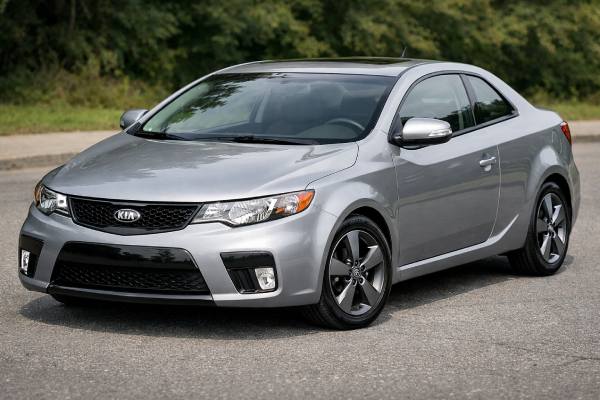
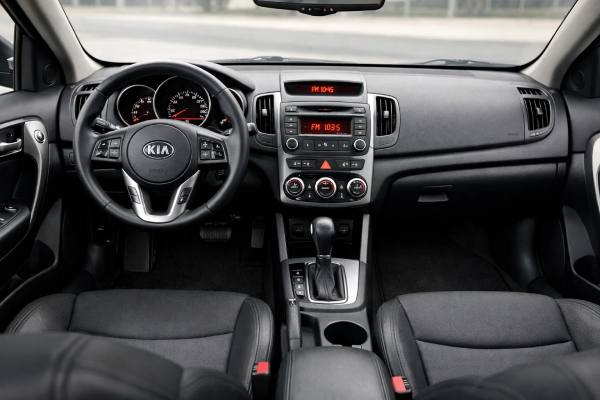
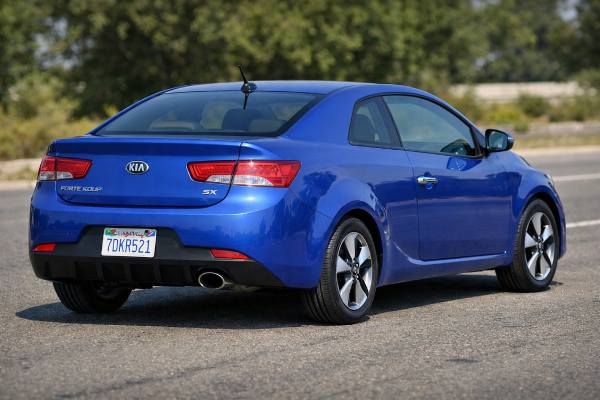
The 2012–2013 facelift Kia Forte Koup (TD) with the 2.0-liter Theta II and 156 hp sits in a sweet spot for used-car shoppers who want a compact coupe that’s practical enough for daily use. It shares most mechanical parts with the sedan and hatchback, but the Koup’s lower roofline and longer doors change how it feels to live with—especially in parking lots and when loading the back seat. The Theta II 2.0 is a simple, naturally aspirated setup (no turbo heat management, no direct-injection carbon headaches), and it pairs well with the 6-speed manual or 6-speed automatic.
Buyers tend to like the Koup for its straightforward driving feel, reasonable running costs, and good highway manners. The key is picking a well-maintained example and staying on top of fluids, brakes, and known recall checks.
Owner Snapshot
- Stable and predictable at highway speeds, with a lower, more planted feel than many compact sedans.
- Naturally aspirated 2.0 favors smooth, mid-range driving over hard low-rpm punch.
- Parts availability is generally strong because many components are shared with the Forte sedan.
- Watch recall completion history and signs of ABS/ESC warning lights before purchase.
- Plan oil changes every 8,000–10,000 km (5,000–6,000 mi) or 6 months, depending on use.
Quick navigation
- Kia Forte Koup TD facelift explained
- Kia Forte Koup TD 2.0 spec tables
- Kia Forte Koup TD trims and safety
- Known faults and recall checks
- Maintenance schedule and buying tips
- Road feel and real mpg
- Competitors and best alternatives
Kia Forte Koup TD facelift explained
The 2012–2013 facelift Koup is best understood as a “different body, same mechanical spine” approach. Underneath, it uses the familiar front-drive compact layout: transverse engine, strut front suspension, and a torsion-beam rear. That combination is not exotic, but it’s durable when bushings and dampers are kept in shape. Where the Koup separates itself is in its packaging and aero. The lower roof and coupe profile reduce wind noise and help it feel calmer at speed, while the longer doors and frameless-window vibe (depending on market/trim) lean into a sporty identity without demanding sports-car compromises.
With the 156 hp Theta II 2.0, the personality is more “clean and linear” than “fast.” You get a predictable throttle, decent top-end pull, and the ability to cruise without hunting between gears. This is also a simpler ownership proposition than many modern small cars: no turbo plumbing, no high-pressure direct-injection system, and fewer complex driver-assist sensors to recalibrate after repairs. That simplicity is a real advantage in the used market.
The Koup’s real ownership strengths show up over time:
- Shared parts ecosystem: many consumables (filters, brakes, sensors, suspension pieces) match the wider Forte family, keeping costs and downtime reasonable.
- Comfort at speed: it tracks straight and feels stable on motorways, especially on good tires and a fresh alignment.
- Everyday usability: the rear seat is usable for shorter adults and kids, and the trunk is legitimate for a compact coupe.
Trade-offs are predictable for the body style. Rear access is tighter, visibility over the shoulder can be worse than the sedan, and long doors make tight parking spots annoying. If you live in a dense city or you regularly carry adults in the back, the Koup’s style premium may not be worth it. But if you want a compact that feels a little more special than a basic sedan—without stepping into higher insurance groups or complicated powertrains—this facelift Koup is one of the more sensible picks.
Kia Forte Koup TD 2.0 spec tables
Below are the key specs for the facelift Koup with the naturally aspirated Theta II 2.0. Exact values can vary by market, emissions calibration, and trim. Use your VIN-specific service information for final confirmation.
Powertrain and efficiency
| Item | Specification |
|---|---|
| Engine code (common) | Theta II 2.0 (often G4KD, market-dependent) |
| Layout | Inline-4, aluminum block/head |
| Valvetrain | DOHC, 4 valves/cyl, CVVT |
| Displacement | 2.0 L (1,998 cc) |
| Bore × stroke | 86.0 × 86.0 mm (3.39 × 3.39 in) |
| Induction | Naturally aspirated |
| Fuel system | Multi-port injection (MPI) |
| Compression ratio | ~10.5:1 (market-dependent) |
| Max power | 156 hp (114 kW) @ ~6,200 rpm |
| Max torque | 195 Nm (144 lb-ft) @ ~4,300 rpm |
| Timing drive | Chain |
| Rated efficiency (typical) | ~9.8/7.1 L/100 km (24/33 mpg US) manual; ~9.4/6.9 L/100 km (25/34 mpg US) automatic |
| Real-world highway @ 120 km/h | Commonly ~7.4–8.2 L/100 km (29–32 mpg US), depending on tires, wind, and load |
Transmission and driveline
| Item | Specification |
|---|---|
| Transmission (common) | 6-speed manual or 6-speed automatic |
| Drive type | FWD |
| Differential | Open (traction control uses brakes) |
Chassis and dimensions (coupe body)
| Item | Specification |
|---|---|
| Suspension (front/rear) | MacPherson strut / torsion beam |
| Steering | Electric or hydraulic assist (varies by market); rack-and-pinion |
| Brakes | 4-wheel disc with ABS/ESC (disc sizes vary by trim/market) |
| Wheels/tires (common) | 205/55 R16 (EX) or 215/45 R17 (sport trims), market-dependent |
| Wheelbase | 2,649 mm (104.3 in) |
| Length / width / height | 4,481 / 1,765 / 1,400 mm (176.4 / 69.5 / 55.1 in) |
| Turning circle | ~10.3 m (33.9 ft) |
| Cargo volume | ~357 L (12.6 ft³) seats up; up to ~1,512 L (53.4 ft³) seats folded (method varies) |
Performance (typical expectations)
| Metric | Typical range (healthy car) |
|---|---|
| 0–100 km/h (0–62 mph) | ~9.5–10.5 s (manual often quicker than automatic) |
| Top speed | ~195–205 km/h (121–127 mph), market/tires dependent |
| Braking | Heavily tire- and pad-dependent; prioritize consistent pedal feel over a single number |
Fluids and service capacities (common guidance)
| Item | Typical specification |
|---|---|
| Engine oil | 5W-20 or 5W-30 (climate dependent); capacity often ~4.0–4.3 L with filter |
| Coolant | Long-life ethylene glycol; mix commonly 50/50 (capacity varies by radiator and market) |
| Automatic transmission fluid | Kia/Hyundai-spec ATF; fill method is sensitive—avoid “universal” fluids |
| A/C refrigerant | Typically R-134a on this era (verify under-hood label) |
Safety and driver assistance (era-correct)
| Category | Notes |
|---|---|
| Core safety | Multiple airbags, ABS, ESC, traction control, tire pressure monitoring (varies by market/trim) |
| ADAS | Most cars of this generation do not have modern AEB/ACC/LKA; expect basic stability systems instead |
Kia Forte Koup TD trims and safety
Most facelift Forte Koup TD models are organized around two broad trims: a comfort-focused trim (often EX) and a sportier trim (often SX), with option packages that can blur the line. When shopping used, trim badges help, but equipment can be mixed due to packages and mid-year updates. The practical approach is to verify features by VIN build sheet, then confirm physically.
Trims and options that matter day-to-day
Look for these functional differences because they change ownership costs and the driving feel:
- Wheel and tire package: 16-inch setups usually ride better, cost less to replace, and can be quieter on rough asphalt. 17-inch packages sharpen response but are more sensitive to alignment, bent rims, and tire quality.
- Transmission choice: the 6-speed manual is typically more engaging and can feel stronger in passing if you use the rev range. The 6-speed automatic is easier in traffic but should shift cleanly without flares or harsh engagement.
- Infotainment and lighting: navigation units, upgraded audio, and HID/LED-style lighting (market-dependent) can be expensive to replace. Test every speaker and backlight.
- Comfort options: heated seats, automatic climate control, and a sunroof add value, but also add failure points (seat heaters, blend-door actuators, sunroof drains).
Quick identifiers: sport trims often have larger wheels, firmer suspension tuning, and sometimes sport seats or different interior trim accents. Also check for fog lights, steering wheel controls, and the instrument cluster type; these can hint at higher packages.
Safety ratings and how to interpret them
A key nuance: safety testing agencies may rate the sedan more consistently than the coupe body style, even when the underlying platform is shared. If you see a rating for the 4-door Forte, treat it as informative but not a guarantee for the Koup. For shopping decisions, the safer method is:
- Check whether your exact body style/year is listed by the rating body.
- Confirm airbags and stability-control equipment on the specific vehicle.
- Prioritize tire condition and brake performance—these often matter more in real-world avoidance.
Safety systems and “what you actually get”
Expect traditional safety tech rather than modern ADAS:
- Airbags: typically front, side, and curtain airbags (count and coverage can vary).
- Child-seat anchors: LATCH/ISOFIX in the rear seating positions (verify anchor condition; coupes can see more wear).
- Stability and traction control: ESC and traction control are valuable in wet or snowy conditions, but they depend on good tires and correct wheel speed sensor signals.
- ABS and brake assist: the system should cycle smoothly with no warning lights. If ABS/ESC lights are on, treat it as a real diagnostic job, not a “cheap sensor” assumption.
If you plan to keep the car long-term, choose the cleanest example you can find rather than chasing the highest trim. A well-kept mid-trim Koup with complete service history usually beats a loaded car with patchy maintenance.
Known faults and recall checks
This generation of Forte Koup is generally straightforward, but a few patterns appear often enough that you should plan around them. Think in three buckets: common wear items, occasional “nuisance” failures, and rarer high-consequence issues.
Common (expect at this age)
- Front suspension wear (low to medium cost):
Symptoms: clunks over bumps, vague steering, uneven tire wear.
Likely causes: worn stabilizer links, control arm bushings, strut mounts, or tired dampers.
Remedy: replace worn components in pairs, then align. Don’t skip alignment—this chassis can chew tires quickly when toe is off. - Brake vibration or uneven feel (low to medium cost):
Symptoms: steering shake under braking, pedal pulse (not ABS activation).
Likely causes: pad material transfer, overheated rotors, sticking caliper pins.
Remedy: service caliper slides, verify torque procedure on wheels, replace rotors/pads if thickness or runout is out of spec. - Battery and charging aging (low cost):
Symptoms: slow crank, random electrical glitches, radio resets.
Likely causes: weak 12V battery, corroded terminals, aging alternator regulator.
Remedy: load-test battery, clean and protect terminals, check charging voltage under load.
Occasional (varies by climate and use)
- Cabin HVAC actuator noises (low to medium cost): clicking behind dash, inconsistent temperature control. Often a blend-door actuator or linkage.
- Door and window sealing issues (low cost): wind noise or water intrusion if door seals are tired or a coupe door has sagged slightly over time.
- Ignition coils and plugs (medium cost if neglected): misfires under load, rough idle, check-engine light. Often solved by plugs at correct interval and replacing weak coils.
Higher-severity items to take seriously
- ABS/ESC module-related recalls and fire-risk campaigns (high consequence):
Some vehicles in this family have had recalls related to the hydraulic electronic control unit (HECU) or ABS module electrical concerns.
What to do: - Verify recall completion by VIN through official channels and dealer documentation.
- Treat any ABS/ESC warning light, burning smell, or under-hood smoke report as a hard stop until diagnosed.
Pre-purchase checks that prevent surprises
- Cold start: listen for abnormal rattles, then confirm smooth idle after 30–60 seconds.
- Test drive: straight-line tracking, braking from highway speed, and tight low-speed turns (listen for CV joint clicks).
- Scan tool: check for stored ABS/ESC codes even if the dash is currently clear.
- Paperwork: confirm transmission service history (especially if the automatic shifts harshly).
Most problems on these cars are manageable—what separates a good buy from a regret is whether the previous owner stayed ahead of maintenance and recalls.
Maintenance schedule and buying tips
A facelift Koup TD will reward you if you treat it like a simple machine that still needs consistent care. The goal is to prevent heat and friction from turning into expensive repairs.
Practical maintenance schedule (distance/time)
Use whichever comes first.
- Engine oil and filter: every 8,000–10,000 km (5,000–6,000 mi) or 6 months. Short trips, high heat, or heavy traffic justify the shorter interval.
- Engine air filter: inspect every 15,000 km (9,000 mi); replace around 30,000 km (18,000 mi) or sooner in dusty areas.
- Cabin air filter: 15,000–20,000 km (9,000–12,000 mi), especially if HVAC airflow drops.
- Spark plugs: around 100,000 km (60,000 mi) is common for long-life plugs, but earlier replacement can help if you see misfire codes or rough running.
- Coolant: 5 years/100,000 km as a typical long-life baseline, then 3 years/60,000 km thereafter (confirm for your coolant type).
- Brake fluid: every 2 years, regardless of mileage, to protect ABS components and maintain pedal feel.
- Automatic transmission fluid (if equipped): a conservative plan is 60,000–80,000 km (40,000–50,000 mi), especially for city driving. Use the correct spec fluid—this matters.
- Manual transmission fluid: 80,000–120,000 km (50,000–75,000 mi), sooner if shifts feel notchy or you track/drive hard.
- Serpentine belt and hoses: inspect yearly; replace at first signs of cracking, glazing, or seepage.
- Tires: rotate every 8,000–10,000 km and align annually or after any suspension work.
Useful “decision torque” values (typical)
Because specs vary by market and wheel type, treat these as common guidance and verify for your exact vehicle:
- Wheel lug nuts: often in the 90–110 Nm (66–81 lb-ft) range
- Spark plugs: follow plug manufacturer and service manual spec; over-tightening can damage threads
Buyer’s guide: what to seek and what to avoid
Seek:
- Complete service records, especially oil changes and brake fluid history
- Clean underbody and straight panels (coupe doors can hide hinge wear)
- Smooth shifts (automatic) or a clutch that engages cleanly without chatter (manual)
- Stock or lightly modified examples; heavy “tuning culture” mods often mean harder life
Be cautious with:
- Any unresolved ABS/ESC lights or vague “it goes away sometimes” stories
- Cars with uneven tire wear (often signals bent components or alignment neglect)
- Overheated brakes or repeated rotor replacements without addressing caliper slide condition
Long-term outlook is favorable if you buy a clean example. Most costly surprises come from neglected fluids, ignored warning lights, and recall work that never got completed.
Road feel and real mpg
In daily driving, the facelift Koup TD feels more grown-up than its price suggests—provided the suspension and tires are in good shape. Straight-line stability is a highlight. The coupe body and slightly lower stance give it a settled motorway demeanor, and wind noise is usually reasonable for the class. If you test drive one that feels busy or loud, don’t assume “that’s just how they are”; it often means old dampers, cheap tires, or an alignment that’s slightly off.
Ride, handling, and NVH
- Ride: firm enough to feel controlled, but not harsh on the typical 16-inch setup. The 17-inch tire package can transmit sharper impacts and can get noisy on coarse pavement.
- Handling balance: safe and front-led. It resists sudden rotation, which is good for everyday confidence. Lift-off mid-corner will usually tighten the line slightly rather than snap.
- Steering: light around town, more stable at speed. Don’t expect sports-car feedback; expect predictability.
- Braking feel: best described as consistent when maintained. A good Koup stops straight and doesn’t wander under hard braking.
Powertrain character (2.0 Theta II, 156 hp)
This engine likes revs more than many modern turbo compacts. Around town, it’s smooth and easy, but not “punchy” at low rpm. For passing, it rewards a downshift:
- Manual drivers can keep it in the meat of the powerband and make it feel quicker than the numbers suggest.
- Automatic drivers should check kickdown behavior; it should be decisive without flaring or slipping.
Real-world economy
Official ratings for this era often look optimistic in mixed driving. In practice:
- City-heavy use: typically lands in the ~9.5–11.0 L/100 km range (21–25 mpg US), depending on traffic and temperature.
- Highway cruising (100–120 km/h): often sits around ~7.4–8.2 L/100 km (29–32 mpg US).
- Cold weather penalty: short trips in winter can add 10–20% consumption due to warm-up and denser air.
Two ownership tips that genuinely move the needle:
- Keep tires correctly inflated and avoid mismatched tire models front-to-rear.
- Maintain the brake system so calipers and parking brake mechanisms don’t drag.
The result is a compact coupe that’s easy to live with and cheap to run when you keep it mechanically “square”: good tires, fresh fluids, and no lingering warning lights.
Competitors and best alternatives
The facelift Forte Koup TD sits among compact coupes and sporty-leaning compact cars from the same era. Your best alternative depends on whether you prioritize driving feel, interior quality, fuel economy, or long-term simplicity.
If you want sharper handling
- **Mazda Mazda3 (same era): typically offers more steering feel and a more playful chassis. The trade-off is road noise on some trims and, depending on climate, more corrosion sensitivity.
- **Honda Honda Civic coupe: often feels tighter and has strong resale, but can cost more up front and may have higher theft/insurance considerations depending on market.
If you want low-stress ownership
- **Toyota Toyota Corolla: not a coupe-first experience, but strong for predictable reliability and cheap consumables. You give up some style and cabin “specialness.”
- **Volkswagen Volkswagen Jetta (non-turbo trims in some markets): comfortable and solid-feeling, but trim and engine choices vary widely—shop carefully.
If you want a coupe experience specifically
- **Scion Scion tC: roomy for a coupe and easy to live with. It leans more “big hatch coupe” than “sport coupe,” and fuel economy can be weaker.
- **Hyundai Hyundai Elantra Coupe: similar value logic, but availability and equipment can be more variable by region.
Where the Forte Koup still wins
The Forte Koup’s advantage is balance: it looks sportier than most compact sedans, it’s mechanically simple in 2.0 form, and it’s usually priced fairly because the segment is niche. Choose it if you want a coupe that behaves like a normal daily car—easy service, reasonable fuel use, and no exotic parts requirements. Choose a rival if you want a noticeably sharper chassis, a more premium cabin feel, or the best resale story.
References
- 2013 KIA FORTE KOUP 2012 (Press Release)
- Vehicle Detail Search – 2013 KIA FORTE KOUP 2 DR FWD | NHTSA 2013 (Recall Database)
- Part 573 Safety Recall Report 23V-652 2023 (Recall Report)
- Gas Mileage of 2013 Kia Forte 2013 (Official Fuel Economy)
- 2013 Kia Forte 2013 (Safety Rating)
Disclaimer
This article is for informational purposes only and is not a substitute for professional inspection, diagnosis, or repair. Specifications, torque values, service intervals, and procedures vary by VIN, market, and equipment. Always verify details using official service documentation for your exact vehicle.
If this guide helped, please consider sharing it on Facebook, X (Twitter), or your favorite forum to support our work.