
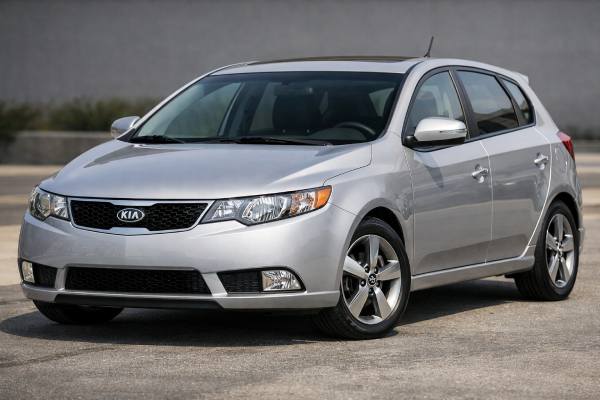
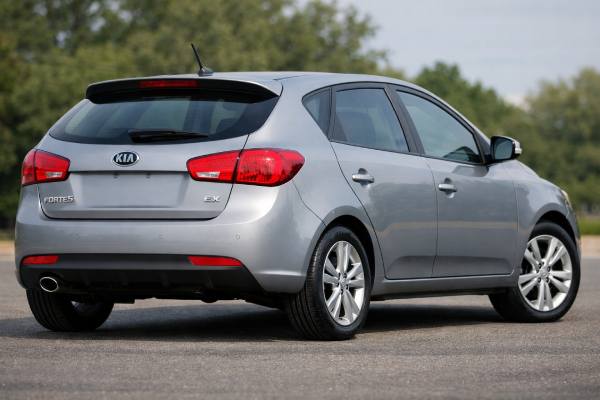
The 2012–2013 facelift Kia Forte5 (TD) with the 2.0-liter Theta II (156 hp) is a practical hatchback that leans more toward smart daily use than pure sport. It shares its core platform with the Forte sedan, but the Forte5’s shorter rear overhang and taller cargo area make it noticeably easier to live with—especially if you carry strollers, luggage, tools, or bulky groceries. The naturally aspirated 2.0 is also an ownership-friendly choice: fewer heat-soak problems than turbo engines, simpler fueling than many direct-injection designs, and a predictable powerband that suits commuting.
Where buyers win with this model is picking the right condition and service history. A clean Forte5 can feel tight, stable on the highway, and inexpensive to maintain. A neglected one can burn money through tires, brakes, and suspension wear. This guide focuses on the facelift 2012–2013 Forte5 with the 2.0 Theta II at 156 hp.
Quick Specs and Notes
- A genuinely useful hatchback cargo area without stepping up to a larger, heavier vehicle.
- Simple 2.0 NA powertrain is easier to own long-term than many turbo alternatives from the same era.
- Stable highway manners when tires and alignment are correct.
- Verify recall completion and treat any ABS/ESC warning lights as a serious pre-purchase issue.
- Plan engine oil and filter every 8,000–10,000 km (5,000–6,000 mi) or 6 months, whichever comes first.
Contents and shortcuts
- Kia Forte5 TD facelift ownership profile
- Kia Forte5 TD 2.0l specs and dimensions
- Kia Forte5 TD trims options and safety
- Reliability patterns issues and service actions
- Maintenance plan and buyer checklist
- Driving character and real-world economy
- How the Forte5 stacks up against rivals
Kia Forte5 TD facelift ownership profile
The facelift 2012–2013 Forte5 is best thought of as a “useful compact” first and a “sporty hatch” second. It’s built around a straightforward front-drive layout with a transverse four-cylinder and a simple chassis: MacPherson struts up front and a torsion-beam rear. That rear suspension design is not exotic, but it’s durable and inexpensive to refresh when bushings and dampers eventually age out. The facelift years mainly matter because equipment and calibrations can differ by market, and many cars by this point have had important recall work or service campaigns performed—or skipped.
With the 156 hp Theta II 2.0, the Forte5 feels strongest when driven smoothly and kept in the mid-range. It isn’t a low-rpm torque monster, but it cruises comfortably and responds well to downshifts. The ownership advantage is mechanical simplicity: naturally aspirated induction, conventional fueling on many versions, and fewer powertrain “surprises” than turbocharged rivals. That doesn’t make it maintenance-free, but it does make it easier to keep healthy on a normal budget.
The Forte5 body style changes the experience more than many people expect:
- Cargo usefulness: the hatch opening and flatter load area make it easier to carry tall items than the sedan trunk does. Folding rear seats expand practicality for weekend trips and DIY runs.
- Rear-seat reality: legroom is usually fine for kids and shorter adults, but taller passengers feel the compact footprint. Door openings are still better than a coupe, which matters for child seats.
- Daily drivability: visibility is generally good, parking is easy, and the car’s weight stays modest—helpful for brakes and tires.
The trade-offs are typical for compact hatches of this era. Cabin materials can feel basic on lower trims, road noise depends heavily on tire choice, and neglected suspension parts can make the car feel older than it is. If you want a “set-and-forget” used hatch, the Forte5 can fit that role—provided you buy one that has been kept square: good fluids, clean braking behavior, and no unresolved warning lights.
Kia Forte5 TD 2.0l specs and dimensions
This section focuses on the facelift Forte5 (TD) with the 2.0-liter Theta II rated at 156 hp. Exact figures can vary by market, emissions certification, and trim. Use VIN-specific service information for final confirmation.
Powertrain and efficiency
| Item | Specification |
|---|---|
| Engine family | Theta II 2.0 (market-specific code) |
| Engine layout | Inline-4, transverse |
| Valvetrain | DOHC, 4 valves/cyl, CVVT |
| Bore × stroke | 86.0 × 86.0 mm (3.39 × 3.39 in) |
| Displacement | 2.0 L (1,998 cc) |
| Induction | Naturally aspirated |
| Fuel system | Multi-port injection on many versions |
| Compression ratio | ~10.5:1 (varies by market) |
| Max power | 156 hp (114 kW) @ ~6,200 rpm |
| Max torque | ~195 Nm (144 lb-ft) @ ~4,300 rpm |
| Timing drive | Chain |
| Rated efficiency (typical) | Around 25–26 mpg city and 34–36 mpg highway (US test cycles), depending on transmission and trim |
| Real-world highway @ 120 km/h | Commonly ~7.4–8.4 L/100 km (28–32 mpg US), tire and wind dependent |
Transmission and driveline
| Item | Specification |
|---|---|
| Transmission (common) | 6-speed manual or 6-speed automatic |
| Drive type | FWD |
| Differential | Open (traction control uses brakes) |
Chassis and dimensions (Forte5 hatch)
| Item | Specification |
|---|---|
| Suspension (front/rear) | MacPherson strut / torsion beam |
| Steering | Rack-and-pinion with power assist (type varies by market) |
| Brakes | 4-wheel disc with ABS; ESC on most trims/markets |
| Common tire sizes | 205/55 R16 (comfort trims) or 215/45 R17 (sport trims), market dependent |
| Wheelbase | 2,649 mm (104.3 in) |
| Length | ~4,341 mm (170.9 in) |
| Width | ~1,775 mm (69.9 in) |
| Height | ~1,461 mm (57.5 in) |
| Ground clearance | ~150 mm (5.9 in) |
| Fuel tank (typical) | ~50 L (13.2 US gal / 11.0 UK gal) |
| Cargo volume | Often listed around ~550 L seats up and ~1,500 L seats folded (measurement methods vary) |
Performance expectations (healthy car, typical conditions)
| Metric | Typical range |
|---|---|
| 0–100 km/h (0–62 mph) | ~9.8–11.0 s (transmission dependent) |
| Passing feel | Stronger above mid-range; benefits from downshifts |
| Braking confidence | Very tire- and pad-dependent; consistent pedal feel is the priority |
Fluids and service capacities (typical guidance)
| Item | Typical guidance to verify by VIN |
|---|---|
| Engine oil | 5W-20 or 5W-30 (climate dependent); often ~4.0–4.3 L with filter |
| Coolant | Long-life ethylene glycol; commonly 50/50 mix |
| Automatic ATF | Use the correct Kia/Hyundai-spec ATF; avoid “universal” fluids |
| A/C refrigerant | Often R-134a on this era (verify under-hood label) |
Safety and driver assistance (era-correct)
| Category | What to expect |
|---|---|
| Crash structure | Strong occupant cell for its class, but verify exact rating body coverage for your market |
| Airbags | Typically front, side, and curtain (count varies) |
| ADAS | Modern AEB/ACC/LKA generally not offered; expect ABS, ESC, and traction control instead |
Kia Forte5 TD trims options and safety
Forte5 trims vary by market, but the practical split is usually comfort-focused trims and sport-leaning trims, with option packages that add technology and appearance features. For used buyers, the most important point is not the badge—it’s whether the equipment matches your needs and whether the car has been maintained without shortcuts.
Trims and options that change ownership
These features have an outsized impact on running costs and day-to-day satisfaction:
- Wheel and tire package: 16-inch setups typically ride better, cost less per tire, and are less sensitive to pothole damage. 17-inch packages respond more crisply but punish neglected alignment and cheap tires.
- Transmission choice: the manual can feel more responsive in passing because you control gearing. The automatic is easier in traffic, but you should insist on clean, consistent shifts with no flare, thump, or delayed engagement.
- Climate and comfort equipment: automatic climate control, heated seats, and sunroof options add convenience but also add failure points (actuators, seat elements, drain maintenance).
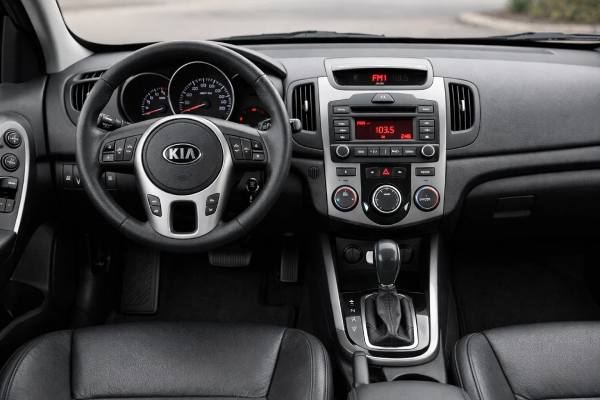
- Infotainment upgrades: navigation head units and premium audio can be expensive to replace. Confirm every speaker, button, and display function during inspection.
If you’re trying to identify trims quickly, look at wheel size, fog lights, steering wheel controls, and seat material. However, don’t rely on those alone—many cars have had wheels swapped, stereos replaced, or interior pieces changed.
Mechanical and functional differences by trim
Most trims share the same core engine and transmissions, but sport trims may bring:
- firmer suspension tuning,
- wider tires,
- larger brakes in some configurations,
- appearance upgrades that can raise replacement costs (bumper covers, lamps, trim).
For a daily driver, the “best” trim is often the one with the tire size you prefer and the least questionable modifications. A moderate trim with great maintenance history usually beats a top trim with poor service habits.
Safety ratings and what they mean for the Forte5
Safety testing can be confusing because some rating bodies list a model primarily by sedan body style even when the platform is shared. Treat ratings as a platform signal, then verify the specific equipment on the vehicle you’re buying. For real-world safety in a used hatch, the biggest controllable factors are:
- good tires with even tread,
- healthy brakes and brake fluid,
- functioning ABS and stability control,
- correct alignment and suspension condition.
Safety systems and service implications
Expect traditional safety equipment rather than modern driver assistance:
- ABS and ESC: these should operate silently in normal driving and only intervene on slip. Warning lights are not “minor” on this generation; they can indicate sensor problems, wiring issues, or module concerns.
- Airbags and seatbelt pretensioners: confirm the airbag light works correctly (bulb check on start, then off).
- Child-seat anchors: ISOFIX/LATCH are typically present, but confirm the anchor covers and hardware are intact—family use can leave them loose or damaged.
If you’re choosing between two cars, prioritize the one with clean diagnostics and documented recall completion over the one with slightly nicer options.
Reliability patterns issues and service actions
A well-kept Forte5 can be dependable, but age and mileage bring predictable patterns. The easiest way to evaluate risk is to sort issues by prevalence and cost tier, then look for symptoms during inspection and the first weeks of ownership.
Common (low to medium cost)
- Front suspension wear:
Symptoms: clunks over bumps, loose or “wandering” steering feel, inside-edge tire wear.
Likely root cause: stabilizer links, control arm bushings, strut mounts, tired dampers.
Remedy: replace worn parts in pairs (left/right), then perform an alignment. If tires are already uneven, budget for new tires—alignment alone won’t undo damage. - Brake vibration and uneven braking:
Symptoms: steering shake under braking, pedal pulsation (not ABS activation), or pulling.
Likely root cause: pad material transfer, overheated rotors, sticking caliper slide pins.
Remedy: service caliper slides and hardware, verify correct wheel torque procedure, replace rotors/pads if thickness or runout is out of spec. - Ignition wear (plugs/coils) and sensor aging:
Symptoms: misfire under load, rough idle, reduced fuel economy, intermittent check-engine light.
Likely root cause: overdue plugs, weak coil packs, aging oxygen sensors.
Remedy: install correct plugs at proper interval, replace coils if misfires follow a cylinder, then confirm fuel trims return to normal.
Occasional (varies by climate and use)
- HVAC blend-door actuator issues: clicking behind the dash or inconsistent temperature control.
- Hatch seals and water management: water in spare-tire well or damp cargo trim if seals are tired or drains are blocked.
- Door and window noise: wind noise can increase if weatherstripping hardens or the car has had prior door repairs.
Higher-severity concerns (treat as decision makers)
- ABS/ESC module-related recalls and fire-risk campaigns:
Some vehicles in the broader model family have had recall campaigns addressing electrical faults in the hydraulic control unit area.
What to do: verify completion by VIN through official recall documentation and dealer records. Do not ignore ABS/ESC warning lights, burning smells, or any history of smoke in the engine bay. - Cooling system neglect:
Symptoms: unexplained coolant loss, overheating in traffic, sweet smell after shutdown.
Likely root cause: aged hoses, radiator end-tank seepage, worn cap, or water pump seepage.
Remedy: pressure test the system, repair leaks before they turn into overheating events.
Software and calibration notes
This era is not dominated by over-the-air updates, but module reflashes and campaign procedures do exist. If a car has unresolved drivability quirks (odd idle behavior, transmission shift quality issues, intermittent ABS faults), ask the seller for proof of dealer-level service actions, not just “it was scanned.”
A reliable Forte5 is mostly about condition. If you buy one with clean braking behavior, tight suspension, and verified recall completion, you avoid most of the expensive surprises.
Maintenance plan and buyer checklist
The Forte5 responds well to a conservative, practical maintenance plan. It’s not a fragile car, but it does punish skipped fluids and “close enough” repairs—especially in brakes, tires, and alignment.
Maintenance schedule (distance/time)
Use whichever comes first.
- Engine oil and filter: every 8,000–10,000 km (5,000–6,000 mi) or 6 months. Short trips, hot climates, and heavy traffic justify the shorter interval.
- Engine air filter: inspect every 15,000 km (9,000 mi); replace around 30,000 km (18,000 mi), sooner in dusty areas.
- Cabin air filter: every 15,000–20,000 km (9,000–12,000 mi) or yearly if airflow drops.
- Spark plugs: typically around 100,000 km (60,000 mi) for long-life plugs, earlier if drivability suggests wear.
- Coolant: commonly around 5 years/100,000 km initially, then 3 years/60,000 km thereafter (confirm coolant type).
- Brake fluid: every 2 years, regardless of mileage, to protect ABS components and maintain pedal feel.
- Automatic transmission fluid: a conservative interval is 60,000–80,000 km (40,000–50,000 mi), especially for city use. Use the correct specification fluid.
- Manual transmission fluid: 80,000–120,000 km (50,000–75,000 mi), earlier if shifts feel notchy.
- Tire rotation and alignment: rotate every 8,000–10,000 km; align yearly or after any suspension work.
- 12V battery testing: yearly after year 4; many batteries last 4–6 years depending on climate.
Fluid specifications and “don’t wing it” items
Two areas deserve extra discipline:
- ATF choice and fill procedure: wrong fluid or incorrect level can create harsh shifts and long-term wear.
- Brake service quality: lubricated slide pins, correct hardware, and proper wheel torque prevent repeat comebacks.
Buyer checklist (what to inspect before money changes hands)
Body and underbody
- Check hatch area for water intrusion: lift the trunk floor and look for moisture or rust staining.
- Inspect rocker panels and rear wheel arch areas for corrosion in harsh climates.
- Confirm panel gaps and paint consistency; hatchback rear-end repairs are common.
Mechanical
- Cold start and idle quality: stable idle after warm-up, no persistent ticking or knocking.
- Test braking from speed: straight stops, no steering shake, consistent pedal.
- Steering and suspension: no clunks on broken pavement, no wandering on a flat road.
- Tires: even wear across tread is a strong indicator of alignment and suspension health.
Electronics
- Confirm ABS/ESC lights perform a proper bulb check and turn off.
- Test all windows, locks, HVAC modes, and infotainment functions.
Which versions to seek or avoid
Seek: stock or lightly modified cars with service records, correct tires, and documented recall completion.
Be cautious: cars with persistent warning lights, uneven tire wear, unknown transmission fluid history, or evidence of repeated brake “band-aid” repairs.
A good Forte5 is a low-drama hatch. Your best long-term value comes from buying condition, not chasing the highest trim.
Driving character and real-world economy
The facelift Forte5 feels like a straightforward compact that has been tuned for stability and easy control. It isn’t a razor-edged hot hatch, but it can be pleasant and confidence-inspiring when maintained correctly. Tire choice, alignment, and suspension condition make a larger difference here than many owners expect.
Ride, handling, and NVH
- Ride quality: on 16-inch tires, the car usually rides with a calm, slightly firm character that filters most bumps without feeling floaty. 17-inch packages sharpen response but transmit more road texture and can get louder on coarse surfaces.
- Straight-line stability: a strong point. It tracks well on highways when toe settings are correct and the tires are not mismatched.
- Cornering behavior: safe and predictable. The front end leads, and stability control typically intervenes smoothly when traction is low.
- Cabin noise: mostly tire-driven. Cheap tires can make the car feel older; quality touring tires often transform the experience.
Powertrain character (2.0 NA, 156 hp)
This engine is at its best when you drive it like a naturally aspirated four-cylinder:
- It rewards moderate revs and clean downshifts rather than lugging at very low rpm.
- Throttle response is generally linear, which makes the car easy in traffic.
- The automatic should shift decisively; hesitation or flares deserve diagnosis, not excuses.
For passing, the Forte5 is more “competent” than “quick.” If you want strong midrange punch, turbo rivals may feel stronger, but they also bring more heat and complexity. For many owners, the Forte5’s predictable delivery is a benefit.
Real-world economy
Real results depend on speed, temperature, tires, and commute style, but typical patterns look like this:
- City-heavy driving: often ~9.5–11.0 L/100 km (21–25 mpg US), with winter short trips pushing higher.
- Mixed use: commonly ~8.0–9.0 L/100 km (26–29 mpg US).
- Highway at 100–120 km/h: often ~7.4–8.4 L/100 km (28–32 mpg US).
Cold weather can add 10–20% consumption on short trips due to warm-up and denser air. Two practical moves help more than most “hypermiling” tricks:
- Maintain tire pressures and rotate regularly to prevent scrubby, noisy wear.
- Keep brakes fully releasing (clean slide pins, correct hardware) so you’re not wasting fuel as heat.
If you test drive a Forte5 and it feels sluggish or thirsty, don’t assume that’s normal. Many times the fix is basic: tired plugs, dragging brakes, poor alignment, or low-quality tires.
How the Forte5 stacks up against rivals
The Forte5 competes with compact hatches and practical compacts from the same era. Your best alternative depends on whether you value steering feel, interior refinement, fuel economy, or the simplest long-term ownership.
If you want a more engaging drive
- Mazda3 hatchback: usually sharper steering and a more “alive” chassis. The trade-off can be higher road noise and, in some climates, more corrosion sensitivity.
- Ford Focus hatch (non-performance trims): often has solid steering feel. Shop carefully for transmission and maintenance history depending on version and market.
If you want the calmest ownership experience
- Toyota Matrix / Corolla hatch alternatives (where available): typically a strong reliability reputation with easy parts access. You may give up some feature content or driving personality.
- Honda Civic hatch variants (availability varies by market): strong resale and broad support, but often priced higher used.
If you want more premium feel
- Volkswagen Golf (same era): can feel more refined inside with a solid, mature ride. The trade-off is higher parts and service costs, plus you must shop carefully for maintenance quality.
Where the Forte5 often wins
The Forte5’s value proposition is balance:
- Useful hatch packaging without stepping up in size.
- Simple, naturally aspirated 2.0 that’s easier to keep healthy than many turbo options.
- Shared parts ecosystem with the broader Forte family, which helps cost and availability.
Choose the Forte5 if you want a practical hatch that behaves like a normal daily car and you’re willing to prioritize condition and service history. Choose a rival if you want noticeably sharper handling, a quieter cabin, or a more premium interior—just expect trade-offs in purchase price or maintenance complexity.
References
- 2013 Kia Forte5 Specifications 2013 (Specifications)
- 2012 Kia Forte5 Overview 2012 (Manufacturer Overview)
- Gas Mileage of 2013 Kia Forte 2013 (Official Fuel Economy)
- 2013 Kia Forte 2013 (Safety Rating)
- Part 573 Safety Recall Report 23V-652 2023 (Recall Report)
Disclaimer
This article is for informational purposes only and is not a substitute for professional inspection, diagnosis, or repair. Specifications, torque values, service intervals, and procedures vary by VIN, market, and equipment. Always verify details against official service documentation for your exact vehicle.
If you found this guide useful, please consider sharing it on Facebook, X (Twitter), or your preferred platform to support our work.