
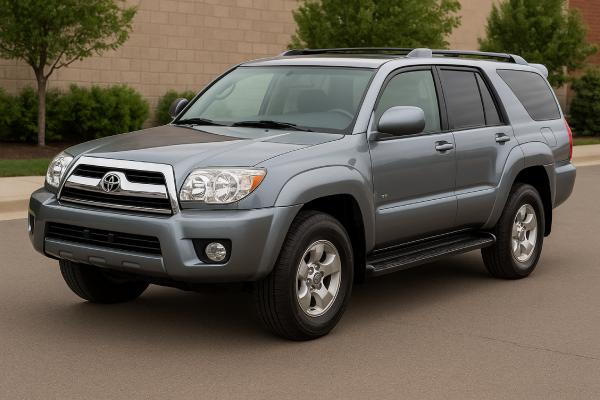
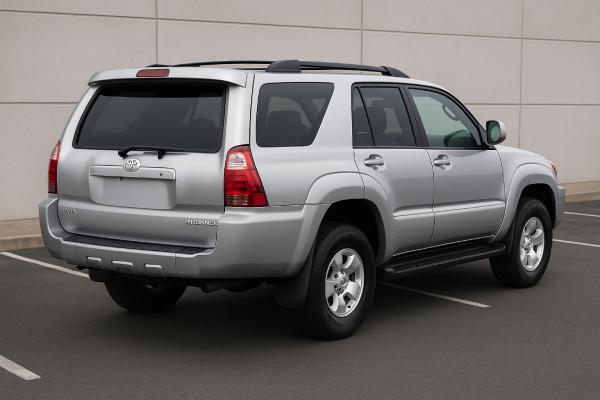
The fourth-generation Toyota 4Runner launched for 2003 shifted the nameplate deeper into midsize-SUV territory while keeping a classic body-on-frame recipe. This guide focuses on the 2WD (GRN210) models from 2003–2004 with the 1GR-FE 4.0-liter V6 (245 hp) and a 4-speed automatic. In the lineup, this V6 2WD sits beneath V8 and 4WD variants, appealing to buyers who want truck durability and cargo/towing utility without the weight, cost, or complexity of a transfer case. These years introduced a stiffer chassis, more sophisticated suspension, and improved cabin refinement versus the prior generation, plus the hallmark roll-down rear glass and split liftgate.
If you are cross-shopping older crossovers or newer body-on-frame SUVs, the early-4th-gen 4Runner 2WD is prized for longevity, simple maintenance, and strong resale value. It is not the quickest or most frugal SUV, but it is consistent, predictable, and easy to keep on the road. Below you will find a detailed technical breakdown, trim and safety context, maintenance schedule with fluid specs and torque values, common trouble spots, real-world driving notes, and an honest buyer’s guide tailored to these exact years and configuration.
Fast Facts
- Proven 4.0-liter 1GR-FE V6 (timing chain) with broad midrange torque; robust A340-series 4-speed automatic.
- Ladder frame with independent front suspension and coil-spring solid rear axle balances comfort and durability; optional X-REAS on Sport/selected trims improves body control.
- Spacious cargo bay with roll-down rear glass; straightforward ergonomics and excellent parts availability.
- Watch for slip-yoke “thunk,” front brake caliper seizure in rust belts, and age-related cooling or suspension rubber.
- Typical intervals: engine oil every 5,000–7,500 mi (6–12 months) depending on use; coolant first at 100,000 mi, then 50,000 mi thereafter.
Navigate this guide
- Detailed Overview
- Specifications and Technical Data
- Trims and Options, Safety and Driver Assistance
- Reliability, Common Issues and Service Actions
- Maintenance and Buyer’s Guide
- Driving and Performance
- How 4Runner Compares to Rivals
2003–2004 4Runner 2WD: Detailed Overview
The 2003–2004 4Runner 2WD (internal code GRN210) pairs Toyota’s then-new 1GR-FE 4.0-liter V6 (aluminum block/heads, DOHC, VVT-i on the intake) to an A340-family 4-speed automatic driving the rear wheels. Rated at 245 hp and strong midrange torque, the V6 moves the 4Runner with more urgency than the outgoing 3.4-liter V6, while keeping a simple, service-friendly architecture (chain-driven cams, port fuel injection).
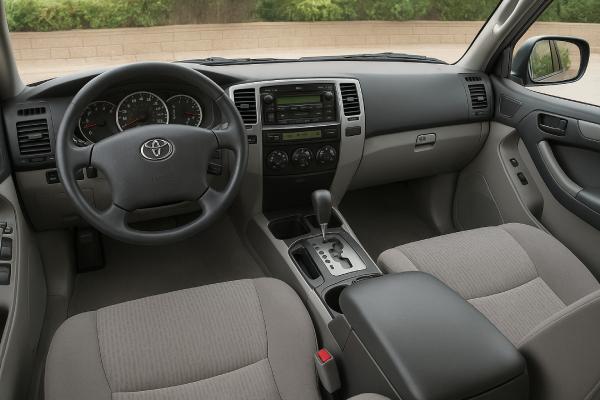
Underneath, a boxed, hydroformed ladder frame increases rigidity, while the double-wishbone front suspension and 4-link, coil-spring solid rear axle give a comfortable, controlled ride for a body-on-frame SUV. Brakes are 4-wheel discs, and steering is rack-and-pinion for tighter on-road feel than older trucks. The cabin is quiet for the era, with supportive seats and a cargo area that’s square and usable; Toyota’s roll-down rear window makes loading long items and ventilating pets or gear unusually easy.
Trim walk (SR5, Sport Edition, Limited) unlocks features like X-REAS (a cross-linked shock system that reduces roll and pitch), larger wheels, upgraded audio (JBL), and convenience additions. Even as a 2WD, the 4Runner maintains credible towing manners, a stout cooling package, and a straightforward driveline that—if kept in fluids—ages gracefully. Owners value these early 4th-gens for predictability: they are not finicky, parts are abundant, and repairs are typically conventional. Weaknesses tend to be age and climate related (rubber, corrosion, sticky brake calipers), not design catastrophes.
If your use is commuter duty, long highway trips, light towing, or family hauls with occasional dirt roads, the GRN210 makes sense versus 4WD: you save weight and complexity, yet keep the frame, suspension hardware, and cargo practicality that define a 4Runner.
Specifications and Technical Data
Engine and Performance
| Item | Detail |
|---|---|
| Engine code | 1GR-FE (V6, 24-valve, DOHC, VVT-i intake) |
| Displacement | 4.0 L (3,956 cc) |
| Induction / fueling | Naturally aspirated / Port fuel injection |
| Compression ratio | ~10.0:1 |
| Rated output | 245 hp (183 kW) @ ~5,200 rpm |
| Rated torque | 382 Nm (282 lb-ft) @ ~3,800 rpm |
| Timing drive | Chain (no scheduled replacement; inspect for noise/advance correlation faults) |
| Emissions/efficiency std. | LEV-II era for these MYs |
| Fuel tank | 87 L (23.0 gal US) |
| Rated economy (typical) | ~18–19 mpg combined (≈ 12.4–13.1 L/100 km) for 2WD V6 auto |
| Real-world highway @ 120 km/h (75 mph) | ~19–21 mpg (11.2–12.4 L/100 km), load/grade/tires dependent |
| Aerodynamics (Cd / A) | Body-on-frame SUV; not a primary efficiency lever in this class |
Transmission and Driveline
| Item | Detail |
|---|---|
| Transmission | 4-speed automatic (A340-series, electronic control) |
| Ratios (approx.) | 1st 2.804 · 2nd 1.531 · 3rd 1.000 · 4th 0.705 · Rev 2.393 |
| Final drive (typical) | ~3.91 (varies by trim/towing pkg) |
| Driveline | RWD (2WD), open rear differential |
| Tow equipment | Class III/IV receiver available; trans cooler in tow package |
| Refuel to full | ~23.0 gal (87 L) from near empty |
Chassis and Dimensions
| Item | Detail |
|---|---|
| Platform | Body-on-frame, boxed ladder frame |
| Front suspension | Double wishbone, coil springs, stabilizer bar |
| Rear suspension | 4-link solid axle, coil springs, stabilizer bar |
| Optional system | X-REAS cross-linked dampers (Sport, some Limited) |
| Steering | Rack-and-pinion, hydraulic assist |
| Brakes | 4-wheel discs; ABS with EBD |
| Wheels/tires (typical) | 16–17 in alloys; 265/65R17 common |
| Ground clearance | ≈ 230 mm (9.1 in), tire/package dependent |
| Approach/departure (2WD) | Approx. mid-20s° / high-20s° with stock tires |
| L × W × H | ≈ 4,801 × 1,875 × 1,815 mm (189.0 × 73.8 × 71.5 in) |
| Wheelbase | 2,790 mm (109.8 in) |
| Curb weight | ≈ 1,880–1,950 kg (4,145–4,300 lb) by trim/options |
| GVWR | ≈ 2,400–2,450 kg (5,300–5,400 lb) |
| Turning circle | ≈ 11.4 m (37.4 ft) |
| Cargo volume | ~1,190 L (42 cu ft) seats up · ~1,885 L (66–67 cu ft) seats folded |
Fluids and Capacities (with essential torques)
| System | Spec / Capacity | Notes (torque values) |
|---|---|---|
| Engine oil | 5W-30 (API SL/SN), ~5.2 L (5.5 qt) with filter | Drain plug ~39 Nm (29 lb-ft); filter snug + ¾ turn or to spec |
| Coolant | Toyota SLLC Pink, ~10–11 L (10–12 qt) | First at 100,000 mi, then 50,000 mi |
| Automatic transmission | Toyota ATF Type T-IV; drain-fill ~3.5–4.0 L (3.7–4.2 qt) | Pan bolts ~7–9 Nm (60–80 in-lb); check level per temp procedure |
| Rear differential (2WD) | SAE 75W-90 GL-5, ~1.6–1.8 L (1.7–1.9 qt) | Fill to plug; drain/fill plugs ~49–59 Nm (36–44 lb-ft) |
| Power steering | ATF (Dexron III/T-IV, per label) | Inspect for seep at pump/lines with age |
| Brake fluid | DOT 3 | Flush every 2–3 years |
| Spark plugs | Iridium, IFR6T-11-type; gap ~1.1 mm | Install ~18 Nm (13 lb-ft) |
| Wheel lug nuts | — | 113 Nm (83 lb-ft), star pattern |
Performance and Economy
| Metric | Figure (typical for 2WD V6 auto) |
|---|---|
| 0–60 mph (0–100 km/h) | ~7.8–8.5 s depending on load/tires/elevation |
| Top speed (governed) | ~112–115 mph (180–185 km/h) |
| EPA-typical combined | ~19 mpg US (12.4 L/100 km) |
| Towing capacity | Up to ~2,270 kg (5,000 lb) properly equipped |
| Payload (door-jamb label) | ~450–550 kg (1,000–1,200 lb) by build |
| Roof load | ~75 kg (165 lb) with factory rails/crossbars |
Figures vary by trim, options, axle ratio, and testing method. Always verify your exact VIN/build for final numbers.
Trims and Options, Safety and Driver Assistance
Trim overview (2003–2004, 2WD):
- SR5: Cloth seats, manual HVAC, 16-in wheels, basic audio, body-color trim. Popular options: roof rack, running boards, tow receiver, power seat, sunroof. Mechanical baseline with open rear diff and conventional shocks.
- Sport Edition: Adds X-REAS cross-linked shocks, hood scoop, 17-in wheels, sport trim, often with power driver seat and upgraded audio. The X-REAS package notably reduces fore-aft pitch and side roll on sweepers and freeway ramps.
- Limited: Leather, dual-zone climate, JBL audio, 17-in alloys, power everything, optional sunroof. X-REAS commonly available/standard depending on build; chrome/exterior detailing; memory driver seat.
Mechanical/functional differences that matter:
- X-REAS vs. standard dampers: X-REAS improves body control without increasing ride harshness; long-term service means replacing corner pairs or the entire system if opened/leaking (it is pre-charged). Many owners retrofit standard shocks later for cost simplicity.
- Axle ratio/tow package: Some builds include auxiliary cooling and a hitch; confirm the axle code on the door-jamb label for final drive ratio. Tow-ready trucks feel calmer at freeway speeds and maintain transmission temps better on grades.
- Brakes/wheels: 17-in packages accept larger aftermarket brake options; caliper design is shared across trims but rust-belt trucks can seize slide pins.
Safety ratings context (these years):
- Frontal crash performance was strong for the class, reflecting the more rigid frame and improved front structure of the 4th gen. Side protection varies with side-airbag availability (curtain and seat-mounted bags were offered/added during this period). If you routinely carry rear passengers, prioritize a truck with side curtains.
- Anti-lock brakes (ABS) with Electronic Brake-force Distribution (EBD) are standard; Vehicle Stability Control (VSC) appears with certain equipment mixes and becomes more prevalent after mid-cycle updates. For these early years, VSC presence is a plus for wet-road stability.
- Child seats: LATCH anchors are present; the tall second-row cushion and long belt stalks can require a different child-seat model for optimal fit—test installation if possible.
Year-to-year highlights (2WD V6):
- 2003 launch: New platform, new 1GR-FE, 4-speed auto, X-REAS debuts on Sport.
- 2004: Availability expands for side-curtain airbags and options; incremental audio and trim changes. If you want side curtains on an early truck, 2004 increases your odds.
Quick identifiers:
- VIN series: “JTEZU” prefix is common for 2WD V6 4Runners assembled in Japan. The axle/trans codes on the door-jamb sticker reveal gearing and whether the truck shipped with a tow-friendly ratio.
- Interior tells: Sport Edition’s perforated wheel, metallic trim, and scoop hood; Limited’s wood-tone accents and JBL badging.
Reliability, Common Issues and Service Actions
Decades on, the early 4th-gen 2WD V6 has an excellent reputation. Most problems are age/usage rather than inherent design flaws. Use the map below to triage a candidate truck.
Common (predictable) – generally low to medium cost
- Prop-shaft slip-yoke “thunk” (stop/start clunk):
Symptom: A single clunk as the chassis settles after stops.
Cause: Dry slip yoke on the driveshaft.
Fix: Clean and grease the splines with high-moly grease; replace slip yoke or entire shaft if splines are worn. - Front brake caliper seizing (rust-belt trucks):
Symptom: Pulling, drag, uneven pad wear, steering wheel vibration.
Cause: Corroded slide pins/pistons.
Fix: Rebuild/replace calipers; lube slides with high-temp silicone; consider biennial brake-fluid flush. - A/C blend door actuator noise or misposition:
Symptom: Clicking under dash, wrong air temp/door position.
Cause: Stripped actuator gears.
Fix: Replace actuator; recalibrate HVAC doors. - Aging rubber (bushings/mounts/hoses):
Symptom: Thumps, minor vibration, vague steering.
Cause: Time/heat cycles.
Fix: Front lower-control-arm bushings, rear upper/lower link bushings, sway-bar links; replace coolant and heater hoses preventively.
Occasional – medium cost; inspect carefully
- Radiator internal cooler seep (ATF cross-contamination risk):
Symptom: Pink “strawberry milkshake” in the trans or radiator.
Cause: Aging radiator tank/ATF cooler.
Fix: Proactive radiator replacement on high-mile originals; if contaminated, full ATF/coolant remediation and potential transmission service. - Exhaust manifold/fastener corrosion:
Symptom: Ticking at cold start, exhaust odor.
Cause: Cracks or leaking gaskets/bolts.
Fix: Replace manifold/gaskets; use proper torque sequence after heat cycles. - Rear window regulator wear:
Symptom: Slow or stuck tailgate glass.
Cause: Dried guides or failing motor/regulator.
Fix: Clean/lube tracks; replace regulator if binding persists.
Rare but notable – higher cost if present
- 1GR-FE head-gasket seep (early build, high mileage):
Symptom: Coolant loss, sweet exhaust smell, misfire on cold start.
Cause: Localized gasket leakage.
Fix: Confirm with block test/borescope; gasket job with updated fasteners/surface prep. - X-REAS system leaks:
Symptom: Wet shocks/lines, floaty/uneven body control.
Cause: Aged seals/lines.
Fix: Replace X-REAS as an assembly or convert to conventional shocks/springs (common and cost-effective).
Recalls/TSBs and how to verify
- These years saw typical service bulletins for driveline clunk, HVAC actuators, and brake feel. Some trucks also received updated calibration files addressing shift quality and idle characteristics.
- Always run an official VIN recall check and ask the seller for dealer service printouts. Confirm completion of safety-related campaigns and inspect for evidence of updated parts (e.g., radiator, calipers).
Pre-purchase checklist (what to ask and test)
- Full maintenance log (oil, ATF, brake fluid, coolant), tow use history, and any radiator/trans cooler replacement.
- Cold start and hot idle — listen for exhaust tick and check for coolant odor.
- Straight-line braking from 50 mph — feel for pulsation (warped rotors or sticky caliper).
- Multiple stop-and-go cycles — check for slip-yoke clunk.
- Tailgate glass operation and lock actuator; sunroof track function.
- Underside corrosion at frame rails, crossmembers, rear shock mounts, and brake hard-lines.
Maintenance and Buyer’s Guide
Practical maintenance schedule (2WD 1GR-FE, severe vs. normal use)
- Engine oil/filter: Every 5,000 mi / 6 months (severe: short trips, towing, dusty), up to 7,500 mi / 12 months (light highway). Spec 5W-30, ~5.2 L with filter.
- Engine air filter: Inspect 15,000 mi; replace 30,000–45,000 mi (sooner in dust).
- Cabin air filter: 15,000–20,000 mi or 12 months.
- Spark plugs (iridium): 90,000–100,000 mi; torque ~18 Nm (13 lb-ft).
- Coolant (SLLC Pink): First 100,000 mi (160,000 km) / ~10 years, then 50,000 mi (80,000 km).
- ATF (Type T-IV): Drain-and-fill 30,000–60,000 mi depending on heat/towing; follow temp-based level set.
- Rear differential oil (75W-90 GL-5): 30,000–60,000 mi; sooner if towing or water crossings.
- Brake fluid: Flush every 2–3 years; inspect caliper slides annually in rust climates.
- Drive belts and hoses: Inspect annually; replace at first cracking/noise.
- Valve clearances: Hydraulic lifters—no routine adjustment; listen for abnormal tick that persists when warm.
- Power steering & pump/lines: Inspect annually for seep and hose softness.
- Fuel filter: Integrated in tank on these years—no routine interval; diagnose only if pressure/flow faults.
- 12-V battery: Load-test annually after year 4; typical life 4–6 years.
- Alignment/tyre rotation: Rotate 5,000–7,500 mi; align after any suspension work; keep tires matched to preserve steady-state tracking.
Essential service tips
- When servicing the transmission, use the proper temperature window for level set—guessing the level is how you get shift flare or delayed engagement.
- For X-REAS, do not open the hydraulic circuit casually; it is pre-charged and requires specific procedures. Converting to standard shocks is a practical path when the system ages.
- A new radiator every 15–20 years (or any evidence of seep at the tanks) is cheap insurance against ATF contamination.
Buyer’s Guide: what to seek or avoid
- Best picks: 2004 trucks with side-curtain airbags, documented fluid services (ATF, diff, brake), a newer radiator, and minimal underside corrosion. A Sport Edition with fresh conventional shocks (post-X-REAS) can be a sweet spot for ride/handling and future service cost.
- Be cautious of: Lift kits without proper alignment data, oversized wheels/tires that degrade braking and acceleration, trucks with persistent driveline clunk after yoke service, and any signs of cross-contaminated coolant/ATF.
- Reconditioning budget: Plan $800–$1,500 for tires, fluids, front brakes (and calipers in rust states), and a few rubber bits on a newly acquired truck. Add $400–$800 if converting aging X-REAS to conventional dampers.
Durability outlook
With fluids on schedule and rust kept at bay, the 1GR-FE/A340-series combo routinely clears 250,000+ miles (400,000+ km) without major internal work. The parts ecosystem is deep, and most jobs are driveway-friendly with basic tools.
Driving and Performance
Ride, handling, and NVH
The 2WD 4Runner balances a planted highway demeanor with the compliance you expect from long-travel suspension. Standard dampers allow some initial heave and roll, but the truck quickly settles; X-REAS versions feel notably flatter in S-bends and freeway ramp transitions without being brittle. Compared with crossovers of the same era, road noise is modest and wind noise increases smoothly with speed. The chassis feels unflappable over expansion joints, and rattles are rare if the tailgate glass and tracks are healthy.
Powertrain character
The 1GR-FE makes its best work above 2,500 rpm, with a broad plateau through typical passing speeds. Downshifts are decisive, and the 4-speed’s wide gear spacing encourages an early upshift around town. Kickdown for passing is prompt; hunting is uncommon unless oversized tires are fitted. Throttle tip-in is linear, with little latency. Warm restarts are instant. The timing chain is quiet when healthy; tick on cold start that fades quickly is usually benign injector/clutch noise, but persistent tick with coolant loss warrants deeper inspection.
Efficiency and range
- City: ~16–18 mpg US (13–15 L/100 km) depending on load, tires, and traffic.
- Highway (60–75 mph / 100–120 km/h): ~19–22 mpg US (10.7–12.4 L/100 km) stock tires/pressures.
- Mixed: ~18–20 mpg US (11.8–13.1 L/100 km).
Cold weather, short trips, roof baskets, and AT tires can trim 2–3 mpg from these figures.
Key performance notes
- 0–60 mph: high-7s to mid-8s in typical street trim.
- 100–0 km/h braking: Confident and straight when calipers are healthy; judder indicates rotor thickness variation or a sticky slide pin—both easy fixes.
- Turning circle: ~37 ft makes parking manageable for a body-on-frame SUV.
Load and towing behavior
Properly equipped, the 2WD V6 tows up to 5,000 lb (2,270 kg). Expect a 15–30% fuel-economy penalty with moderate trailers and a more severe hit in headwinds. Transmission temperatures stay reasonable with clean ATF and an auxiliary cooler; downshift proactively to keep RPM in the mid-2,000s on grades. Rear-suspension coil springs maintain level stance with tongue weights in spec; if you tow frequently, fresh rear shocks and load-range C tires improve composure without compromising ride.
How 4Runner Compares to Rivals
Ford Explorer (2002–2005, V6 2WD): Quieter cabin and more car-like steering than older Explorers, but front suspension/transfer-case issues (on 4WD) and transmission concerns ding long-term confidence. The 4Runner’s frame and powertrain age more gracefully, and resale is stronger.
Jeep Grand Cherokee (WJ, 1999–2004, 2WD or RWD): Offers strong engines and good seats. However, electrical gremlins and suspension bushing wear are more frequent with age. As a daily, the Toyota is generally less drama over 10+ years.
Nissan Pathfinder (R50, 2001–2004, 2WD where offered): Smaller inside, more wagon-like feel, decent durability. Timing belt service adds cost periodically. The 4Runner is roomier, tows more confidently, and has broader parts availability.
Honda Pilot (2003–2004, FWD): More efficient in town, more seats, and a flatter load floor. But it’s a unibody with a lighter-duty powertrain; for towing, rough roads, or long-term body integrity, the 4Runner’s frame wins. If you never tow and value third-row space, the Pilot makes sense; otherwise, choose the Toyota.
Bottom line: If you want years of low-drama ownership, keep a simple service cadence, and occasionally tow or haul, the 2003–2004 4Runner 2WD V6 is one of the safest bets from its era. Crossovers may be thriftier, and V8 4Runners are stronger at the hitch, but very few alternatives match this truck’s blend of durability, parts pipeline, and residual value.
References
- Fuel Economy of 2004 Toyota 4Runner 2004 (Fuel Economy)
- Toyota 4Runner 2004 (Safety Rating)
- Vehicle Details | 2004 TOYOTA 4RUNNER RWD 2004 (Recall Database)
- 2003 Toyota 4Runner Press Kit 2003 (Manufacturer Publication)
Disclaimer
This article is for informational purposes only and is not a substitute for professional diagnosis or repair. Specifications, torque values, intervals, and procedures vary by VIN, market, options, and production date. Always verify against your vehicle’s official service documentation and follow applicable safety practices.
If this guide helped you, please consider sharing it with fellow owners on Facebook or X/Twitter to support xcar’s work.