
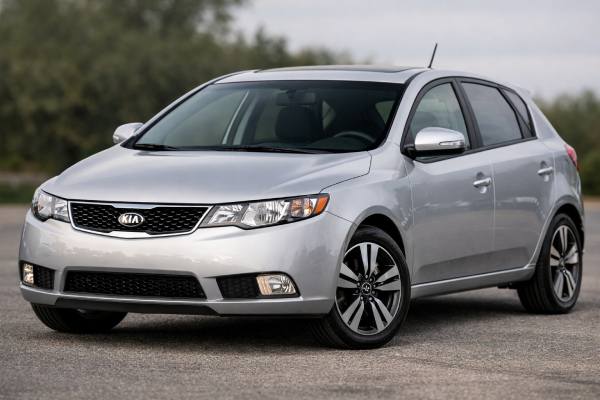
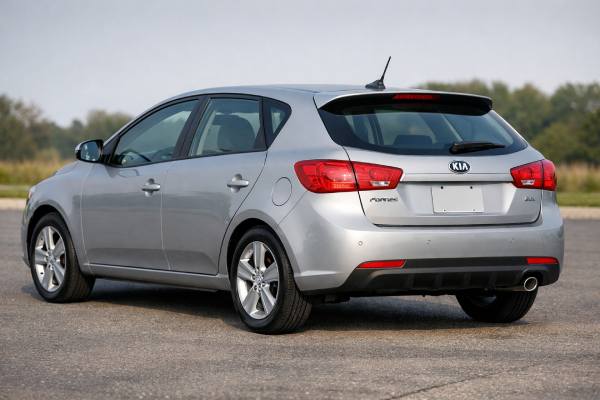
The 2012–2013 facelift Kia Forte5 with the 2.4-liter Theta II is the “hidden” warm-ish hatch in the Forte family: not a true hot hatch, but a genuinely useful five-door with a larger-displacement engine that changes how the car feels day to day. The 173 hp output isn’t about peak speed as much as it is about easier merging, fewer downshifts, and stronger mid-range pull than the 2.0. Underneath, it’s a straightforward front-wheel-drive compact with a torsion-beam rear suspension, hydraulic power steering (on many builds), and conventional automatic or manual transmissions depending on market and trim.
For owners today, the value is simple: roomy cargo for the class, manageable running costs, and simple mechanical packaging. The trade-off is that Theta II ownership rewards careful maintenance habits—especially oil-change discipline and attention to early warning signs.
What to Know
- The 2.4-liter delivers noticeably stronger passing power than the 2.0 without needing high rpm.
- Forte5 packaging is a real advantage: useful hatch opening and practical rear cargo space for a compact.
- The torsion-beam rear keeps costs down but can feel less composed over broken pavement than multi-link rivals.
- Treat oil checks as routine (every 1,000–1,500 km / 600–900 mi) on higher-mile cars and fix leaks early.
- A solid baseline interval is engine oil and filter every 8,000–12,000 km (5,000–7,500 mi) or 6–12 months, adjusted for driving conditions.
Quick navigation
- Kia Forte5 TD facelift profile
- Kia Forte5 TD 2.4 specs and measurements
- Kia Forte5 TD trims, tech, and safety
- Reliability patterns and known faults
- Maintenance plan and smart buying
- Driving character and real economy
- Forte5 2.4 vs compact hatchbacks
Kia Forte5 TD facelift profile
The Forte5 (TD) facelift is a practical compact hatch built around simple, proven hardware: front strut suspension, torsion-beam rear, and a transversely mounted inline-four driving the front wheels. What makes the 2.4-liter Theta II version distinct is how it changes the “effort level” of the car. In normal traffic, the larger engine produces more usable torque without needing to hunt for revs, so the Forte5 feels less strained with passengers, hills, or highway speeds.
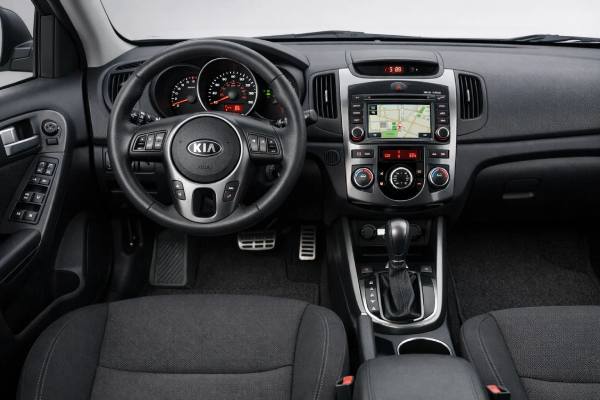
The facelift-era cabin and controls are also part of the ownership story. You get straightforward ergonomics, parts availability that tends to stay decent, and fewer exotic systems compared with newer small cars. That’s good news when you’re buying one at a budget-friendly price today. The hatch layout matters too: the rear opening is wide, the load floor is usable, and the car’s overall footprint stays city-friendly.
Under the skin, this is not a “tuned” performance chassis in the way some European hatches are. The torsion-beam rear suspension is compact and durable, but it can transmit sharp impacts more directly than a multi-link setup, and it typically doesn’t track quite as calmly over choppy mid-corner pavement. For most owners, that’s a fair trade for lower long-term complexity.
Where you should be more intentional is powertrain care. Theta II engines have a reputation—some deserved, some exaggerated—because neglect, extended oil intervals, or low oil can turn a minor issue into a major one. The 2.4 can be a very good engine when it’s maintained, but it’s not a “set and forget” unit on higher-mileage cars. If you approach it with a light-duty fleet mindset (records, intervals, inspections), the Forte5’s strengths—space, simplicity, and decent performance—tend to shine.
Kia Forte5 TD 2.4 specs and measurements
Below are the key specifications that matter for maintenance planning, fitment (wheels/brakes), and real-world use. Numbers can vary by market, emissions certification, and trim, so treat these as a strong baseline for the 2012–2013 facelift Forte5 2.4 and verify by VIN when ordering parts.
Powertrain and efficiency
| Item | Specification |
|---|---|
| Engine family | Theta II inline-4 (aluminum block/head) |
| Displacement | 2.4 L (2,359 cc) |
| Valvetrain | DOHC, 4 valves/cyl, CVVT |
| Bore × stroke | ~88.0 × 97.0 mm (3.46 × 3.82 in) |
| Induction | Naturally aspirated |
| Fuel system | Multi-port injection (MPI) on many 173 hp applications; verify by VIN/market |
| Compression ratio | 10.5:1 |
| Max power | 173 hp (129 kW) @ 6,000 rpm |
| Max torque | 168 lb-ft (228 Nm) @ 4,000 rpm |
| Timing drive | Chain |
| Rated economy (auto, typical) | 23/32 mpg US city/highway (≈10.2 / 7.4 L/100 km) |
| Real-world highway @ 120 km/h | Often ~7.8–8.8 L/100 km (27–30 mpg US), wind/tires/temperature dependent |
Transmission and driveline
| Item | Specification |
|---|---|
| Drive type | FWD |
| Automatic | 6-speed electronically controlled (manual mode on many trims) |
| Manual | 6-speed (availability depends on region/trim) |
| Differential | Open |
Chassis and dimensions
| Item | Specification |
|---|---|
| Front suspension | MacPherson strut, coil springs, stabilizer bar |
| Rear suspension | Torsion beam, coil springs |
| Steering | Rack-and-pinion; hydraulic assist on many builds |
| Brakes (front/rear) | 300 mm (11.8 in) vented discs / 262 mm (10.3 in) solid discs |
| Common tire size (2.4 trims) | 215/45 R17 |
| Wheelbase | 2,650 mm (104.3 in) |
| Length / width / height | 4,341 / 1,775 / 1,461 mm (170.9 / 69.9 / 57.5 in) |
| Ground clearance | ~150 mm (5.9 in) |
| Turning circle (curb-to-curb) | ~10.8 m (35.4 ft) |
| Curb weight (auto, typical) | ~1,335 kg (2,944 lb) |
| Fuel tank | ~52 L (13.7 US gal) |
| Cargo volume (seats up) | ~549 L (19.4 ft³), method varies by market |
Fluids and service capacities (practical planning)
| Fluid | Spec (typical) | Capacity (typical) |
|---|---|---|
| Engine oil | API SM/SN, ILSAC GF-4/5; 5W-20 or 5W-30 | ~4.5 L (4.8 US qt) with filter |
| Coolant | Phosphate-OAT/HOAT depending on supplier; 50/50 mix | ~6.5–7.0 L (6.9–7.4 US qt) |
| Automatic transmission | SP-IV type ATF (common for Hyundai/Kia 6AT) | Drain/fill often ~4–5 L; total ~7–8 L (varies) |
| A/C refrigerant | R-134a | charge varies by label |
Key torque specs (common “decision-making” values)
| Fastener | Torque (typical range) |
|---|---|
| Wheel lug nuts | 88–108 Nm (65–80 lb-ft) |
| Spark plugs (small thread) | 18–25 Nm (13–18 lb-ft) |
| Oil drain plug | 25–40 Nm (18–30 lb-ft) |
Performance baselines depend heavily on tires, transmission, and conditions. A healthy 2.4 Forte5 typically lands around 0–100 km/h in ~8.0–8.8 seconds, with a top speed near 195–205 km/h (121–127 mph) in favorable conditions. For braking, expect 100–0 km/h in roughly the high-30-meter range with quality tires and fresh pads/rotors.
Kia Forte5 TD trims, tech, and safety
Forte5 trims and option mixes vary more than many buyers expect because the hatch sometimes follows its own packaging rules versus the sedan. In many markets, the 2.4-liter sits near the top of the range (often aligned with “sport” or “premium” positioning), which usually brings larger wheels, upgraded interior materials, and more convenience tech. When shopping, focus less on badge names and more on mechanical identifiers and functional equipment.
Trims and options that change the experience
Common equipment differences you’ll notice quickly:
- Wheel and tire package: 17-inch wheels with 215/45 tires are typical on 2.4 trims. This improves steering response but can make sharp-edged bumps more noticeable.
- Braking hardware: the 2.4 setup commonly uses larger front discs than the 2.0, which helps fade resistance.
- Infotainment tiers: base units are simple and durable; higher trims add touchscreen/nav and more speakers. Check that every function works—older head units can be expensive to replace with OEM parts.
- Convenience features: push-button start, heated seats, and sunroof availability varies by package. Sunroofs add drain maintenance (clogging can cause wet carpets).
Quick identifiers that help on a used car lot:
- Tire size on the door jamb or sidewall (215/45R17 suggests the higher-output setup in many markets).
- Front brake rotor diameter if you can see it through the wheel spokes (bigger rotors often accompany the 2.4 trim level).
- VIN decode/build sheet from a dealer parts counter can confirm engine and transmission.
Safety ratings and what they mean today
For 2012–2013 compact cars, safety is “good” when you get the fundamentals: strong structure, side airbags, stability control, and properly maintained brakes/tires. The Forte’s crash performance in independent testing is generally competitive for its era, especially in side-impact performance. However, don’t assume modern active-safety features: automatic emergency braking, modern lane centering, and advanced headlight ratings are largely a newer-car story.
Safety systems and ADAS notes
Expect the core suite:
- Front airbags, side-impact airbags, and side-curtain airbags on most higher trims (confirm presence and that the airbag light proves out correctly).
- ABS and electronic stability control (ESC) are common and important—if the ABS/ESC warning lights are on, budget for diagnosis before purchase.
- Child-seat hardware: ISOFIX/LATCH anchors are typically present; check the anchor covers and make sure rear seatbacks latch securely.
After collision repairs or front-end work, pay attention to steering centering, ABS sensor wiring, and wheel alignment. A straight-tracking Forte5 with no warning lights is usually a sign that the basics—tires, suspension, and sensors—are in healthy shape.
Reliability patterns and known faults
A well-kept Forte5 can be a dependable daily, but the ownership curve depends on how the car was treated before you got it. Think in terms of (1) powertrain health, (2) wear items, and (3) “age electronics.”
Common issues (worth actively checking)
1) Oil consumption or low-oil operation (medium to high cost if ignored)
- Symptoms: low dipstick readings between services, ticking on cold start, oil smell, blue haze on hard acceleration (not always present).
- Likely causes: extended oil intervals, stuck rings, PCV system issues, or general wear.
- Remedy: shorten oil intervals, verify PCV function, address leaks early, and monitor level. If consumption is heavy, a compression/leak-down test helps quantify engine condition before you invest further.
2) Engine knock / bearing distress risk (high cost, take seriously)
- Symptoms: rhythmic knocking under load, metal glitter in oil, low oil pressure warnings, worsening noise as engine warms.
- Likely causes: bearing wear accelerated by low oil, contaminated oil, overheating, or prior damage.
- Remedy: stop driving and diagnose promptly. If you’re shopping, avoid cars with any knock history unless there is documented professional repair or replacement.
3) Cooling system age faults (low to medium cost)
- Symptoms: coolant smell, slow loss of coolant, overheating in traffic, heater performance changes.
- Likely causes: aging hoses, radiator seepage, thermostat sticking, or cap issues.
- Remedy: pressure test, replace weak parts proactively, and keep the correct coolant type.
4) Ignition coils and spark plugs (low to medium cost)
- Symptoms: misfire under load, flashing check-engine light, rough idle.
- Likely causes: coil breakdown, worn plugs, oil in plug wells from valve cover gasket seepage.
- Remedy: replace plugs at interval, coils as needed, and fix gasket leaks so the ignition stays clean.
5) Suspension and steering wear (low to medium cost)
- Symptoms: clunks over bumps, vague steering, inner tire wear.
- Likely causes: stabilizer links, control arm bushings, strut mounts, alignment drift.
- Remedy: inspect on a lift, align after replacing parts, and don’t ignore tire wear patterns.
Occasional to rarer items
- Automatic transmission shift quality changes (solenoid wear, old fluid, or mount issues): look for harsh 2–3 shifts, shudder, or delayed engagement.
- A/C performance drop (leaks or compressor wear): verify vent temps and listen for compressor noise.
- Body and water leaks (door seals, hatch seals, sunroof drains): check carpet dampness and spare-tire well moisture.
Recalls, TSBs, and service actions
On any Forte5 of this era, treat recall completion as a must-check item. Use an official VIN lookup and ask for dealer printouts of completed campaigns. If the car has warning lights related to ABS/ESC or powertrain, don’t assume it’s “just a sensor”—scan it and price the fix before committing.
Maintenance plan and smart buying
A strong maintenance plan for the Forte5 2.4 is about protecting the engine and keeping the chassis tight. The good news is that most tasks are conventional and affordable compared with many newer cars.
Practical maintenance schedule (distance/time)
Use this as a planning baseline, then adjust for your driving style and climate:
- Engine oil and filter: every 8,000–12,000 km (5,000–7,500 mi) or 6–12 months.
- Severe use (short trips, extreme heat/cold, heavy traffic): every 6,000 km (3,750 mi) or 6 months.
- Oil level check: every 1,000–1,500 km (600–900 mi) on higher-mile cars, and before long trips.
- Engine air filter: inspect every 15,000 km (10,000 mi); replace ~30,000 km (20,000 mi) or as needed.
- Cabin air filter: every 15,000–20,000 km (10,000–12,000 mi), especially in dusty cities.
- Spark plugs: typically 150,000–170,000 km (90,000–105,000 mi) for iridium (verify plug type fitted).
- Coolant: every 5 years or 100,000–160,000 km (60,000–100,000 mi) depending on coolant spec; refresh sooner if unknown.
- Automatic transmission fluid: a conservative interval is 60,000–80,000 km (40,000–50,000 mi) for drain/fill, sooner if shift quality degrades or history is unknown.
- Brake fluid: every 2 years regardless of mileage.
- Brake pads/rotors: inspect every 15,000 km (10,000 mi); replace by wear, not time.
- Tire rotation: every 8,000–10,000 km (5,000–6,000 mi); align when you install new tires or see uneven wear.
- Serpentine belt and tensioner: inspect annually after 8–10 years; replace at first cracking/noise.
Fluid specs and “ownership-critical” habits
- Pick a reputable oil meeting the correct API/ILSAC standard and don’t stretch intervals “because it still looks clean.”
- If the engine consumes oil, top-ups are normal—but rising consumption is a diagnostic clue, not a lifestyle feature.
- Keep the cooling system healthy; overheating events are one of the fastest ways to shorten engine life.
Buyer’s guide: what to inspect before purchase
Paperwork checks
- Proof of regular oil services (dates and mileage matter more than brand).
- Recall completion printout by VIN.
- Transmission fluid service history (especially if the car is over ~150,000 km / 90,000 mi).
Hands-on inspection
- Cold start: listen for rattles/knock, check for smoke, confirm stable idle.
- Test drive: verify smooth shifts, straight braking, and no steering shimmy at 90–110 km/h.
- Underbody: look for oil pan seepage, axle seal leaks, and exhaust corrosion.
- Cabin: check for damp carpets, hatch-area moisture, and all electrical functions.
Recommended “sweet spot” setups
- Seek cars with documented oil service history and a clean mechanical baseline over the fanciest options.
- If you prioritize ride comfort, consider whether the 17-inch tire package suits your roads; smaller wheels can ride better if compatible with the brake hardware.
Long-term durability outlook: with disciplined fluids, prompt repairs, and oil-level awareness, the Forte5 2.4 can be a satisfying long-haul compact. Without that discipline, it can become an expensive lesson.
Driving character and real economy
The 2.4-liter Forte5 feels like a compact hatch that’s been given a more relaxed “engine reserve.” Around town, throttle response is typically more confident than the 2.0, and the car needs fewer deep throttle inputs to keep pace with traffic. That matters for comfort as much as speed: the cabin stays calmer when the engine doesn’t have to work as hard.
Ride, handling, and NVH
- Ride: the torsion-beam rear is durable and space-efficient, but sharp impacts can feel abrupt—especially on 17-inch tires with shorter sidewalls. On smoother roads, it’s stable and predictable.
- Handling balance: safe and slightly front-heavy at the limit, with mild understeer when pushed. It’s not a “tail-happy” hatch, but it’s honest and easy to place.
- Steering feel: many builds use hydraulic assist, which can feel more natural than early electric systems. Expect moderate weight and decent on-center stability when aligned correctly.
- Braking feel: strong enough for daily driving; pedal feel and fade resistance improve noticeably when the system is maintained (fresh fluid, quality pads, true rotors).
Noise levels are typical for an early-2010s compact: acceptable at city speeds, with more wind and tire noise on coarse highway pavement. Worn door seals or cheap tires can make the cabin noticeably louder.
Powertrain character
The 2.4’s torque peak arrives at moderate rpm, which helps the car feel strong in 50–90 km/h (30–55 mph) transitions. With the 6-speed automatic, kickdown is usually quick enough, but you may still feel occasional “gear hunting” on rolling hills—common for compact automatics of the era. If equipped, manual mode can reduce that sensation on long grades.
Real-world fuel use
EPA-style ratings for the 2.4 automatic are typically 23 mpg city and 32 mpg highway, which translates to about 10.2 L/100 km city and 7.4 L/100 km highway. In real life:
- Urban, short trips: 10–12 L/100 km (20–24 mpg US) is common, especially in winter.
- Steady highway at 120 km/h: often ~7.8–8.8 L/100 km (27–30 mpg US) depending on tires and wind.
- Mixed driving: ~8.5–9.5 L/100 km (25–28 mpg US) is a realistic planning range.
If you want to improve economy, the biggest levers are tire choice (rolling resistance), alignment, and throttle discipline—not exotic modifications.
Forte5 2.4 vs compact hatchbacks
The Forte5 2.4’s core pitch is “more engine than you expect in a practical hatch,” usually at a price that undercuts trendier nameplates. But competitors can beat it in specific ways, so it helps to match the car to your priorities.
Where the Forte5 2.4 stands out
- Effortless daily power: compared with many 1.8–2.0 liter rivals of the same era, the 2.4 feels less strained on the highway and when loaded.
- Practical hatch packaging: cargo usability is a real advantage if you frequently carry bulky items.
- Straightforward mechanicals: conventional suspension and driveline layout often mean predictable repair paths and wide parts availability.
Where rivals may be stronger
- Ride sophistication: a multi-link rear suspension (common on some competitors) can feel more planted and composed on broken pavement.
- Cabin refinement: some rivals deliver better wind and tire isolation, especially at 110–130 km/h.
- Long-term resale: depending on your region, resale can favor more established nameplates.
If you’re cross-shopping, common alternatives include the Volkswagen Golf, Mazda3, and Ford Focus of the same era, plus the closely related Hyundai Elantra GT. In general: the Forte5 tends to win on value and “easy power,” while some rivals win on chassis polish and interior quietness.
Best-fit owner profiles
The Forte5 2.4 is a smart pick if you:
- Want a compact hatch that doesn’t feel underpowered.
- Prefer simple, serviceable engineering over complex modern driver-assist systems.
- Plan to maintain proactively and keep records.
It’s a weaker fit if you:
- Need the quietest cabin and most sophisticated ride in the class.
- Want modern active-safety tech as standard equipment.
- Don’t want to monitor oil level between services on an older engine.
References
- 2013 Kia Forte5 Specifications 2013 (Specifications)
- Gas Mileage of 2013 Kia Forte 2013 (Fuel Economy Database)
- 2013 Kia Forte 4-door sedan 2013 (Safety Rating)
- Check for Recalls: Vehicle, Car Seat, Tire, Equipment | NHTSA 2026 (Recall Database)
Disclaimer
This article is for informational purposes only and is not a substitute for professional inspection, diagnosis, or repair. Specifications, torque values, fluid types, service intervals, and procedures can vary by VIN, market, trim, and prior repairs. Always verify details using the vehicle’s official service documentation and labeling, and consult qualified technicians for safety-critical work.
If you found this guide useful, please consider sharing it on Facebook, X (Twitter), or your favorite forum to support our work.