
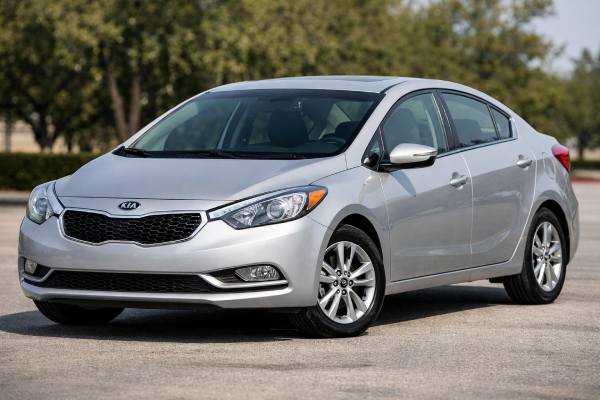
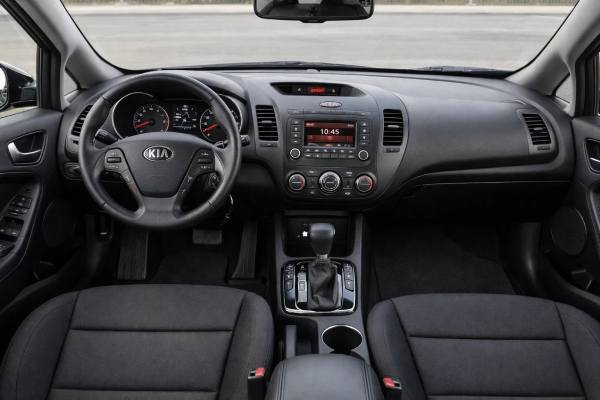

The 2015–2016 Kia Forte (YD) with the 1.8-liter Nu MPI engine is a straightforward compact sedan built around low running costs and simple, proven engineering. The naturally aspirated port-injected four-cylinder avoids the complexity of direct injection and turbocharging, which matters for long-term ownership in mixed driving and short-trip use. Most examples pair the 1.8 with a conventional 6-speed automatic, though a 6-speed manual exists in some markets and trims.
What owners tend to notice first is how “normal” everything feels: predictable throttle response, smooth daily drivability, and service needs that align with common shop capabilities and parts availability. At the same time, this generation sits in an era where safety structure and airbag coverage became more standardized, but advanced driver assistance features were still limited on many trims—so trim selection matters more than people expect.
Owner Snapshot
- Smooth, low-stress power delivery and simple port injection suit long-term daily use.
- Efficient on highway commutes for a non-hybrid compact, especially at steady speeds.
- Steering and suspension are tuned for comfort more than sharp handling.
- Budget for occasional wear items (bushings, brakes, sensors) as mileage climbs past 120,000–160,000 km.
- Change engine oil every 8,000–12,000 km (5,000–7,500 mi) or 6–12 months, depending on duty cycle.
Explore the sections
- Kia Forte YD ownership picture
- Kia Forte YD 1.8 specs and dimensions
- Kia Forte YD trims and safety equipment
- Reliability and known problems
- Maintenance plan and buying advice
- Real-world driving and economy
- Rivals and smart alternatives
Kia Forte YD ownership picture
This 2015–2016 Forte configuration is best understood as a “keep it simple” compact: a naturally aspirated 1.8-liter engine (Nu MPI) tuned for everyday torque and predictable efficiency rather than fast acceleration. If you’re choosing it for durability, the biggest advantage is the fuel system. Multi-port injection (MPI) sprays fuel upstream of the intake valves, which generally helps keep intake deposits lower than direct-injection-only designs. That doesn’t make it maintenance-free, but it reduces one common long-term cost category.
The chassis is conventional and easy to live with. Ride quality leans toward comfort—useful on broken city pavement—while the suspension geometry and tire sizes typically prioritize low noise and reasonable replacement costs. Steering is light, and the car is easy to place in traffic and parking lots, which is a real day-to-day benefit if your driving includes tight urban streets.
Where buyers should slow down is equipment variation. In these years, safety structure and airbag basics are strong for the class, but driver assistance tech (automatic emergency braking, adaptive cruise, lane centering) is often absent or limited. That makes it important to confirm what your specific trim and market actually include. In some regions, the same body can be sold as Cerato/K3, and equipment packages can differ even when the mechanicals are nearly identical.
For long-term ownership, this model rewards the basics:
- Use correct oil viscosity and don’t stretch intervals if you do short trips or cold starts.
- Refresh brake fluid and coolant on time (age matters as much as mileage).
- Address small steering/suspension noises early, because compact-car front ends can develop play gradually and quietly.
Overall, if you want a compact that behaves predictably and doesn’t demand specialized service tools, the 1.8 MPI Forte is one of the more ownership-friendly picks from its era—provided you buy the cleanest example you can and verify recalls and maintenance history.
Kia Forte YD 1.8 specs and dimensions
Below are practical, ownership-focused specifications for the 2015–2016 Kia Forte (YD) with the 1.8 Nu MPI and 145 hp. Exact figures can vary by market, body style (sedan vs hatch in some regions), wheel/tire package, and emissions calibration—so treat these as a strong baseline and confirm against your VIN documentation.
Powertrain and efficiency (typical for 1.8 MPI)
| Item | Spec |
|---|---|
| Engine family | Nu MPI inline-4 |
| Displacement | 1.8 L (≈1,797 cc) |
| Engine layout and cylinders | I-4, DOHC, 4 valves/cyl |
| Bore × stroke | ≈81.0 × 87.2 mm (3.19 × 3.43 in) |
| Induction | Naturally aspirated |
| Fuel system | MPI / PFI (multi-port fuel injection) |
| Compression ratio | ≈10.3:1 (market dependent) |
| Max power | 145 hp (≈108 kW) @ ~6,500 rpm |
| Max torque | ≈176 Nm (≈130 lb-ft) @ ~4,700 rpm |
| Timing drive | Chain |
| Rated efficiency (typical automatic) | ≈7.0–7.8 L/100 km (≈30–34 mpg US / 36–41 mpg UK) |
| Real-world highway @ 120 km/h | Often ≈7.0–8.2 L/100 km depending on wind, tires, and load |
Transmission and driveline
| Item | Spec |
|---|---|
| Transmission | 6-speed automatic (common) or 6-speed manual (some trims/markets) |
| Drive type | FWD |
| Differential | Open |
Chassis and dimensions (typical sedan)
| Item | Spec |
|---|---|
| Suspension (front/rear) | MacPherson strut / torsion beam (most markets) |
| Steering | Electric power steering (EPS) |
| Brakes | 4-wheel disc on many trims; some base trims may vary by market |
| Popular tire size | Often 205/55 R16 or 215/45 R17 (trim dependent) |
| Ground clearance | ≈140 mm (≈5.5 in) |
| Length / width / height | ≈4,560 / 1,780 / 1,435 mm (≈179.5 / 70.1 / 56.5 in) |
| Wheelbase | ≈2,700 mm (≈106.3 in) |
| Turning circle | ≈10.6–11.0 m (≈34.8–36.1 ft) |
| Curb weight | ≈1,220–1,300 kg (≈2,690–2,866 lb) |
| Fuel tank | ≈50 L (≈13.2 US gal / 11.0 UK gal) |
| Cargo (sedan trunk) | ≈424 L (≈15.0 ft³) (method varies) |
Performance (realistic expectations)
| Metric | Typical range |
|---|---|
| 0–100 km/h (0–62 mph) | ≈9.5–11.0 s (auto slower than manual in many tests) |
| Top speed | ≈190–200 km/h (≈118–124 mph) |
| Braking 100–0 km/h | Often ≈38–41 m with good tires and brakes |
Fluids and service capacities (verify by VIN)
| Item | Spec (typical) |
|---|---|
| Engine oil | API/ILSAC spec per market; common viscosity 5W-20 or 5W-30 |
| Oil capacity | ≈4.0 L (≈4.2 US qt) with filter |
| Coolant | Ethylene glycol long-life coolant; typical 50/50 mix |
| Coolant capacity | ≈6.0 L (≈6.3 US qt) (varies) |
| Automatic ATF | Hyundai/Kia-spec ATF (model-dependent) |
| A/C refrigerant | Often R-134a (charge varies; check under-hood label) |
Key torque values also vary with fastener and wheel size. As a decision-making baseline, wheel lug nuts are commonly tightened in the ≈88–108 Nm (≈65–80 lb-ft) range on many compacts, but always confirm for your exact wheels and studs.
Kia Forte YD trims and safety equipment
Trim naming depends heavily on region, but a common pattern is a value-focused base trim (often “LX” or equivalent), a mid-trim with convenience upgrades, and an upper trim with more infotainment and appearance features. With the 1.8 MPI specifically, expect it to be most common in the lower-to-mid trims, while higher trims in some markets may shift to larger engines or different feature packaging.
Trims and options that matter mechanically
Even when the engine is the same, trim choices can affect ownership costs through wheels, tires, and brake sizing.
- Wheels and tires: Moving from 16-inch to 17-inch packages can sharpen steering response but usually increases tire cost and makes pothole damage more likely. If your roads are rough, the smaller wheel package is often the smarter long-term choice.
- Brakes: Many trims use 4-wheel discs; some base configurations in certain markets may differ. Confirm rotor type and size before ordering parts.
- Infotainment: Factory head units vary widely. If you care about hands-free calling stability and modern phone integration, verify the exact unit and firmware behavior during your test drive—older systems can be more frustrating than buyers expect.
Quick identifiers when shopping used:
- Compare the wheel size, headlight style, and steering wheel controls across listings—these usually track trim level reliably.
- Check the door jamb build label and the option list on the original window sticker (if available) rather than trusting badges alone.
Safety ratings and what they mean
This model sits in a period where crashworthiness improved, but some test categories changed year to year. In the U.S., two bodies are commonly referenced: Insurance Institute for Highway Safety and National Highway Traffic Safety Administration.
A practical way to interpret results as an owner:
- Structure and restraint performance: This affects survivability in severe crashes and doesn’t depend on trim as much as you might think (though airbags and seat design can).
- Headlights and crash avoidance tech: These can vary a lot by trim and options. If you drive at night frequently, headlight performance can be as important as raw crash structure ratings.
- Child-seat usability: Rear LATCH/ISOFIX access and tether anchors matter daily if you carry kids, and can be more important than one star difference in a test you’ll hopefully never experience.
Safety systems and driver assistance (ADAS)
Expect strong “baseline” safety: multiple airbags, stability control, ABS, and traction control were common. Where you should not assume anything is in advanced features:
- Automatic emergency braking (AEB): Often not available or not widespread on 2015–2016 compacts in many markets.
- Adaptive cruise control (ACC) and lane centering: Typically absent.
- Blind-spot monitoring and rear cross-traffic alert: Sometimes optional on higher trims; confirm with a physical check and the instrument cluster indicators.
If the car does have any radar/camera-based systems, remember that windshield replacement, bumper repairs, and alignment changes can require calibration. That adds cost and complexity, so it’s worth confirming correct operation before purchase.
Reliability and known problems
The 1.8 Nu MPI Forte is generally favorable for long-term use because it avoids a turbocharger and usually avoids direct-injection-specific maintenance. Most real-world “reliability” outcomes come down to maintenance discipline, driving conditions, and whether small issues are repaired early.
Below is a prevalence-and-severity map that fits typical ownership patterns for this generation. Exact rates vary by climate and road conditions.
Common (low to medium cost)
- Steering clunk or looseness (EPS-related feel):
Symptoms: light clunk over small bumps, vague on-center feel.
Likely cause: wear in steering column coupler/bushing or related steering components (common across many EPS compacts).
Remedy: inspection and replacement of the worn coupler/bushing or related parts; align afterward if needed. - Suspension wear (front end and rear shocks):
Symptoms: knocking over bumps, uneven tire wear, reduced stability in crosswinds.
Cause: bushings, links, and dampers aging.
Remedy: replace worn links/bushings/shocks; perform alignment and rotate tires. - Ignition coils or plugs (age/mileage wear):
Symptoms: misfire under load, rough idle, flashing MIL.
Cause: coil degradation or overdue plugs.
Remedy: replace coils as needed; install correct-spec plugs and verify gap/type.
Occasional (medium cost)
- A/C performance decline:
Symptoms: weak cooling at idle, intermittent operation.
Cause: refrigerant loss, compressor control issues, or condenser damage from road debris.
Remedy: leak test, correct recharge by weight, and repair the underlying leak rather than topping off repeatedly. - Brake pulsation:
Symptoms: vibration under braking at highway speeds.
Cause: uneven pad transfer, overheated rotors, or caliper slide issues.
Remedy: service slides, replace pads/rotors if thickness or runout is out of spec, flush brake fluid if old.
Rare but higher cost (inspect carefully)
- Engine oil consumption (not universal, but important to monitor):
Symptoms: oil level dropping between services, smoke on startup in severe cases.
Cause: can be related to ring wear, PCV system issues, or long intervals with heavy duty cycles.
Remedy: shorten oil intervals, verify PCV function, and document consumption rate (e.g., per 1,000 km). Significant consumption needs diagnosis before it becomes a catalyst or engine longevity problem. - Automatic transmission shift quality issues:
Symptoms: delayed engagement, flare on upshifts, shudder.
Cause: fluid deterioration, adaptation issues, or internal wear in high-mileage units.
Remedy: verify fluid condition and correct spec; consider drain-and-fill service intervals earlier than “lifetime” claims if you plan to keep the car.
Recalls, service actions, and how to verify
For any used purchase, recall completion status is not optional—it’s part of safety and resale value. Use the official VIN recall lookup and keep screenshots or service invoices. In practice:
- Run a VIN check on an official recall database.
- Ask the seller for dealer repair orders or recall completion documents.
- If results are unclear, a dealer can usually confirm completion from the service history tied to the VIN.
This is particularly important for older compacts because recall remedies can involve critical systems (airbags, braking components, wiring) that you don’t want to discover after purchase.
Maintenance plan and buying advice
A simple engine can still become expensive if maintenance is delayed. The goal with the 1.8 MPI Forte is to keep fluids fresh, prevent heat-related wear, and avoid running worn suspension parts long enough to damage tires.
Practical maintenance schedule (distance or time)
Intervals below are sensible ownership targets; always confirm your market’s official schedule.
- Engine oil and filter: every 8,000–12,000 km (5,000–7,500 mi) or 6–12 months.
Use the shorter interval for short trips, heavy city use, very hot climates, or frequent cold starts. - Engine air filter: inspect every oil change; replace about 24,000–48,000 km (15,000–30,000 mi) depending on dust.
- Cabin air filter: 12 months or 15,000–20,000 km for best HVAC performance.
- Spark plugs (often iridium): commonly 160,000–170,000 km (100,000–105,000 mi), but earlier if misfires occur.
- Coolant: commonly first service around 190,000 km (120,000 mi) or 10 years, then more frequent (market dependent).
- Brake fluid: every 2 years, regardless of mileage.
- Automatic transmission fluid: a conservative ownership interval is 60,000–100,000 km (40,000–60,000 mi), especially for city driving or high heat.
If the vehicle sees mostly gentle highway miles, you may stretch it—but “lifetime” fluid is rarely a best practice for long ownership. - Tire rotation: every 8,000–12,000 km; align annually or when tires show uneven wear.
- 12 V battery: test yearly after year 4; many batteries last 4–6 years depending on climate.
Fluids and specifications (ownership-friendly guidance)
Because oil and ATF specs can differ by market, focus on two rules:
- Use the exact viscosity range recommended for your climate.
- Use the correct specification (API/ILSAC for engine oil; the exact Hyundai/Kia ATF standard for the transmission).
If you’re buying used, plan a “baseline service” unless records are excellent:
- Fresh engine oil and filter
- Cabin and engine filters
- Brake fluid flush
- Tire rotation and alignment check
- Coolant condition test (or replace if unknown and age suggests it’s due)
Buyer’s guide: what to inspect before purchase
Bring a flashlight, and don’t rush the test drive.
Body and chassis
- Look for uneven panel gaps, overspray, or mismatched paint (accident indicators).
- Inspect rocker panels and underbody seams for rust, especially in salted-winter regions.
Engine bay
- Check for oil seepage around the valve cover area and front of the engine.
- Pull the dipstick: oil level and color matter less than evidence of neglect (sludge smell, extremely low level).
Driving checks
- On a smooth road, the car should track straight with the wheel centered.
- Over small bumps, listen for steering clunks or suspension knocks.
- During a moderate acceleration roll-on, the engine should pull cleanly without misfire.
Paperwork
- Confirm recall completion.
- Verify consistent oil service and at least some documented brake/tire maintenance.
Long-term outlook: maintained examples commonly make good daily drivers well past 200,000 km. Neglected examples often “look fine” but quietly stack costs in tires, suspension, and deferred fluids—so condition beats trim every time.
Real-world driving and economy
In daily use, the 1.8 MPI Forte feels calm rather than sporty. Throttle response is linear, and the engine’s character is more about steady progress than punchy acceleration. Around town, that predictability is a benefit: it’s easy to modulate in traffic, and it rarely surprises you with sudden torque spikes.
Ride, handling, and NVH
- Ride: generally compliant over broken pavement. With smaller wheels and taller tires, the car is noticeably more forgiving over sharp edges.
- Handling: safe and stable, with moderate body roll. It’s not a “hot hatch” or a sharp sports sedan, but it’s confident in normal cornering and lane changes.
- Steering feel: light, especially at parking speeds. On-center feedback can feel muted compared with benchmark rivals, but many owners prefer that for commuting.
- Noise: tire noise is often more noticeable than engine noise at highway speeds, and tire choice can change the cabin experience significantly.
Powertrain behavior
With the 6-speed automatic, shift logic is typically tuned for smoothness and fuel economy. Expect:
- Gentle upshifts at low throttle
- Downshifts that prioritize avoiding harshness rather than immediate response
- Better responsiveness in lower gears when you press deeper for kickdown
If you find an example with the manual transmission, it can feel more lively at city speeds, but the car still isn’t quick—it simply gives you more control over where the engine sits in the power band.
Real-world efficiency (what owners actually see)
Fuel economy depends heavily on speed and temperature. As a practical guide:
- City driving: often 8.0–9.5 L/100 km (≈25–29 mpg US / 30–35 mpg UK) depending on traffic and trip length.
- Highway 100–120 km/h (60–75 mph): often 6.5–8.2 L/100 km (≈29–36 mpg US / 34–43 mpg UK).
- Cold weather: short trips can add 10–25% consumption due to longer warm-up time and thicker fluids.
The most effective “free” efficiency wins:
- Keep tires at correct pressure.
- Replace dirty engine air filters.
- Fix alignment issues early (toe misalignment quietly kills fuel economy and tires).
- Don’t ignore dragging brakes—if a wheel is hotter than the others after a drive, investigate.
Performance metrics that matter for safety
Rather than chasing 0–100 numbers, focus on real safety-relevant performance:
- Confident braking with quality pads/rotors and good tires
- Predictable wet-road stability (tires again)
- Clean passing response: use manual mode (if equipped) to pre-select a lower gear before a short merge
If you treat the Forte as a comfortable commuter and maintain it like you plan to keep it, it tends to deliver exactly what it promises: low drama, consistent running costs, and good day-to-day usability.
Rivals and smart alternatives
Cross-shopping matters because compact sedans are defined by tradeoffs: reliability patterns, driving feel, safety equipment availability, and long-term parts costs. Here’s how a 2015–2016 Forte 1.8 MPI typically stacks up against common rivals.
Where the Forte 1.8 MPI tends to win
- Simplicity of the powertrain: Port injection and natural aspiration can be an advantage for long-term maintenance planning.
- Value for money on the used market: These often price attractively relative to the top “nameplate premiums.”
- Comfort-first tuning: If you want an easy commuter rather than a sporty feel, the Forte’s manners can be a plus.
Where key rivals may be stronger
- Toyota Corolla (similar years): often sets the baseline for low drama and resale value. If you want “appliance reliability” above all, it’s a common reference point.
- Honda Civic: typically offers a more engaging steering/handling balance and strong aftermarket/parts ecosystem, though some configurations bring different complexity.
- Mazda Mazda3: often feels more premium in steering response and cabin design, but tire and suspension choices can lean sportier (sometimes harsher) depending on trim.
- Hyundai Elantra (platform cousin in many respects): similar strengths and some shared component patterns. Condition and maintenance history often matter more than the badge here.
- Nissan Sentra (certain years): can be comfortable and efficient, but some powertrain choices in that era require careful research—especially if you’re trying to minimize drivetrain risk.
Picking the right car for your use case
Choose the Forte 1.8 MPI if you:
- Drive daily, want predictable running costs, and value simple servicing.
- Prefer comfort and quiet commuting over sporty feedback.
- Can find a well-maintained example with clean records.
Choose a rival instead if you:
- Prioritize the sharpest handling (often Civic/Mazda3).
- Want the strongest resale value and a “default safe choice” reputation (often Corolla).
- Need advanced driver assistance features that are more widely available on certain trims/models.
A smart approach is to shop condition-first across multiple models:
- Compare service history quality and evidence of consistent oil changes.
- Favor cars with recent tires and brakes done correctly (it’s a proxy for owner care).
- Verify recall status and confirm all keys, manuals, and proper tire sizing.
For most buyers, the “best” compact isn’t the one with the most features—it’s the one with the fewest hidden problems. The Forte 1.8 MPI can be an excellent answer when it’s been maintained with that mindset.
References
- 2015 Kia Forte 4-door sedan 2015 (Safety Rating)
- Vehicle Detail Search – 2015 KIA FORTE | NHTSA 2015 (Recall Database)
- Gas Mileage of 2016 Kia Forte 2016 (Fuel Economy Data)
- Manuals 2026 (Owner’s Manual Portal)
Disclaimer
This article is for informational purposes only and is not a substitute for professional diagnosis, inspection, or repair. Specifications, torque values, service intervals, and procedures vary by VIN, market, emissions equipment, and installed options—always verify details using your official owner’s manual, service manual, and vehicle labels before purchasing parts or performing work.
If this guide helped you, consider sharing it on Facebook, X/Twitter, or your favorite forum to support our work.