

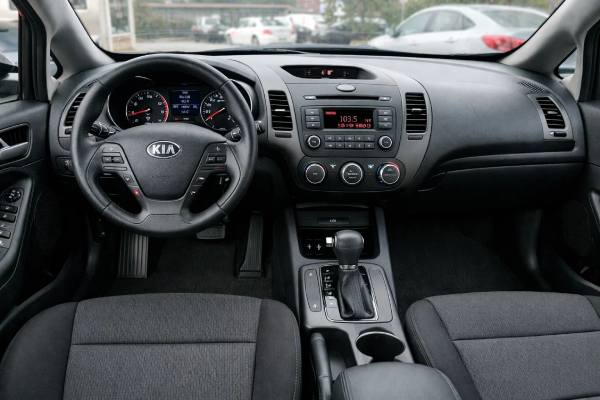
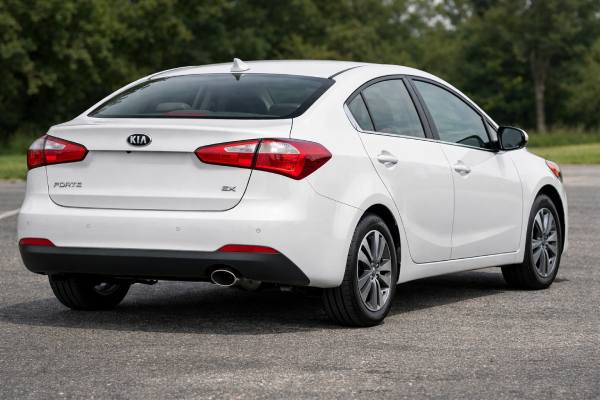
The 2014–2016 Kia Forte (YD) with the 2.0-liter Nu GDI is the “fastest mainstream” Forte of its era: a naturally aspirated engine with direct injection (GDI) tuned for stronger mid-range pull and easy highway merging, without the added heat and plumbing of a turbo. That mix can feel ideal for owners who want simple daily drivability but don’t want the softer response of smaller engines.
The tradeoff is that GDI ownership is more sensitive to fuel quality, oil-change discipline, and intake cleanliness over time. This version also tends to be paired with the 6-speed automatic, which is generally smooth, but benefits from sensible fluid service if you plan to keep the car long-term. Safety is solid for a compact of the mid-2010s, yet advanced driver assistance features vary sharply by trim and market—so the “right” Forte is often the one with the right equipment, not the lowest mileage.
Quick Specs and Notes
- Stronger acceleration and passing power than the 1.8 MPI models, especially above 50 km/h.
- Direct injection supports good power for the size, with steady highway efficiency when driven smoothly.
- Conventional 6-speed automatic is generally predictable and easy to service.
- Plan for GDI-related intake valve carbon cleaning on higher-mileage cars if drivability declines.
- Change engine oil every 6,000–10,000 km (4,000–6,000 mi) or 6–12 months based on duty cycle.
Quick navigation
- Kia Forte YD 2.0 GDI profile
- Kia Forte YD 2.0 GDI specifications
- Kia Forte YD trims and ADAS
- Common faults and recall checks
- Service schedule and ownership costs
- Road manners and fuel use
- Alternatives in the segment
Kia Forte YD 2.0 GDI profile
The 2.0 Nu GDI Forte sits in a sweet spot for many buyers: enough power to feel confident on short on-ramps, a naturally aspirated throttle that stays consistent in heat, and a drivetrain layout that most independent shops understand. In everyday driving it feels more “grown up” than the smaller engines because it needs less effort to maintain speed with passengers, luggage, or long motorway grades. If you drive a lot of mixed roads—urban traffic plus frequent highway merges—this engine is the one that changes the Forte’s personality.
Direct injection is the key technical difference. With GDI, fuel is injected directly into the cylinder rather than onto the back of the intake valves. That helps power and efficiency, but it also means the intake valves don’t get washed by fuel, so oil vapor from the PCV system can build carbon deposits over time. Not every car suffers equally: long highway trips can be kinder than repeated short trips, and oil quality and service intervals matter. Still, buyers should expect that “GDI housekeeping” may be part of long-term ownership.
Chassis tuning remains comfort-oriented. Steering is light and predictable, and the suspension favors stability and ease over sharp feedback. That aligns with the Forte’s role as a commuter and family compact. The biggest day-to-day differences usually come from wheel and tire package: larger wheels can look better and turn in a bit quicker, but they also transmit more impact harshness and can be more vulnerable to pothole damage.
Finally, equipment variation is a bigger deal than many shoppers assume. In these years, you may see strong basic safety systems but limited modern driver assistance. That makes it worth prioritizing trim and condition together: the best buy is often a well-kept example with sensible tire sizing, complete maintenance records, and verified service actions—rather than the highest trim with unknown history.
Kia Forte YD 2.0 GDI specifications
Specifications for the 2014–2016 Forte YD 2.0 Nu GDI vary slightly by market, emissions calibration, body style, and wheel package. The tables below focus on the typical 173 hp configuration and the ownership-relevant numbers you’ll use for comparisons, service planning, and parts decisions.
Powertrain and efficiency (2.0 Nu GDI)
| Item | Typical specification |
|---|---|
| Code | Nu 2.0 GDI (market naming varies) |
| Engine layout and cylinders | I-4, DOHC, 4 valves/cyl |
| Bore × stroke | ≈81.0 × 97.0 mm (≈3.19 × 3.82 in) |
| Displacement | 2.0 L (≈1,999 cc) |
| Induction | Naturally aspirated |
| Fuel system | GDI (direct injection) |
| Compression ratio | ≈11.5:1 (market dependent) |
| Max power | 173 hp (≈129 kW) @ ~6,500 rpm |
| Max torque | ≈205–209 Nm (≈151–154 lb-ft) @ ~4,700 rpm |
| Timing drive | Chain |
| Rated efficiency (typical) | Often ≈7.4–8.6 L/100 km (≈27–32 mpg US / 33–38 mpg UK) |
| Real-world highway @ 120 km/h | Commonly ≈7.2–8.8 L/100 km depending on tires, wind, and load |
Transmission and driveline
| Item | Typical specification |
|---|---|
| Transmission | 6-speed automatic (common) or 6-speed manual (some trims/markets) |
| Drive type | FWD |
| Differential | Open |
Chassis and dimensions (typical sedan baseline)
| Item | Typical specification |
|---|---|
| Suspension (front/rear) | MacPherson strut / torsion beam |
| Steering | EPS (electric power steering) |
| Brakes | Disc front and rear on many trims; verify by VIN/market |
| Most popular tire size | Often 215/45 R17 (many 2.0 trims), with 16-inch packages also common |
| Ground clearance | ≈140 mm (≈5.5 in) |
| Length / width / height | ≈4,560 / 1,780 / 1,435 mm (≈179.5 / 70.1 / 56.5 in) |
| Wheelbase | ≈2,700 mm (≈106.3 in) |
| Turning circle | ≈10.6–11.0 m (≈34.8–36.1 ft) |
| Curb weight | ≈1,250–1,340 kg (≈2,756–2,954 lb) |
| GVWR | Market dependent; confirm on door jamb label |
| Fuel tank | ≈50 L (≈13.2 US gal / 11.0 UK gal) |
| Cargo volume (sedan) | ≈424 L (≈15.0 ft³) (method varies) |
Performance and capability (what to expect)
| Metric | Typical range |
|---|---|
| 0–100 km/h (0–62 mph) | ≈8.0–9.0 s (auto vs manual varies) |
| Passing 80–120 km/h | Stronger than 1.8 MPI; depends on kickdown and load |
| Top speed | ≈200–210 km/h (≈124–130 mph) |
| Braking 100–0 km/h | Often ≈37–41 m on quality tires |
Fluids and service capacities (verify by VIN label and manual)
| Item | Typical guidance |
|---|---|
| Engine oil | API/ILSAC spec per market; often 5W-20 or 5W-30 depending on climate |
| Oil capacity | Commonly ≈4.3–4.7 L (≈4.5–5.0 US qt) with filter |
| Coolant | Long-life ethylene glycol; typically 50/50 mix |
| Automatic ATF | Hyundai and Kia specific ATF standard; do not substitute universal fluids |
| A/C refrigerant | Often R-134a in these years; confirm under-hood label |
Key torque values are fastener- and wheel-dependent. As a safe planning baseline, many compacts use wheel lug torque in the ≈88–108 Nm (≈65–80 lb-ft) range, but confirm for your wheel studs and wheel size before tightening.
Kia Forte YD trims and ADAS
Trim names differ by region, but the 2.0 GDI configuration is commonly tied to mid and upper trims where buyers want stronger performance and more features. For used shopping, the most important thing is not the badge—it’s the combination of wheels, headlights, and safety equipment actually fitted.
Trims and options that change ownership experience
- Wheel and tire packages: Many 2.0 cars use 17-inch tires. They can feel more responsive, but they increase tire cost and reduce pothole tolerance. If your roads are rough, a 16-inch package can be the “quiet upgrade” in comfort and long-term durability.
- Headlights: Halogen vs projector vs HID (market dependent) can meaningfully change night driving safety. Check beam pattern and lens clarity, not just whether the lights turn on.
- Infotainment and camera systems: Backup cameras and larger head units can be excellent daily features, but reliability depends on how cleanly the system integrates with steering wheel controls and Bluetooth. Test pairing, microphone clarity, and any screen lag during the inspection.
Quick identifiers while browsing listings
- Interior clues: Steering wheel buttons, cluster display type, and seat upholstery often correlate more reliably with trim than exterior badges.
- Safety hardware clues: Look for the presence of parking sensors, a front camera area near the rear-view mirror, or radar modules behind the grille (rare in this era, but possible in some markets). Then confirm via the vehicle’s equipment list, not assumptions.
- Year-to-year changes: Minor updates can shift standard equipment. When shopping 2014 vs 2016, verify which airbags are present (especially side and curtain coverage) and whether stability control is standard in your market.
Safety ratings and what matters day to day
For this generation, crashworthiness performance is often strong in several tests while some categories may be weaker depending on test type and year. The practical takeaway is to separate:
- Structure and restraints: mostly consistent across trims for the same body style.
- Headlights and crash avoidance features: can vary sharply by trim and are highly relevant for real-world risk.
Driver assistance and calibration considerations
In many 2014–2016 compacts, full modern ADAS is limited. You can typically count on ABS, stability control, traction control, and multiple airbags. Features that may be optional or uncommon:
- Forward collision warning and automatic emergency braking
- Blind-spot monitoring and rear cross-traffic alert
- Lane departure warning
If your car does have any camera- or radar-based system, remember that windshield replacement, front bumper repairs, and some alignment work can require sensor checks or calibration. That’s not a reason to avoid the feature—but it is a reason to budget for correct repairs rather than shortcuts.
Common faults and recall checks
The 2.0 Nu GDI Forte can be a dependable long-term car, but it has a few predictable “ownership patterns.” The goal is to know which issues are common and cheap, which are occasional but manageable, and which need careful pre-purchase screening because they can become expensive.
Common issues (low to medium cost)
- Intake valve carbon buildup (GDI pattern):
Symptoms: rough idle, hesitation, reduced fuel economy, stumble on cold start.
Likely cause: carbon deposits from oil vapor and blow-by accumulating on intake valves.
Remedy: intake cleaning (often walnut blasting) when symptoms appear; reduce risk with correct oil intervals, a healthy PCV system, and regular highway operation. - Ignition coils and spark plugs:
Symptoms: misfire under load, check engine light, shaky idle.
Cause: normal wear, heat cycling, or overdue plugs.
Remedy: replace plugs on schedule and coils as needed; verify correct plug type and torque procedure. - EPS feel changes or clunks:
Symptoms: light knock over small bumps, vague on-center steering.
Cause: wear in steering coupler or front-end components.
Remedy: inspection of coupler, tie rods, and links; align after repairs.
Occasional issues (medium cost)
- High-pressure fuel system sensitivity:
Symptoms: extended cranking, power loss, fuel trims out of range, injector noise.
Cause: fuel quality, injector deposits, high-pressure pump wear, or sensor faults.
Remedy: confirm fuel pressure and injector balance; use quality fuel and correct filters; address codes with proper diagnosis rather than parts guessing. - A/C performance decline:
Symptoms: weak cooling at idle, intermittent cycling.
Cause: leaks, condenser damage, or compressor control issues.
Remedy: leak test and recharge by weight after repair.
Rare but higher-risk checks (higher cost if ignored)
- Oil consumption or neglected oil maintenance:
Symptoms: low oil between services, ticking noise on cold start, catalytic converter efficiency codes later.
Cause: long intervals, wrong oil viscosity, or engine wear.
Remedy: verify consumption rate, shorten intervals, and confirm PCV health; avoid buying a car that repeatedly ran low on oil. - Transmission shift quality complaints:
Symptoms: delayed engagement, flare, shudder.
Cause: aged fluid, adaptation issues, or internal wear at higher mileage.
Remedy: verify correct ATF spec and service history; test drive when fully warm.
Service campaigns, recalls, and how to verify completion
For this model range there have been service actions that matter to owners, including software updates and corrosion-related inspections in some regions. The safe routine is:
- Run an official VIN lookup for recalls.
- Ask for dealer repair orders showing completion.
- If paperwork is missing, call a dealer with the VIN and request completion status.
A good used purchase is one with proof: clear maintenance history, documented campaign completion where applicable, and an inspection that confirms the engine runs smoothly when cold and hot—because GDI issues often show up most clearly at those transitions.
Service schedule and ownership costs
If you want the 2.0 GDI Forte to stay inexpensive, your strategy is simple: keep oil clean, keep fluids fresh, and treat drivability changes as early warnings rather than annoyances. Direct injection rewards owners who are proactive, not reactive.
Practical maintenance schedule (distance or time)
Use the shorter interval if you drive short trips, heavy traffic, cold climates, or frequent high load.
- Engine oil and filter: every 6,000–10,000 km (4,000–6,000 mi) or 6–12 months.
For mostly highway use, you can lean toward the longer end; for short trips, stay conservative. - Engine air filter: inspect at each oil change; replace roughly 24,000–48,000 km (15,000–30,000 mi) depending on dust.
- Cabin air filter: every 12 months or 15,000–20,000 km for HVAC performance.
- Spark plugs (often iridium): typically 150,000–170,000 km (90,000–105,000 mi), or earlier if misfire codes appear.
- Coolant: commonly first change around 10 years / 160,000–190,000 km (market dependent), then follow the “after first change” interval in your manual.
- Brake fluid: every 2 years, regardless of mileage.
- Automatic transmission fluid: a conservative ownership interval is 60,000–100,000 km (40,000–60,000 mi); earlier if driven hard, in heat, or in stop-and-go traffic.
- Tire rotation: every 8,000–12,000 km; alignment check annually or at first sign of uneven wear.
- 12 V battery: test yearly after year 4; typical life 4–6 years.
GDI-specific upkeep that pays off
- Fuel quality: use reputable fuel and avoid chronically running the tank low, which can stress the pump and increase heat.
- PCV system health: a sticking PCV valve can increase oil vapor and deposits. If idle quality worsens over time, consider PCV inspection as part of diagnosis.
- Intake cleanliness: don’t “pre-pay” for intake cleaning without symptoms, but do budget for it at higher mileage if idle quality or responsiveness declines.
Buyer’s guide: inspection checklist
Before starting the engine (cold):
- Check oil level and smell (burnt odor or very low level is a red flag).
- Look for fresh oil around the valve cover and front engine area.
Cold start and idle:
- Listen for abnormal ticking beyond a brief warm-up.
- Confirm steady idle without hunting or shaking.
Test drive (fully warm):
- Smooth part-throttle acceleration is the key: hesitation or surging can point to deposits, coils, or fuel delivery issues.
- Braking should be linear; a soft pedal may suggest old fluid or hydraulic concerns.
- Steering should be consistent on-center; clunks over small bumps deserve inspection.
Ownership cost planning (realistic budgeting):
Expect normal compact-car wear items—tires, brakes, filters, battery—and plan an extra buffer for GDI housekeeping if the car is near or above 120,000–160,000 km. The best way to reduce total cost is buying a car with documented oil changes and a calm, smooth cold start.
Road manners and fuel use
The 2.0 GDI Forte feels noticeably quicker than the 1.8 models in normal traffic. You don’t have to “floor it” as often, and that reduces day-to-day stress—especially when merging into fast lanes or climbing grades with passengers. The power delivery is still naturally aspirated, so response is progressive rather than punchy, but it has more usable pull in the mid-range.
Ride, handling, and cabin noise
- Ride comfort: generally compliant, especially on 16-inch tires. On 17-inch packages the ride firms up and pothole harshness increases.
- Handling balance: safe and predictable with moderate body roll. The Forte is more about stability than corner speed.
- Steering: light effort, easy parking, and a calm highway feel. Feedback can be muted, but the car tracks well when alignment and tires are healthy.
- NVH (noise, vibration, and harshness): tire noise is often the dominant sound at highway speed. Choosing a quieter touring tire can change the entire car more than many “performance” mods.
Transmission behavior (6-speed automatic)
The automatic typically prioritizes smoothness:
- Early upshifts during gentle driving
- A kickdown that can feel slightly delayed if you request sudden passing power
- Better response if you use manual mode to pre-select a lower gear before a merge
For a used buyer, the important test is consistency: shifts should be the same when cold and warm, with no flare, shudder, or delayed engagement.
Real-world efficiency (what to expect)
Fuel economy depends heavily on speed, temperature, and tire choice. Typical owner patterns:
- City: often 8.5–10.5 L/100 km (≈22–28 mpg US / 27–34 mpg UK), especially with short trips.
- Highway 100–120 km/h: often 7.2–8.8 L/100 km (≈27–33 mpg US / 32–40 mpg UK).
- Mixed use: frequently lands around 8.0–9.2 L/100 km for many drivers.
Cold weather and short trips can raise consumption by 10–25% due to warm-up time and thicker fluids. If you want the best real-world results, focus on:
- Correct tire pressure and alignment
- Clean air filter
- No dragging brakes
- Smooth acceleration rather than short, hard bursts
In terms of performance metrics that matter for safety, the 2.0’s biggest advantage is passing confidence. It reduces the time you spend exposed in the oncoming lane or during short merges—an underrated form of “active safety” that doesn’t appear in crash-test tables.
Alternatives in the segment
The 2014–2016 compact class is full of strong choices, so the smartest comparison is not “which model is best,” but “which model best matches my risk tolerance and driving needs.” The Forte 2.0 GDI offers a valuable blend of power and everyday simplicity, but rivals may win on resale value, driving feel, or long-term engine cleanliness depending on design.
How the Forte 2.0 GDI typically compares
- Strengths: strong naturally aspirated performance for the era, straightforward packaging, and solid daily usability.
- Tradeoffs: GDI intake deposit risk, and trim-dependent driver assistance availability.
Common rival patterns to consider
- Toyota Corolla: often the “safe bet” for low drama and resale strength. Performance may feel calmer, but many owners value its predictable long-term ownership profile.
- Honda Civic: frequently more engaging to drive with strong visibility and steering feel. Depending on configuration, it may bring different complexity, so shop carefully by engine and transmission.
- Mazda Mazda3: often feels more premium in steering response and cabin design. Some trims ride firmer; tire and suspension choices matter.
- Hyundai Elantra: often close mechanically and philosophically, and sometimes similar ownership patterns depending on engine and year. Condition and service history usually matter more than brand differences here.
What to prioritize when choosing
- Condition over trim: A well-maintained car with clean fluids and good tires beats a “nicer” trim with deferred maintenance.
- Cold start quality: For GDI engines, cold idle behavior is a powerful clue about deposits and ignition health.
- Service documentation: Regular oil changes matter more than almost any optional feature.
- Equipment match: If you want better headlights or specific safety features, verify them physically and in the build equipment list.
If you find a Forte 2.0 GDI with verified campaigns completed, smooth cold and warm operation, and a maintenance history you trust, it can be one of the most satisfying “daily driver” compacts of its era—because it delivers real-world power without demanding luxury-car service habits.
References
- 2014 Kia Forte 4-door sedan 2014 (Safety Rating)
- Vehicle Detail Search – 2015 KIA FORTE | NHTSA 2015 (Recall Database)
- Gas Mileage of 2016 Kia Forte 2016 (Fuel Economy Data)
- SC180 – 2014-2016 MY KIA FORTE 2.0-LITER GDI – ECM UPDATE 2019 (Service Campaign)
- SC238 –2014-2017 MY FORTE AND FORTE KOUP VEHICLES BRAKE LINE CORROSION 2022 (Service Campaign)
Disclaimer
This article is for informational purposes only and is not a substitute for professional inspection, diagnosis, or repair. Specifications, torque values, service intervals, and procedures vary by VIN, market, emissions configuration, and installed equipment. Always verify details against the official owner’s manual and service documentation for your exact vehicle before purchasing parts or performing work.
If you found this guide useful, please consider sharing it on Facebook, X/Twitter, or your favorite community to support our work.