


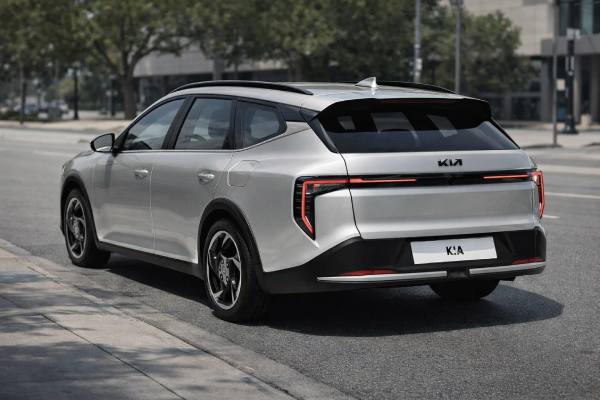
The Kia K4 Sportswagon (CL4) with the 1.0 T-GDi “Hybrid” setup is best understood as a 48-volt mild-hybrid (often written as 48V or mHEV), not a full hybrid like a Toyota system. You still fuel it like a normal gasoline car, but a small belt-driven motor-generator supports the engine during takeoff and smooths stop-start events. In daily use, that means cleaner launches, less hesitation in traffic, and a drivetrain that can feel “bigger than 1.0” as long as you drive within its comfort zone.
As a wagon, the K4 also targets buyers who want real cargo room without SUV height, plus a long wheelbase that helps stability on the highway. The trade-off is that the 48V hardware can slightly reduce underfloor storage and adds a few maintenance and diagnostic considerations compared with the simplest manual 1.0 versions.
What to Know
- Smooth, low-stress city driving thanks to the 48V assist and quick DCT response when calibrated well
- Strong space efficiency: wagon cargo packaging that still fits daily family and commute needs
- Turbo three-cylinder tuned for usable midrange torque rather than outright speed
- Ownership caveat: the 7-speed DCT and 48V belt system reward correct fluids, updates, and gentle low-speed habits
- Plan oil changes around 10,000–15,000 km (6,000–9,000 mi) or 12 months, especially with short trips
Navigate this guide
- Kia K4 Sportswagon CL4 hybrid basics
- Kia K4 Sportswagon CL4 numbers
- Kia K4 Sportswagon CL4 trims and safety tech
- Reliability watch list
- Maintenance plan and buying tips
- On-road feel and efficiency
- Rivals and value check
Kia K4 Sportswagon CL4 hybrid basics
This K4 Sportswagon configuration pairs a 1.0-liter turbocharged gasoline three-cylinder with a 48-volt mild-hybrid system and (in most markets that label it “Hybrid”) a 7-speed dual-clutch automatic (DCT7). The key point: the car does not drive as an EV on its own for meaningful distances. Instead, the 48V system uses a small motor-generator (typically belt-driven) to assist the engine during transient moments—pulling away from a stop, filling torque during a quick pedal tip-in, and restarting the engine smoothly after stop-start events.
That assistance matters because a small turbo engine lives and dies by transient response. With the 48V “torque fill,” the K4 can feel more relaxed at low speeds than a similar 1.0 without electrical support. You’ll also notice smoother shutoff/restart at intersections, and in gentle driving the system can reduce the amount of fuel burned in stop-and-go traffic.
As a Sportswagon, the CL4 body brings two ownership advantages that don’t show up in peak horsepower numbers:
- Long wheelbase stability. The wagon’s footprint and wheelbase give it a calmer, less busy feel on fast roads than short hatchbacks.
- More usable cargo shape. Even when total liters are similar to rivals on paper, a wagon’s opening height, load floor, and roofline tend to make bulky items easier to manage.
Where owners should set expectations: 113 hp is enough, not sporty. The 200 Nm torque band (low-to-mid rpm) is the work zone. If you routinely load the car with passengers and luggage, or you drive mountainous routes at high speeds, the drivetrain will do the job but you’ll feel it working. The mild-hybrid help reduces strain in the moments that usually feel weakest, but it doesn’t turn the K4 into a full-hybrid torque monster.
The best way to get satisfaction from this powertrain is to treat it like a modern turbo: warm it up gently, use steady throttle rather than sudden jabs, and allow the DCT to select the right gear instead of forcing constant kickdowns. Done that way, the wagon rewards you with respectable real-world economy and a refined daily rhythm.
Kia K4 Sportswagon CL4 numbers
Below are the key specifications for the K4 Sportswagon (CL4) 1.0 T-GDi 48V variant (the “Hybrid” mild-hybrid setup). Values can vary slightly by trim, wheel size, and market homologation, so treat these as a baseline and verify with your VIN-specific documentation.
Powertrain and efficiency
| Item | Specification |
|---|---|
| Code | 1.0 T-GDi 48V (mild-hybrid) |
| Engine layout and cylinders | I-3 (inline 3), DOHC, 4 valves/cyl |
| Bore × stroke | 71.0 × 84.0 mm (2.80 × 3.31 in) |
| Displacement | 1.0 L (998 cc) |
| Induction | Single-scroll turbo |
| Fuel system | Direct injection (DI) |
| Compression ratio | 11.5:1 |
| Max power | 113 hp (84.6 kW) @ 6,000 rpm |
| Max torque | 200 Nm (148 lb-ft) @ 2,000–3,000 rpm |
| “Hybrid” system type | 48V mild-hybrid assist (belt motor-generator) |
| Rated efficiency (WLTP combined) | 6.2 L/100 km (37.9 mpg US / 45.6 mpg UK) |
| Real-world highway @ 120 km/h (75 mph) | Typically 6.8–7.6 L/100 km (31–35 mpg US / 37–42 mpg UK), wheel size and load dependent |
Transmission and driveline
| Item | Specification |
|---|---|
| Transmission | 7-speed dual-clutch automatic (DCT7) |
| Drive type | FWD |
| Differential | Open (brake-based traction control via ESC) |
Chassis and dimensions
| Item | Specification |
|---|---|
| Suspension (front / rear) | MacPherson strut / multi-link |
| Steering | Electric assist, rack and pinion; 2.41 turns lock-to-lock |
| Turning circle (kerb-to-kerb) | 10.72 m (35.2 ft) |
| Brakes (front / rear) | Ventilated discs 305 × 25 mm (12.0 × 1.0 in) / discs 284 × 10 mm (11.2 × 0.4 in) |
| Wheels and tyres (common) | 205/55 R16 or 225/45 R17 (trim dependent) |
| Ground clearance | 140 mm (5.5 in) |
| Length / width / height | 4,695 / 1,850 / 1,435 mm (184.8 / 72.8 / 56.5 in) |
| Wheelbase | 2,720 mm (107.1 in) |
| Fuel tank | 47 L (12.4 US gal / 10.3 UK gal) |
| Cargo volume (VDA) | 482 L (17.0 ft³) seats up / 1,317 L (46.5 ft³) seats down |
Performance and capability
| Item | Specification |
|---|---|
| Acceleration 0–100 km/h (0–62 mph) | 12.3 s |
| Top speed | 186 km/h (116 mph) |
| Towing capacity | 1,010 kg (2,227 lb) braked / 500 kg (1,102 lb) unbraked |
| Payload (typical range by trim) | ~435 kg (959 lb) maximum |
Fluids and service capacities (VIN-dependent)
Manufacturer brochures often omit fluid capacities and torque specs. The values below are typical ranges for modern Kia/Hyundai 1.0 T-GDi + DCT layouts and should be verified in the service manual for your exact engine and gearbox code.
| Item | Typical spec to confirm |
|---|---|
| Engine oil | API/ACEA spec per market; common viscosities 0W-20 or 5W-30; typical capacity ~3.5–4.0 L (3.7–4.2 US qt) |
| Coolant | Long-life OAT coolant; typical capacity ~5–7 L (5.3–7.4 US qt) |
| DCT fluid | OEM DCT fluid only; service fill varies by gearbox revision |
| A/C refrigerant | R-1234yf is common on new models; charge varies by trim and HVAC |
Safety and driver assistance (baseline checklist)
| Item | Notes to verify by trim and market |
|---|---|
| Crash ratings | Euro NCAP and IIHS results may not be published for the Sportswagon body at launch; check the latest databases |
| ADAS suite | AEB, lane support, ACC, blind-spot monitoring, rear cross-traffic alert (availability varies by trim/packages) |
| Headlights | LED systems common; rating depends on exact lamp and calibration |
Kia K4 Sportswagon CL4 trims and safety tech
Most buyers meet the K4 Sportswagon through trim structure first, because trim often determines wheel size, lighting, parking sensors/cameras, and driver-assistance coverage. In common European-style lineups, you’ll see grades like Core, Vision, Spirit, and GT-Line. The important mechanical note for this article: the 1.0 T-GDi 48V with DCT7 is typically offered in the lower-to-mid grades (commonly Core and Vision), while higher grades may focus on larger engines or sport styling.
Trims and options that change how the car drives
Even when the engine is identical, three choices can noticeably change daily feel:
- Wheel and tyre size. Moving from 16-inch to 17/18-inch wheels usually improves steering response but can add impact harshness and road noise. For long-distance comfort and pothole tolerance, the smaller wheel option is often the smarter buy.
- Headlight specification. Better LED modules can improve night confidence and, in some regions, unlock stronger adaptive functions. Headlights can also affect safety-test scoring in markets that rate illumination.
- Parking and camera equipment. A wagon’s rear visibility is generally good, but sensors and a clear reversing camera reduce bumper scrapes and make the longer tail easier to place.
Safety structure and passive safety
Kia typically builds this class of wagon around a high-strength steel safety cell with engineered load paths. What matters for an owner is less the marketing language and more the practical outcomes:
- Airbags and belt systems should cover front, side, and curtain protection; confirm if a center airbag (between front seats) is fitted in your market.
- Child-seat hardware (ISOFIX/LATCH) placement and access can differ by rear seat shape and trim upholstery; check if the center position supports a full latch setup or only outer seats.
- Brake and stability systems are standard on modern platforms, but tyre choice and alignment have a larger effect on emergency handling than most people expect.
Driver assistance and calibration realities
Most K4 buyers will care about three ADAS functions: automatic emergency braking (AEB), lane support, and adaptive cruise control (ACC). Two ownership tips make these systems less frustrating:
- Keep sensors clean and aligned. Radar behind badges and cameras behind the windshield are sensitive to dirt, stone chips, and misalignment after a windshield replacement.
- Treat alignment as an ADAS service item. If the car pulls, wanders, or the steering wheel is off-center, lane-centering performance often degrades. A proper four-wheel alignment can improve both tire life and ADAS behavior.
If you buy used or import across regions, verify the presence of options with quick identifiers: headlight style, steering wheel buttons for ACC/lane functions, front bumper sensor windows, and the infotainment “driver assistance” menu depth. Those tell you more than a badge on the tailgate.
Reliability watch list
Because the CL4 K4 Sportswagon is a new-generation model, the most honest reliability view is a risk map: what tends to be common on small turbo + DCT + 48V mild-hybrid layouts, and what you can do early to reduce the chance of expensive surprises. Think in terms of prevalence and cost tier, not fear.
Common (low to medium cost): drivability and sensor items
- Rough cold start or uneven idle → often linked to ignition coils, spark plugs, or fuel quality.
Remedy: scan for misfire counts, verify correct plugs, and keep oil changes consistent. Turbo DI engines dislike neglected oil. - Intermittent check-engine lights with no clear symptom → often a sensor, vacuum leak, or software logic edge case.
Remedy: insist on proper diagnostics (freeze-frame data), not parts swapping.
Occasional (medium cost): DCT behavior in traffic
A 7-speed dual-clutch can feel excellent when moving, but low-speed creeping is where it works hardest.
- Shudder during gentle takeoff → can be clutch heat, software adaptation, or contamination.
Remedy: ensure the latest transmission calibration is applied; avoid holding the car on the throttle on inclines—use the brake. - Hesitation when merging → can be a downshift decision issue (calibration) or a driver input mismatch.
Remedy: use a deliberate throttle input for a clean kickdown; if it persists, ask for software updates and check for stored gearbox codes.
Occasional (medium): 48V mild-hybrid hardware
The 48V system adds components that are usually reliable, but when they fail, diagnosis matters.
- Stop-start becomes erratic or disabled → could be a weak 12V battery, 48V battery state issue, belt wear, or temperature limits.
Remedy: test the 12V battery first, then scan the 48V system for fault codes and charge status. - Belt noise or vibration → the belt-driven motor-generator can be sensitive to belt condition and tension.
Remedy: inspect belt and pulleys at service intervals; replace proactively if cracking or glazing appears.
Rare (higher cost): turbo and cooling system faults
- Loss of boost, whistle, or oil smoke → turbo plumbing leaks, wastegate actuator issues, or (rarely) turbo bearing wear.
Remedy: pressure-test intake, check PCV function, and avoid long oil-change intervals. - Coolant loss with no visible leak → can be a small hose seep, water pump seep, or heat-cycle clamp relaxation.
Remedy: use dye testing and pressure testing early; small losses become bigger problems if ignored.
Recalls, TSBs, and software actions
On new models, software updates are often the “repair” for early production quirks—engine response, DCT logic, infotainment bugs, or ADAS alerts. Practical advice:
- Check recall status by VIN and keep proof of completion.
- If the car shows repeated warnings with no mechanical fault found, ask specifically whether an ECU/TCU/ADAS update applies to your build month.
A careful owner approach—updates current, fluids correct, and drivetrain treated gently in low-speed heat—usually makes this type of powertrain a dependable long-term partner.
Maintenance plan and buying tips
A mild-hybrid turbo wagon is not complicated, but it is less forgiving of neglected basics than an old naturally aspirated engine. Use the schedule below as a practical baseline, then refine it using your market’s official service book and your driving pattern.
Practical maintenance schedule (distance or time, whichever comes first)
| Item | Recommended interval | Notes |
|---|---|---|
| Engine oil and filter | 10,000–15,000 km (6,000–9,000 mi) / 12 months | Short trips, cold climate, and heavy traffic justify the shorter end |
| Engine air filter | 20,000–30,000 km / 12–24 months | Dusty environments: inspect more often |
| Cabin air filter | 15,000–20,000 km / 12 months | Helps HVAC performance and reduces windshield fogging |
| Spark plugs | 60,000 km (37,000 mi) / 4 years | Turbo DI engines often prefer timely plug changes |
| Coolant | 5 years then every 2–3 years (or per OEM spec) | Use only the specified long-life coolant type |
| Brake fluid | Every 2 years | Moisture raises boiling point risk and pedal softness |
| DCT service | 60,000–100,000 km depending on OEM spec | Use only the correct DCT fluid; confirm if “lifetime” is claimed in your region |
| Tyre rotation and inspection | Every 10,000–12,000 km | Protects handling balance and reduces noise |
| Alignment check | Yearly or after major pothole hits | Also improves lane-keeping behavior |
| 12V battery test | Annually after year 3 | Stop-start complaints often trace to a weak 12V battery |
| 48V belt and pulley inspection | At each service | Replace early if noise, cracking, or glazing appears |
Fluids and torque values: what actually matters
Even if you don’t wrench on the car, ask your service provider to document:
- Oil viscosity and approval standard (not just “synthetic”).
- Correct DCT fluid part number/spec (generic ATF is a common mistake).
- Wheel bolt torque (critical for brake rotor health and vibration avoidance).
- Any ADAS calibration steps after windshield, bumper, or alignment work.
Buyer’s guide: quick inspection checklist
Before purchase (new or used), check:
- Cold start behavior. Listen for rattles, belt chirps, or unstable idle in the first 60 seconds.
- DCT low-speed smoothness. In a parking lot, do gentle takeoffs and slow rolling stops; note shudder or delay.
- Stop-start consistency. If it is always disabled, don’t assume “it’s normal”—verify battery health and fault codes.
- Cooling system integrity. Look for dried coolant residue around hose joints and under the engine bay.
- Tire wear pattern. Feathering or heavy inner-edge wear suggests alignment issues.
Best-fit trims and options
For long-term durability and comfort on the 1.0 48V, the sweet spot usually looks like this:
- Mid trim (often Vision) with 16- or 17-inch wheels, not the biggest wheel package.
- The ADAS pack you’ll actually use (ACC and lane support are worth it for highway commuters).
- Avoid “looks-first” wheel upgrades if your roads are rough; tyres and suspension bushings live longer on sensible sizes.
Overall durability outlook: if you keep oil changes disciplined and treat the DCT kindly in traffic, this powertrain layout can age well. Neglect and constant low-speed clutch heat are the most common paths to expensive frustration.
On-road feel and efficiency
The K4 Sportswagon’s driving experience is shaped less by its peak 113 hp number and more by how the 48V assist + turbo torque band + DCT work together. In normal commuting, it feels like a modern “small-displacement done right” setup: light effort, easy to place, and stable at speed.
Ride, handling, and NVH
- Ride: With sensible wheel sizes, expect a composed ride that favors control over softness. The multi-link rear suspension generally helps the wagon settle quickly after bumps, especially when the cargo area is loaded.
- Handling: The long wheelbase supports straight-line stability. Turn-in response depends heavily on tyre choice; 16-inch setups feel calmer, while larger wheels can sharpen steering at the cost of harsher impacts.
- NVH (noise, vibration, harshness): A three-cylinder has a distinct thrum under load. At steady cruise it should fade into the background, but you will hear it more during uphill pulls or quick overtakes.
Powertrain character
- Throttle response: The mild-hybrid assist helps smooth the first moment of acceleration, reducing the “wait” some small turbos can show.
- Turbo behavior: Expect modest turbo lag if you demand full torque below the midrange. The engine is happiest once it’s in the 2,000–3,000 rpm torque band.
- DCT logic: When calibrated well, the DCT feels crisp. In stop-and-go traffic, it may feel less natural than a torque-converter automatic because it uses clutches. Smoothness improves with gentle inputs and avoiding “creep fighting” on inclines.
Efficiency you can realistically expect
The official combined figure sits around 6.2 L/100 km. In real driving:
- City: mild-hybrid assistance helps most here, especially with frequent stops. Short trips still raise consumption because the engine spends more time cold.
- Highway (100–120 km/h): the wagon body’s aerodynamics and load matter. Many drivers land roughly in the 6.8–7.6 L/100 km range at 120 km/h depending on tyres, wind, and luggage.
- Cold weather: expect higher fuel use in the first 10–15 minutes of each trip, plus reduced stop-start activity if the system prioritizes cabin heat or battery protection.
Selective performance metrics that matter
- 0–100 km/h: about 12.3 seconds, which is fine for daily use but not a passing-lane weapon.
- Top speed: around 186 km/h, mostly academic for most owners.
- Towing: braked towing around 1,010 kg means it can manage a small trailer, but plan for a noticeable fuel penalty and keep speeds conservative on long grades.
If your driving is mostly urban and suburban with occasional highway trips, this version makes a strong case. If you frequently do high-speed, fully-loaded motorway runs, stepping up in engine size (where available) will feel more relaxed.
Rivals and value check
The K4 Sportswagon 1.0 T-GDi 48V sits in a competitive space: wagons and long-roof hatches that promise family practicality without SUV bulk. The best rival depends on whether you prioritize fuel economy, smoothness, purchase price, or long-term simplicity.
Where the K4 Sportswagon 1.0 48V fits best
- Balanced commuter wagon: If you want a modern cabin, current driver assistance, and wagon cargo usefulness, the K4’s formula is compelling.
- Light towing and weekend gear: With about 1,010 kg braked towing, it can handle small trailers better than some full-hybrid wagons that de-rate towing.
- Value through equipment: Kia-style packaging often means you can get strong safety tech without chasing top trims.
Key rivals to cross-shop
- Toyota Corolla (Touring Sports): usually the efficiency benchmark in mixed driving, with a very smooth hybrid feel, but towing and high-speed efficiency can vary by version.
- Škoda Octavia (Combi 1.0 TSI class): often shines for cargo room and long-distance comfort; check option pricing and service costs in your region.
- Ford Focus (Turnier with mild-hybrid): typically strong steering feel and chassis tuning; confirm long-term gearbox and infotainment satisfaction.
- Hyundai i30 (Wagon with 48V 1.0/1.5): closely related engineering philosophy; often a direct “same idea, different flavor” comparison.
How to choose quickly
If you want maximum efficiency and smoothness, a full hybrid wagon can be the better daily tool, especially in heavy city use. If you want simple long-distance behavior and the ability to tow small loads without drama, the K4’s turbo + DCT setup can make more sense—provided you accept the DCT’s low-speed personality and maintain it correctly.
A practical decision rule:
- Mostly city, lots of stop-and-go, low towing → lean full hybrid.
- Mixed driving, frequent highway, occasional towing, you like crisp shifting → the K4 1.0 48V is a smart fit.
- Fully loaded motorway runs all year → consider a larger engine option if your market offers it.
If pricing is close, let the test drive decide: pay attention to parking-lot creep, kickdown response, and road noise on the exact wheel/tyre package you would buy.
References
- Der neue Kia K4 Sportswagon. Preise / Daten 2026 (Price List and Technical Data)
- 2025 Kia K4 2025 (Safety Rating)
- 2025 TOP SAFETY PICKs 2025 (Safety Rating)
- Kia Recalls | Kia Europe 2026 (Recall Database)
- Check for Recalls: Vehicle, Car Seat, Tire, Equipment | NHTSA 2026 (Recall Database)
Disclaimer
This article is for informational purposes only and is not a substitute for professional inspection, diagnosis, or repair. Specifications, torque values, fluid capacities, maintenance intervals, and procedures can vary by VIN, market, build date, and equipment. Always confirm details using your vehicle’s official owner’s manual and service documentation before purchasing parts or performing service.
If this guide helped, please consider sharing it on Facebook, X (Twitter), or your favorite forum to support our work.