
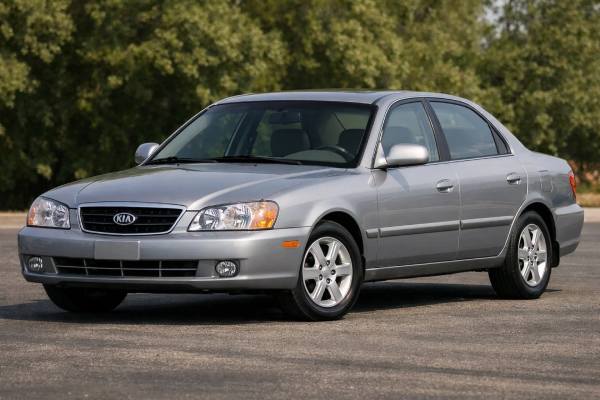
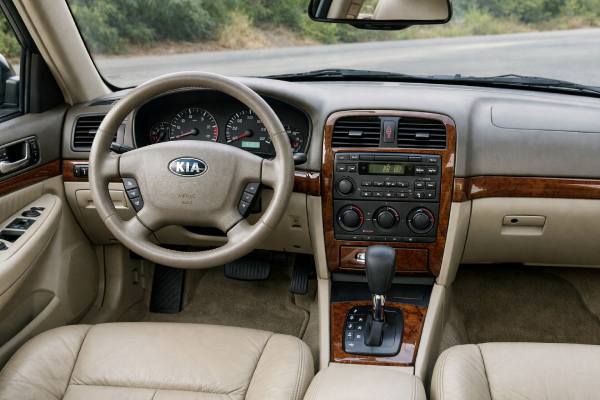
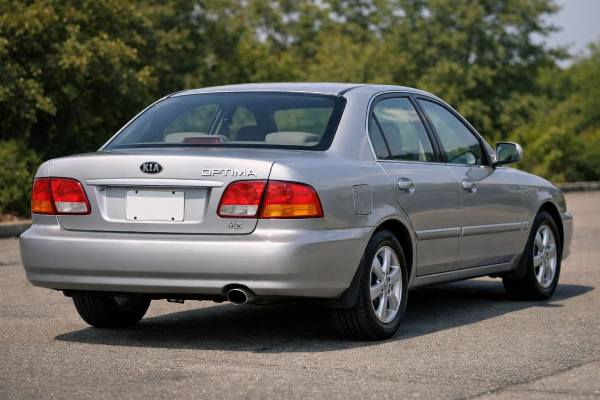
The 2001–2002 Kia Optima (MS) with the 2.4-liter inline-four is a straightforward midsize sedan built around simple, serviceable hardware. The headline is durability-by-design: a naturally aspirated, belt-timed DOHC engine, conventional front-wheel-drive layout, and parts commonality with other early-2000s Korean platforms. For owners, that usually translates into approachable maintenance and predictable operating costs—provided you stay ahead of age-related wear.
Where this Optima shows its age is also easy to understand. Corrosion protection varies by climate and previous care, and the suspension and cooling system can become “maintenance-forward” after two decades. Safety equipment and crash performance also reflect its era: basic airbags and ABS coverage, with little in the way of modern crash-avoidance tech. If you shop carefully and maintain it methodically, it can still be a comfortable, honest daily driver.
What to Know
- Comfortable ride and simple mechanical layout make it easy to live with and easy to service.
- Strong value in the used market, with widely available wear parts and familiar repair patterns.
- Watch closely for rust in the front subframe and underbody seams, especially in road-salt regions.
- Replace the timing belt on schedule (commonly around 90,000 km / 60,000 mi or by age) to avoid major engine damage.
- Plan on engine oil and filter service about every 10,000 mi (16,000 km) or 12 months for normal use; shorten for severe driving.
Navigate this guide
- Kia Optima MS overview
- Kia Optima MS 2.4 technical specs
- Kia Optima MS trims and safety kit
- Reliability and known weak points
- Maintenance plan and buying tips
- Road manners and fuel use
- Rivals and value today
Kia Optima MS overview
The MS-chassis Optima arrived as a practical midsize sedan aimed at everyday comfort rather than cutting-edge performance. In 2001–2002 form with the 2.4-liter four-cylinder, it’s best understood as a “simple and stable” commuter: roomy enough for five, tuned for a compliant ride, and mechanically conservative in a way that helps long-term ownership.
The 2.4-liter identity. The 149 hp version of the G4JS is a naturally aspirated, multi-point fuel-injected DOHC inline-four. It’s not a high-rev hero; it’s built for smoothness and predictable torque delivery, especially in normal city and highway use. With a 4-speed automatic (or a 5-speed manual in some markets), the car prioritizes relaxed cruising and reasonable fuel economy over rapid acceleration.
Where it fits today. Two decades later, this Optima tends to appeal to three kinds of buyers:
- Budget daily drivers who want a conventional sedan with low parts costs and no complex electronics.
- DIY-friendly owners who prefer engines with straightforward service access and familiar diagnostics.
- Second-car households looking for a comfortable backup vehicle.
What ages well—and what doesn’t. The core mechanical package often holds up if fluids and belts were handled on time. The bigger swing factors are climate and maintenance history. Cars from dry regions can feel impressively solid. Cars from heavy road-salt regions can hide serious corrosion underneath, especially around structural mounting points. Interior materials and trim are “period-correct”: comfortable, but not always resistant to UV fade and brittle plastics.
Ownership mindset that works. Treat the Optima MS like an older aircraft: routine inspections prevent surprises. The payoffs are real—good ride comfort, predictable repairs, and a cabin that still works well for commuting. The risks are also clear—rust and deferred maintenance can quickly erase the value advantage if you buy the wrong example.
Kia Optima MS 2.4 technical specs
Specifications can vary by market, transmission, and equipment level. The tables below focus on the 2001–2002 Optima (MS) with the 2.4-liter 149 hp engine and front-wheel drive.
Powertrain and efficiency
| Item | Specification |
|---|---|
| Engine code | G4JS |
| Layout | Inline-4 (I-4), DOHC, 16 valves (4 valves/cyl) |
| Bore × stroke | 86.5 × 100.0 mm (3.41 × 3.94 in) |
| Displacement | 2.4 L (2351 cc) |
| Induction | Naturally aspirated |
| Fuel system | Multi-point fuel injection (MPFI) |
| Compression ratio | ~10.0:1 (market-dependent) |
| Max power | 149 hp (111 kW) @ ~5500 rpm (varies slightly by calibration) |
| Max torque | ~210–215 Nm (155–159 lb-ft) @ ~4000 rpm (typical range) |
| Timing drive | Belt |
| Rated fuel economy (typical) | ~11.8–10.5 L/100 km (20–27 mpg US range depending on transmission and cycle) |
| Real-world highway @ 120 km/h (75 mph) | Often ~8.5–9.5 L/100 km (25–28 mpg US) with a healthy drivetrain and correct tire pressures |
Transmission and driveline
| Item | Specification |
|---|---|
| Transmission | 4-speed automatic (common) or 5-speed manual (market/trim dependent) |
| Drive type | FWD |
| Differential | Open |
Chassis and dimensions
| Item | Specification |
|---|---|
| Front suspension | MacPherson strut |
| Rear suspension | Multi-link / trailing-arm style (market-dependent tuning) |
| Steering | Power-assisted rack-and-pinion |
| Brakes | Front ventilated discs / rear discs or drums (depends on trim and market) |
| Common tire size | 195/65 R15 (varies with wheel package) |
| Ground clearance | ~150 mm (5.9 in) (approx.) |
| Length / width / height | ~4720 / 1815 / 1410 mm (185.8 / 71.5 / 55.5 in) |
| Wheelbase | ~2700 mm (106.3 in) |
| Turning circle (kerb-to-kerb) | ~11.0 m (36.1 ft) (approx.) |
| Curb weight | ~1370–1450 kg (3020–3197 lb) depending on equipment |
| Fuel tank | ~60 L (15.9 US gal / 13.2 UK gal) |
Performance and capability (typical ranges)
| Metric | Typical result (healthy car) |
|---|---|
| 0–100 km/h (0–62 mph) | ~10.5–11.5 s (automatic often slower) |
| Top speed | ~195–205 km/h (121–127 mph) |
| Braking (100–0 km/h) | Commonly ~40–45 m (depends heavily on tires and brake condition) |
| Towing capacity | Often not officially rated in many markets for this sedan; treat as “light duty” only |
| Payload | Varies by market; check door-jamb label for your VIN |
Fluids and service capacities (verify by VIN and manual)
Because manuals and parts catalogs differ by market, use these as planning numbers and confirm before purchase or service:
| Fluid | Typical spec (era-appropriate) | Typical capacity |
|---|---|---|
| Engine oil | API SL/SM-era equivalent; common viscosities 5W-30 or 10W-30 depending on climate | ~4.0 L (4.2 US qt) with filter |
| Coolant | Phosphate-free ethylene glycol coolant; 50/50 mix | ~7–8 L (7.4–8.5 US qt) |
| Automatic transmission | Kia/Hyundai ATF spec of the period (often SP-III family) | ~6–7 L total (varies by service method) |
| Manual transmission | GL-4 gear oil (typical) | ~2–3 L (varies) |
| A/C refrigerant | R-134a | charge varies by market sticker |
Key takeaway for specs: most “surprises” come from trim variation (rear disc vs drum, ABS availability, wheel/tire package) and from years of owner modifications. When comparing cars, read the door-jamb tire label, confirm brake hardware visually, and match the engine code on the VIN/ID plate.
Kia Optima MS trims and safety kit
For 2001–2002, trim naming varies by region, but the pattern is consistent: one or two mainstream trims with option groups for comfort and safety. When shopping today, the goal is to identify what the car actually has—not what the badge suggests.
Trims and options that matter
Common equipment differences you’ll see across markets include:
- Wheels and brakes: Base models often run 15-inch wheels with rear drums, while higher trims may add rear discs, better pads, or ABS. Rear disc conversions exist but are not always done well—inspect the parking brake operation and rear brake line routing.
- Comfort packages: Sunroof, upgraded audio, power driver seat, automatic climate control, and leather were often bundled. Verify everything functions—window regulators, blower speeds, and A/C performance are typical age-related repair items.
- Cold-climate features: Heated mirrors or seats (where offered) can be valuable because electrical repairs on older harnesses can be time-consuming.
Quick identifiers (useful in the driveway):
- Check for an ABS pump/module and ABS warning lamp behavior at key-on.
- Look at the rear brakes through the wheel: drum housings are obvious; discs show a rotor face and caliper.
- Confirm tire size and load rating on the door placard; mismatched tires can make the car feel unstable and noisy.
Safety ratings and what they mean here
This Optima sits in a transitional era: it benefits from basic airbags and improved structures versus older 1990s sedans, but it predates modern side-structure performance and advanced restraint tuning. In U.S.-market testing, IIHS results for early-2000s midsize sedans often show a wide gap between frontal and side impact performance depending on side-airbag coverage and structure. In other words, a “good enough” commuter can still score poorly in certain crash modes compared with newer cars.
Safety systems and ADAS (what’s realistically available)
- Airbags: Dual front airbags are typical; front seat-mounted side airbags may be optional on some trims/markets. Curtain airbags are generally not part of this generation’s mainstream equipment.
- ABS: Often optional. If present, confirm it self-tests correctly and that brake fluid has been changed periodically (old fluid increases corrosion risk inside the ABS unit).
- Stability control: Electronic stability control (ESC) is usually not standard in this era/segment.
- ADAS: No modern AEB, lane keeping, blind-spot monitoring, or adaptive cruise. Any “driver assistance” is limited to basic ABS and, in some cases, traction control.
Child seats: Many 2001–2002 vehicles include LATCH/ISOFIX-style lower anchors depending on market adoption timing. Physically verify anchor points and check the owner’s manual guidance for seating positions and tether use.
Practical safety advice: If you’re buying this Optima for family duty, prioritize examples with side airbags (if available), ABS, excellent tires, and fully functional seatbelts and pretensioners. Condition matters more than the badge.
Reliability and known weak points
The Optima MS 2.4 can be reliable, but it rewards owners who treat aging components proactively. Below is a practical map of issues by prevalence and cost tier. Mileage ranges are broad because age, climate, and maintenance history matter as much as odometer readings.
Common (low to medium cost)
- Valve cover gasket seepage
Symptoms: oil smell, oily residue on the engine, occasional smoke near exhaust heat.
Likely cause: hardened gasket with age.
Remedy: gasket replacement; clean PCV system to reduce crankcase pressure. - Cooling system fatigue (hoses, radiator end tanks, thermostat)
Symptoms: slow coolant loss, overheating in traffic, weak heater output.
Likely cause: plastic and rubber aging; neglected coolant changes.
Remedy: pressure test; replace suspect components as a set if history is unknown. - Accessory belt and tensioner wear
Symptoms: chirping, squeal at startup, intermittent charging noise.
Remedy: belt replacement; inspect tensioner and idlers. - Suspension consumables (sway links, control arm bushings, strut mounts)
Symptoms: clunks over bumps, wandering steering, uneven tire wear.
Remedy: replace worn links/bushings; align after suspension work.
Occasional (medium cost)
- Ignition and sensor issues (crank/cam sensors, coils, plug wires depending on setup)
Symptoms: intermittent stalling, hard starts, misfire under load, check-engine light.
Remedy: scan for codes, confirm with live data; use quality sensors to avoid repeat failures. - Automatic transmission shift quality degradation
Symptoms: delayed engagement, flare between gears, harsh shifts when hot.
Likely cause: old ATF, varnish, solenoid wear.
Remedy: correct-spec fluid service; diagnose before condemning the unit. - A/C performance drop
Symptoms: warm air at idle, cycling, oily residue at fittings.
Remedy: leak test; repair correctly rather than repeated “top-offs.”
Rare but high impact (high cost)
- Timing belt overdue or improperly serviced
Symptoms: belt noise, rough running, or sudden no-start.
Risk: belt failure can cause major engine damage on many DOHC designs of this era.
Remedy: replace belt on schedule; include tensioner/idlers and typically the water pump. - Structural corrosion (high severity in salt regions)
Symptoms: visible scaling on the front subframe, poor alignment stability, steering pull, unusual tire wear.
Root cause: long-term salt exposure and trapped moisture.
Remedy: inspect on a lift; address recalls/service actions; avoid severely corroded cars.
Recalls, service actions, and how to verify
This generation has had safety-related campaigns in some markets, including corrosion-related subframe concerns in road-salt regions. Your verification checklist should be:
- Run a VIN lookup through NHTSA (for U.S.-market cars) and confirm completion status.
- Ask the seller for dealer repair orders showing recall work done.
- Inspect the underbody anyway—recall completion doesn’t guarantee the car was kept clean afterward.
Pre-purchase checks to request: compression or leak-down test if the engine feels weak, a scan for stored codes, proof of timing belt service, and a full underbody inspection (subframe, brake lines, fuel lines, and pinch welds).
Maintenance plan and buying tips
A good maintenance plan for an older Optima MS is less about “following the book perfectly” and more about controlling known risks: lubrication, cooling, timing belt service, and corrosion.
Practical maintenance schedule (distance and time)
Use the shorter interval if the car sees short trips, heavy city use, extreme heat/cold, or long idle time.
| Item | Normal use | Severe use / unknown history |
|---|---|---|
| Engine oil + filter | ~10,000 mi (16,000 km) or 12 months | 5,000–7,500 mi (8,000–12,000 km) or 6 months |
| Engine air filter | 15,000–20,000 mi (24,000–32,000 km) | 10,000–15,000 mi (16,000–24,000 km) |
| Cabin air filter (if fitted) | 12 months | 6–12 months |
| Coolant | Every 3–5 years | If unknown, service now; then 3 years |
| Spark plugs | ~60,000 mi (96,000 km) (typical for standard plugs) | Inspect now; replace if wear is unknown |
| Brake fluid | Every 2 years | Every 2 years |
| Brake pads/rotors | Inspect every 10,000 mi (16,000 km) | Inspect every 5,000–7,500 mi |
| ATF (automatic) | 30,000–60,000 mi (48,000–96,000 km) depending on use | Service now; then 30,000 mi (48,000 km) |
| Manual gear oil | 60,000–100,000 mi (96,000–160,000 km) | Service now; then 60,000 mi |
| Timing belt system | Commonly ~60,000 mi (96,000 km) / 90,000 km or by age | If unknown: do it immediately |
| Accessory belt(s) | Inspect every oil change | Replace if cracking/noise |
| Alignment + tire rotation | Rotate 5,000–7,500 mi (8,000–12,000 km) | Same + alignment check annually |
| 12 V battery test | Annually | Replace proactively at ~4–6 years old |
Fluids, parts quality, and “do it once” strategy
- Use the correct ATF specification. These transmissions can shift poorly on the wrong fluid. If you’re unsure, confirm by VIN/label or a service manual for your market.
- Timing belt service should be complete. A belt-only job is false economy. Plan for belt, tensioner, idlers, and usually the water pump (since labor overlaps).
- Cooling system refresh pays off. Replacing the thermostat, radiator cap, and tired hoses together can prevent overheating events that shorten engine life.
Essential torque values (planning numbers—verify for your VIN)
- Wheel lug nuts: ~90–110 Nm (66–81 lb-ft)
- Engine oil drain plug: ~30–40 Nm (22–30 lb-ft)
- Spark plugs (typical): ~20–25 Nm (15–18 lb-ft)
Buyer’s guide: what to inspect and what it costs later
Must-check areas (high leverage):
- Front subframe and suspension mounting points: look for scaling, perforation, or fresh undercoating hiding damage.
- Timing belt proof: invoice with date and mileage. If absent, budget for immediate service.
- Cooling system health: stable temperature in traffic, no coolant smell, clean overflow tank.
- Transmission behavior: consistent shifts hot and cold; no flare or harsh slam.
- Electrical basics: windows, locks, blower speeds, and A/C—small failures add up.
Best ownership profile: a car from a low-rust region with documented belt service and steady fluid maintenance.
Durability outlook: with corrosion controlled and timing/cooling kept current, 200,000+ miles (320,000+ km) is achievable; without those, the car can become uneconomical quickly.
Road manners and fuel use
The Optima MS 2.4 is tuned for calm, predictable driving. In modern traffic it won’t feel quick, but it can feel “right-sized” for commuting if the chassis is tight and the powertrain is healthy.
Ride, handling, and NVH
- Ride comfort: The suspension generally favors a soft initial response that takes the edge off broken pavement. When the original dampers age, the car can become floaty over highway undulations—fresh struts restore control more than many owners expect.
- Handling balance: Front-wheel drive and conservative alignment give safe, mild understeer. With good tires and a healthy rear suspension, it tracks confidently, but it’s not a car that encourages aggressive corner entry.
- Steering feel: Light to moderate steering effort with limited road texture feedback. If the wheel feels vague, suspect worn tie-rod ends, control arm bushings, or alignment rather than “just old-car feel.”
- Cabin noise: Wind and tire noise are typical for the era. Fresh door seals and correct tire selection (touring tires over loud budget compounds) can noticeably improve highway refinement.
Powertrain character
- Throttle response: Linear and easy to modulate. The engine feels strongest in the midrange rather than at the top end.
- Automatic behavior (4-speed): Smooth when healthy, but wide gear spacing can cause kickdown hesitations on hills or during passing. If it hunts between gears, check fluid condition and consider that modern traffic speeds can expose marginal shift control.
- Manual behavior (5-speed): Usually more responsive and efficient, but clutch wear and shifter bushing play are common age issues.
Real-world efficiency
Fuel economy depends heavily on transmission type, tire choice, and maintenance. A well-sorted car with correct tire pressures, clean plugs, and a healthy thermostat typically returns:
- City: roughly 11–13 L/100 km (18–21 mpg US)
- Highway (100–120 km/h / 60–75 mph): roughly 8.5–10 L/100 km (24–28 mpg US)
- Mixed: roughly 10–11.5 L/100 km (20–23 mpg US)
Cold weather can raise consumption notably due to longer warm-up times and higher rolling resistance in winter tires.
Key performance metrics that matter
In daily use, the most relevant metric isn’t 0–100 km/h—it’s passing response. Expect the car to be adequate rather than eager at highway speeds, especially with the automatic. The practical solution is to keep the engine in its stronger midrange (downshift early, avoid lugging) and prioritize maintenance that preserves output: clean air filter, correct plugs, no vacuum leaks, and healthy catalytic converter/backpressure.
Rivals and value today
In the early-2000s midsize segment, the Optima MS competed against heavy hitters. Today, that context helps you decide whether it’s a smart buy or simply the cheapest option on the lot.
Where the 2001–2002 Optima 2.4 wins
- Value per dollar: Purchase prices often undercut Japanese rivals of the same year, leaving budget room for catch-up maintenance.
- Mechanical simplicity: No turbocharging, no high-voltage systems, and limited networked electronics—good for DIY ownership.
- Comfort-first tuning: The ride is often more forgiving than sport-oriented alternatives, especially on rough urban roads.
- Parts availability: Wear items (brakes, filters, belts, suspension components) are widely available and typically affordable.
Where key rivals can be stronger
- Long-term corrosion resistance: Many buyers find that a well-kept Camry or Accord from the same era resists structural rust better in harsh climates, though local history matters most.
- Crash protection evolution: Some competitors gained side-curtain airbags and stronger side structures earlier, and newer model years quickly outpace this Optima.
- Powertrain refinement: The best rivals often deliver smoother automatics, quieter cabins, and slightly better highway passing response.
A realistic comparison snapshot
- Versus Toyota Camry (XV20) and Honda Accord (6th gen): Often better resale, strong durability reputation, and broad service knowledge. The Optima counters with lower buy-in cost and simpler “fix what’s worn” ownership.
- Versus Nissan Altima (L30): Similar value logic, sometimes more responsive to drive. The Optima may feel more comfort-oriented.
- Versus Volkswagen Passat (B5.5): Passat offers a more European cabin/ride feel but can carry higher repair complexity and cost depending on engine/transmission.
- Versus Mazda 626 (GF): Similar era and mission; condition determines the winner.
Who should choose this Optima now?
Pick the Optima MS 2.4 if you can inspect thoroughly, you value a comfortable ride, and you’re willing to maintain an older car proactively—especially timing belt and rust prevention. Skip it if you need modern crash-avoidance features, live in a heavy-salt area without access to a clean-bodied example, or want a car that feels quick in modern freeway traffic.
The best strategy is simple: buy the cleanest, best-documented car you can, then spend your money on preventive maintenance rather than on chasing problems after they appear.
References
- 2001 Kia Optima 2026 (Safety Rating)
- Gas Mileage of 2001 Kia Optima 2026 (Fuel Economy Database)
- Safety Recall Notice 2009 (Recall Notice)
- 7.2 Kia Service Intervals.xlsx 2025 (Service Intervals)
- Car Safety Ratings | Vehicles, Car Seats, Tires 2026 (Safety Rating Program)
Disclaimer
This article is for informational purposes only and is not a substitute for professional diagnosis, inspection, or repair. Specifications, torque values, service intervals, and procedures can vary by VIN, market, and installed equipment, so always verify details using your official owner’s manual, factory service information, and vehicle labeling before performing work.
If this guide helped, please consider sharing it on Facebook or X (Twitter) to support our work.