
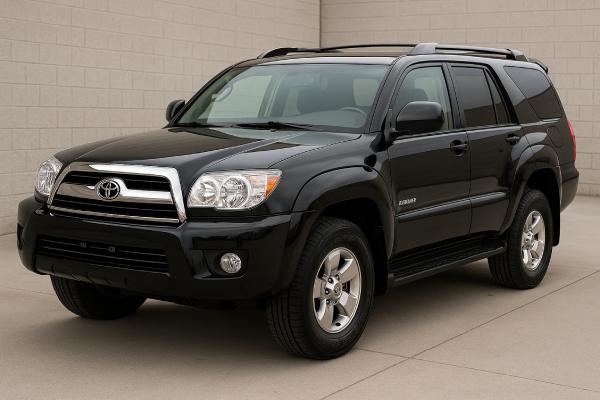
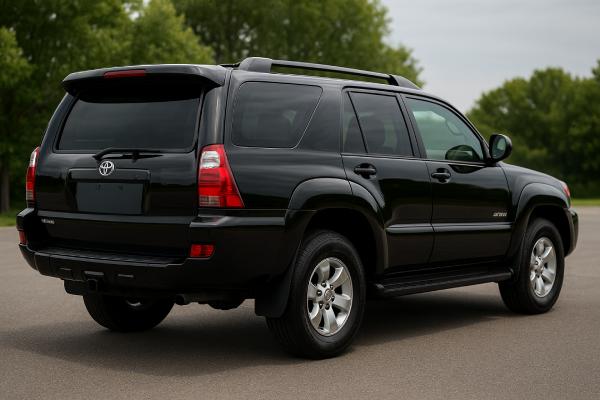
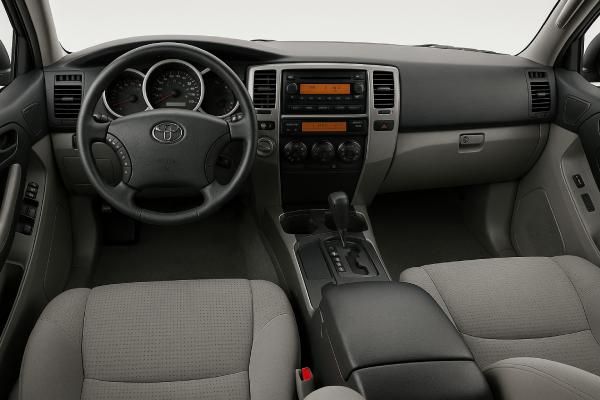
The 2006–2009 facelifted Toyota 4Runner 2WD (chassis GRN210 with the 1GR-FE 4.0-liter V6) is a midsize, body-on-frame SUV that sits between the Highlander (unibody) and the Sequoia (full-size). It is the later phase of the fourth generation (N210) and was sold widely in the United States and Canada. This article focuses on the rear-wheel-drive V6 model rated at 236 hp in these years, noted for its ladder frame, honest towing manners, and long-life powertrain. Owners value its durability, simple mechanicals, and high resale, while accepting that efficiency and infotainment are dated. We cover what shoppers and owners most often ask: exact specifications, real-world performance, common issues and service actions, maintenance pointers, safety ratings, and how it stacks up against rivals.
At a Glance
- Proven 1GR-FE V6 with timing chain, robust 5-speed automatic, ladder-frame chassis; 5,000 lb (2,268 kg) tow rating when properly equipped.
- Simple, reliable 2WD driveline with fewer wear points than 4×4; lower running costs in fair-weather regions.
- Spacious cargo hold (42.2 cu ft seats up; ~75 cu ft seats down) and practical roll-down rear glass.
- Watch for frame and underbody corrosion on older northern trucks; verify floor-mat recall completion.
- Typical maintenance rhythm: engine oil and filter every 5,000–7,500 miles (8–12 months), tire rotation at the same interval.
Navigate this guide
- Detailed overview
- Specifications and technical data
- Trims, options, safety and ADAS
- Reliability, issues and service actions
- Maintenance and buyer’s guide
- Driving and performance
- How 4Runner compares to rivals
Detailed overview
The facelifted 2006–2009 4Runner 2WD (GRN210) pairs Toyota’s 4.0-liter 1GR-FE V6 with a 5-speed automatic (A750E) and a conventional rear-wheel-drive layout. The body-on-frame construction gives it real truck capability and a calm, unflustered feel over broken pavement when loaded or towing. Compared with unibody crossovers, it trades some ride sophistication and fuel economy for durability, serviceability, and a linear, predictable feel on the highway.
The 2006 refresh brought updated styling, chassis tuning changes, and—most importantly for safety—structural improvements that helped side-impact performance, followed by side-curtain airbags becoming standard by 2008. The V6 uses port fuel injection, aluminum block/heads, and a timing chain (no scheduled replacement), producing 236 hp (176 kW) and 266 lb-ft (361 Nm). In 2WD form, curb weight is roughly 4,050–4,350 lb depending on trim and options. Tow rating is 5,000 lb (2,268 kg) with the factory Class III receiver and 7-pin wiring. Owners frequently cite the roll-down rear window, excellent outward visibility, and simple, intuitive cabin controls as everyday wins.
Where it shows age: fuel economy (EPA label 16/21/18 mpg city/highway/combined for 2009 V6 2WD), limited driver-assist tech by modern standards, and a truck-like turning circle compared with newer crossovers. Still, for buyers who prioritize mechanical toughness, ease of long-term ownership, and strong residuals, the 4Runner 2WD of this era remains a smart, low-drama choice—especially in dry climates where frame corrosion is minimal.
Specifications and technical data
Engine and performance
- Code / Type: 1GR-FE, 4.0-liter DOHC 24-valve V6, aluminum block/heads, VVT-i (intake).
- Displacement: 3,956 cc (4.0 L).
- Rated output: 236 hp (176 kW) @ ~5,200 rpm.
- Rated torque: 361 Nm (266 lb-ft) @ ~4,000 rpm.
- Induction / fueling: Natural aspiration / port fuel injection.
- Compression ratio: ~10.0:1.
- Timing drive: Chain (no routine replacement; inspect by symptom).
- Fuel type: Regular unleaded (87 AKI).
- Fuel economy (2009 2WD V6): 16/21/18 mpg (city/hwy/combined) · 14.7/11.2/13.1 L/100 km (approx).
Transmission and driveline
- Gearbox: A750E 5-speed automatic with lock-up torque converter and overdrive.
- Drive: Rear-wheel drive (2WD) with automatic limited-slip functionality from stability/traction control.
- Final drive ratio: Typical 3.73–3.91 (varies by year/trim; confirm by axle code).
- Towing: 5,000 lb (2,268 kg) with factory receiver and 7-pin harness; Class III rating; tongue load 500 lb (227 kg) typical.
Chassis and dimensions
- Construction: Ladder frame with welded body.
- Suspension: Front independent double-wishbone with coil springs; rear 4-link solid axle with coil springs. Sport/X-REAS cross-linked shock system optional on some trims; Limited may have rear air springs (Self-Leveling Air Suspension) on some packages.
- Steering: Rack-and-pinion with variable assist.
- Brakes: 4-wheel discs; ABS with EBD and Brake Assist.
- Wheels/Tyres: 17–18 in wheel packages; common sizes P265/65R17 or P265/60R18.
- Dimensions (typical V6 2WD):
- Length: 4,805 mm (189.2 in)
- Width: 1,910 mm (75.2 in)
- Height: ~1,800 mm (70.9–71.1 in depending on rack)
- Wheelbase: 2,790 mm (109.8–109.9 in)
- Track (F/R): 1,575/1,575 mm (62.0/62.0 in)
- Ground clearance: ~230 mm (9.0–9.1 in)
- Turning circle: ~11.7 m (38.0 ft)
- Weights and capacities:
- Curb weight (V6 2WD): ~1,950–1,975 kg (4,300–4,355 lb) depending on equipment.
- GVWR (typical): ~2,530 kg (5,580 lb).
- Payload: ~499–494 kg (1,100–1,090 lb) package-dependent.
- Fuel tank: 87 L (19.0 gal).
- Cargo volume: 1.20 m³ (42.2 cu ft) behind 2nd row; 2.13 m³ (75.1 cu ft) seats folded.
Fluids and capacities (typical)
- Engine oil: ~5.2–5.5 L (5.5–5.8 qt) with filter; 5W-30 meeting API/ILSAC spec for these years.
- Coolant: Toyota Super Long Life (pink), extended-life ethylene glycol; capacity varies with options (~9–10 L).
- Automatic transmission: Toyota WS ATF (A750E), service by condition/interval basis.
- Differential (rear): 75W-90 GL-5 gear oil; ~2.6–3.0 L depending on axle housing.
- Power steering: ATF per manual for this era.
- Brake fluid: DOT 3 (some owners upgrade to DOT 4; follow manual spec).
- Essential torque highlights (verify by VIN before service):
- Wheel lugs: ~113 Nm (83 lb-ft).
- Engine oil drain plug: ~39–43 Nm (29–32 lb-ft).
- Differential fill/drain: ~49–64 Nm (36–47 lb-ft).
Performance and economy
- 0–60 mph (manufacturer-independent estimates for V6 2WD): ~7.8–8.4 s.
- Top speed (governed): ~110–115 mph.
- Real-world fuel economy (mixed): ~16–19 mpg US (14.7–12.4 L/100 km) depending on load/tires.
- Towing, stability, and temperature management: Adequate with factory cooler; plan 20–35% fuel-use penalty when towing a ~3,500 lb travel trailer at highway speeds.
Trims, options, safety and ADAS
Trims and key equipment (V6 2WD focus, 2006–2009)
- SR5: Cloth seats, 17-in wheels, VSC/TRAC, power rear glass, basic audio, optional Sport/X-REAS package.
- Sport Edition: Hood scoop, X-REAS shocks, sport trim, upgraded brakes on some years, 17-in alloys, steering-wheel audio controls; often the best handling feel of the lineup.
- Limited: Leather, dual-zone climate, 18-in wheels, JBL audio options, available rear air suspension (self-leveling) on some packages, integrated garage door opener; typically heavier curb weight.
Mechanical/functional options (vary by year)
- X-REAS cross-linked dampers (firmer body control on undulating roads).
- Rear height-control air suspension (Limited) to maintain stance when loaded.
- 3rd-row seating was rare on 2WD; most 2WD V6 examples are 5-passenger.
Quick identifiers
- Sport Edition: hood scoop and graphite accents.
- Limited: chrome grille/handles, 18-in wheels, leather interior with wood-tone trim.
- Axle/trans codes on the driver-door jamb label; 2WD V6 typically shows A750E transmission.
Year-to-year notes (facelift window)
- 2006: Refresh styling; structural updates improved side impact performance.
- 2008: Side-curtain airbags standard; tire pressure monitoring system present by this era.
- 2009: Final year of the generation; equipment rationalization ahead of 2010 redesign.
Safety ratings (representative)
- IIHS results for this generation show Good in moderate overlap front and side tests for properly equipped later models; head restraints & seats often rated Poor due to geometry and dynamic test outcomes typical of the era.
- Front/side/curtain airbags were available earlier and became standard by 2008, improving side ratings consistency.
Safety systems and child-seat provisions
- Front, side-torso, and roll-sensing side-curtain airbags (by 2008 standard).
- LATCH anchors in the outboard second-row positions; top tethers for child seats.
- Stability control (VSC) and traction control (TRAC) standard; ABS with EBD and Brake Assist.
- No factory AEB/lane-keeping/adaptive cruise; head unit lacks modern ADAS camera integration—keep expectations era-appropriate.
- Calibration after service: If the steering angle sensor or yaw rate sensor is disturbed (column/wheel alignment work), zero-point calibration for VSC may be required using scan-tool procedures.
Reliability, issues and service actions
Overall outlook: The 1GR-FE/A750E/ladder-frame combination is widely regarded as long-lived with routine maintenance. The 2WD variant removes front-diff/transfer-case wear points, slightly reducing lifetime service costs. Most failures are age- and environment-related.
Common to occasional issues (by prevalence and cost)
- Floor-mat accelerator interference (recall campaigns)
Symptom: Throttle may not return if an unsecured or incompatible mat traps the pedal.
Remedy: Recall remedy includes pedal modification and floor-mat updates; verify completion and use only correct, secured mats. - Frame and underbody corrosion (cold/salty regions)
Symptom: Scaling rust on frame rails, crossmembers, rear lower control arm brackets.
Remedy: Thorough inspection with pick/hammer test; budget for cleaning, rust conversion, and coating; severe cases can be a walk-away. - Rear hatch glass and regulator wear
Symptom: Slow or uneven roll-down; inoperative defogger or wiper interlock.
Root cause: Aged regulator, guides, or wiring at door jamb.
Fix: Regulator/motor replacement; verify harness continuity at flex points. - X-REAS damper seep/leak (if equipped)
Symptom: Uneven damping, front-to-rear heave, visible oily residue at cross-links.
Fix: Replace dampers (often as an axle pair); many owners convert to conventional shocks/struts to reduce cost and complexity. - Rear air springs (if equipped on Limited)
Symptom: Sagging tail, compressor cycling, height sensor faults.
Fix: Replace air bags or height sensors; conversion kits to coils are common if failure repeats. - Front lower control arm bushings/ball joints
Symptom: Clunks over sharp bumps, looseness on braking/turn-in, inside-edge tire wear.
Fix: Control arm bushings/ball joints; align to factory caster for straight-line stability. - Accessory drive noise (idlers/tensioner/serpentine belt)
Symptom: Chirp or squeal on cold start or with A/C load.
Fix: Belt and pulley/tensioner replacement; inspect water pump for seep. - Evap/charcoal canister and purge valves
Symptom: EVAP codes, fuel-filling shutoff sensitivity.
Fix: Diagnose for cracked canister or sticky purge; renew hoses/valves as needed. - Sunroof drains (if equipped)
Symptom: Wet headliner/footwells after heavy rain.
Fix: Clean drains; inspect cassette seals.
Powertrain specifics (1GR-FE)
- Timing chain system: No scheduled replacement. Investigate rattle on hot restarts or cam/crank correlation codes; chain/guides/tensioner service only by symptom.
- Cooling and thermostat: Age-related plastic fittings and radiator tanks can seep; replace radiator/hoses preventively around 12–15 years if in harsh climates.
- Oil consumption: Generally low on 1GR-FE; sustained high-rpm towing or neglected oil changes can elevate usage—monitor at every fill.
- Intake carbon: Port-injected design minimizes DI-type deposits; throttle body cleaning may smooth idle after many years.
Driveline and chassis
- A750E characteristics: Durable, prefers clean WS ATF. Watch for harsh 2–3 shift on cold mornings—often improved with fluid exchange and adaptation reset.
- Rear axle seals: Inspect for wetness at backing plates; address promptly to protect rear brakes.
- Wheel bearings: Long life; hum on sweepers indicates beginning wear—replace as assemblies.
Recalls, TSBs, extended coverage (high-level)
- Accelerator pedal/floor-mat interference campaigns (multi-year actions): Confirm completion via official VIN lookup.
- Dealer communications about safety recall renotification: Ensure any open campaigns are closed in service records before purchase.
Pre-purchase requests
- Full service history (oil/filters, coolant, ATF, diff oil, brake fluid).
- Proof of recall completion (VIN screenshot/printout).
- Underside photos on a lift, including frame rails and control arm mounts.
- Recent alignment sheet and tire date codes.
- Evidence of timing-chain or cooling-system work if mileage is high (over 200k miles) or symptoms present.
Maintenance and buyer’s guide
Practical maintenance schedule (distance/time)
- Engine oil & filter: Every 5,000–7,500 miles (8–12 months). Severe use (towing, short trips, dusty roads): 5,000 miles.
- Engine air filter: Inspect each oil change; replace ~30,000 miles (48 months) or sooner in dust.
- Cabin filter: 15,000–20,000 miles (24–32 months).
- Coolant (SLLC pink): First change ~100,000 miles (10 years) then every 50,000 miles (5 years) typical for Toyota SLLC; inspect annually.
- Spark plugs (iridium): 90,000–120,000 miles (9–12 years).
- Fuel filter: Integral with pump (no routine service); diagnose by symptom/pressure.
- Serpentine belt: Inspect each oil change; expect 60,000–100,000 miles by climate; replace on cracks/glazing/noise.
- Automatic transmission (WS ATF): “Lifetime” in period literature; for longevity, refresh 60,000–90,000 miles (96–145k km) with gentle drain-and-fills.
- Rear differential: 30,000–60,000 miles depending on towing/dust; 75W-90 GL-5.
- Brake fluid: Replace every 2–3 years; test strip moisture check annually.
- Brake pads/rotors: Inspect each service; rust-lip and inner pad wear can be hidden—remove wheels.
- Suspension/alignment: Rotate tires every oil change; align annually or with any tire/suspension work.
- PCV valve & throttle body: Inspect/clean ~60,000 miles.
- 12-V battery: Load test yearly after year 4; replace proactively at 5–7 years.
- Timing chain: No fixed interval—monitor for noise/correlation faults; address only by symptom.
Fluid specs (baseline)
- Engine oil: API SN or later, 5W-30.
- ATF: Toyota WS.
- Coolant: Toyota Super Long Life (pink).
- Differential: GL-5 75W-90.
- Power steering: ATF per manual spec.
- Brake fluid: DOT 3.
Buyers’ checklist
- Corrosion: Frame, rear lower control arm mounts, front crossmember, body mounts; check spare-tire hoist and bumper supports.
- Suspension: X-REAS leaks (if fitted), rear air suspension self-test (Limited), front lower control arm bushings, sway-bar links.
- Driveline: Seepage at axle seals; smooth 1–2–3 shifts cold; no clunk when shifting into Drive.
- Cooling: Radiator end-tank staining; heater T-fittings; water pump weep hole.
- Electrical: Rear window glass operation; tailgate harness; TPMS sensors age out (~8–12 years).
- Interior: Sunroof drains; seat track play; cracked dash is less common here than on some contemporaries but inspect.
- Tires & alignment: Uneven wear hints at worn bushings or prior curb hits.
- Recalls: Print VIN report; confirm floor-mat/pedal campaign completion.
Best bets
- Dry-climate trucks with documented fluid services and no frame rust.
- SR5 or Sport without rear air suspension if you value long-term simplicity.
- Limited with documented rear-air repairs if you prefer its comfort—budget for eventual air-bag refresh or coil conversion.
Long-term durability outlook
- With routine fluids and rust prevention, 300k-mile outcomes are common. The 2WD layout reduces front-end wear and parts count. Biggest life-cycle risk factor is severe corrosion; prioritize clean frames over low odometer alone.
Driving and performance
Ride and NVH: The 4Runner’s frame and long-travel suspension yield a settled, almost “heavy” composure over expansion joints and gravel. Unloaded, it can feel busy on sharp, choppy surfaces; add passengers or cargo and it smooths out. X-REAS-equipped trucks keep body motions flatter in high-speed sweepers and over whoops but transmit more small impacts.
Steering and handling: Steering effort is light-to-medium with reasonable on-center stability. Expect some body roll relative to crossovers; Michelin/Continental highway all-terrains in stock sizes work well for everyday grip and braking consistency. The turning circle is larger than car-based SUVs—plan parking maneuvers.
Powertrain character: The 1GR-FE makes its best work in the midrange; throttle response is clean and linear with minimal lag. The A750E shifts are prompt and unobtrusive, downshifting willingly for climbs and passing. Kickdown behavior is predictable; avoid oversized tires if you want to preserve crisp response and reasonable economy.
Braking: Pedal feel is firm with short travel. Heat capacity is fine for daily driving and light towing; fresh DOT 3 fluid and quality pads keep performance consistent on mountain descents.
Real-world efficiency: Mixed suburban use typically returns 16–18 mpg US (14.7–13.1 L/100 km). Highway cruising at 70–75 mph can reach 19–21 mpg with stock tires and alignment. Winter blends, roof racks, and A/T tires each trim 1–2 mpg. Towing a 3,000–4,000 lb camper usually imposes a 20–35% consumption penalty.
Load and towing: The frame, rear coils, and factory hitch produce a planted, confidence-inspiring tow experience at moderate loads. Add a friction sway control if your trailer has a blunt profile. Watch transmission temps on long summer grades; the factory cooler is adequate for the rated 5,000 lb so long as you keep speed and gear selection sensible.
How 4Runner compares to rivals
- Honda Pilot (2006–2009, unibody, FWD/AWD): More efficient, more car-like ride and packaging; less towing confidence and off-pavement durability. If you never tow and value third-row space, the Pilot is easier to live with in town; the 4Runner is tougher and simpler to service long-term.
- Nissan Pathfinder (R51, 2005–2012, body-on-frame): Similar ladder-frame capability, available V8 later, but more variable reliability and rust concerns in salty climates. 4Runner holds value better and has a cleaner service record for transmissions and timing components.
- Ford Explorer (2006–2010, body-on-frame): Competitive tow ratings; V8 is stronger but thirstier. 4Runner’s V6 is smoother and typically more reliable with fewer high-mileage transmission complaints.
- Toyota Highlander (2008–2010, unibody): Same showroom alternative if you don’t need frame-based towing. Highlander rides quieter and uses less fuel but lacks the 4Runner’s ladder-frame robustness and simple rear-drive hardware.
If your use case is 80% commuting and 20% trails or towing, the 4Runner is a durable long-term asset. If it’s 95% city errands and you never tow, a unibody crossover may be cheaper to run.
References
- Gas Mileage of 2009 Toyota 4Runner 2009 (EPA/DOE FuelEconomy.gov)
- 2009 Toyota 4Runner 2009 (Safety Rating)
- 2009_4Runner_Eng_V4_LR.indd 2009 (Specifications)
- Scheduled Maintenance Guide 2009 (Scheduled Maintenance)
- Look up Safety Recalls & Service Campaigns by VIN 2025 (Recall Database)
Disclaimer
This guide is for informational purposes only and is not a substitute for professional diagnosis or repair. Specifications, torque values, service intervals, and procedures vary by VIN, market, and equipment level. Always confirm parts, fluids, and procedures in your vehicle’s official Toyota service documentation and perform safety-critical work to manufacturer standards.
If this article helped, consider sharing it with fellow owners on Facebook or X/Twitter—thanks for supporting high-quality, people-first car guides.