
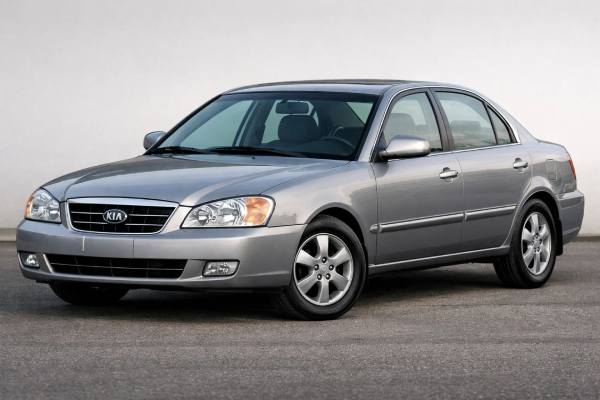


The 2002 Kia Magentis (MS) with the 2.0-liter G4JP is the “balanced” powertrain in this generation: enough output to keep pace with modern traffic, without the extra packaging and fuel use of the V6 variants. Under the hood, the G4JP is a naturally aspirated inline-four with a timing belt and multi-port fuel injection—old-school in a good way, because diagnosis and parts sourcing are generally straightforward for a 2000s-era family sedan.
What matters most with a one-year focus like 2002 is condition. At this age, the ownership experience is decided less by brochure specs and more by cooling-system health, corrosion (especially the front subframe area in salt climates), and transmission behavior when fully warmed. Buy a well-maintained example and it can still deliver quiet, comfortable commuting. Buy one with unknown timing-belt history or a tired cooling system and the “cheap” purchase price can vanish quickly.
Owner Snapshot
- The G4JP 2.0 is simple to service and usually parts-friendly, which helps keep running costs predictable.
- Comfort-first ride quality suits rough roads and daily commuting when suspension bushings and dampers are fresh.
- Timing-belt history is essential—budget for a full belt kit and water pump if paperwork is missing.
- Inspect underbody and front subframe carefully in road-salt regions; structure condition matters more than mileage.
- Plan oil and filter service about every 10,000 mi (16,000 km) or 12 months for normal use; shorten for frequent short trips.
Section overview
- Kia Magentis MS 2.0 profile
- Kia Magentis MS G4JP specs
- Kia Magentis MS equipment and safety
- Known problems and campaigns
- Upkeep plan and purchase tips
- On-road behavior and economy
- Alternatives worth cross-shopping
Kia Magentis MS 2.0 profile
The 2002 Magentis MS is best understood as a traditional midsize sedan engineered around comfort and practicality. It prioritizes stable highway manners, easy daily use, and serviceable mechanicals rather than sharp “sport sedan” responses. In this trim, the 2.0-liter G4JP sits at the center of that mission: it’s a naturally aspirated four-cylinder with straightforward fueling and a conventional timing-belt valvetrain, paired with front-wheel drive and a period-correct manual or 4-speed automatic (market dependent).
What the G4JP does well. The engine’s advantage is consistency. Power delivery is linear, throttle response is predictable, and there’s no turbo hardware to add heat and complexity in an older engine bay. For most owners, that means fewer special-case repairs and easier troubleshooting when age-related issues show up. The G4JP also tends to tolerate mixed driving—stop-and-go plus highway—so long as the cooling system and ignition parts are kept in good condition.
Where ownership costs actually come from. At 20+ years old, the “cost drivers” are rarely exciting:
- Timing-belt service history (belt, tensioner, idlers, and often the water pump as a set).
- Cooling-system margin (radiator condition, thermostat behavior, hoses, and fan operation).
- Underbody structure (subframe and suspension mounting points, especially if the car has lived in road salt).
- Transmission behavior when hot (shift timing, engagement quality, and fluid condition).
How the chassis ages. The Magentis rides best when its rubber parts are still doing their job. Old strut mounts, sway links, and control arm bushings can make the car feel loose or noisy, even if the engine runs perfectly. The good news is that a suspension refresh often “returns” the car to its intended character—quiet, composed, and easy to place on the road.
Who this car fits today. The 2002 Magentis MS 2.0 makes sense for buyers who want an affordable sedan that can be maintained with routine preventive work, and who are willing to inspect carefully before purchase. It is less ideal if you want modern crash-avoidance technology, high-efficiency gearing, or the low-noise refinement of newer platforms. Treated as a well-kept older car—not a bargain miracle—it can still be a dependable commuter.
Kia Magentis MS G4JP specs
The tables below focus on the 2002 Magentis (MS) with the G4JP 2.0-liter engine. Exact values can vary by market, transmission, and trim level, so use these as a planning baseline and confirm with your vehicle’s labels and documentation.
Powertrain and efficiency
| Item | Specification |
|---|---|
| Code | G4JP |
| Engine layout and cylinders | Inline-4 (4 cyl), DOHC, 16 valves (4 valves/cyl) |
| Bore × stroke | 85.0 × 88.0 mm (3.35 × 3.46 in) |
| Displacement | 2.0 L (1997 cc) |
| Induction | Naturally aspirated |
| Fuel system | Multi-port fuel injection (MPFI) |
| Compression ratio | ~10.0:1 |
| Max power | 136 hp (100 kW) @ ~6000 rpm |
| Max torque | ~180 Nm (133 lb-ft) @ ~4500 rpm |
| Timing drive | Belt |
| Rated efficiency (typical) | ~8.5–9.8 L/100 km (24–28 mpg US / 29–33 mpg UK) depending on transmission and cycle |
| Real-world highway @ 120 km/h (75 mph) | Often ~7.8–9.0 L/100 km (26–30 mpg US) with healthy tires and alignment |
Transmission and driveline
| Item | Typical specification |
|---|---|
| Transmission | 5-speed manual or 4-speed automatic (market dependent) |
| Drive type | FWD |
| Differential | Open |
Chassis and dimensions
| Item | Typical specification (varies by market/trim) |
|---|---|
| Suspension (front / rear) | MacPherson strut / multi-link or trailing-arm style rear layout |
| Steering | Power-assisted rack-and-pinion |
| Brakes | Front ventilated discs; rear discs or drums by trim/market |
| Wheels and tires (popular) | 195/65 R15 (common); verify placard for your trim |
| Ground clearance | ~145–155 mm (5.7–6.1 in) (approx.) |
| Length / width / height | ~4730 / 1820 / 1410–1420 mm (186.2 / 71.7 / 55.5–55.9 in) |
| Wheelbase | ~2700 mm (106.3 in) |
| Turning circle | ~11.0 m (36.1 ft) (approx.) |
| Curb weight | ~1400–1500 kg (3086–3307 lb) depending on transmission/equipment |
| GVWR | ~1950–2000 kg (4299–4409 lb) (market dependent) |
| Fuel tank | ~60 L (15.9 US gal / 13.2 UK gal) |
| Cargo volume | ~450–500 L (15.9–17.7 ft³) seats up (method varies) |
Performance and capability (typical ranges)
| Metric | Typical result (healthy car) |
|---|---|
| 0–100 km/h (0–62 mph) | ~10.5–12.0 s (auto often slower) |
| Top speed | ~195–205 km/h (121–127 mph) |
| Braking distance (100–0 km/h) | Often ~41–46 m (tires and brake condition dominate) |
| Towing capacity | Often not formally rated; treat as light-duty only |
| Payload | Confirm on door-jamb label for your VIN |
Fluids and service capacities (verify by VIN/market)
| Item | Planning spec (common) |
|---|---|
| Engine oil | 5W-30 or 10W-30 (climate-dependent); ~4.0–4.5 L (4.2–4.8 US qt) with filter |
| Coolant | Ethylene glycol coolant, usually 50/50; total system often ~7–8.5 L (7.4–9.0 US qt) |
| Manual gearbox oil | Use the correct spec for your transmission; capacity varies |
| Automatic ATF | Use the period-correct Hyundai/Kia spec for the unit; wrong fluid can cause shift issues |
| A/C refrigerant | R-134a (charge quantity on under-hood label) |
Safety and driver assistance
| Category | What to expect in 2002 |
|---|---|
| Crash ratings | Ratings exist for the platform in some regions; outcomes depend on test type and equipment |
| ABS and traction | ABS often optional; traction control may appear on higher trims/markets |
| ADAS | No modern AEB, ACC, lane keeping, or blind-spot monitoring |
If you want the most accurate “spec” for a specific car, treat tire condition, brake health, and underbody structure as part of the data. On older vehicles, those factors change real-world performance more than small differences in published numbers.
Kia Magentis MS equipment and safety
Because “Magentis” naming and trim strategies vary by country, it’s common to find 2002 cars that look similar but differ in safety equipment and running gear. When you’re shopping, focus on features that change safety outcomes and ownership costs—ABS, airbags, brake configuration, and tire sizing—rather than cosmetic upgrades.
Trims and options: what actually changes
Most markets group equipment into a base trim and a higher trim (names differ), then add packages. The 2.0 engine is often available across that range. Key differences you’ll see:
- ABS availability: ABS is one of the most important options on an older sedan. Confirm the warning lamp behavior: it should illuminate at key-on and then turn off after startup. If it stays on, the system may be disabled and you should budget diagnosis (sensors, wiring, tone rings, or module issues).
- Rear brake type: Depending on market, rear discs may be fitted on higher trims while others use drums. Rear discs can improve feel and serviceability, but only if caliper slides and parking brake mechanisms are maintained.
- Wheel and tire packages: A “nicer” wheel often comes with a better tire size and load rating. Verify the tire placard and ensure all four tires match in size and similar tread depth—mismatches can affect braking stability and steering feel.
- Comfort and convenience: Power windows, seat motors, A/C performance, and sunroof drains can create nuisance costs. These aren’t usually safety-critical, but they affect your day-to-day satisfaction.
Quick identification tips
- Look through rear wheels to confirm discs vs drums.
- Read the tire placard and compare it to what’s installed.
- Check the instrument cluster for ABS and airbag lamps during startup self-test.
Safety ratings: interpreting older results
This platform predates many of the structural design advances and restraint strategies common in later 2000s and 2010s midsize sedans. In practical terms, that means:
- You should not expect modern small-overlap crash performance or modern side-impact protection unless the car is equipped with the right airbags and structure for that test era.
- A well-maintained braking system and good tires matter disproportionately, because crash avoidance is largely “driver + brakes + tires” in a 2002 car.
Safety systems and ADAS (what you get, and what you don’t)
- Airbags: Dual front airbags are typical. Side airbags may be present on some trims/markets—verify with seat tags and interior markings rather than assumptions.
- Seatbelts: Ensure belts retract smoothly and lock under sharp pull. Aging retractors and frayed webbing are not “minor issues.”
- Child-seat provisions: LATCH/ISOFIX availability depends on region and build spec. Physically confirm lower anchors and tether points if you plan to carry child seats.
- Stability control and modern ADAS: Electronic stability control is often absent on cars of this era, and modern ADAS features (AEB, ACC, lane support, blind-spot monitoring) are not part of the equipment set.
For safety-focused buyers, the best approach is simple: choose the cleanest structure, the best tires, and a car with working ABS if available. Those choices usually outweigh small trim differences.
Known problems and campaigns
A 2002 Magentis MS 2.0 can age gracefully, but it follows predictable older-sedan patterns. The goal is to spot issues early, fix root causes, and avoid the “domino effect” where one neglected system (often cooling or timing components) triggers bigger failures. The categories below map issues by prevalence and cost severity, with symptoms and practical remedies.
Common (low to medium cost)
- Valve cover gasket seepage
Symptoms: oil smell, oily residue around the top of the engine, occasional smoke near hot components.
Root cause: gasket hardening and crankcase pressure from a tired PCV system.
Remedy: replace gaskets and service the PCV valve/hoses to reduce repeat leaks. - Ignition wear leading to misfires
Symptoms: hesitation under load, rough idle, intermittent check-engine light.
Root cause: aging plugs, wires or coils (depending on exact setup), and occasionally vacuum leaks.
Remedy: diagnose with scan data; replace ignition components with quality parts and verify no intake leaks. - Cooling system margin loss
Symptoms: temperature creep in traffic, weak cabin heat, slow coolant loss, radiator fan cycling oddly.
Root cause: thermostat aging, radiator end-tank fatigue, hose softening, tired cap sealing.
Remedy: pressure test; replace weak components proactively if history is unknown. - Front suspension and steering wear
Symptoms: clunks, wandering, steering vibration, uneven tire wear.
Root cause: sway links, control arm bushings, tie-rod ends, strut mounts.
Remedy: refresh worn parts, then align; don’t “chase” tire wear without fixing looseness first.
Occasional (medium cost)
- Automatic transmission shift quality changes
Symptoms: delayed engagement into Drive/Reverse, flare on upshift, harsh shifting when hot.
Root cause: incorrect or aged ATF, solenoid wear, or internal wear from long-term neglect.
Remedy: confirm correct-spec fluid and level; evaluate shift behavior hot and cold before condemning the unit. - A/C performance decline
Symptoms: warm air at idle, inconsistent cooling, compressor noise.
Root cause: low refrigerant from slow leaks, condenser corrosion, worn compressor clutch.
Remedy: leak test and repair properly; repeated “top-offs” are a sign of postponed repairs.
Rare but high-impact (high cost)
- Overdue timing-belt service
Risk profile: the timing belt is the highest-stakes maintenance item on the G4JP. If history is missing, treat it as due.
Best practice remedy: belt + tensioner + idlers, and strongly consider the water pump because labor overlaps. - Severe underbody corrosion (salt regions)
Symptoms: heavy scaling near suspension mounting points, alignment that won’t hold, unusual pulling, creaking under load.
Remedy: inspect on a lift; avoid structurally compromised cars even if they “drive fine” today.
Campaigns and recalls: verification habits that matter
Depending on market, the MS platform has had safety campaigns related to underbody/subframe corrosion in high road-salt regions. Even if your region did not issue the same campaign, the inspection lesson is universal: corrosion is a structural condition, not a dashboard warning light.
Use a simple verification routine:
- Run a VIN-based recall check through an official recall lookup tool.
- Ask for repair documentation showing completion (inspection, treatment, or replacement).
- Inspect the underbody yourself anyway—repairs don’t reverse years of salt exposure.
A well-inspected Magentis with documented timing-belt work is usually a low-drama older car. A neglected one can become a cycle of overheating scares, misfires, and suspension noise that never quite goes away.
Upkeep plan and purchase tips
The smartest way to own a 2002 Magentis MS 2.0 is to treat maintenance as risk control. If you keep the belt system, cooling system, and fluids in good shape, the car’s remaining needs are mostly normal wear items that you can plan and budget.
Practical maintenance schedule (distance and time)
Use the shorter interval for short-trip driving, heavy city use, extreme heat/cold, or unknown history.
| Service item | Normal use | Severe use or unknown history |
|---|---|---|
| Engine oil and filter | ~10,000 mi (16,000 km) or 12 months | 5,000–7,500 mi (8,000–12,000 km) or 6 months |
| Engine air filter | 15,000–20,000 mi (24,000–32,000 km) | 10,000–15,000 mi (16,000–24,000 km) |
| Cabin air filter (if fitted) | 12 months | 6–12 months |
| Coolant | Every 3–5 years | Service now if unknown; then every 3 years |
| Spark plugs | ~60,000 mi (96,000 km) planning interval | Inspect now; replace if type/history unknown |
| Brake fluid | Every 2 years | Every 2 years (non-negotiable) |
| Brake inspection | Every 10,000 mi (16,000 km) | Every 5,000–7,500 mi |
| Manual gearbox oil | 60,000–90,000 mi (96,000–144,000 km) | Service now if unknown |
| ATF (automatic) | 30,000–60,000 mi (48,000–96,000 km) | Service now; then ~30,000 mi (48,000 km) |
| Timing belt system | Commonly ~60,000 mi (96,000 km) / 90,000 km or by age | If unknown: do immediately |
| Accessory belts and hoses | Inspect each oil service | Replace at first cracking/noise |
| Tire rotation | 5,000–7,500 mi (8,000–12,000 km) | Same plus annual alignment check |
| 12 V battery test | Annually | Replace proactively around 4–6 years |
Fluids and “correct spec” priorities
- Use correct ATF and gearbox oil specs. Wrong fluid is a common cause of rough shifting and premature wear.
- Coolant quality matters. If the system is rusty or contaminated, flush properly and fix leaks before refilling.
- Don’t ignore brake fluid. Old fluid increases corrosion risk inside calipers and ABS components.
Essential torque values (planning numbers—verify by VIN)
- Wheel lug nuts: ~90–110 Nm (66–81 lb-ft)
- Engine oil drain plug: ~30–40 Nm (22–30 lb-ft)
- Spark plugs: ~20–25 Nm (15–18 lb-ft)
Buyer’s guide: what to check before you commit
High-priority checks (walk away if bad):
- Structural rust at subframe/suspension mounting points.
- Overheating history, coolant contamination, or persistent temperature instability.
- Automatic transmission that slips, flares repeatedly, or bangs into gear once hot.
Strongly prefer:
- Documented timing-belt service with date and mileage.
- Clean coolant, stable fan operation, and a dry radiator area.
- Even tire wear and a straight-tracking road test.
Typical reconditioning budget items:
- Struts, sway links, and control arm bushings (plus alignment).
- Valve cover gaskets and PCV service.
- Full brake refresh: pads/rotors, slide service, and fluid.
A good Magentis purchase is usually “boring”: clean structure, clear belt history, stable temperature, and smooth shifts. If any of those are unclear, negotiate as if you’re buying a project—because you are.
On-road behavior and economy
In real-world driving, the 2002 Magentis MS 2.0 feels like what it is: a comfort-oriented midsize sedan designed to be easy to live with. If you expect modern steering precision or fast-shifting automatics, it can feel dated. If you want stable commuting, decent highway refinement, and predictable manners, it can still deliver—especially after a suspension and tire refresh.
Ride, handling, and NVH
- Ride quality: The chassis tends to absorb broken pavement well. When dampers and bushings are healthy, it feels calm rather than floaty. Worn struts usually show up as extra bounce over dips and more noise over sharp bumps.
- Cornering balance: Safe, predictable understeer. The car prefers smooth inputs, and it rewards good tires more than aggressive driving technique.
- Steering: Light power assist with limited feedback. If it feels vague or unstable, suspect alignment, tired tie rods, or uneven tires—issues that can often be corrected without major expense.
- Braking feel: Good brakes on this car are mostly about maintenance. Clean caliper slides, correct pad bedding, and fresh fluid can make a dramatic difference in pedal confidence.
Powertrain character
- Engine response: The G4JP’s naturally aspirated delivery is smooth and linear. It won’t feel fast, but it responds predictably, which matters for everyday merges and lane changes.
- Automatic behavior: A 4-speed automatic has wide gear spacing, so kickdown is more noticeable than in newer transmissions. It should still shift consistently hot and cold; harsh or delayed shifts often point to fluid/spec issues or neglected service.
- Manual behavior: If your market has a manual, it can feel more responsive and may improve economy, but clutch engagement and shifter bushing wear are common age-related concerns.
Real-world efficiency targets
A healthy 2.0 Magentis typically lands in these ranges:
- City: ~10.0–12.0 L/100 km (19–23 mpg US / 24–28 mpg UK)
- Highway (100–120 km/h / 60–75 mph): ~7.8–9.0 L/100 km (26–30 mpg US / 31–36 mpg UK)
- Mixed: ~8.8–10.5 L/100 km (22–27 mpg US / 27–32 mpg UK)
Cold weather and short trips raise consumption because warm-up takes longer and cabin heat demand increases. The most reliable efficiency gains are basic: correct tire pressures, a thermostat that reaches proper operating temperature, clean filters, and brakes that do not drag.
Performance metrics that actually matter
Expect 0–100 km/h in roughly 10.5–12.0 seconds and a top speed around 200 km/h in good condition. The bigger story is not peak numbers; it’s how the car behaves at everyday speeds. With a sound suspension and good tires, it tracks straight, rides comfortably, and remains easy to drive for long stretches—exactly what most owners want from a car like this.
Alternatives worth cross-shopping
If you’re considering a 2002 Magentis MS 2.0, you’re likely shopping value: a midsize sedan with a low purchase price and manageable upkeep. The best comparison strategy is to focus on total condition and documented maintenance, then use rivals to sense-check whether you’re paying for a badge or paying for a better-kept car.
Where the Magentis usually wins
- Purchase price headroom: It’s often cheaper than better-known Japanese rivals, leaving budget to “reset” maintenance (belt, fluids, cooling system).
- Simple mechanicals: Naturally aspirated engine, conventional transmission options, and limited networked electronics keep diagnosis straightforward.
- Comfort bias: The ride is generally forgiving, which helps on rough roads and longer commutes.
- Repair practicality: Suspension, brakes, and common engine service items are typically within reach of standard repair shops.
Where common rivals can be stronger
- Crash protection evolution: Many competitors improved side-impact protection and restraint strategies quickly in the early-to-mid 2000s, and newer generations can feel substantially safer.
- Automatic transmission refinement: Some rivals offer smoother, quicker responses as mileage climbs—assuming they were maintained.
- Resale and parts ecosystem: High-volume models often have a deeper aftermarket and more community knowledge, which can reduce friction during repairs.
Rival set that makes sense for 2002-era midsize sedans
- Toyota Avensis / Toyota Camry (market dependent): Often stronger resale and broad service familiarity; prices can be higher.
- Honda Accord 2.0 / 2.3: Generally strong driving feel; condition is critical, and neglected examples can be costly.
- Ford Mondeo: Often excellent chassis balance; rust and maintenance history decide the deal.
- Volkswagen Passat (B5/B5.5) 1.8T/2.0: More European feel, but higher complexity and potential parts cost escalation.
- Mazda 626: Similar mission and size; again, rust and cooling-system health are major deciding factors.
How to choose between them
If you find a Magentis with documented timing-belt service, stable cooling behavior, smooth shifts, and clean underbody structure, it can be a smart buy—even if a rival model has a stronger reputation. If the Magentis you’re looking at is missing key maintenance proof, the safer move is often to buy a better-documented competitor, even at a slightly higher price. In this segment and age bracket, the “best car” is usually the one with the most honest paperwork and the least corrosion—not the one with the best badge story.
References
- Owner’s Manuals and Documents 2026 (Owner’s Manual Portal)
- 2002 Kia Optima 2026 (Safety Rating)
- Check for Recalls: Vehicle, Car Seat, Tire, Equipment 2026 (Recall Database)
- Safety Recall Notice 2009 (Recall Notice)
Disclaimer
This article is for informational purposes only and is not a substitute for professional inspection, diagnosis, or repair. Specifications, torque values, service intervals, and procedures vary by VIN, market, and installed equipment, so verify all details using your official owner’s manual and factory service information before purchasing parts or performing work.
If you found this guide helpful, please consider sharing it on Facebook or X (Twitter) to support our work.