
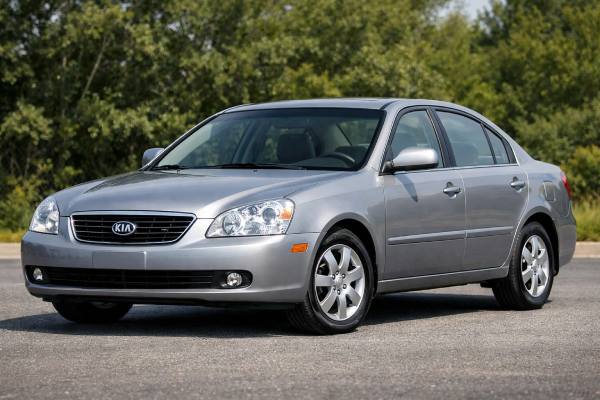
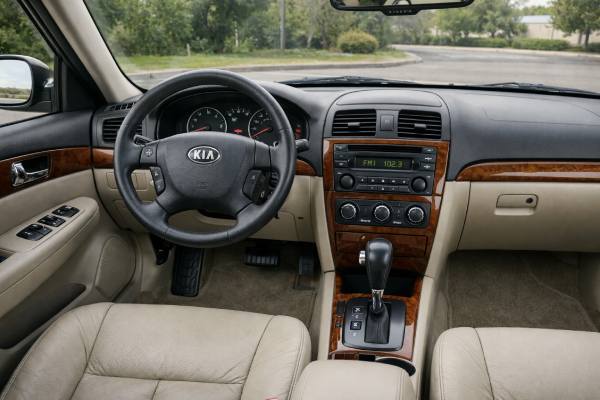
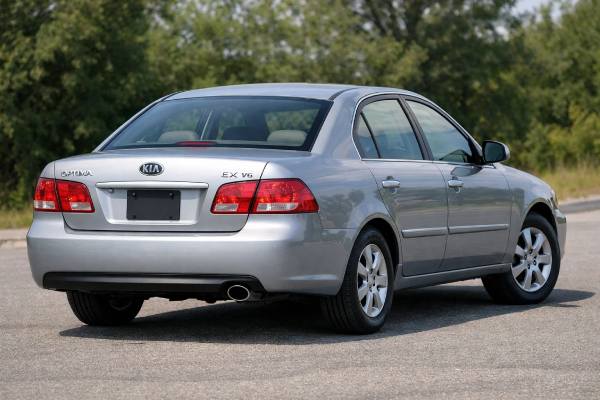
If you’re looking at the facelifted 2003–2005 Kia Optima (MS) with the 2.7-liter G6BA V6, you’re usually shopping for one thing: a comfortable midsize sedan with simple mechanicals, decent highway manners, and a low entry price. This powertrain is naturally aspirated and conventional—no turbo plumbing, no direct injection, and typically a straightforward FWD automatic setup—so troubleshooting tends to be familiar to most independent shops.
The trade-off is age. These cars are old enough that reliability is less about the original design and more about maintenance quality, timing-belt history, cooling-system health, and whether previous owners stayed ahead of leaks and neglected fluids. Buy a good one and it can be a surprisingly honest daily driver. Buy a tired one and you can quickly spend more than the car is worth catching up.
Quick Specs and Notes
- Smooth, low-stress V6 power delivery that suits highway cruising and relaxed commuting.
- Generally simple, serviceable drivetrain with wide parts availability in many markets.
- Comfortable ride and predictable handling on standard tyre sizes.
- Timing-belt service history matters; missing records should be treated as “due now.”
- Plan engine-oil service about every 8,000 km (5,000 mi) or 6 months, depending on usage.
Navigate this guide
- Kia Optima MS V6 facelift profile
- Kia Optima MS G6BA specs and measurements
- Kia Optima MS trim, equipment, and safety
- Common problems and fixes
- Maintenance plan and buying tips
- Real driving and fuel use
- Rival midsize sedans compared
Kia Optima MS V6 facelift profile
The 2003–2005 facelift version of the Optima (MS) is easiest to understand as a traditional early-2000s midsize sedan: unpretentious packaging, a quiet-enough cabin, and mechanical choices that prioritize durability and low operating cost over cutting-edge efficiency. In this configuration, the G6BA 2.7-liter V6 is the headline. It’s a naturally aspirated 24-valve V6 designed for smoothness and usable mid-range torque, not high-rev drama. For owners, that usually means effortless merging and less “gear hunting” than many four-cylinder versions—especially with passengers or on long grades.
This Optima’s strengths are rooted in how ordinary it is. The engine bay is not cramped by modern standards, common service parts are widely available, and diagnostic paths are typically straightforward: ignition, air leaks, sensors, and fluid condition checks solve a large percentage of drivability complaints. The facelift years also tend to feel more “finished” in day-to-day use thanks to updated exterior details and, in many markets, incremental interior improvements.
Where ownership becomes more nuanced is age-related wear. A 2003–2005 car is now old enough that rubber and plastic parts can be more important than the core engine design. Expect that hoses, vacuum lines, engine mounts, and suspension bushings may be living on borrowed time unless they’ve been refreshed. The V6 itself is usually tolerant of mileage if oil changes were consistent, but deferred maintenance—especially on timing components and cooling—can be expensive quickly.
If you’re choosing between the V6 and smaller engines, the V6 is often the more relaxed daily driver. However, it’s also the one where you should be strictest about documentation. A clean, well-kept V6 Optima is a good example of “old car value.” A neglected one can be a lesson in how quickly small leaks, overdue belts, and tired cooling systems snowball.
Kia Optima MS G6BA specs and measurements
Specifications vary slightly by market, emissions package, and transmission. The tables below focus on the common facelift-era 2.7 V6 layout and the data points that matter most for ownership and comparison.
Powertrain and efficiency (typical for facelift 2003–2005 V6)
| Item | Specification |
|---|---|
| Code | G6BA |
| Engine layout and cylinders | V6, 6 cylinders; DOHC; 4 valves/cyl (24v) |
| Displacement | 2.7 L (≈2656 cc) |
| Induction | Naturally aspirated |
| Fuel system | Multi-point fuel injection (MPFI) |
| Compression ratio | ~10.0–10.4:1 (varies by market/year) |
| Max power | 170 hp (127 kW) @ ~6,000 rpm |
| Max torque | ~240–250 Nm (177–184 lb-ft) @ ~4,000 rpm (varies) |
| Timing drive | Belt |
| Rated efficiency (realistic ownership range) | ~10.0–12.5 L/100 km combined (23–19 mpg US) depending on transmission and conditions |
| Real-world highway @ 120 km/h (75 mph) | ~8.0–9.5 L/100 km (29–25 mpg US) depending on wind, tyres, and load |
Transmission and driveline
| Item | Specification |
|---|---|
| Transmission | Commonly 4-speed automatic; some markets offered manual |
| Drive type | FWD |
| Differential | Open |
Chassis and dimensions (common range)
| Item | Specification |
|---|---|
| Suspension (front/rear) | Independent front strut/double-wishbone-style layout (market-dependent); independent rear multi-link-type layout (market-dependent) |
| Steering | Hydraulic power steering |
| Brakes | 4-wheel discs on many V6 trims (sizes vary by market) |
| Wheels and tyres (popular size) | Commonly 205/60 R15 or 215/50 R16 (varies by trim) |
| Length / width / height | ~4,720–4,740 mm / ~1,820 mm / ~1,410–1,420 mm |
| Wheelbase | ~2,700 mm |
| Turning circle (kerb-to-kerb) | ~10.6–11.0 m (varies) |
| Kerb weight | ~1,420–1,520 kg (3,130–3,350 lb), depending on equipment |
| Fuel tank | ~60–65 L (15.9–17.2 US gal / 13.2–14.3 UK gal) |
| Cargo volume | Typical midsize sedan trunk; exact L varies by measurement standard |
Performance and capability (typical test range)
| Item | Specification |
|---|---|
| 0–100 km/h (0–62 mph) | ~9.0–10.5 s (transmission and test method dependent) |
| Top speed | ~200–210 km/h (124–130 mph), market-dependent |
| Braking 100–0 km/h | Typically ~40–45 m on good tyres (varies widely) |
| Towing capacity | Often not officially rated in some markets; assume “light duty only” unless your owner documentation states otherwise |
| Payload | Depends on GVWR; verify door-jamb sticker/plate |
Fluids and service capacities (practical owner values)
| Item | Specification (verify by VIN/market) |
|---|---|
| Engine oil | API SL/SJ-era spec common; 5W-30 or 10W-30 typical; capacity ~4.5–4.8 L with filter |
| Coolant | Ethylene-glycol long-life; 50/50 mix; capacity ~7.0–7.5 L |
| Automatic transmission fluid | SP-III-type fluid common; drain/fill often ~4–5 L; dry fill higher |
| Brake fluid | DOT 3 or DOT 4 (follow cap/manual) |
| A/C refrigerant | R-134a (charge varies by market) |
Key torque specs (common “decision-making” values)
| Item | Typical torque (verify) |
|---|---|
| Engine oil drain plug | ~34–45 Nm (25–33 lb-ft) |
| Wheel lug nuts | Often ~90–110 Nm (varies by wheel) |
| Spark plugs | Often ~20–25 Nm (thread and plug type dependent) |
Kia Optima MS trim, equipment, and safety
Trim naming depends heavily on country and importer, but the facelift Optima MS V6 usually followed a familiar ladder: base or mid trims with comfort essentials, and higher trims adding wheels, interior upgrades, and convenience features. The V6 was often positioned as the “more premium” engine, which means you’ll frequently find it paired with better equipment—automatic transmission, upgraded audio, alloy wheels, and sometimes traction control depending on year and market.
Trims and options: what changes the ownership experience
Key differences that matter beyond cosmetics:
- Brakes and wheels: V6 trims more often received rear disc brakes and larger wheel/tyre packages. Larger wheels can sharpen response but increase tyre cost and make worn suspension bushings feel worse.
- Comfort equipment: Automatic climate control, upgraded seats, and better sound insulation are more common on V6 cars. For a daily driver, condition matters more than feature count—faded leather and failed seat heaters can be annoying and time-consuming to fix.
- Electrical load: Higher trims add more motors and modules (window regulators, sunroof, seat controls). On an older car, you want proof that charging system voltage is stable and that the battery and alternator are healthy.
Quick identifiers when inspecting:
- Badging and engine cover usually confirms V6 quickly, but don’t rely on badges alone.
- VIN decoding and emissions label under the hood will confirm the engine family.
- Transmission type is obvious in the cabin, but verify the shift quality on the road.
Safety ratings: what the published results imply
For this generation, published crash-test results can be a mixed story depending on the test type and equipment. A key point: early-2000s structures often perform acceptably in some crash modes and poorly in others, and airbag coverage varies by trim.
A well-known set of results for this platform shows:
- Moderate overlap front performance around “acceptable,” with notes that structural performance can be weaker than the overall rating suggests.
- Side impact performance can be poor in older test regimes even when front airbags are present, because torso protection and structure behind the door area matter a lot.
- Head restraint and seat ratings can be poor, which matters for whiplash-type injuries in rear impacts.
Safety systems and driver assistance (typical for the era)
Most examples will include:
- Front airbags and three-point belts
- ABS on many trims (not universal in all markets)
- Basic traction/stability systems may be absent or optional depending on year/trim
What you generally won’t get:
- Modern ADAS like AEB, lane keeping, blind-spot monitoring, or adaptive cruise control
For real-world use, the best “safety upgrade” is condition: quality tyres, fresh brake fluid, properly working ABS, and suspension components that keep the car stable under emergency braking.
Common problems and fixes
At this age, it’s more helpful to think in patterns: what fails often, what fails expensively, and what failure you can prevent with smart service. Below is a practical map for the facelift Optima MS V6.
Common (high prevalence)
- Timing belt and water pump neglect (high cost if ignored)
Symptoms: no warning until failure; sometimes belt noise or oil contamination near covers.
Root cause: overdue belt, aging tensioners/idlers, or a water pump beginning to seize/leak.
Remedy: replace belt, tensioner, idlers, and water pump together; renew accessory belt(s) while you’re there. - Valve cover gasket leaks (low to medium cost)
Symptoms: oil smell, oil on exhaust-side components, misfires if oil reaches plug wells.
Root cause: hardened gaskets and grommets.
Remedy: reseal covers; inspect PCV function to reduce crankcase pressure. - Ignition wear: plugs, wires/coils (low to medium cost)
Symptoms: misfire under load, rough idle, poor fuel economy, flashing MIL.
Root cause: aged plugs, weak coils, deteriorated boots/wires, oil in plug wells.
Remedy: correct plugs at correct gap/heat range; address oil leaks first; replace weak coils. - Cooling system aging (medium cost, high risk if overheated)
Symptoms: creeping temperature gauge, coolant smell, intermittent heater output, small drips.
Root cause: old radiator end tanks, tired hoses, sticking thermostat, weak cap.
Remedy: pressure test; refresh thermostat, cap, and suspect hoses; do a proper coolant service.
Occasional (moderate prevalence)
- Crankshaft/camshaft position sensor faults (medium cost)
Symptoms: random stalling, hard starts when hot, intermittent no-start.
Remedy: confirm with scan data; replace sensor(s); inspect connector condition. - Automatic transmission shift quality issues (medium to high cost)
Symptoms: delayed engagement, flare shifts, harsh 2–3, shudder.
Root cause: old fluid, solenoid wear, valve-body contamination, mounts exaggerating feel.
Remedy: correct fluid specification and level; service cautiously (avoid aggressive flushing on unknown history); diagnose solenoids if symptoms persist. - Front suspension wear (medium cost)
Symptoms: clunks over bumps, uneven tyre wear, vague steering.
Root cause: worn control-arm bushings, ball joints, stabilizer links, strut mounts.
Remedy: inspect with the car loaded; align after parts replacement.
Rare but costly
- Overheating damage and head-gasket/warpage risk (high cost)
Usually not a design issue as much as neglected coolant, a failed fan circuit, or a small leak ignored too long. Avoid any car with a history of repeated overheating.
Recalls, service bulletins, and how to verify
Because recall status varies by VIN and country, treat the official database as part of your pre-purchase process. Ask for:
- Recall completion printout from a dealer (or official lookup results).
- Evidence of timing-belt service (invoice with mileage/date).
- Transmission fluid service history showing correct fluid spec.
If the seller cannot document these, price the car as if you must do them immediately.
Maintenance plan and buying tips
A maintenance plan for an older Optima should do two things: prevent expensive failures (timing and cooling) and keep consumables from turning into reliability problems (fluids, filters, ignition).
Practical maintenance schedule (distance and time)
Intervals below are conservative “owner-safe” values. Always align with your official documentation for your VIN/market.
- Engine oil and filter: every 8,000 km (5,000 mi) or 6 months
If you do short trips, cold starts, or heavy city driving, shorten the interval. - Engine air filter: inspect every oil service; replace about 24,000–32,000 km (15,000–20,000 mi) depending on dust conditions.
- Cabin air filter: every 15,000–25,000 km or annually.
- Coolant: every 4–5 years (or earlier if contamination/rust is present).
Replace the thermostat and radiator cap proactively if temps fluctuate. - Spark plugs: typically 60,000–100,000 km (40,000–60,000 mi) depending on plug type.
Replace earlier if misfire begins or if oil contamination is found. - Timing belt kit: treat as a priority at ~96,000 km (60,000 mi) or 5–6 years, unless your official interval differs.
Do belt + tensioner + idlers + water pump together. - Accessory belt(s) and hoses: inspect every 6 months; replace at the first sign of cracks, glazing, swelling, or seepage.
- Automatic transmission fluid: every 40,000–60,000 km (25,000–37,000 mi) for longevity, especially in city use.
Use the correct specification fluid; wrong ATF can create shift complaints. - Brake fluid: every 2 years.
- Brake pads/rotors: inspect every 10,000–15,000 km; age matters as much as mileage.
- Tyre rotation: every 8,000–10,000 km; align annually or when tyres show uneven wear.
- 12 V battery and charging check: test annually; many cars need a battery every 4–6 years.
Fluids, specs, and “good enough” guidance
- Oil viscosity: 5W-30 is a safe all-round choice in many climates; some markets allow 10W-30. Match the spec listed in your documentation.
- Coolant: stick with a quality long-life ethylene glycol coolant and a proper 50/50 mix unless your manual specifies otherwise.
- ATF: use the specified fluid family (commonly SP-III-type for this era), and keep the level correct at operating temperature.
Buyer’s guide checklist (fast but thorough)
Bring a flashlight and give yourself time:
- Cold start: listen for belt noise, tapping, or rough idle; confirm stable idle after a few seconds.
- Cooling system: look for dried coolant trails, wet hose ends, oily residue in coolant, and poor heater performance.
- Leaks: valve cover area, power steering lines, and transmission pan area.
- Transmission behavior: smooth engagement in D and R, consistent upshifts, no flare or harsh bang.
- Steering and suspension: clunks over bumps, steering wander, and uneven tyre wear are red flags.
- Brakes: firm pedal, no pulsation, ABS light off.
- Electrical: windows, locks, A/C performance, and charging voltage stability.
Long-term durability outlook
A well-maintained V6 Optima can be a dependable budget commuter, especially for steady highway use. The best examples are the ones with documented timing-belt service, clean fluid history, and a cooling system that’s been refreshed. If you buy one without records, assume you’re purchasing a project and budget accordingly.
Real driving and fuel use
The 2.7 V6 Optima’s personality is more “quiet competence” than “sport sedan.” It delivers its power smoothly, and that matters in daily life: less throttle input to keep pace, fewer downshifts on hills, and a calmer feel when the car is loaded with passengers or luggage. If you’re coming from a smaller four-cylinder, the V6 typically feels less strained at highway speeds and more relaxed during overtakes.
Ride, handling, and noise (NVH)
- Ride: generally compliant over broken pavement, with the usual caveat that worn dampers and tired bushings can make it feel floaty or noisy.
- Handling balance: predictable and front-biased; it’s designed to be stable rather than sharp.
- Steering feel: hydraulic steering often provides more natural weighting than newer electric systems, but age-related wear can introduce slack or vibration.
- Cabin noise: expect more wind and road noise than modern midsize cars. Tyre choice and door seals make a noticeable difference.
Powertrain character and transmission behavior
- Throttle response: typically linear. If the car feels sluggish, check ignition health and vacuum leaks first.
- Automatic shifting: should be smooth and consistent. A slight kickdown delay is normal for the era, but harsh engagements or flare shifts are not.
- Heat management: the V6 should hold temperature steadily once warmed up. Any wandering gauge is a reason to stop and diagnose.
Real-world efficiency
Fuel use depends heavily on tyre choice, traffic, and how much time the car spends warming up:
- City: often 12–14 L/100 km (19–17 mpg US) in heavy traffic or short trips.
- Highway (100–120 km/h): often 8–10 L/100 km (29–24 mpg US) in steady cruising.
- Mixed: commonly 10–12.5 L/100 km (23–19 mpg US).
Cold weather can add a noticeable penalty because the engine spends more time in warm-up enrichment and because winter tyres and dense air increase drag. If your numbers are far worse than expected, look for dragging brakes, low tyre pressure, old oxygen sensors, misfires, and transmission fluid issues.
Performance metrics that matter in daily use
The headline acceleration number is less important than passing response. A healthy V6 Optima typically feels comfortable in the 80–120 km/h passing range, but only if the ignition system is strong and the transmission is shifting correctly. If you test-drive and it hesitates, surges, or downshifts harshly, treat it as a diagnostic item—not “just how old cars are.”
Rival midsize sedans compared
When new, this Optima competed directly with the mainstream midsize class. Today, the comparison is about what you get for your money and how much risk you’re willing to take on maintenance.
Versus Toyota Camry V6 (early-2000s)
- Camry advantage: long-term durability reputation, broad parts support, strong resale.
- Optima advantage: often cheaper to buy, sometimes better-equipped at the same price.
- What decides it: condition. A clean Optima can be the smarter buy than a neglected Camry with the “Toyota tax.”
Versus Honda Accord V6 (same era)
- Accord advantage: typically sharper driving dynamics and strong powertrains.
- Optima advantage: purchase price and sometimes lower insurance/parts costs depending on market.
- What decides it: if you value steering and chassis feel, Accord usually wins; if you want calm transport on a budget, Optima can make sense.
Versus Nissan Altima V6 / 3.5 (where applicable)
- Altima advantage: lively power and often a more modern feel.
- Optima advantage: simpler ownership experience in some trims and less “sporty wear” from aggressive driving by previous owners.
- What decides it: drivetrain condition and service records.
Versus Hyundai Sonata V6 (closely related)
- Sonata advantage: in many regions, higher production volume can make used parts and trim pieces easier to find.
- Optima advantage: sometimes better value pricing for similar mechanical content.
- What decides it: which specific car is better cared for.
Bottom line
If you want the safest “yes” in this class, you usually buy the best-maintained example of the model with the cleanest records—regardless of badge. For the Optima MS V6, the non-negotiables are timing-belt proof, stable cooling temperatures, and a transmission that shifts cleanly. Get those right, and the car can be an affordable, comfortable daily driver.
References
- 2004 Kia Optima 2004 (Safety Rating)
- Gas Mileage of 2004 Kia Optima 2004 (Fuel Economy Database)
- Vehicle Detail Search – 2004 KIA OPTIMA | NHTSA 2004 (Recall Database)
- Engine Oil Grades and Capacities 2023 (Service Document)
Disclaimer
This article is for informational purposes only and is not a substitute for professional diagnosis, inspection, or repair. Specifications, torque values, service intervals, and procedures can vary by VIN, market, and equipment. Always verify details using official owner and service documentation for your specific vehicle and confirm recall status through official channels.
If you found this guide useful, please consider sharing it on Facebook, X (Twitter), or your favorite forum to help others keep these cars on the road.