
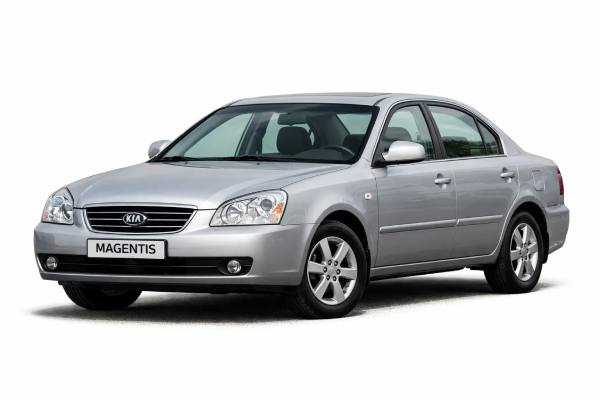
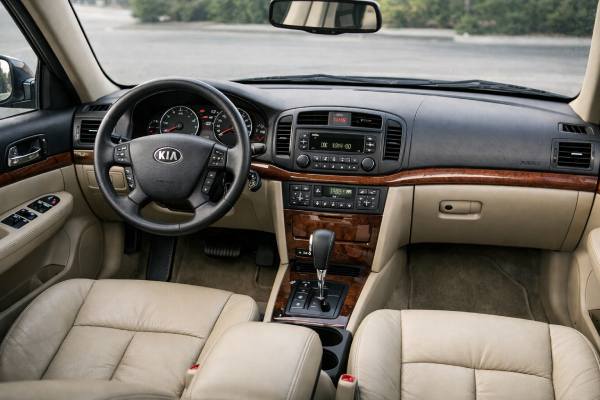
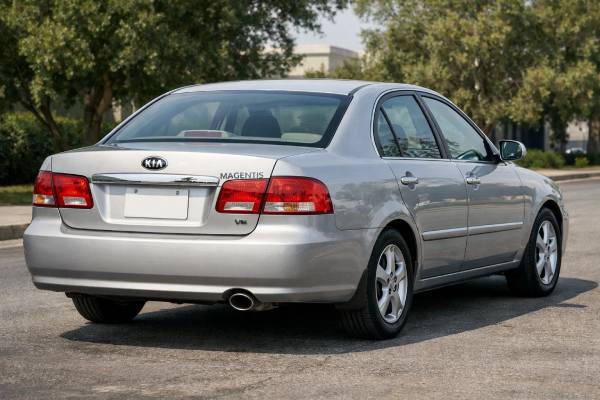
The facelifted Kia Magentis (MS) with the G4JP 2.0-liter engine sits in a practical sweet spot: simple multi-point fuel injection, a conventional automatic (or manual in some markets), and a chassis tuned for comfort over sharp sportiness. In 2003–2005 form, it’s best understood as a durable, mid-size daily driver that rewards steady maintenance rather than one that tolerates neglect. The 136 hp output won’t feel quick by modern standards, but the power delivery is predictable, the cabin is typically quieter than many compact sedans of the same era, and parts availability is usually manageable thanks to shared Kia/Hyundai-era components. For owners today, the real story is age-related reliability: rubber, seals, cooling components, and suspension wear dictate whether the car feels tight—or tired. Buy and maintain it like a “systems” car, and it can still do honest, low-drama miles.
Owner Snapshot
- A comfortable, stable highway sedan with straightforward mechanicals and predictable road manners.
- G4JP’s simple MPI setup is typically easier (and cheaper) to keep running than early direct-injection designs.
- Cabin packaging and trunk space make it a practical family or commuter car even today.
- Timing-belt service discipline matters; skipping it can turn a good car into an expensive one.
- Plan oil changes every 10,000 km (6,200 mi) or 12 months (shorter if you do mostly city trips).
Jump to sections
- Magentis MS facelift in context
- Magentis MS G4JP core specifications
- Magentis MS trims, safety, and tech
- Reliability patterns and known fixes
- Maintenance schedule and buyer checklist
- Road feel and real economy
- Magentis MS versus key rivals
Magentis MS facelift in context
If you’re shopping the 2003–2005 Magentis (MS), it helps to separate “design age” from “ownership reality.” The platform dates to an era when mid-size sedans were built around comfort, crash structure improvements, and relatively conventional drivetrains. That’s good news for long-term ownership, because most of the car’s behavior comes down to basic mechanical condition rather than complicated electronics.
What the facelift usually changes for an owner: lighting details, bumpers, interior trim, and—depending on market—equipment packaging. The key value is not that it becomes a different car, but that many examples you’ll find today have had more years of routine servicing, and sometimes benefited from running updates in parts supply (aftermarket radiators, updated bushings, revised sensors).
Where the 2.0 G4JP fits: In many markets, this engine sits below the V6 and is aimed at everyday drivability and lower running costs. It’s not a “hot” engine; it’s an engine you keep healthy. When maintained well, it tends to deliver smooth, linear torque and a calm character that suits the chassis. When maintained poorly, it often telegraphs issues early—rough idle, heat creep in traffic, vibration from tired mounts—giving you a chance to intervene before a breakdown.
Who it suits today:
- Commuters who want a stable, comfortable ride at sane speeds.
- Budget-conscious owners who prefer predictable repairs over high-tech surprises.
- DIY-leaning owners who can stay ahead of belts, fluids, and wear items.
Who should think twice:
- Drivers expecting modern acceleration or fuel economy.
- Buyers without access to a trustworthy independent shop.
- Anyone who can’t verify timing-belt history and cooling-system condition.
A good Magentis feels “tight enough” when suspension bushings, engine mounts, and alignment are current. A tired one feels older than it is: floaty ride, vague steering on-center, and brake pedal inconsistency from neglected fluid and hardware. The facelift version doesn’t magically avoid those age issues—but it’s often found at a price where careful reconditioning still makes financial sense.
Magentis MS G4JP core specifications
Below is a practical spec set for the 2003–2005 facelift Magentis (MS) 2.0 G4JP, 136 hp. Treat some values as market-dependent: gearing, curb weight, brakes, and tire sizes can vary by trim and region.
Powertrain and efficiency
| Item | Specification |
|---|---|
| Code | G4JP |
| Engine layout and cylinders | Inline-4, 4 cylinders, DOHC, 4 valves/cyl |
| Displacement | 2.0 L (≈ 1,997 cc) |
| Induction | Naturally aspirated |
| Fuel system | Multi-point fuel injection (MPI) |
| Compression ratio | Typically around 10:1 (market/calibration dependent) |
| Max power | 136 hp (100 kW) @ ~6,000 rpm |
| Max torque | Typically ~180 Nm (133 lb-ft) @ ~4,500 rpm (varies by tune) |
| Timing drive | Belt |
| Rated efficiency | Commonly ~8.5–10.5 L/100 km (22–28 mpg US / 27–33 mpg UK) depending on gearbox and traffic |
| Real-world highway @ 120 km/h (75 mph) | Often ~7.5–9.0 L/100 km (26–31 mpg US / 31–38 mpg UK) when healthy |
Transmission and driveline
| Item | Specification |
|---|---|
| Transmission | 5-speed manual (some markets) or 4-speed automatic (common) |
| Drive type | FWD |
| Differential | Open |
Chassis and dimensions
| Item | Typical specification (varies by market/trim) |
|---|---|
| Suspension (front/rear) | MacPherson strut / multi-link or strut-type rear (market dependent) |
| Steering | Hydraulic power steering (typical for era) |
| Brakes | Front discs; rear discs or drums depending on trim/market |
| Wheels/tyres (popular) | Commonly 195/65 R15 or 205/60 R16 |
| Length / width / height | Approx. 4,720 mm / 1,820 mm / 1,410–1,420 mm (≈ 185.8 in / 71.7 in / 55.5–55.9 in) |
| Wheelbase | Approx. 2,700 mm (≈ 106.3 in) |
| Turning circle (kerb-to-kerb) | Often around 11.0–11.4 m (≈ 36–37 ft) |
| Kerb (curb) weight | Commonly ~1,350–1,500 kg (≈ 2,976–3,307 lb) |
| Fuel tank | Often ~60 L (≈ 15.9 US gal / 13.2 UK gal) |
Performance and capability
| Metric | Typical observed range (condition and gearbox matter) |
|---|---|
| 0–100 km/h (0–62 mph) | Roughly 10.5–12.5 s |
| Top speed | Roughly 190–205 km/h (118–127 mph) |
| Towing capacity | Market-specific; many approvals are modest—verify your VIN plate and manual |
| Payload | Typically ~450–550 kg depending on trim/approval |
Fluids and service capacities (practical owner values)
Because regional manuals vary, confirm for your VIN before filling to capacity.
| Fluid | Common guidance |
|---|---|
| Engine oil | Typically 5W-30 or 10W-40 depending on climate; target API/ACEA per manual |
| Engine oil capacity | Often ~4.0–4.5 L (4.2–4.8 US qt) with filter |
| Coolant | Ethylene glycol long-life coolant; common 50/50 mix |
| Coolant capacity | Often ~6.5–7.5 L (6.9–7.9 US qt) |
| Automatic transmission fluid | ATF spec per transmission label/manual (often Dexron-era equivalents for many markets) |
| A/C refrigerant | Typically R134a; charge amount varies by system label |
Key torque specs (typical “decision” fasteners):
- Wheel lug nuts: often ~90–110 Nm (66–81 lb-ft) depending on wheel type
- Spark plugs: commonly ~18–25 Nm (13–18 lb-ft) depending on plug seat design
Always verify exact torque for your engine and wheel package.
Magentis MS trims, safety, and tech
Trim structure on the 2003–2005 Magentis (MS) is highly regional, so the smartest approach is to identify the car by what it physically has, not by badge alone. Most examples fall into “base,” “mid,” and “high” equipment bands, with the 2.0 often paired to comfort-oriented trims.
Trims and options you’ll commonly see
Base-focused cars usually include manual HVAC, fabric seats, simpler audio, smaller wheels, and sometimes rear drum brakes. These can be excellent value because fewer luxury features means fewer age-related failures (seat motors, climate actuators, premium amps).
Mid trims often add:
- Automatic climate control (or upgraded manual system)
- Alloy wheels
- Better audio and steering wheel controls (market dependent)
- Rear disc brakes on some packages
Higher trims may add leather, heated seats, sunroof, and upgraded sound. These are nicer to live with but cost more to refresh, especially if the interior has suffered heat and UV.
Quick identifiers to check:
- Brake hardware: look through the rear wheel—disc vs drum matters for parts and service cost.
- Wheel size: 15 vs 16 inch packages change ride and tire cost.
- Climate control panel: automatic systems can develop blend-door or actuator issues with age.
- VIN and build plate: confirms model year, weights, and sometimes axle codes; don’t guess.
Safety ratings and what they mean today
This generation sits in a transition period: structure and restraint design improved versus many late-1990s sedans, but it won’t match modern cars in small-overlap impacts or advanced driver assistance. If you see published crash results for a closely related Optima/Magentis, treat them as a useful baseline, not a guarantee—test protocols and exact build dates matter.
Typical safety equipment for the era (varies by market):
- Front airbags standard on most cars
- Side airbags optional or standard on better trims
- ABS commonly available; not always standard everywhere
- Electronic stability control (ESC) is often absent or late availability depending on region
Driver assistance and service implications
True ADAS features (automatic emergency braking, adaptive cruise, lane support) are generally not part of this era. The “assistance” you’ll deal with is basic chassis electronics:
- ABS sensors and tone rings: failures show as ABS lights and reduced wet braking confidence.
- Brake proportioning and calipers: sticking calipers or slide pins can mimic warped rotors.
- Airbag warning lights: often wiring/connectors under seats or aging sensors—always diagnose properly.
Child-seat provisions vary: some markets adopted ISOFIX earlier than others. If you need child-seat compatibility, physically confirm anchor points rather than relying on trim claims.
The takeaway: safety is adequate for its time when everything works—tires, brakes, lights, and restraints—but your best safety upgrade is condition: fresh tires, correct alignment, strong brakes, and properly functioning airbags.
Reliability patterns and known fixes
At 20+ years old, the facelift Magentis is less about “design flaws” and more about predictable aging. A good one is dependable; a neglected one becomes a chain of small failures that feel like a big failure. Use this section as a triage map.
Common issues (high prevalence)
1) Timing-belt uncertainty (high severity if ignored)
- Symptoms: no symptoms until it’s too late; sometimes squeaks or visible cracking on inspection
- Likely root cause: overdue belt, old tensioner/idler bearings, water pump not done with belt
- Remedy: replace belt + tensioners/idlers + water pump as a kit; reset service baseline
2) Cooling system fatigue (medium to high severity)
- Symptoms: temperature creep in traffic, coolant smell, low reservoir level, heater output changes
- Root causes: tired radiator, brittle plastic tanks, weak cap, aging hoses, sticky thermostat
- Remedy: pressure test, replace suspect parts proactively; flush with correct coolant mix
3) Engine mounts and vibration (medium severity, high annoyance)
- Symptoms: shaking at idle in Drive, clunks on throttle transitions, harshness over bumps
- Root causes: collapsed mounts, worn torque mount bushings
- Remedy: replace mounts in pairs where possible; re-check idle quality afterward
4) Suspension wear (medium severity)
- Symptoms: front-end clunks, vague steering, uneven tire wear, wandering at speed
- Root causes: control arm bushings, ball joints, sway links, tired struts
- Remedy: refresh wear items, then align; don’t align a worn suspension
Occasional issues (moderate prevalence)
Oil seepage and gasket aging (low to medium severity)
- Symptoms: oily residue around valve cover, burning smell on hot engine, small drips
- Remedy: replace gaskets/seals; ensure PCV system is working to reduce crankcase pressure
Idle instability (low to medium severity)
- Symptoms: hunting idle, stalling when cold, sluggish throttle response
- Root causes: dirty throttle body, aging IAC components (where fitted), vacuum leaks
- Remedy: smoke test for leaks, clean throttle body properly, address cracked hoses
Automatic transmission shift quality (medium severity)
- Symptoms: delayed engagement, harsh 2–3, flare under light throttle
- Root causes: old ATF, solenoid wear, tired mounts exaggerating feel
- Remedy: fluid service (correct spec), inspect mounts, then diagnose if symptoms persist
Rare but costly items (low prevalence, high severity)
- Head gasket/cylinder head issues after repeated overheating events
- Electrical gremlins from prior alarm/remote-start installs or poor repairs
- Rust in structural areas (region dependent): check sills, subframe mounts, rear arches
Recalls, service actions, and how to verify
Because names vary by market (Magentis vs Optima), always verify by VIN rather than model badge. Your checklist:
- Run a VIN check on official databases (and keep a screenshot or printout).
- Ask a dealer to confirm open campaigns (if your region supports it).
- Match receipts to the VIN and mileage.
A Magentis with documented belt service and cooling refresh is usually a safer buy than a “low mileage” car with missing history.
Maintenance schedule and buyer checklist
For this car, maintenance is less about perfection and more about rhythm. If you keep fluids fresh and replace age-sensitive parts before they fail, ownership stays inexpensive. If you wait for symptoms, you’ll pay in downtime and secondary damage.
Practical maintenance schedule (distance or time, whichever comes first)
Every 10,000 km (6,200 mi) or 12 months
- Engine oil and filter (shorten to 7,500 km if mostly short trips)
- Tire rotation and pressure check
- Inspect brakes, coolant level, belts, and visible leaks
Every 20,000–30,000 km (12,000–18,000 mi)
- Engine air filter (more often in dusty areas)
- Cabin air filter (if fitted)
- Inspect suspension links and bushings; check alignment if tire wear appears
Every 40,000–60,000 km (25,000–37,000 mi)
- Brake fluid (every 2 years is a good rule)
- Automatic transmission fluid service (interval depends on usage and spec; earlier is safer)
- Coolant hoses inspection; replace any soft or swollen hoses
Timing belt service
- Replace timing belt kit at the manufacturer interval for your market; a conservative real-world rule on older cars is ~90,000–100,000 km (55,000–62,000 mi) or 5–6 years
- Do the water pump, tensioners, and idlers with it
This is the single highest-leverage job on the car.
Every 80,000–120,000 km (50,000–75,000 mi)
- Spark plugs (interval depends on plug type)
- Inspect ignition leads/coils depending on setup
- Inspect engine mounts and replace as needed
12 V battery
- Test yearly after year 3; many batteries last 4–6 years depending on climate.
Fluid specifications (practical guidance)
- Engine oil: many markets accept 5W-30 for temperate climates; 10W-40 often appears in warmer or high-mileage contexts. Match the manual’s API/ACEA requirement.
- Coolant: use the correct long-life coolant type and maintain a true 50/50 mix unless your manual specifies otherwise.
- ATF: do not guess—use the spec listed for the transmission. Wrong ATF can create shift issues that look like “transmission failure.”
Buyer’s guide: inspection checklist
Bring a flashlight, a cheap OBD reader (where applicable), and don’t skip a cold start.
Engine and cooling
- Cold start should be clean: no heavy ticking, no misfire shake, no coolant smell.
- Check coolant reservoir for oil contamination and correct level.
- Verify timing belt documentation; if unknown, price in the full job.
Transmission and driveline
- Automatic: engagement into Drive/Reverse should be prompt and smooth.
- Road test: watch for flare, harsh shifts, or delayed kickdown.
Chassis
- Listen for clunks over small bumps (links/bushings).
- Check tire wear: inside-edge wear suggests alignment or worn arms.
Body and rust
- Inspect sills, rear arches, and subframe mounting areas.
- Check door bottoms and trunk channels for trapped moisture.
Electrics
- Ensure windows, locks, HVAC modes, and dash illumination all work.
- Airbag and ABS warning lights must illuminate at key-on and go out after start.
Long-term durability outlook
A well-maintained G4JP Magentis can be a dependable “appliance sedan.” The best examples are those with a documented belt history, a refreshed cooling system, and a tight suspension. If you find one like that, it can be cheaper to run than many newer cars with higher parts costs and more complex systems.
Road feel and real economy
On the road, the 2003–2005 Magentis (MS) leans into comfort and stability. Think of it as a calm mid-size sedan rather than a sporty one. When the suspension is healthy, it tracks straight at speed, absorbs broken pavement without harshness, and isolates occupants from much of the road buzz that smaller cars transmit.
Ride, handling, and NVH
Ride quality:
The Magentis typically rides with a slightly soft primary motion—meaning it takes the edge off potholes and expansion joints. If it feels bouncy or “floaty,” that’s usually aged dampers/struts rather than the design itself.
Handling balance:
Expect safe understeer at the limit. The chassis is predictable, and that’s a compliment for daily driving. Fresh tires and correct alignment make a noticeable difference in steering confidence.
Steering feel:
Hydraulic steering of this era often has better natural feedback than many early electric systems, but it won’t feel sharp if bushings and ball joints are tired. If the wheel doesn’t self-center well or feels vague on-center, suspect alignment, worn lower arms, or uneven tire wear.
Cabin noise:
At highway speeds, a good example is reasonably quiet for the age. Common NVH offenders are:
- Dry door seals
- Worn engine mounts
- Cupped tires from misalignment
- Rear wheel bearings beginning to rumble
Powertrain character
With 136 hp, the G4JP is about smoothness, not punch. It generally prefers revs for confident passing, especially with an automatic. The automatic’s logic (typical of the era) may downshift decisively when you ask for power, and that can feel busy compared with modern multi-speed gearboxes—but it’s also straightforward and easy to diagnose when something feels off.
What to expect:
- City driving: adequate step-off, best when throttle inputs are smooth
- Passing: plan ahead; a manual gearbox (where available) feels more responsive
- Hot weather: ensure cooling is perfect—this is when weak radiators show themselves
Real-world fuel economy (what owners actually see)
Real economy depends heavily on transmission, tire size, and condition:
- City: often ~10–12.5 L/100 km (19–24 mpg US / 23–28 mpg UK)
- Highway (100–120 km/h): often ~7.5–9.0 L/100 km (26–31 mpg US / 31–38 mpg UK)
- Mixed: often ~8.5–10.5 L/100 km (22–28 mpg US / 27–33 mpg UK)
Cold weather, short trips, and a tired thermostat can all worsen consumption. If your economy is poor, check basics first: tire pressures, alignment, engine temp behavior, and intake/vacuum integrity.
The Magentis doesn’t need to be fast to be satisfying; it needs to be healthy. When it is, it feels like a settled, confident car that covers distance without drama.
Magentis MS versus key rivals
In its era, the Magentis competed with value-focused mid-size sedans that prioritized comfort, space, and sensible ownership costs. Today, its competition is less about showroom features and more about which aging platform is easiest to keep in good condition.
Versus Toyota Camry (early-2000s)
Camry strengths:
- Typically strong reputation for long-term durability and resale
- Many parts and service familiarity worldwide
Magentis advantages:
- Often significantly cheaper to buy in similar condition
- Comfort and space can feel comparable in everyday use
Verdict:
If you find a Magentis with belt and cooling history, the value proposition is strong. A neglected Camry is still a risk, but buyers often pay a “reputation premium” even when condition doesn’t justify it.
Versus Honda Accord (early-2000s)
Accord strengths:
- Often sharper steering and handling
- Strong powertrain options in many markets
Magentis advantages:
- Usually softer ride and quieter “cruise” feel
- Lower purchase cost and sometimes lower insurance group (region dependent)
Verdict:
Choose the Accord if you prioritize driving feel and can find a clean one. Choose the Magentis if you want comfort and value and you’re willing to baseline maintenance.
Versus Mazda6 (first generation)
Mazda6 strengths:
- Engaging chassis, responsive controls
- Often better “driver’s car” dynamics
Magentis advantages:
- Typically calmer ride and simpler ownership expectations
- Often less likely to have been driven hard
Verdict:
If you want a relaxed commuter that you’ll maintain steadily, the Magentis can be the better “appliance sedan.” If you care about cornering and feedback, Mazda6 often wins.
Versus Volkswagen Passat (B5/B5.5 era)
Passat strengths:
- Solid highway feel and interior design (for the era)
- Strong engine options in some markets
Magentis advantages:
- Usually simpler to keep running on a budget
- Less sensitivity to specialist diagnostics and brand-specific parts supply
Verdict:
A well-kept Passat can feel more “premium,” but the Magentis is often easier to own long-term if you’re trying to keep costs predictable.
The practical takeaway
A facelift Magentis (MS) with the 2.0 G4JP wins when:
- You value purchase price and comfort over speed
- You can verify timing-belt history (or budget to do it immediately)
- You’re willing to refresh suspension and cooling components proactively
In today’s used market, condition beats badge. A cared-for Magentis can be a smarter buy than a neglected “more famous” rival.
References
- 2006 Kia Optima 2010 (Safety Rating)
- Vehicle Detail Search – | NHTSA 2026 (Recall Database)
- NHTSA VIN Decoder 2026 (VIN Decoder)
- Euro NCAP | Latest Safety Ratings 2026 (Safety Rating)
Disclaimer
This article is for informational purposes only and is not a substitute for professional diagnosis, inspection, or repair. Specifications, torque values, fluid types, capacities, and service intervals can vary by VIN, market, drivetrain, and equipment, so always verify details using the official owner’s manual and service documentation for your exact vehicle.
If this guide helped, please consider sharing it on Facebook, X (Twitter), or your favorite forum to support our work.