


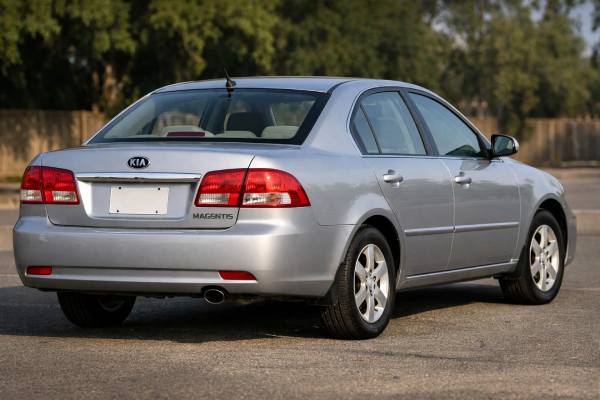
The facelifted 2003–2005 Kia Magentis (MS) with the 2.5-liter G6BV V6 is the “quietly capable” version of this sedan. Compared with the four-cylinder models, it leans into smoothness: more relaxed highway passing, less strain with a full cabin, and a broader torque curve that suits an automatic gearbox. It is still an early-2000s, value-focused midsize—simple by modern standards, generally easy to service, and forgiving to own if you stay ahead of fluids and cooling system health.
Where this Magentis rewards careful ownership is consistency. Regular oil changes, timely timing-belt service, and attention to rubber parts (hoses, mounts, bushings) matter more than chasing upgrades. Buy a well-maintained example and it can feel surprisingly refined for the money; buy a neglected one and small deferred items can stack up fast.
Quick Specs and Notes
- Smooth, low-effort V6 power delivery that suits long highway trips and loaded driving.
- Straightforward mechanical layout with good access for routine service and common repairs.
- Comfortable ride tuning and stable cruising manners for an early-2000s midsize sedan.
- Biggest ownership risk is skipped timing-belt and water-pump service—budget it if history is unclear.
- Plan on a baseline service cadence of 10,000 miles (16,000 km) or 12 months, whichever comes first.
Guide contents
- Kia Magentis MS V6 overview
- Kia Magentis MS 2.5 specs
- Kia Magentis MS equipment and safety
- Common faults and service campaigns
- Maintenance plan and buying tips
- Driving feel and fuel use
- How Magentis MS V6 compares
Kia Magentis MS V6 overview
In facelift form (2003–2005), the Magentis MS sits in the classic early-2000s midsize template: front-engine, front-wheel drive, a comfort-oriented suspension setup, and an emphasis on quiet cruising rather than sporty feedback. The G6BV 2.5-liter V6 is the key differentiator. It brings a smoother idle, a more refined sound under load, and stronger mid-range pull than the four-cylinders—especially noticeable when merging, overtaking, or climbing grades with passengers.
This generation is also refreshingly “pre-complexity.” You do not have modern driver assistance systems to maintain, and most faults are conventional: sensors, rubber aging, cooling system leaks, and wear in suspension joints. That simplicity can keep ownership affordable—if you buy wisely and keep maintenance predictable.
From a buyer’s standpoint, the V6 version tends to be owned in two very different ways. Some were treated as the “nicer” trim and kept up with dealership service schedules; others were bought cheaply later in life and maintained reactively. Your goal is to find evidence of preventative work: timing belt and water pump, coolant renewal, transmission fluid service, and steady oil change intervals.
What the Magentis does well is daily comfort. The seating position and cabin layout are straightforward, visibility is usually good for the class, and the ride is typically tuned to take the edge off broken pavement. On the downside, age catches up in predictable places: interior plastics can rattle, door seals harden, and electrical conveniences (window regulators, central locking) can become intermittent. None of that is unusual for a 20-plus-year-old sedan, but it is worth factoring into the price.
If you want a calm commuter with enough engine for relaxed highway driving—and you are willing to keep up with belt-driven V6 maintenance—the 2.5 can be the most satisfying version of the MS lineup.
Kia Magentis MS 2.5 specs
Below is a practical spec set for the facelift 2003–2005 Magentis MS with the G6BV 2.5 V6 (169 hp). Exact numbers can vary by market, emissions calibration, and transmission; use your VIN-specific documentation for final confirmation.
Powertrain and efficiency
| Item | Spec |
|---|---|
| Code | G6BV |
| Engine layout and cylinders | V6, 6 cylinders, DOHC, 4 valves/cyl |
| Bore × stroke | 84.0 × 75.0 mm (3.31 × 2.95 in) |
| Displacement | 2.5 L (2497 cc) |
| Induction | Naturally aspirated |
| Fuel system | Multi-port fuel injection (MPFI) |
| Compression ratio | 10.0:1 (typical) |
| Max power | 169 hp (126 kW) @ ~6000 rpm |
| Max torque | ~220–230 Nm (162–170 lb-ft) @ ~4000 rpm (market dependent) |
| Timing drive | Belt |
| Rated efficiency | Typically ~9–11 L/100 km combined (26–21 mpg US / 31–26 mpg UK), varies by gearbox/market |
| Real-world highway @ 120 km/h (75 mph) | Often ~8.5–10.0 L/100 km if well-tuned and tires/alignment are correct |
Transmission and driveline
| Item | Spec |
|---|---|
| Transmission | 4-speed automatic commonly paired (market dependent) |
| Drive type | FWD |
| Differential | Open |
Chassis and dimensions
| Item | Spec |
|---|---|
| Suspension (front/rear) | MacPherson strut front; multi-link or strut-type rear (varies by market) |
| Steering | Hydraulic power steering (typical for era) |
| Brakes | Front disc / rear disc or drum (trim dependent) |
| Wheels/tyres (common) | 195/65 R15 or 205/60 R16 depending on trim |
| Length / width / height | ~4740 / 1815 / 1415 mm (186.6 / 71.5 / 55.7 in) |
| Wheelbase | ~2700 mm (106.3 in) |
| Turning circle (kerb-to-kerb) | ~10.8–11.2 m (35–37 ft) typical |
| Kerb weight | Often ~1400–1550 kg (3086–3417 lb), depends on equipment |
| Fuel tank | ~60 L (15.9 US gal / 13.2 UK gal) |
| Cargo volume | Typical midsize sedan trunk; method varies (confirm by market) |
Performance and capability
| Item | Spec |
|---|---|
| 0–100 km/h (0–62 mph) | ~9–10 s (depends on transmission and test method) |
| Top speed | ~205–215 km/h (127–134 mph) |
| Braking distance | Depends heavily on tires and brake condition; treat published numbers as test-specific |
| Towing capacity | Often not officially rated in many markets for this class/era; verify locally |
| Payload | Market and tire rating dependent |
Fluids and service capacities (typical guidance)
| System | Spec (typical) |
|---|---|
| Engine oil | API SL/SJ era equivalent; commonly 5W-30 or 10W-30; capacity often ~4.5–5.0 L (4.8–5.3 US qt) with filter |
| Coolant | Ethylene glycol long-life coolant; 50/50 mix; capacity varies by radiator size |
| Automatic transmission fluid | Dexron-III era spec is common; confirm label and manual |
| Brake fluid | DOT 3 / DOT 4 (confirm cap) |
| A/C refrigerant | R-134a (typical for era); charge amount varies by market |
Key torque specs (decision-making level)
These vary by revision and market, so use them as “sanity checks,” not final instructions:
- Wheel lug nuts: often ~90–110 Nm (66–81 lb-ft) depending on wheel size
- Spark plugs: typically ~18–25 Nm (13–18 lb-ft) depending on plug type and head
- Drain plug: commonly ~25–35 Nm (18–26 lb-ft) depending on pan/thread
Safety and driver assistance (era-appropriate summary)
| Item | Spec |
|---|---|
| Crash ratings | Many early-2000s variants are not listed under modern percentage-based protocols; check your market’s official databases |
| Headlights (IIHS scale) | Not typically published for this generation |
| ADAS suite | None in modern sense; expect ABS, possibly traction control, and later-era stability control depending on trim/market |
Kia Magentis MS equipment and safety
The facelift Magentis MS range usually revolves around a small number of trims, with the V6 often positioned as a higher-spec choice. Exact names vary by country, but the pattern is consistent: base models focus on essential comfort features, and higher trims add convenience items (alloy wheels, upgraded audio, climate control, cruise control, leather or leather-look seating, and sometimes a sunroof).
Practical trim identifiers (what to look for when shopping):
- Wheels and brakes: alloy wheels often correlate with higher trims and sometimes rear disc brakes.
- Interior cues: steering-wheel audio controls, trip computer display, and seat material changes are useful signals that the car is not a de-contented fleet spec.
- VIN/build plate and option stickers: these are your best way to verify original equipment—especially airbags and braking systems.
Options that matter mechanically
In this era, most options are comfort-focused, but a few can affect ownership cost:
- ABS and traction control: ABS is common; traction control availability varies. If equipped, confirm the warning lamps illuminate at key-on and go out after startup—intermittent wheel-speed sensor faults are common aging issues.
- Climate control type: automatic climate control adds actuators and control modules. Not “bad,” just more to diagnose if airflow doors stick or temperature control becomes erratic.
- Audio and security: factory head units and keyless entry can be reliable, but aftermarket stereo wiring is a frequent source of parasitic battery drain—inspect carefully.
Safety structure and restraint systems
Expect a conventional early-2000s safety setup:
- Airbags: front airbags are standard in most markets; side airbags may be trim-dependent. Check the A-pillar or seat tags and confirm the airbag warning light behavior.
- Child seats: ISOFIX/LATCH availability depends on market and year; verify anchor points physically rather than assuming.
- Brakes: ABS is typically present; electronic stability control (ESC) is uncommon in this segment and time period, and if available, may be late-cycle or market-specific.
Crash ratings and what they mean here
A common trap with older cars is expecting a single “star rating” that applies everywhere. Testing protocols and vehicle specs vary by region, and many official databases focus on recalls rather than standardized crash scorecards for early-2000s vehicles. Use official sources for your exact market, but interpret results with context:
- A “good” result by early-2000s standards may still lack modern crash-avoidance tech.
- Equipment differences (airbags, belt pretensioners, and structure revisions) can change outcomes within the same model family.
- Tire condition and brake performance matter more than people realize—especially in wet or cold climates.
Bottom line: treat safety as a combination of baseline structure + maintained tires/brakes + correct seating and belt use. In ownership terms, the most effective “upgrade” is often simply running quality tires, keeping brake fluid fresh, and fixing ABS faults promptly.
Common faults and service campaigns
A 2003–2005 Magentis MS V6 is old enough that many problems are less about design flaws and more about time, heat cycles, and deferred maintenance. Think in two layers: predictable wear (rubber, fluids, seals) and platform-typical issues (sensors, cooling, ignition).
Common (expect to see)
1) Timing belt overdue (high severity if ignored)
- Symptoms: no symptoms until it is too late; sometimes belt noise or visible cracking on inspection.
- Likely cause: skipped interval, unknown history, or “it still runs fine” logic.
- Remedy: replace timing belt, tensioners/idlers, and water pump as a kit; include fresh coolant and a careful leak check after.
2) Cooling system seepage and heat-management drift (medium to high severity)
- Symptoms: slow coolant loss, sweet smell, occasional temperature creep in traffic, heater performance changes.
- Likely cause: aging radiator end tanks, hoses, thermostat, or water pump seepage.
- Remedy: pressure test, replace weak components proactively, and ensure proper bleeding (air pockets can mimic bigger failures).
3) Oil leaks from covers and seals (low to medium severity)
- Symptoms: oil smell, damp valve covers, drips after parking, smoke on hot exhaust surfaces.
- Likely cause: valve cover gasket hardening, PCV system not flowing well, crank seals aging.
- Remedy: replace gaskets, confirm PCV function, and clean/inspect so you can spot fresh leaks.
Occasional (depends on use and past repairs)
4) Ignition and fueling age issues (medium severity)
- Symptoms: misfire under load, rough idle, higher fuel use, check-engine light.
- Likely cause: worn plugs, aging coils or leads (market dependent), vacuum leaks, or tired O2 sensors.
- Remedy: start with plugs and intake/vacuum inspection, then scan codes and verify fuel trims before swapping parts.
5) Automatic transmission shift quality decline (medium severity)
- Symptoms: delayed engagement, flare on upshift, harsh shifts when cold, shudder at light throttle.
- Likely cause: old ATF, clogged solenoids, worn mounts exaggerating harshness, or internal wear.
- Remedy: correct fluid service with the right specification, inspect mounts, and diagnose with scan data if problems persist.
Rare (but expensive when it happens)
6) Head gasket or internal cooling failure (high severity)
- Symptoms: persistent overheating, pressure in hoses when cold, coolant contamination, unexplained coolant loss.
- Likely cause: repeated overheating events rather than random failure.
- Remedy: stop driving, confirm with block test/compression test, and address root cause before engine work.
Recalls, TSBs, and “service actions”
Service campaigns vary by market, and the Magentis often shares components with closely related regional siblings. This is why it is worth checking records even if the car feels fine. Use official VIN-based tools or dealer history to confirm completion. If paperwork is missing, treat open campaigns as a negotiating point—because you may spend time (and sometimes money) to resolve them after purchase.
Pre-purchase checks to request:
- Proof of timing belt/water pump service (invoice beats a handwritten note).
- Cooling system service history and any radiator replacement.
- Transmission fluid service record and whether the correct ATF was used.
- A basic scan for stored codes, not just “no warning lights today.”
- A road test long enough to reach full temperature and include stop-and-go and highway speeds.
Maintenance plan and buying tips
The best way to keep a Magentis MS V6 inexpensive is to treat maintenance as a schedule, not a reaction. Use your local manual as the final authority, but the following plan works well as a real-world baseline for the 2003–2005 2.5 V6.
Practical maintenance schedule (distance/time)
Every 10,000 miles (16,000 km) or 12 months
- Engine oil and filter (use the correct viscosity for climate; avoid bargain filters).
- Inspect air filter; replace if visibly dirty or annually in dusty areas.
- Inspect belts, hoses, coolant level, and look for fresh seepage.
- Tire rotation and a quick brake inspection (pad thickness, uneven wear, slider movement).
- Battery test and charging voltage check—weak batteries create “mystery” electrical faults.
Every 20,000 miles (32,000 km) or 24 months
- Cabin air filter (if equipped).
- Brake fluid (especially if ABS is present—fresh fluid protects valves and calipers).
- Clean throttle body and inspect PCV system if idle quality drifts.
Every 40,000–60,000 miles (64,000–96,000 km)
- Automatic transmission fluid service (interval depends on driving conditions; heavy city use benefits from the shorter end).
- Coolant replacement if you cannot confirm long-life coolant history.
- Inspect engine mounts and suspension bushings—small tears become big vibrations.
Timing belt interval (critical)
Many belt-driven V6 engines in this era use an interval in the 60,000–90,000 mile (96,000–145,000 km) range or 5–7 years. If you cannot prove it was done recently, assume it is due and budget accordingly. Replace the belt, tensioners/idlers, and water pump together.
Fluids and specifications that matter
- Oil: use a reputable oil meeting the appropriate API spec for the era; choose viscosity based on climate and engine condition.
- ATF: confirm the correct specification for your transmission. Using “universal” fluids can worsen shift quality.
- Coolant: stick to a known compatible long-life coolant and keep the mix ratio consistent (typically 50/50).
Buyer’s guide: what to inspect
Body and corrosion hotspots
- Lower door seams, rear arches, and underbody pinch welds.
- Subframe and suspension mounting points—surface rust is normal; structural rot is not.
Engine bay
- Look for oil pooling around valve covers and any coolant residue near hose junctions.
- Confirm the radiator fans cycle normally with A/C on.
- Check for brittle vacuum lines and cracked intake boots.
Road test checklist
- Cold start: listen for belt squeal, idle stability, and exhaust leaks.
- Fully warm: watch temperature stability in traffic; any climb above normal is a red flag.
- Transmission: confirm consistent shifts when cold and hot; avoid cars with delayed engagement.
- Brakes: ABS lamp behavior, straight braking, and no pulsing from warped rotors.
Long-term durability outlook
A well-maintained Magentis MS V6 can be a steady daily driver because its problems are usually knowable and solvable. The cars that become “money pits” are typically the ones with stacked neglect: old belt, tired cooling parts, worn suspension joints, and overdue fluids all at once. Buy on history, not just on how smooth it feels for 10 minutes.
Driving feel and fuel use
On the road, the 2.5 V6 Magentis is defined by ease rather than excitement. The steering is typically light to moderate with a calm on-center feel, and the suspension is tuned to keep the cabin composed over rough surfaces. In city driving, it feels like a traditional automatic sedan: predictable throttle response, modest body roll, and brakes that do the job best when the system is fully maintained (fresh fluid, free-moving caliper sliders, and decent tires).
Ride, handling, and NVH
- Ride: generally compliant at low speeds, with a “soft edge” over potholes. If the ride feels brittle or crashy, suspect tired dampers, worn top mounts, or incorrect tire pressures.
- Handling balance: front-heavy, safe understeer when pushed—normal for the layout.
- Cabin noise: wind and tire noise depend heavily on tire choice and door seal condition. A quiet cabin is a strong sign the car has not been beaten up or repaired poorly.
Powertrain character
The V6’s advantage is torque spread and smoothness. It does not need to rev hard to make progress, which helps it feel refined even if the automatic transmission is only a four-speed. Kickdown for passing is usually confident, but you may notice a brief pause as the transmission decides between gears—again, typical for the era.
If you feel shuddering at light throttle, harsh engagement into drive, or inconsistent shifts between cold and warm operation, do not assume it is “just old.” Often it is a mix of old fluid, tired mounts, and minor engine tune issues combining into a bigger complaint.
Real-world economy
Fuel use varies more than owners expect because the V6 is sensitive to baseline condition:
- Highway (100–120 km/h): a healthy car with correct alignment can often stay in a reasonable consumption band for a V6.
- City: short trips are the worst case; expect a noticeable penalty in winter or heavy traffic.
- Mixed driving: the V6 can be surprisingly reasonable if you drive smoothly, but it will not match a four-cylinder on stop-and-go commutes.
What improves economy the most:
- correct tires and pressures, 2) clean air intake and fresh plugs, 3) functional oxygen sensors and no vacuum leaks, 4) a cooling system that reaches and holds proper temperature, and 5) transmission fluid health.
Key performance metrics that matter in practice
The headline 0–100 km/h time is less important than how the car behaves from 80–120 km/h on the highway. This is where the V6 version feels more relaxed: fewer high-rpm moments, less noise, and less “planning” when you need to pass. For most owners, that is the real benefit of the 2.5.
How Magentis MS V6 compares
When you compare the 2003–2005 Magentis MS V6 to its period rivals, it helps to be honest about what it is: a comfort-oriented midsize sedan designed to deliver good value, not to dominate handling tests or set class benchmarks for cabin materials. The upside is that it can be a strong used-buy when priced fairly and maintained properly.
Where it tends to win
Value for features and size
Many competitors from the same era cost more on the used market in similar condition. If you find a Magentis with a documented belt service, tidy cooling system, and decent suspension health, it can deliver a lot of car per dollar.
V6 smoothness without “premium complexity”
Some rivals pair V6 power with more complicated electronic features or higher part costs. The Magentis’ relative simplicity can keep routine repairs more approachable.
Comfort-first tuning
If your priority is calm commuting and stable highway cruising, the Magentis’ ride character is often a better match than sport-tuned alternatives.
Where it tends to lose
Brand perception and resale
Even a great example may be harder to sell later than a segment leader. That affects both buying leverage and long-term value.
Parts quality variation
While many mechanical parts are straightforward, the quality of previous repairs matters a lot. Cheap aftermarket sensors, poor cooling system work, and incorrect fluids create repeat problems.
Safety and modern expectations
Rivals of the era share the same limitation: none have modern ADAS. But some competitors may have more widely documented crash-test coverage in certain markets, making it easier to research.
Rival short list and how to choose
- If you want maximum long-term simplicity: look for the cleanest maintenance history rather than the “best badge.” The Magentis can be a smart pick here.
- If you want sharper steering and chassis feel: some European and Japanese alternatives will satisfy more, but you may pay more for comparable condition.
- If you want the least ownership uncertainty: choose the car with the strongest service file—timing belt proof and cooling system work often matter more than the model name.
A sensible buying rule: if the Magentis is meaningfully cheaper than its rivals, use that margin to “reset” maintenance (belt kit, fluids, tires, brakes). Done right, you get a comfortable V6 sedan with predictable running costs and fewer surprises.
References
- Service Intervals V25.1 2025 (Service Schedule)
- Vehicle Detail Search – 2004 KIA OPTIMA 2026 (Recall Database)
- Kia Magentis I 2.5 V6 (169 Hp) Automatic | Technical specs, data, fuel consumption, Dimensions 2026 (Technical Specifications)
Disclaimer
This article is for informational purposes only and is not a substitute for professional diagnosis, inspection, or repair. Specifications, torque values, service intervals, and procedures vary by VIN, market, and equipment. Always verify details using official owner and service documentation for your specific vehicle, and use qualified technicians when needed.
If this guide helped, please consider sharing it on Facebook, X (Twitter), or your favorite forum to support our work.