

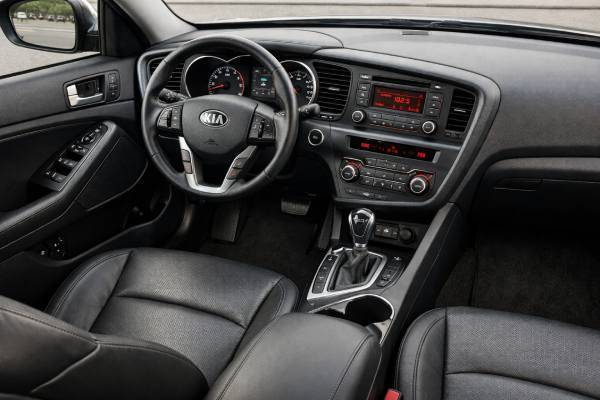
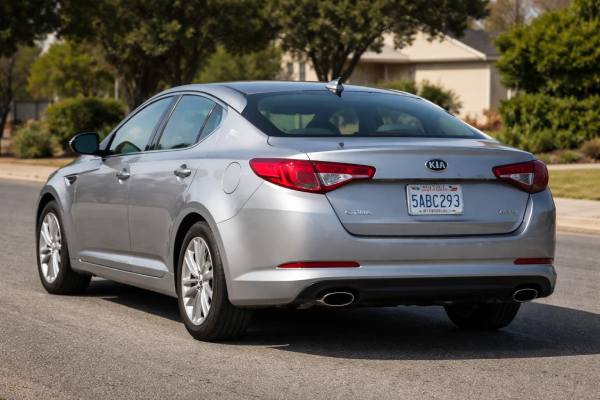
The 2011–2013 Kia Optima (TF) with the 2.0-liter G4KD gasoline engine is the “quietly sensible” version of this generation: naturally aspirated, front-wheel drive, and tuned for smooth daily use rather than headline speed. In most markets it delivers enough mid-range pull for relaxed commuting, with fewer turbo-specific parts to age out later. The trade-off is that you’ll work the engine harder on steep grades or when fully loaded, so maintenance discipline matters more than on the bigger 2.4 or the turbo models.
As an ownership proposition, the best examples are the ones with consistent oil services, clean coolant history, and proof that any recall or service action has been completed. When those basics are in place, the TF Optima can feel like a larger, more mature sedan than its price suggests—stable at speed, comfortable on rough pavement, and easy to live with.
What to Know
- Comfortable ride quality and strong high-speed stability for long highway runs
- Straightforward naturally aspirated powertrain with fewer turbo-related wear items
- Spacious cabin and good everyday ergonomics for a midsize sedan
- Watch for oil consumption and timing-chain noise as mileage climbs
- Plan oil and filter service every 10,000–15,000 km (6,000–9,000 mi) or 12 months (shorter in severe use)
Quick navigation
- Kia Optima TF 2.0 in context
- Kia Optima TF G4KD specifications
- Kia Optima TF trims and safety
- Reliability patterns and fixes
- Maintenance plan and buying tips
- Driving feel and fuel use
- Rivals and smart alternatives
Kia Optima TF 2.0 in context
The TF-generation Optima sits in the heart of the midsize-sedan class: wide enough to feel planted, long enough to track straight at speed, and spacious enough for adult passengers in the rear. With the 2.0-liter G4KD (Theta-family) engine rated around 165 hp, this version prioritizes linear response and predictable behavior over fast sprints. That matters in real ownership, because a naturally aspirated engine typically delivers the same character in summer heat and winter cold—no boost spikes, no intercooler plumbing, and fewer “it depends” variables when diagnosing drivability complaints.
For buyers, the 2.0 can be a sweet spot when you want TF styling and cabin space without committing to higher fuel use from the larger engines. It’s also a version that tends to age more gracefully in the hands of owners who do frequent short trips, because the thermal load and cylinder pressures are generally lower than on turbocharged setups. That said, the G4KD family is sensitive to oil quality and oil level: when maintenance slips, wear patterns can accelerate quickly.
On the road, the Optima’s strengths come through in the boring (good) moments: steady highway cruising, a calm cabin, and suspension tuning that leans toward comfort without feeling floaty. The chassis is typically more “European” in its control than many older Korean sedans, and the steering—while not a sports-car tool—usually feels consistent and easy to place in traffic.
If you’re shopping today, condition beats mileage. A higher-kilometer car with complete service records, clean fluids, and a smooth idle is often safer than a lower-mileage example with patchy history. Focus your early attention on evidence of proper oil service intervals, cooling-system health, and whether any official recall or service campaign work is documented.
Kia Optima TF G4KD specifications
Below are practical, ownership-focused specs for the 2011–2013 Optima (TF) with the 2.0 G4KD. Expect small variations by market, emissions equipment, wheel package, and transmission choice.
Powertrain and efficiency
| Item | Specification |
|---|---|
| Code | G4KD |
| Engine layout and cylinders | Inline-4 (I-4), DOHC, typically 4 valves/cyl (16V) |
| Displacement | 2.0 L (≈1998 cc) |
| Induction | Naturally aspirated (NA) |
| Fuel system | Multi-point injection (MPI) on many markets (varies) |
| Compression ratio | Typically ~10:1 (market-dependent) |
| Max power | 165 hp (121 kW) @ ~6,200 rpm (typical) |
| Max torque | ~196 Nm (145 lb-ft) @ ~4,600 rpm (typical) |
| Timing drive | Chain (inspect for noise/stretch symptoms over time) |
| Rated efficiency | ~7.5–8.5 L/100 km (31–28 mpg US / 38–33 mpg UK) typical mixed range |
| Real-world highway @ 120 km/h | ~7.0–8.0 L/100 km (34–29 mpg US / 40–35 mpg UK) depending on gearbox and tyres |
Transmission and driveline
| Item | Specification |
|---|---|
| Transmission | Commonly 6-speed manual or 6-speed automatic (market/trim dependent) |
| Drive type | FWD |
| Differential | Open |
Chassis and dimensions
| Item | Specification |
|---|---|
| Suspension (front/rear) | MacPherson strut / multi-link (typical for TF) |
| Steering | Electric power steering (EPS) or hydraulic on some markets; ratio varies |
| Brakes | 4-wheel discs (front ventilated); sizes vary with wheel package |
| Wheels and tyres (popular sizes) | Often 205/65 R16 or 215/55 R17 (market/trim dependent) |
| Ground clearance | Typically ~145–155 mm (5.7–6.1 in) depending on tyres/springs |
| Length / Width / Height | ~4,845 mm / 1,830 mm / 1,455 mm (190.7 / 72.0 / 57.3 in) typical |
| Wheelbase | ~2,795 mm (110.0 in) |
| Turning circle (kerb-to-kerb) | ~11.0–11.4 m (36–37 ft) typical |
| Kerb (curb) weight | ~1,420–1,520 kg (3,130–3,350 lb) typical |
| Fuel tank | ~70 L (18.5 US gal / 15.4 UK gal) typical |
| Cargo volume | ~450 L (≈15.9 ft³) seats up (method varies by market) |
Performance and capability
| Item | Typical range |
|---|---|
| 0–100 km/h (0–62 mph) | ~9.5–11.0 s (gearbox and tyres matter) |
| Top speed | ~200–210 km/h (124–130 mph) |
| Braking distance 100–0 km/h | ~37–41 m (tyres and brake condition dominate) |
| Towing capacity | Market-dependent; often ~1,300–1,600 kg braked (verify by VIN plate/handbook) |
| Payload | Typically ~450–550 kg (verify by door-jamb label) |
Fluids and service capacities (verify by VIN)
| Item | Typical specification |
|---|---|
| Engine oil | Quality API/ACEA spec per market; common viscosities include 5W-30 or 5W-40 depending climate |
| Engine oil capacity | ~4.0–4.5 L (4.2–4.8 US qt) with filter (engine-dependent) |
| Coolant | Long-life ethylene glycol mix (often 50/50); capacity commonly ~6–8 L (6.3–8.5 US qt) |
| Transmission/ATF | Manufacturer-specified ATF for 6AT; capacity varies widely (service drain is much less than dry fill) |
| A/C refrigerant | R134a in many markets; charge varies by system label |
| Key torque specs (critical fasteners) | Wheel nuts often 88–108 Nm (65–80 lb-ft); verify in service data |
Safety and driver assistance
| Item | Summary |
|---|---|
| Crash ratings | Vary by market and test year; see official rating bodies for your region |
| ADAS suite | Early 2010s TF models are typically pre-AEB/ACC; focus is on ABS, stability control, and airbags |
| Child-seat provisions | ISOFIX/LATCH commonly present (check rear seat labels) |
A practical way to use these numbers: treat them as a baseline for shopping and maintenance planning, then confirm the exact figures from the vehicle’s handbook, under-hood labels, and VIN-specific service information.
Kia Optima TF trims and safety
Trim names vary by country (and sometimes by importer), but the TF Optima generally follows a familiar ladder: a value-focused base trim, one or two mid grades with comfort and tech upgrades, and a high trim with premium audio, leather, and larger wheels. For the 2.0 G4KD specifically, the biggest “feel” changes usually come from gearbox choice (manual vs automatic), wheel and tyre package, and whether the car has a comfort-oriented or sportier suspension tune in that market.
Quick trim identifiers you can spot in minutes:
- Wheel size and tyre profile: 16-inch packages usually ride softer and are cheaper to keep in tyres; 17–18-inch wheels look sharper but increase impact harshness and can shorten bushing life on bad roads.
- Headlamp type: projector-style housings or factory HID (where offered) often indicate higher trim; base cars are more likely halogen reflectors.
- Cabin clues: dual-zone climate control, heated rear seats, factory navigation, and a branded audio system (where offered) typically sit above entry trims.
- Exterior badges: some markets badge engine size or trim grade, but many do not—always verify via VIN and engine code.
Safety equipment (what matters most for this generation):
- Structure and restraint systems: TF cars were engineered around modern crash structures for the time, with front airbags and side/curtain airbags common in many markets. Confirm airbag count on the B-pillar label or the handbook—some base trims in some regions may have fewer.
- Stability control: ESC (electronic stability control) and traction control are high-value features on wet or snowy roads. Make sure the warning lights illuminate at key-on and turn off after start; a permanently lit ESC/ABS lamp can signal expensive sensor or module faults.
- Braking systems: ABS with electronic brake-force distribution (EBD) is typical. Brake performance depends heavily on tyre quality and caliper condition; neglected slide pins can cause uneven pad wear and pulling under braking.
Driver assistance reality check: On 2011–2013 vehicles, “driver assistance” usually means stability control, parking sensors, and possibly a rear camera on higher trims. Full modern ADAS—automatic emergency braking (AEB), adaptive cruise control (ACC), lane centering—generally isn’t part of the package for this era. That’s not automatically a negative, but it does shift responsibility to tyres, brakes, lights, and driver awareness.
After-service calibration implications: Because TF-era cars are mostly non-ADAS, maintenance is simpler than later models. Still, alignment after suspension work matters, and steering-angle sensor calibration can be required after certain steering repairs. If you see a traction-control warning after a battery disconnect or steering repair, a basic scan tool check is often the first step.
Reliability patterns and fixes
A well-maintained Optima TF 2.0 can be dependable, but it rewards preventive thinking. The goal is to catch small issues—oil level drift, early chain noise, minor cooling leaks—before they become “tow truck” problems.
Common issues (most often reported)
- Oil consumption (low to medium cost, if caught early):
Symptoms: oil level drops between services, blue smoke on cold start (sometimes), spark plug fouling, oily intake tract.
Likely causes: ring wear, PCV (positive crankcase ventilation) valve issues, long oil intervals, or high-temperature operation.
Remedy: shorten oil interval, verify PCV function, check for leaks first, then perform a proper consumption test. Staying on top of oil level is critical on engines that use a timing chain and hydraulic tensioning. - Timing chain noise (medium cost if progressed):
Symptoms: rattling on cold start, noise near timing cover, correlation faults in diagnostics on severe cases.
Likely causes: stretched chain, worn guides, tired tensioner—often accelerated by dirty oil.
Remedy: inspect for noise pattern and scan for timing correlation; replace chain set if out of spec or noisy.
Occasional issues (situational)
- Ignition coils and plugs (low to medium cost):
Symptoms: misfire under load, flashing check-engine light, rough idle.
Remedy: replace plugs with correct heat range and gap; swap coils to confirm misfire movement before buying parts. - Crankshaft or camshaft position sensors (medium inconvenience):
Symptoms: intermittent no-start, stalling, random fault codes.
Remedy: confirm with scan data and wiring inspection; replace sensor if validated. - Cooling system seepage (medium cost if ignored):
Symptoms: coolant smell, gradual loss, damp radiator end tanks, residue at hose joints.
Remedy: pressure test, repair leak promptly, and avoid mixing incompatible coolants.
Rare but high-impact risks
- Bottom-end bearing wear on some Theta-family engines (high cost):
Symptoms: knocking that rises with rpm, low oil pressure warnings, metallic debris in oil.
Remedy: stop driving, confirm oil pressure, inspect for debris, and check whether the vehicle is affected by any campaign or extended coverage in your market. Even if your region differs from others, it’s still smart to treat new engine noise as urgent.
Service actions, recalls, and updates
For a used TF Optima, “reliability” isn’t only parts—it’s documentation. Your best protection is proof that any safety recalls or service campaigns were completed. Use an official VIN lookup and keep records of oil services and major fluid changes. If a seller can’t show paperwork, budget for baseline fluids, filters, plugs (if due), and a full scan for stored fault codes—those steps often reveal hidden neglect.
Maintenance plan and buying tips
A simple, disciplined maintenance plan is the difference between an Optima that feels tight at 250,000 km and one that feels tired at 140,000 km.
Practical maintenance schedule (distance or time, whichever comes first)
| Item | Normal use | Severe use (short trips, heavy city, heat/cold, dusty roads) |
|---|---|---|
| Engine oil and filter | 10,000–15,000 km or 12 months | 7,500–10,000 km or 6–12 months |
| Engine air filter | 30,000 km or 24 months | 15,000–20,000 km |
| Cabin filter | 15,000–30,000 km | 15,000 km |
| Spark plugs | 60,000–100,000 km (plug type dependent) | 60,000 km |
| Coolant | 5 years / 100,000–120,000 km (typical long-life) | 4 years / 80,000–100,000 km |
| Brake fluid | Every 2 years | Every 2 years |
| Transmission fluid (6AT) | 60,000–90,000 km (service drain/fill) | 45,000–60,000 km |
| Tyre rotation | 10,000–12,000 km | 10,000 km |
| Alignment check | Yearly or with tyre wear | Every 6–12 months |
| 12 V battery test | Yearly after 3 years | Yearly after 3 years |
Fluids and spec discipline (why it matters)
Use the correct oil specification for your climate and market, and don’t treat “top-ups” as optional. On engines that can consume oil, the habit that saves engines is simple: check level monthly, and before long highway trips. For coolant, avoid mixing random types—choose one compatible long-life coolant and stick with it.
Buyer’s guide: inspection checklist
- Cold start test: listen for timing-chain rattle, top-end ticking, or deep knocking; confirm idle settles smoothly.
- Oil level and condition: check level before the test drive; look for metal glitter on the dipstick and for fresh undercoating that could hide leaks.
- Cooling system: inspect radiator end tanks, hose joints, and coolant level stability; overheating history is a red flag.
- Transmission behavior (automatic): smooth take-off, predictable shifts, no flare (rev jump) between gears, and no harsh engagement when selecting Drive/Reverse.
- Brakes and tyres: uneven tyre wear suggests alignment or suspension bushing issues; pulsation suggests warped rotors or pad deposits.
- Underbody and corrosion hotspots: check subframe edges, pinch welds, rear suspension mounts, and brake lines—especially in salted climates.
- Electronics scan: run a full scan for stored fault codes even if the dashboard looks clean.
Best “value” configuration advice
If comfort and running costs matter most, prioritize 16-inch wheels, a documented service history, and a clean mechanical baseline over luxury options. If you want the nicest daily experience, a mid trim with dual-zone climate, parking sensors, and a good tyre package often hits the sweet spot without adding complex hardware.
Long-term outlook: maintained examples can be durable, but neglected oil service or unresolved engine noise can turn the economics upside down fast. Buy the best history you can find.
Driving feel and fuel use
The TF Optima with the 2.0 G4KD is not a “fast sedan” by modern standards, but it is often a satisfying daily driver because its responses are predictable. Throttle mapping is usually progressive, and the naturally aspirated setup means power builds steadily as revs rise. Around town, it feels calm and cooperative; on the highway, it tends to settle into a stable, low-drama rhythm.
Ride, handling, and NVH (noise, vibration, harshness)
- Ride: Generally compliant over broken pavement, especially on 16-inch tyres. Larger wheels sharpen turn-in but pass more impacts into the cabin.
- Handling: Balanced and confidence-inspiring rather than playful. The chassis typically resists excessive body roll and tracks straight in crosswinds.
- Steering: Light to moderate effort. Feedback is limited compared with enthusiast cars, but accuracy is usually good once aligned properly.
- Cabin noise: Wind and road noise are reasonable for the era; worn door seals or cheap tyres can make the car feel louder than it should.
Powertrain character and real-world performance
- City driving: The 2.0 feels adequate off the line, but it isn’t torque-rich. You’ll notice it most with a full cabin or when merging uphill—expect more downshifts and higher rpm than with larger engines.
- Passing: Planning helps. A clean ignition system (fresh plugs/coils when due) and a healthy transmission make a noticeable difference in midrange response.
- Automatic behavior: A good 6-speed automatic should shift cleanly and avoid excessive hunting. If it constantly shifts on gentle hills, check for outdated fluid, mismatched tyres, or engine issues causing low torque.
Real-world efficiency (typical ownership ranges)
Your actual numbers depend on tyres, alignment, traffic, and climate, but many owners land in these bands:
- Mixed driving: ~7.5–9.0 L/100 km (31–26 mpg US / 38–31 mpg UK)
- Highway 100–120 km/h: ~7.0–8.0 L/100 km (34–29 mpg US / 40–35 mpg UK)
- Cold weather: add ~0.5–1.5 L/100 km depending on trip length and heater use
The biggest “free” efficiency gains come from tyre pressure, alignment, and keeping the engine in good tune. A dragging brake caliper or underinflated tyres can erase the advantage of a smaller engine quickly.
Rivals and smart alternatives
Cross-shopping is smart in this segment because many midsize sedans offer similar space but different ownership risks. The TF Optima 2.0’s main appeal is its comfort and straightforward layout, but your best choice depends on what you value most.
Where the Optima TF 2.0 stands out
- Comfort-first balance: It often feels more “grown up” than its price suggests—stable at speed and comfortable for long commutes.
- Feature value: Depending on trim, it can offer premium-feeling interiors and convenience features that cost more in some rivals.
- Simplicity vs turbo models: The naturally aspirated configuration avoids turbocharger and intercooler aging issues.
Trade-offs to consider
- Performance headroom: If you regularly carry passengers or drive mountainous routes, you may prefer a larger-displacement engine or a more torque-rich alternative.
- Engine reputation sensitivity: The 2.0 Theta-family engines demand careful oil service habits. If you don’t want to think about oil level checks, prioritize a car with a spotless history or consider a rival with a stronger “neglect tolerance.”
Common rival comparisons (how to decide)
- Versus Hyundai Sonata (similar platform family in many markets): Often a close cousin in driving feel and packaging; buy on condition and service history rather than badge.
- Versus Toyota Camry: Frequently the conservative durability pick; may feel less sporty but can be forgiving of imperfect maintenance (still not recommended).
- Versus Honda Accord: Often stronger steering feel and efficiency; can command higher prices in good condition.
- Versus Volkswagen Passat: Spacious and refined, but can bring higher parts and diagnostic complexity depending on engine and gearbox.
- Versus Ford Mondeo/Fusion-era alternatives: Good dynamics in many versions; ownership experience varies heavily by powertrain.
A practical “best pick” rule
Choose the Optima TF 2.0 if you find one with documented oil services, clean running behavior, and proof of recall/campaign completion. If you can’t verify history, it’s often safer to pay more for a rival with transparent records than to “gamble” on an unknown Optima—because the downside costs can be high if engine issues are lurking.
References
- 2013 Kia Optima 4-door sedan – IIHS-HLDI 2013 (Safety Rating)
- NHTSA Vehicle Detail Search – 2011 KIA OPTIMA 2011 (Recall Database)
- Engine Oil Grades and Capacities 2016 (Service Guide)
- Kia_Rescue-sheets_03_2021_ENU 2021 (Technical Guide)
Disclaimer
This article is for informational purposes only and is not a substitute for professional diagnosis, inspection, or repair. Specifications, torque values, fluid capacities, and service intervals can vary by VIN, market, model year, and equipment—always verify details using official service documentation for your exact vehicle.
If this guide helped, consider sharing it on Facebook or X/Twitter to support our work and help other owners research confidently.