
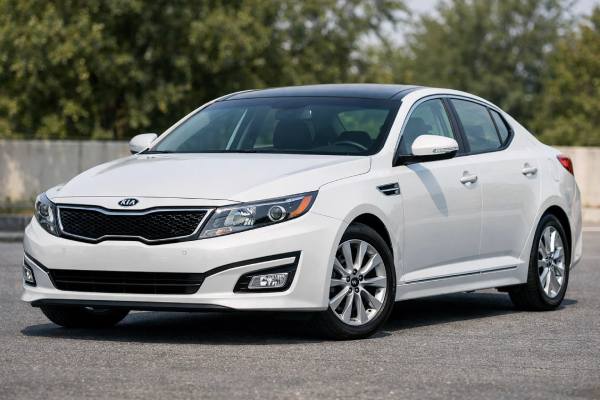


The 2014–2015 facelifted Kia Optima TF with the 2.0-liter turbo G4KH is the “sleeper” in the midsize-sedan world: quick in a straight line, comfortable on long drives, and generally easy to live with—if you shop carefully. This version pairs a torquey direct-injected turbo engine with a conventional 6-speed automatic and front-wheel drive, so it feels familiar to maintain and drive, yet noticeably stronger than the base engines. The facelift years also brought small but meaningful improvements in noise control, infotainment usability, and available safety tech, depending on market and trim.
Where owners get surprised is not day-to-day usability, but risk management: the Theta II turbo family has a reputation shaped by recalls, service campaigns, and the importance of correct oil, intervals, and verified update history. If you approach it like a performance daily—not a neglected commuter—this Optima can be a rewarding buy.
Owner Snapshot
- Strong midrange pull and easy highway passing without needing a larger engine
- Comfortable ride and stable long-distance manners on 18-inch setups
- Good value for features versus many same-era midsize sedans
- Buy only with documented recall and software update completion, plus clean oil-service history
- Plan oil changes every 8,000–10,000 km (5,000–6,000 mi) or 6 months, whichever comes first
Navigate this guide
- Optima TF 2.0T facelift profile
- Optima TF 2.0T specs table
- Optima TF 2.0T trims and safety
- Reliability watchlist and recalls
- Maintenance schedule and buyer checks
- On-road feel and fuel use
- Best alternatives in class
Optima TF 2.0T facelift profile
The 2014–2015 Optima TF facelift is still the same underlying generation introduced earlier in the TF run, but it’s a more polished version of it. The headline for this configuration is the G4KH 2.0 turbo: an inline-four with gasoline direct injection (GDI) and a turbocharger tuned for strong midrange torque. In everyday driving, that torque matters more than peak horsepower. It gives the car the “effortless” feel you usually associate with a V6—especially in rolling highway speeds and quick two-lane passes.
As a platform, the Optima TF leans comfort-first. The suspension is not sporty in the European sense, but it is stable and predictable. The facelift years often feel a bit tighter in sound insulation and cabin finish, and many cars from these years have modern-enough essentials: Bluetooth audio, a usable infotainment layout, and a strong feature-to-price ratio on the used market.
The ownership story comes down to three themes:
- Heat and oil control. Turbo GDI engines run hot and can punish long oil intervals. Clean oil is protection for the turbo bearings, timing chain components, and variable valve timing (VVT) actuators.
- Service history matters more than mileage. A higher-mile car with consistent oil service and recall completion is usually a safer bet than a low-mile car with unknown history and long gaps.
- This is a quick FWD sedan. You may get torque steer on hard launches, and tire quality matters a lot more than many owners expect. A good set of tires can make the car feel calmer, safer, and quieter.
If your goal is a comfortable midsize sedan with real pace, the 2.0T Optima delivers. But it is not the “buy it and ignore it” version of the Optima lineup. Treat it like a lightly performance-oriented daily driver and it tends to repay the attention.
Optima TF 2.0T specs table
Specs vary slightly by market and trim, but the numbers below reflect the common 2014–2015 facelift Optima TF 2.0T configuration.
Powertrain and efficiency
| Item | Specification |
|---|---|
| Code | G4KH (Theta II 2.0 T-GDI) |
| Engine layout and cylinders | I-4, DOHC, 4 valves/cyl |
| Bore × stroke | 86.0 × 86.0 mm (3.39 × 3.39 in) |
| Displacement | 2.0 L (1,998 cc) |
| Induction | Turbocharged |
| Fuel system | Direct injection (GDI) |
| Compression ratio | ~9.5:1 (market dependent) |
| Max power | 274 hp (204 kW) @ ~6,000 rpm |
| Max torque | ~365 Nm (269 lb-ft) @ ~1,750–4,500 rpm |
| Timing drive | Chain |
| Rated efficiency | Typically ~8.5–10.0 L/100 km (28–24 mpg US / 33–28 mpg UK) depending on wheels and market |
| Real-world highway @ 120 km/h (75 mph) | Often ~7.5–9.0 L/100 km (31–26 mpg US / 38–31 mpg UK) with a healthy drivetrain |
Transmission and driveline
| Item | Specification |
|---|---|
| Transmission | 6-speed automatic (torque-converter automatic) |
| Drive type | FWD |
| Differential | Open (traction control manages slip) |
Chassis and dimensions
| Item | Specification |
|---|---|
| Suspension (front / rear) | MacPherson strut / multi-link (typical TF layout) |
| Steering | Electric power steering |
| Brakes | 4-wheel discs (sizes vary by trim; larger on sport trims) |
| Wheels and tyres (popular size) | Common: 235/45 R18 (18 in rim) |
| Ground clearance | Typically ~145–155 mm (5.7–6.1 in) |
| Length / width / height | About 4,845 / 1,830 / 1,455 mm (190.7 / 72.0 / 57.3 in) |
| Wheelbase | About 2,795 mm (110.0 in) |
| Turning circle (kerb-to-kerb) | About ~11.0–11.2 m (36–37 ft) |
| Kerb (curb) weight | Typically ~1,520–1,620 kg (3,350–3,570 lb) |
| Fuel tank | Typically ~70 L (18.5 US gal / 15.4 UK gal) |
Performance and capability
| Item | Typical result |
|---|---|
| 0–100 km/h (0–62 mph) | ~6.8–7.5 s (traction and tires matter) |
| Top speed | ~210–230 km/h (130–143 mph) market limited |
| Braking 100–0 km/h | Often ~36–40 m on good tires |
| Towing capacity | Often not rated or low in many markets; check local handbook |
| Payload | Typically ~450–550 kg (990–1,210 lb) |
Fluids and service capacities (check by VIN)
| Item | Specification |
|---|---|
| Engine oil | Full synthetic meeting the required API/ACEA spec; common grade 5W-30 (some climates allow 0W-30/5W-40). Capacity often ~5.0–5.5 L (5.3–5.8 US qt) with filter |
| Coolant | Long-life ethylene glycol coolant, typically 50/50 mix; capacity often ~6.5–7.5 L (6.9–7.9 US qt) |
| Transmission / ATF | Manufacturer-specified ATF for the 6AT; service fill varies, total often ~7–8 L (7.4–8.5 US qt) |
| A/C refrigerant | Typically R-134a; charge varies by market (label on radiator support) |
Key torque specs (critical fasteners, verify for your engine)
| Fastener | Typical torque range |
|---|---|
| Wheel lug nuts | ~88–108 Nm (65–80 lb-ft) |
| Spark plugs (seat type dependent) | Often ~18–25 Nm (13–18 lb-ft) |
| Engine oil drain plug | Often ~25–40 Nm (18–30 lb-ft) |
Optima TF 2.0T trims and safety
Trim naming varies a lot by country, so it helps to think in “equipment groups” rather than exact badges. In many markets, the 2.0T is positioned as the sporty or top powertrain, often paired with larger wheels, upgraded brakes, and more standard convenience features. The facelift years also tend to bring better head unit layouts and small refinements (lighting details, wheel designs, and interior materials), but the biggest buying differences are still feature packaging.
Trims, options, and how to identify them quickly
Common cues that you are looking at a 2.0T-equivalent car:
- Dual exhaust outlets (market dependent) and a sportier rear bumper treatment
- 18-inch wheels and wider tires (often 235-section)
- More supportive front seats and additional interior trim accents
- More frequent availability of premium audio and navigation packages
If you are shopping remotely, ask for photos of:
- The engine cover and under-hood emissions label (often reveals engine family)
- The tire size printed on the sidewall
- The instrument cluster at ignition-on (warning lights and feature icons differ by trim)
Safety ratings and structural basics
For this generation, crash performance is generally solid in the core tests, but you should separate two ideas:
- Structure and airbags (what the car is built with)
- Crash avoidance tech (what the car can do to help you avoid a crash)
Most 2014–2015 facelift cars include:
- Front, side, and curtain airbags (exact count varies by market)
- Stability control and traction control
- ABS with electronic brake-force distribution
Child-seat hardware is usually straightforward: outer rear seats commonly have ISOFIX/LATCH anchors, plus top tethers.
Driver assistance and what is realistic for 2014–2015
Do not expect modern “full suite” ADAS. On this era of Optima TF, common additions are:
- Blind-spot detection and rear cross-traffic alert (often optional or trim-limited)
- Rear parking sensors and backup camera (varies by trim)
- Tire pressure monitoring (market dependent)
Forward collision avoidance and adaptive cruise were not widely standard on this generation in many markets. If a seller advertises advanced systems, confirm with photos of steering-wheel buttons, radar sensors, and option lists—because “lane assist” and similar phrases are often used loosely.
A practical safety takeaway: if the car has 18-inch wheels and strong power, invest in quality tires and keep the brake system in top condition. On a quick FWD sedan, grip and brake consistency do as much for real-world safety as many factory options.
Reliability watchlist and recalls
This is the section that should shape how you shop. The 2.0T G4KH Optima can be dependable, but it is part of the Theta II family that has seen high-profile recalls and service actions. Your goal is not to panic—it is to verify. A well-maintained, properly updated car is a different ownership proposition than one with missing paperwork.
Common issues (higher prevalence)
- Oil consumption or oil level drop (severity: medium to high if ignored)
- Symptoms: rising oil top-ups, low oil warning, noisy valvetrain on cold start
- Likely causes: extended oil intervals, ring wear, PCV system issues, turbo oil seepage
- Remedy: shorten oil intervals, verify PCV function, check for leaks, compression/leak-down if consumption is heavy
- Carbon buildup on intake valves (GDI trait) (severity: medium)
- Symptoms: rough idle, hesitation, misfires under load, reduced economy
- Cause: direct injection does not wash valves with fuel
- Remedy: intake valve cleaning (walnut blasting or approved method), keep plugs and coils fresh
- Ignition coil and spark plug sensitivity (severity: low to medium)
- Symptoms: misfire codes, stumble on boost, poor cold start
- Cause: turbo cylinder pressures stress ignition components
- Remedy: correct heat-range plugs, proper gap, replace coils as needed
Occasional but important (cost can be higher)
- Turbo and charge-air leaks
- Symptoms: weak boost, whistle, underboost codes, oily residue near intercooler hoses
- Cause: aging hoses, clamps, or intercooler end-tank seepage
- Remedy: smoke test, replace hoses/clamps, inspect PCV and turbo plumbing
- Timing chain noise or VVT actuator issues (severity: medium to high if severe)
- Symptoms: rattle on start, cam correlation codes
- Cause: oil quality/interval, tensioner wear, actuator wear
- Remedy: diagnose early; don’t mask with thicker oil
Recalls, service actions, and software updates
For many owners, the defining event is whether the car received applicable recall repairs and software logic updates meant to detect abnormal bearing wear earlier and reduce catastrophic outcomes. When a seller says “all recalls done,” ask for the repair order printout, not just a verbal promise.
How to verify properly:
- Ask for the VIN and run an official recall check (or have a dealer print status).
- Confirm dates and mileages of recall completion.
- Look for documentation of related follow-up work if the engine was replaced (some later recalls address post-repair risks).
Pre-purchase checks to request (worth paying for)
- Cold start listen test (knock, rattle, or chain noise)
- Oil level and condition, plus evidence of recent changes
- Scan for stored and pending codes, not just a dashboard check
- Boost leak check and test drive under moderate load
- Proof of recall completion and any required software updates
If the car passes these steps and has consistent oil service, it can be a strong daily driver. If paperwork is missing and the seller is vague, assume you are buying risk.
Maintenance schedule and buyer checks
A maintenance plan for the 2.0T Optima TF is less about exotic procedures and more about consistency. Turbo GDI engines reward conservative intervals and correct fluids, especially if you do short trips, heavy traffic, or frequent full-throttle merges.
Practical maintenance schedule (distance or time)
Use whichever comes first:
- Engine oil and filter: every 8,000–10,000 km (5,000–6,000 mi) or 6 months
- If you drive short trips or hot climates, lean toward the shorter interval.
- Tire rotation and brake inspection: every 10,000–12,000 km (6,000–7,500 mi)
- Cabin air filter: every 15,000–20,000 km (9,000–12,000 mi), sooner in dusty cities
- Engine air filter: every 20,000–30,000 km (12,000–18,000 mi)
- Spark plugs (turbo GDI): commonly 50,000–80,000 km (30,000–50,000 mi) depending on plug type and driving style
- Brake fluid: every 2 years regardless of mileage
- Coolant: often 5 years then every 3–5 years (confirm coolant type and local spec)
- Automatic transmission fluid: conservative service at 60,000–90,000 km (40,000–60,000 mi) can improve shift quality and longevity
- 12 V battery test: yearly after year 4; replacement window often 4–6 years
Fluids and specs that matter
- Use full synthetic oil that meets the required standard, not just the right viscosity. The spec is as important as the number on the bottle.
- Avoid “universal” ATF unless it explicitly matches the required transmission spec for your exact gearbox.
- Keep coolant chemistry correct; mixing types can reduce corrosion protection.
Buyer’s guide: what to seek and what to avoid
Seek:
- Documented oil changes at sensible intervals
- Verified recall completion and any related follow-ups
- Smooth boost delivery (no surging, no hesitation)
- Clean, even tire wear (suggests decent alignment and suspension health)
Be cautious with:
- Long oil intervals (15,000–20,000 km claims)
- Heavy modifications (boost controllers, non-calibrated tunes) without proof of supporting maintenance
- Persistent misfire history, especially under load
- Sellers who cannot provide a VIN or service paperwork
Typical reconditioning items after purchase
Budget for a “baseline refresh” unless it was done recently:
- Oil service with a known-quality filter
- Cabin and engine air filters
- Brake fluid exchange if unknown
- Spark plugs if mileage is near the interval
- One good set of tires if the current set is mixed brands or unevenly worn
Long-term durability outlook: with verified updates, frequent oil service, and careful attention to ignition and airflow components, this Optima can do high mileage. Without those, it can become an expensive gamble.
On-road feel and fuel use
The Optima TF 2.0T is at its best as a calm, fast commuter. It does not feel like a sports sedan, but it has real pace when you ask for it.
Ride, handling, and NVH
Ride quality is generally composed, especially on healthy dampers and quality tires. Over broken pavement, 18-inch wheels can add some sharpness, but the chassis stays stable and doesn’t feel nervous. Steering is light to moderate with an emphasis on easy control rather than detailed feedback. In corners, the car prefers smooth inputs; push hard and you will feel typical front-drive behavior: the outside front tire does most of the work, and the car will understeer if you enter too fast.
Cabin noise is acceptable for the class. Wind noise is usually more noticeable than engine noise at highway speeds, and tire choice can dramatically change how quiet the car feels.
Powertrain character
The turbo engine’s personality is the reason to buy this model. It delivers strong torque at low rpm, so you can merge and pass with a short pedal movement rather than a downshift frenzy. Turbo lag is modest, but it exists: from very low rpm, there can be a brief pause before full boost arrives. The 6-speed automatic is generally smooth, but some cars hunt between gears on rolling hills if the throttle is held at a precise, light angle. Using a more decisive pedal input often reduces that behavior.
For longevity, treat it like a turbo car:
- Let oil warm before heavy boost
- After a hard run, drive gently for the last minute to stabilize turbo heat
- Do not ignore small misfires; boost amplifies small problems quickly
Real-world efficiency
Expect fuel use to vary with driving style more than on the base engines. A gentle highway driver can see respectable numbers, but repeated boost events will raise consumption quickly.
Typical patterns:
- City: roughly 10–13 L/100 km (24–18 mpg US / 28–22 mpg UK)
- Highway (100–120 km/h): roughly 7.5–9.0 L/100 km (31–26 mpg US / 38–31 mpg UK)
- Mixed: roughly 8.5–11.0 L/100 km (28–21 mpg US / 33–26 mpg UK)
Cold weather can increase consumption notably due to longer warm-up time and denser air increasing drag.
If you want the speed but dislike fuel swings, the best “mod” is often tires and maintenance: correct plug condition, clean airflow path, and properly inflated tires can make the powertrain feel smoother and more efficient.
Best alternatives in class
The Optima TF 2.0T facelift sits in a competitive era for midsize sedans. It stands out on value and torque, but depending on your priorities, a rival may fit better.
If you want maximum long-term simplicity
- Toyota Camry (same era, non-turbo engines): Typically lower power but a reputation for straightforward ownership. Great if you want to minimize turbo and GDI-related complexity.
- Honda Accord (same era, naturally aspirated options): Efficient and roomy, often with strong resale value.
These alternatives usually feel less “quick for the money,” but they can reduce the risk profile if you want the least drama.
If you want similar power with different tradeoffs
- Ford Fusion 2.0 EcoBoost: Strong torque and good features, but ownership quality depends heavily on maintenance history, and parts costs can vary by region.
- Hyundai Sonata 2.0T (sister platform): Similar performance feel, similar maintenance mindset, and similar “verify the history” buying rules.
In these cases, you are choosing between flavors of the same concept: turbo torque in a comfort-first sedan.
If you want a more driver-focused feel
- Mazda6 (same era): Usually less outright shove than the Optima 2.0T, but often more connected steering and chassis balance. A great pick if you value cornering feel more than straight-line punch.
The practical verdict
Choose the Optima TF 2.0T facelift if:
- You want strong passing power without stepping into a premium-brand price
- You are willing to verify recalls and keep oil intervals conservative
- You prefer comfort and features over sharp handling
Choose a rival if:
- You want the lowest complexity and highest tolerance for neglect
- You strongly prefer a naturally aspirated engine character
- You value steering feel and chassis nuance more than torque
The best “rival” is often the cleanest example. A documented, well-cared-for Optima can be a better buy than a neglected “more reliable” nameplate. History and condition should decide the winner.
References
- 2015 Kia Optima 2015 (Safety Rating)
- RCLRPT-17V224-2355.PDF 2017 (Recall Database)
- RCONL-18V907-3812.pdf 2019 (Recall Database)
Disclaimer
This article is for informational purposes only and is not a substitute for professional diagnosis, inspection, or repair. Specifications, torque values, service intervals, and procedures can vary by VIN, market, powertrain calibration, and installed equipment. Always verify details using official manufacturer service information for your exact vehicle and consult a qualified technician when needed.
If you found this guide useful, please consider sharing it on Facebook, X (Twitter), or your preferred platform to support our work.