
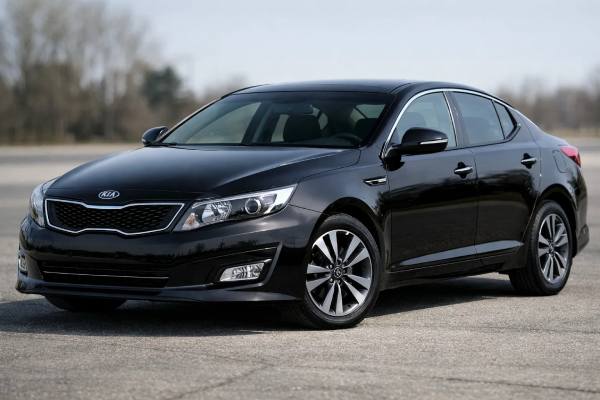
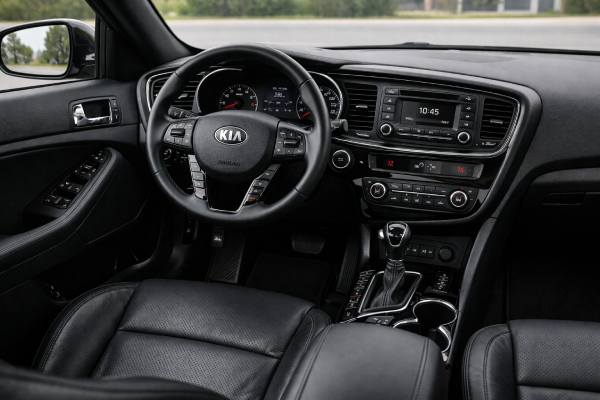
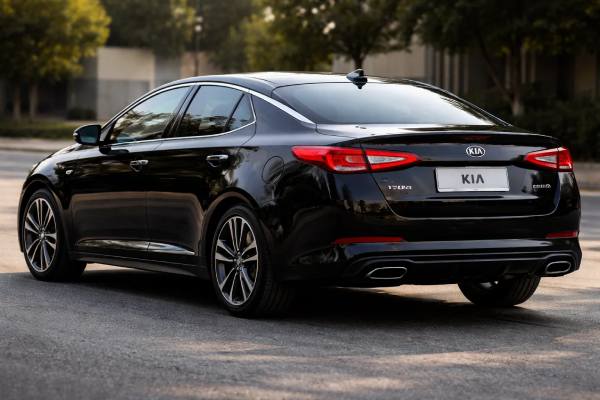
The 2014–2015 facelift version of the Kia Optima TF is the “mature” take on Kia’s third-generation midsize sedan: the chassis tuning is settled, the cabin is quiet for the class, and the naturally aspirated 2.0-liter G4KD (165 hp) keeps ownership simple compared with turbocharged variants. In day-to-day driving, this powertrain prioritizes linear throttle response and predictable traction over outright pace, which suits commuting and long motorway trips. The Optima’s strengths are its roomy wheelbase-led packaging, composed ride, and a straightforward FWD layout that most independent shops understand.
Where owners need to be realistic is long-term maintenance discipline: this engine family rewards clean oil, timely cooling-system service, and attention to small leaks before they become big ones. Buy well, service on time, and the TF can be an honest, comfortable workhorse rather than a finicky project.
Owner Snapshot
- Comfortable, stable ride on broken city pavement and at motorway speeds
- Practical midsize cabin and trunk for family use and airport runs
- Simple, linear NA engine response that suits relaxed driving
- Budget for preventative work on cooling, belts, and small oil leaks as the car ages
- Change engine oil every 10,000–12,000 km or 12 months (whichever comes first)
Quick navigation
- Kia Optima TF facelift overview
- Kia Optima TF 2.0 specs and dimensions
- Kia Optima TF trims, safety and ADAS
- Reliability issues and recalls
- Maintenance plan and buying tips
- Real-world driving and economy
- Optima TF vs midsize rivals
Kia Optima TF facelift overview
The TF Optima sits in the “classic” front-wheel-drive midsize formula: long wheelbase, transverse inline-four, and a comfort-first suspension that still resists float at higher speeds. In facelift form (2014–2015), the Optima benefited from incremental refinement rather than a full redesign—think quieter materials, small infotainment updates, and detail improvements to lighting and trim depending on market. The fundamentals that matter to owners stayed the same: a stiff enough body structure, a planted motorway stance, and seating that works for real adult passengers in the rear.
With the G4KD 2.0-liter naturally aspirated engine, the ownership proposition is “predictable and serviceable.” There’s no turbocharger heat load, no intercooler plumbing, and generally fewer expensive surprises than on higher-output versions. Power delivery is progressive: it won’t pin you to the seat, but it does make it easier to drive smoothly, especially in wet or winter conditions where big low-rpm torque can overwhelm the front tires.
The TF’s packaging is one of its quiet advantages. The wheelbase (about 2.79 m) is a key reason the rear bench feels less cramped than many compact sedans, and the trunk is genuinely useful for luggage. For families, that matters more than an extra second in a 0–100 sprint.
From a used-car perspective, the Optima is at its best when you treat it like a “maintenance-led” car: consistent oil changes, cooling system attention, and preventative replacement of wear items (mounts, belts, bushings) as they age. Buyers who skip service to save money typically end up paying more later—usually through oil leaks, neglected fluids, or overheating episodes that could have been avoided.
Who is this exact spec for? Drivers who want a comfortable midsize sedan with simple mechanicals, who value quiet cruising and predictable handling, and who don’t mind staying ahead of routine service. Who should look elsewhere? Anyone who expects strong passing performance when fully loaded, or who wants modern active safety (AEB/ACC) that wasn’t common on this era and trim level.
Kia Optima TF 2.0 specs and dimensions
Below are practical, owner-relevant specs for the 2014–2015 facelift TF with the 2.0-liter G4KD rated at 165 hp. Exact values can vary by market, emissions certification, and transmission choice; use VIN-specific service data for final confirmation.
Powertrain and efficiency
| Item | Spec |
|---|---|
| Code | G4KD |
| Engine layout and cylinders | Inline-4 (I-4), DOHC, 4 valves/cyl |
| Bore × stroke | 86.0 × 86.0 mm (3.39 × 3.39 in) |
| Displacement | 2.0 L (1,998 cc) |
| Induction | Naturally aspirated |
| Fuel system | MPI/port injection (market dependent) |
| Compression ratio | ~10.5:1 (varies by calibration) |
| Max power | 165 hp (121 kW) @ ~6,200 rpm |
| Max torque | ~198 Nm (146 lb-ft) @ ~4,600 rpm |
| Timing drive | Chain |
| Rated efficiency (typical) | ~7.5–8.2 L/100 km (31–27 mpg US / 38–34 mpg UK) |
| Real-world highway @ 120 km/h | ~7.0–8.0 L/100 km, load and weather dependent |
Transmission and driveline
| Item | Spec |
|---|---|
| Transmission | 6-speed manual or 6-speed automatic (market dependent) |
| Drive type | FWD |
| Differential | Open |
Chassis and dimensions
| Item | Spec |
|---|---|
| Suspension (front/rear) | MacPherson strut / multi-link |
| Steering | Rack and pinion, hydraulic power assist (common on TF) |
| Brakes | 300 mm (11.8 in) vented front / 284 mm (11.2 in) rear discs (typical); some trims use 320 mm (12.6 in) front |
| Wheels/tyres (popular) | 215/55 R17 (17 in rim); also common: 205/65 R16, 225/45 R18 |
| Ground clearance | 130 mm (5.1 in) |
| Length / width / height | 4,844 / 1,831 / 1,450 mm (190.7 / 72.1 / 57.1 in) |
| Wheelbase | 2,794 mm (110.0 in) |
| Turning circle (kerb-to-kerb) | 10.9 m (35.8 ft) |
| Kerb weight | ~1,450–1,520 kg (3,200–3,350 lb), equipment dependent |
| Fuel tank | ~70.0 L (18.5 US gal / 15.4 UK gal) |
| Cargo volume | ~436 L (15.4 ft³), seats up (method varies) |
Performance and capability (typical for 165 hp)
| Item | Spec |
|---|---|
| 0–100 km/h (0–62 mph) | ~10.5–11.5 s (transmission and tyres matter) |
| Top speed | ~200–210 km/h (124–130 mph) |
Fluids and service capacities (owner-level guidance)
Because published capacities differ by sump design, cooler fitment, and service method, treat these as planning ranges:
| Item | Spec |
|---|---|
| Engine oil | 5W-30 or 5W-40 commonly specified; ~4.1–4.8 L (4.3–5.1 US qt) with filter |
| Coolant | Long-life ethylene glycol; typically 50/50 mix; ~6–7 L total system (varies) |
| Automatic transmission/ATF | SP-IV family fluid commonly used; drain and fill often ~4–5 L, total higher |
| A/C refrigerant | R-134a common for this era; charge varies by market and compressor |
Key torque specs (typical, always verify for your VIN)
| Fastener | Torque |
|---|---|
| Wheel lug nuts | ~90–110 Nm (66–81 lb-ft) |
Kia Optima TF trims, safety and ADAS
Trims for the 2014–2015 facelift TF vary widely by region, but the buying logic is consistent: decide whether you want the comfort upgrades (seats, audio, lighting) and then verify the safety equipment that comes with that trim level in your market.
Trims and options that change the ownership experience
Most markets split the Optima into three “bands”:
- Value/base trims: cloth seats, smaller wheels (often 16 in), simpler head unit, fewer sensors. These can ride slightly softer thanks to taller tire sidewalls and usually cost less to re-tire.
- Mid trims: the sweet spot for many used buyers—often adding better infotainment, parking sensors/camera, heated seats, and upgraded interior materials. Look for steering-wheel buttons, larger screens, and more speaker grilles as quick visual tells.
- High trims: leather, ventilated seats in some regions, premium audio, HID/LED lighting elements, panoramic roof options, larger wheels (18 in) and sometimes upgraded front brakes. These feel nicest, but they carry higher costs for tires, headlights, and suspension wear items.
If you’re shopping across borders (common in Europe), spend time confirming the exact equipment list: identical badges can hide different spec sheets.
Crash ratings and what they mean for a 2014–2015 buyer
For TF-era Optima models, IIHS ratings in the U.S. market show strong results in key crash tests for 2011–2015 applicability, with Good scores in moderate overlap front, side, roof strength, and head restraints, and an Acceptable small overlap front (driver-side). That combination mattered in this era because many competitors struggled with small overlap performance when the test was introduced.
For Euro NCAP, manufacturer communications for the Optima highlight a five-star result under the then-current test regime, with published category percentages including Adult Occupant 89%, Child Occupant 86%, and Safety Assist 71%. Treat pedestrian/VRU performance as “good for its time but not modern-car good,” and remember that test protocols evolve; a five-star score from a decade ago doesn’t equal today’s five-star benchmark.
Safety systems and ADAS availability
On this generation, most cars include the fundamentals:
- Front airbags plus side and curtain airbags (counts vary by market)
- ABS and stability control (ESC)
- ISOFIX/LATCH points (verify rear seat positions by market)
Advanced driver assistance is typically limited. Blind-spot monitoring may be optional on some configurations, while forward collision avoidance and adaptive cruise were often unavailable or rare depending on region and year. If you want modern ADAS, confirm the car’s build sheet rather than assuming by model year.
After any windshield replacement, bumper repair, or alignment work, verify that parking sensors and camera guidance lines behave correctly. Even without today’s radar-heavy suites, misalignment can cause annoying false alerts and poor camera calibration.
Reliability issues and recalls
The TF Optima can be reliable, but it responds badly to neglected fluids and “drive it until it breaks” habits. Think of common issues in three buckets: aging rubber/plastics, heat management, and (for some markets and engine variants) well-documented Theta-family engine concerns.
Common, usually low-to-medium cost (watch early)
- Valve cover gasket seepage: oily smell after stops, oil mist on the back of the engine → gasket and PCV inspection.
- PCV valve and intake deposits: rough idle or higher oil use → replace PCV, check for vacuum leaks, keep oil change intervals sensible.
- Cooling system wear: thermostat, radiator cap, hoses, and expansion tank aging → small leaks become overheating if ignored.
- Suspension bushings and links: clunks over bumps → typically stabilizer links, control arm bushings, or top mounts.
Occasional, medium cost (plan for mileage)
- Wheel bearings: humming that rises with speed → replace the affected hub.
- Alternator or battery charging issues: low voltage warnings, slow cranking → test alternator output and battery health rather than guessing.
- A/C performance loss: weak cooling at idle → check condenser condition, fan operation, and refrigerant charge for leaks.
Higher-severity (market and engine dependent)
This is where you must be precise about which engine and which market. In North America, certain Hyundai/Kia Theta-family engines have been involved in major recall actions related to bearing wear and potential engine failure, with documentation describing debris and machining conditions that can restrict oil flow to bearings. If you’re buying an imported vehicle or a variant that falls under those campaigns, verification is not optional.
How to map risk to your car:
- Confirm the exact engine code and production details from the VIN/build plate and registration documents.
- Check recall completion using an official VIN recall lookup and dealer history.
- Listen and scan: cold start rattle, persistent knocking under load, oil pressure warnings, and stored timing correlation codes deserve immediate diagnosis.
Software and calibrations
Even on non-turbo, non-hybrid cars, software updates can matter: idle quality, transmission shift logic, and sensor fault thresholds are sometimes improved through manufacturer updates. Ask for printouts of completed service actions when possible, especially if the car shows intermittent warning lights.
Bottom line: the Optima TF isn’t uniquely fragile, but it does punish missed oil changes and overheating events more than owners expect. A clean service history and a calm mechanical inspection are worth more than shiny wheels.
Maintenance plan and buying tips
A 2014–2015 Optima TF is now old enough that “age maintenance” matters as much as mileage. Use the schedule below as a practical baseline, then adjust to your usage (short trips, extreme heat/cold, heavy traffic).
Practical maintenance schedule (distance/time)
Every 10,000–12,000 km or 12 months
- Engine oil and filter (use the correct spec for your market; don’t stretch intervals on older engines)
- Inspect for coolant leaks, oil seepage, and belt condition
- Tire pressure check and visual tire wear inspection
Every 20,000–30,000 km or 2 years
- Cabin air filter
- Engine air filter (earlier if dusty driving)
- Brake inspection (pad thickness, rotor condition, caliper slide lubrication)
- Wheel alignment check if uneven wear appears
Every 40,000–60,000 km
- Brake fluid (often best at 2-year intervals regardless of km)
- Automatic transmission service (drain/fill; follow the correct fluid spec)
- Inspect accessory belt, tensioner, and idlers; replace if noisy or cracked
Every 80,000–120,000 km (or per manual)
- Spark plugs (interval depends on plug type and market)
- Coolant replacement (long-life coolant still ages—especially if topped up with mixed fluids)
As needed with age (often 8–12 years)
- Radiator hoses, thermostat, and coolant reservoir cap if brittleness or seepage appears
- Engine mounts if you feel vibration at idle or harshness on take-off
- Suspension bushings and stabilizer links if you hear clunks over broken pavement
- Battery testing; many last 4–6 years in real conditions
Buyer’s guide checklist (what to look for on a test drive)
- Cold start behavior: smooth idle within seconds, no persistent metallic knock
- Cooling system health: stable temperature gauge, heater output consistent, no sweet coolant smell
- Transmission behavior: consistent upshifts, no flare or harsh engagement when warm
- Brakes: straight stops, no steering shake under moderate braking
- Steering and front end: no wandering; listen for knocks over small bumps
- Electrical: check every window, mirror, seat motor, and the infotainment system reboot behavior
Recommended “value” configuration
For many buyers, a mid trim with 17-inch wheels is the durability sweet spot: less tire cost than 18s, often enough comfort equipment, and fewer expensive lighting surprises. High trims are great when fully functional, but they punish neglected owners—panoramic roofs, premium headlights, and larger wheels can turn “cheap car, expensive fixes” quickly.
Long-term outlook: with documented oil services, periodic coolant attention, and proactive suspension upkeep, the TF Optima can deliver a calm, comfortable ownership experience well past 200,000 km. The key is to buy the best-maintained example, not the newest-looking one.
Real-world driving and economy
The 165 hp G4KD Optima is at its best when you drive it like a smooth midsize sedan—not like a hot hatch. In city traffic, throttle response is progressive and predictable, which makes it easy to meter traction through intersections and wet roundabouts. On the motorway, the TF’s longer wheelbase pays off: it tracks straight, feels stable in crosswinds, and doesn’t demand constant steering correction.
Ride, handling, and NVH
- Ride quality: The suspension leans toward comfort, especially on 16–17 inch wheels. Sharp pothole edges still come through, but the body usually recovers with a single motion rather than repeated bouncing.
- Handling balance: Neutral and safe. Push hard and it will understeer (front tires slide first), but the breakaway is gradual and easy to manage.
- Steering feel: Typically light-to-medium effort, more “accurate” than “talkative.” For most owners, that’s a feature—less fatigue on long drives.
- Cabin noise: Wind and road noise are competitive for the era. Tire choice makes a bigger difference than many expect; cheaper tires can make the car feel older overnight.
Powertrain character
Expect adequate rather than quick acceleration. Passing at highway speeds is fine if you plan it: give the gearbox time to downshift (automatic) or drop a gear (manual) rather than relying on low-rpm torque. The upside is consistency—there’s no turbo surge, and the engine’s response is easy to predict in traffic.
Real-world economy
Official fuel numbers vary by market and transmission, but most owners see:
- City: roughly 9–11 L/100 km in heavy traffic
- Highway (100–120 km/h): roughly 7–8 L/100 km
- Mixed: roughly 8–9 L/100 km
Cold weather can add 0.5–1.5 L/100 km depending on trip length and heater use. Short trips are the real killer: the engine spends more time warming up, oil can accumulate moisture, and fuel economy drops sharply. If your usage is mostly 5–10 km hops, shorten oil intervals and pay extra attention to coolant and battery health.
Performance metrics that matter in real life
The numbers that actually change your experience are not top speed—they’re passing response and brake confidence. A well-maintained Optima with quality tires will feel calm under braking and stable during lane changes. A neglected one with old tires and tired dampers will feel nervous even at legal speeds. Spend money on tires and brakes first; it’s the highest-return “upgrade” you can buy.
Optima TF vs midsize rivals
To judge the 2014–2015 Optima TF fairly, compare it to mainstream midsize sedans from the same era: practical, comfort-oriented cars built to handle commuting, family duties, and long highway runs.
Where the Optima TF stands out
- Cabin space for the footprint: The long wheelbase makes rear passenger space genuinely usable. For adults in the back seat, it often feels less cramped than some rivals that look similar outside.
- Ride composure: The TF generally feels settled at motorway speed, with a “grown-up” damping style rather than a bouncy economy-car feel.
- Feature value (trim dependent): When you find the right trim, you can get premium-leaning comfort equipment—heated/ventilated seating in some markets, solid infotainment for its time, and good noise isolation—without luxury-brand pricing.
Where rivals can beat it
- Fuel economy leaders: Some competing models—especially hybrids or smaller displacement turbo engines tuned for efficiency—can deliver noticeably better consumption in mixed driving.
- Modern safety tech: Many newer competitors (even within a few years) introduced more consistent availability of AEB, adaptive cruise, and lane support. The TF can have blind-spot monitoring in some configurations, but full ADAS coverage isn’t a reliable assumption.
- Performance per liter: If you want stronger passing acceleration, 2.0-turbo variants (from various brands) will feel livelier than a 165 hp naturally aspirated four—at the cost of added complexity.
Smart comparison questions to ask yourself
- Do you value calm comfort more than efficiency? If yes, the Optima remains compelling.
- Do you need modern ADAS? If yes, you must shop carefully or move to a newer generation.
- Will you maintain it proactively? If yes, the TF rewards you with predictable running. If no, a simpler, lighter car with cheaper parts might suit you better.
A well-kept Optima TF 2.0 is rarely the “best at everything,” but it can be one of the most satisfying everyday sedans to live with: quiet, stable, roomy, and straightforward—provided you buy on condition and service history, not on cosmetics.
References
- 2014 Kia Optima Specifications 2013 (Specifications)
- 2014 Kia Optima 2014 (Safety Rating)
- Five-star safety ratings for all-new Kia Optima and Sportage 2015 (Safety Rating)
- Check for Recalls: Vehicle, Car Seat, Tire, Equipment | NHTSA 2026 (Recall Database)
- Part 573 Safety Recall Report 17V-224 2017 (Recall Report)
Disclaimer
This article is for informational purposes only and is not a substitute for professional inspection, diagnosis, or repair. Specifications, torque values, fluid capacities, service intervals, and procedures can vary by VIN, market, engine calibration, and installed equipment; always verify details using the official owner’s literature and service documentation for your exact vehicle.
If you found this guide useful, please consider sharing it on Facebook, X (Twitter), or your favorite forum to help others find accurate, practical ownership information.