
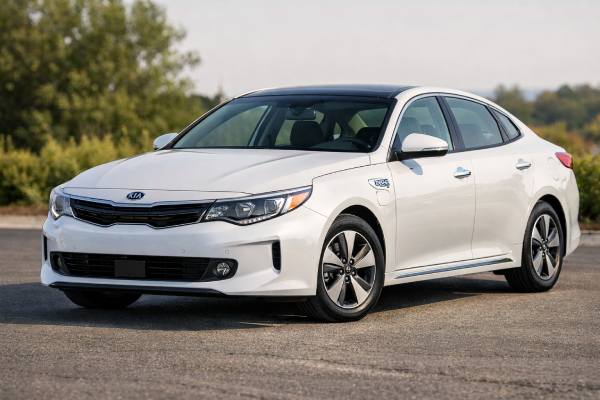
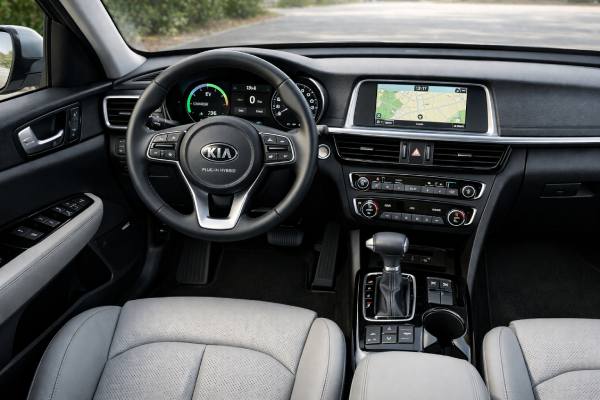
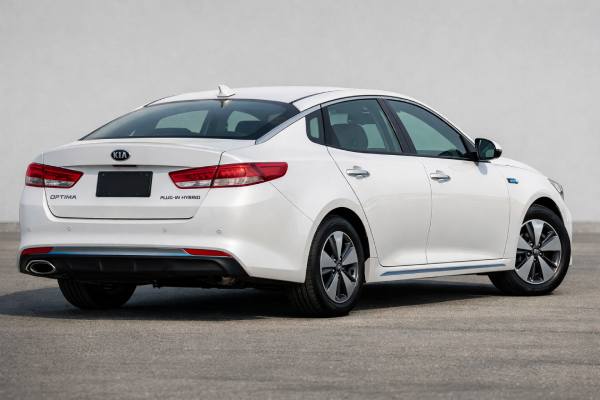
The 2017–2018 Kia Optima Plug-in Hybrid (JF) is a “two-car” midsize sedan for owners who can charge regularly but still need a normal gasoline vehicle for longer trips. Its layout pairs a 2.0-liter GDI four-cylinder with a 50 kW electric motor and a 9.8 kWh battery, delivering 202 hp combined through a conventional 6-speed automatic. That matters: you get familiar driving feel and highway stability, not the rubber-band sensation some hybrids have. The body is also fairly slippery for its class (Cd around 0.25), which helps real-world efficiency.
Ownership success with this Optima PHEV comes down to three things: consistent charging habits, correct fluids (especially coolant for the electrified hardware), and avoiding neglect on the gasoline side (oil quality, GDI deposits, and heat management). Do those well and it can be a calm, economical daily driver that still behaves like a proper sedan.
Owner Snapshot
- Strong blended usability: EV commuting with gasoline backup for road trips
- Traditional 6-speed automatic gives predictable acceleration and highway manners
- Low drag and solid curb weight help stability at speed
- Caveat: GDI engines dislike long oil intervals and short-trip-only use without occasional full warm-ups
- Plan on brake-fluid service about every 2 years (or sooner in humid climates)
Navigate this guide
- Optima PHEV JF ownership overview
- Optima PHEV JF technical specs
- Optima PHEV JF trims and ADAS
- Reliability patterns and fixes
- Maintenance plan and buying tips
- Driving feel and real efficiency
- Rival sedans worth cross-shopping
Optima PHEV JF ownership overview
The Optima Plug-in Hybrid sits in a sweet spot for drivers who want real electric miles without changing how they use a car. In this generation, Kia kept the formula straightforward: a midsize sedan body, front-wheel drive, a conventional automatic transmission, and a plug-in system sized for daily commuting. If your routine includes home charging, the car can cover many weekday miles with little or no gasoline use, then behave like a normal hybrid when the battery is depleted.
A key engineering benefit here is the powertrain’s “familiar” behavior. The 6-speed automatic provides clear gear changes and steady highway pacing. That tends to feel more natural to drivers coming from non-hybrids than an eCVT-style system. The curb weight is substantial (well over 1.7 tonnes), but the chassis is tuned like a mainstream sedan, so it feels planted rather than floaty. Aerodynamics also help: a low drag coefficient reduces high-speed energy demand, which is where many electrified cars lose efficiency quickly.
From an ownership standpoint, the Optima PHEV rewards balanced use. Charging frequently reduces fuel consumption and engine run time, but you still need the gasoline engine to reach full operating temperature regularly. Short-trip-only driving can increase condensation in the oil and accelerate deposit formation in GDI intake tracts. Think of it as a hybrid that likes routine: charge it, drive it, and maintain it on time.
Where buyers sometimes misjudge this model is cargo and packaging. Plug-in hardware reduces trunk volume compared with non-PHEV trims, so it is best for people who prioritize commute economy and comfort over maximum luggage space. Finally, remember that PHEVs combine two systems. The car is not “twice as complex” day to day, but it does mean you should treat coolant, 12-volt battery health, and software updates as first-class maintenance items, not afterthoughts.
Optima PHEV JF technical specs
Below are specifications tailored to the 2017–2018 Optima Plug-in Hybrid (JF) with the 2.0 GDI plus 50 kW motor (202 hp system). Values can vary slightly by market and certification standard, but these figures capture the core configuration.
Powertrain and efficiency
| Item | Specification |
|---|---|
| Powertrain type | PHEV (plug-in hybrid electric vehicle) |
| ICE code and layout | 2.0L I-4 GDI, DOHC CVVT, 4 valves/cyl |
| Displacement | 2.0 L (1,999 cc) |
| Bore × stroke | 81.0 × 97.0 mm (3.19 × 3.82 in) |
| Induction | Naturally aspirated |
| Compression ratio | 13.5:1 |
| ICE output | 154 hp (115 kW) @ 6,000 rpm |
| ICE torque | 190 Nm (140 lb-ft) @ 5,000 rpm |
| Electric motor type | Interior permanent magnet synchronous motor |
| Motor output | 50 kW (66 hp) |
| Motor torque | 205 Nm (151 lb-ft) |
| Traction battery | Lithium-ion polymer |
| Battery energy | 9.8 kWh |
| System voltage | 360 V (battery), 270 V nominal motor circuit (listed) |
| Combined output | 202 hp @ 6,000 rpm |
| Combined torque | 374 Nm (276 lb-ft) |
Transmission and driveline
| Item | Specification |
|---|---|
| Transmission | 6-speed electronic automatic |
| Drive type | Front-wheel drive |
| Final drive ratio | 3.510:1 |
Dimensions and weights
| Item | Specification |
|---|---|
| Length | 4,855 mm (191.1 in) |
| Width | 1,859 mm (73.2 in) |
| Height | 1,461 mm (57.5 in) |
| Wheelbase | 2,805 mm (110.4 in) |
| Ground clearance | 130 mm (5.1 in) |
| Turning circle (kerb-to-kerb) | 10.9 m (35.8 ft) |
| Curb weight | 1,718 kg (3,788 lb) |
| Cargo volume (trunk) | 280 L (9.89 ft³) |
| Drag coefficient | 0.25 (listed) |
| Fuel tank | 50.8 L (13.42 US gal) |
Chassis basics
| Item | Specification |
|---|---|
| Front suspension | Independent MacPherson strut, coil springs, anti-roll bar |
| Rear suspension | Independent multi-link, coil springs, anti-roll bar |
| Steering | Rack and pinion, electric assist |
| Lock-to-lock turns | 2.78 |
Brakes and tires
| Item | Specification |
|---|---|
| Brake system | Active hydraulic boost, stability control and hill assist listed |
| Front brakes | Ventilated discs, 305 mm (12.0 in) |
| Rear brakes | Solid discs, 284 mm (11.2 in) |
| Wheel and tire (common) | 7.0J×17 with P215/55R17 |
Range, MPGe, and charging
| Item | Typical rated figures (varies by standard) |
|---|---|
| EPA-est. EV range | about 29 miles (47 km) listed |
| EPA-est. gasoline economy | about 40 mpg (US) listed |
| EPA MPGe (combined) | around 97 MPGe (with 103 city / 91 highway listed) |
| Total range | about 610 miles listed |
| Level 2 charge time | about 3 hours at 240 V listed |
Fluids and service capacities (practical guidance)
Exact capacities and fluid standards can differ by VIN and market. Use the official service documentation for your vehicle for final numbers. That said, for planning purposes owners typically budget around:
- Engine oil: ~4.3–4.8 L (4.5–5.1 US qt) with filter (use the exact spec and viscosity listed for your market)
- Brake fluid: DOT 3 or DOT 4 as specified for the region (flush interval matters more than brand)
- Coolant: long-life ethylene-glycol coolant, mixed per factory guidance (PHEVs often have more than one coolant circuit)
Key torque specs also vary, but two that matter for routine work:
- Wheel lug nuts: commonly in the 88–108 Nm (65–80 lb-ft) range for this class
- Drain plug and underbody fasteners: verify in service documentation before tightening
Optima PHEV JF trims and ADAS
For 2017–2018, most markets offered the Optima Plug-in Hybrid in a narrow trim spread, commonly centered on a well-equipped “EX” type grade. That limited menu is actually a benefit for used buyers: it reduces the odds of accidentally buying a stripped configuration and makes option checking more about packages than base-versus-top confusion.
Trims and option patterns that matter
Even when the badge looks the same, equipment can differ by region. Focus on the functional items that change ownership experience:
- Charging equipment: confirm the presence and condition of the portable EVSE (charging cable) and check the charge-port door operation. A missing EVSE is not a deal-breaker, but it is a cost to budget.
- Infotainment and navigation: higher infotainment tiers often integrate energy-flow screens and scheduled charging logic more cleanly. Test Bluetooth stability, USB ports, and voice guidance.
- Comfort and visibility: heated and ventilated seats, memory functions, and upgraded headlights are meaningful daily-life upgrades—especially because lighting performance can differ dramatically by trim.
Safety ratings in context
Safety ratings often apply to the broader Optima body structure rather than the powertrain. In practice, the PHEV shares the sedan’s fundamental crash structure, but always verify you are looking at the right year and test protocol.
- NHTSA: the Optima PHEV appears with an overall 5-star rating listing for the 2017 model year. Treat this as a high-level signal and review the sub-scores for the exact vehicle entry when shopping.
- IIHS: Optima crashworthiness results are typically strong in core tests, but final awards can depend on headlight performance and the presence of forward-collision prevention technology.
Driver assistance and calibration realities
ADAS features (if equipped) can be genuinely helpful, but they come with two ownership implications: windshield sensors need correct mounting and camera/radar components may require calibration after repairs. When inspecting a used example:
- Ensure the windshield is correct (cheap replacement glass can distort camera views).
- Check for warning lights related to forward safety systems.
- Ask whether any front-end repairs occurred; misaligned bumper supports can affect sensor aim.
Also confirm the basics: full airbag complement, stability control, and child-seat anchors (ISOFIX or LATCH) are expected in this class, but the condition of seatbelt retractors and pretensioner wiring matters just as much as the feature list. A quick scan tool check during a pre-purchase inspection can reveal stored faults in safety modules that do not always show as a persistent dash light.
Reliability patterns and fixes
A plug-in hybrid can be very reliable, but only if you treat it like a system: gasoline engine, electric drive, battery, cooling, brakes, and software. The Optima PHEV is not exotic, yet it does have known “ownership patterns” that show up repeatedly. Think in terms of prevalence and consequence.
Common (seen often)
- 12-volt battery weakness
- Symptoms: slow start, intermittent warnings, odd infotainment resets, charging errors
- Likely cause: PHEVs still rely on a conventional 12 V battery; short trips and long parking periods can reduce charge
- Remedy: load-test the 12 V battery, clean grounds, confirm DC-DC converter operation, replace with the correct size and spec
- GDI deposit sensitivity on the gasoline engine
- Symptoms: rough idle, hesitation when the engine fires after EV driving, reduced fuel economy
- Likely cause: direct injection does not wash intake valves with fuel; short-trip use and extended oil intervals increase deposits
- Remedy: stricter oil-change intervals, quality fuel, occasional longer drives; professional intake cleaning when symptoms appear
- Brake feel changes or corrosion from low brake use
- Symptoms: rough first stop after rain, pulsation, squeal, or a “grabby” feel
- Likely cause: regenerative braking reduces friction-brake usage; rotors can develop surface rust
- Remedy: periodic firm brake applications, regular brake inspections, timely fluid flush
Occasional (happens, but not universal)
- Cooling system quirks (electric pump, valves, or air in the system)
- Symptoms: temperature warnings, cabin heat inconsistency, efficiency drop, or odd fan behavior
- Likely cause: more coolant plumbing and control valves than a non-hybrid; air pockets after service can cause issues
- Remedy: correct bleeding procedure, inspect for leaks, verify fans and pumps operate under commanded conditions
- Charge-port door and charging handshake issues
- Symptoms: charge session fails to start, charge indicator behaves inconsistently, physical door sticks
- Likely cause: door mechanism wear, contamination, or EVSE compatibility sensitivity
- Remedy: clean contacts, try a known-good Level 2 station, inspect port pins and latch operation
Rare but high-impact (budget awareness)
- High-voltage battery or power electronics faults
- Symptoms: reduced EV range, warning lights, vehicle goes into limited-power mode
- Likely cause: cell imbalance, coolant-related temperature stress, or connector issues
- Remedy: dealer-level diagnostics, software updates, and component replacement where necessary
Recalls, service actions, and software
Do not guess here—verify. For any used PHEV, you want documented completion of safety recalls and any applicable service campaigns. The best practice is to:
- Run an official VIN check.
- Request dealer service history printouts.
- Confirm any hybrid control or charging-related updates were installed.
Software matters more than many owners expect. Calibration updates can address charging behavior, warning lights, and drivability during the transition between EV and engine operation. If the car feels jerky when the engine joins in, or if charging is inconsistent, a software check should be part of the repair plan before replacing parts.
Maintenance plan and buying tips
A good maintenance strategy for the Optima PHEV is simple: maintain the gasoline engine as if it were used daily, and maintain the electrified systems as if they were mission-critical—because they are. Below is a practical schedule framework you can adapt to your local “normal” versus “severe” service definitions.
Practical maintenance schedule (distance or time, whichever comes first)
- Engine oil and filter: every 10,000–12,000 km or 12 months (consider 6,000–8,000 km if mostly short trips)
- Cabin air filter: every 15,000–20,000 km or yearly
- Engine air filter: inspect every 20,000 km; replace as needed (more often in dusty areas)
- Brake fluid: every 2 years (important with regenerative braking)
- Tire rotation and alignment check: rotate every 10,000–12,000 km; align if wear is uneven
- Coolant: follow the exact factory interval for your VIN; PHEVs may have multiple coolant loops, so use the correct coolant type and bleeding procedure
- Spark plugs: typically long-life iridium; replace at the factory interval (often around 150,000–160,000 km in many markets)
- Transmission fluid: inspect condition; consider preventive service by 80,000–100,000 km if you keep the car long-term (use only the specified ATF)
- 12-volt battery test: yearly after year 3; replace proactively if marginal
- Hybrid and charging system check: at least annually—scan for stored codes, check coolant level stability, verify charging completes normally
Fluids and specifications: how to avoid costly mistakes
- Use the exact oil viscosity specified for your climate and market. Small turbo engines are more sensitive than this one, but even naturally aspirated GDI benefits from correct oil.
- Never “mix and match” coolants without verifying compatibility. Hybrid cooling systems are picky, and air pockets after service can create false alarms.
- For brakes, prioritize fluid health over pad wear alone. Moisture absorption is the silent killer in mixed regen/friction systems.
Buyer’s guide: inspection checklist
When shopping used, check items that specifically affect PHEV ownership:
- Charging proof: confirm the car charges from empty-to-full without errors; verify the charge indicator behavior
- EV range sanity: compare displayed EV range to ambient temperature and driving style; very low range can be normal in cold weather, but it should not be “mystery low”
- Cooling system health: look for dried coolant residue, inconsistent cabin heat, or fans running excessively
- Brake condition: inspect rotors for heavy rust lips or scoring; test for smooth braking at low speeds
- Engine behavior: ensure the engine starts smoothly when demanded; rough transitions can indicate maintenance neglect
- Trunk practicality: confirm the reduced cargo space fits your needs
Recommended used-buy approach: prioritize the best-maintained example over the lowest mileage. A PHEV that sat unused can have more issues than one driven regularly and serviced on schedule. If you plan to keep it for years, budget for baseline service after purchase: fresh fluids, filters, a brake inspection, and a full diagnostic scan.
Driving feel and real efficiency
In daily driving, the Optima PHEV behaves like a midsize sedan first and an electrified vehicle second—and for many owners, that is exactly the appeal. Steering is electrically assisted and tuned for ease rather than sharp feedback, but the car tracks straight and feels stable at highway speed thanks to its long wheelbase and weight. Ride quality is typically composed, leaning toward comfort, and the body does a decent job filtering rough pavement without feeling overly soft.
Powertrain character
At low speeds, the electric motor provides smooth step-off torque and quiet operation. When the gasoline engine joins in, the best examples feel seamless, but you will still notice the transition more than you might in some eCVT hybrids because the transmission has real shift events. Under moderate acceleration, it feels predictable rather than fast. The combined system output is enough for confident merging, but this is not a sport sedan; it rewards smooth throttle inputs.
Noise, vibration, and harshness (NVH)
Around town, EV operation keeps things calm. On the highway, wind and tire noise dominate more than powertrain noise, and the low drag shape helps. If you hear a coarse engine note under light load, that can be normal during warm-up or battery management, but persistent harshness is worth diagnosing.
Real-world efficiency: what owners actually see
Your results depend on charging frequency and trip length. A useful way to think about it:
- With regular charging and short commutes: many drivers can complete weekday miles mostly on electricity, using gasoline mainly on weekends.
- As a hybrid without plugging in: it behaves like a heavier hybrid sedan; fuel economy remains decent, but you lose the PHEV advantage.
A practical expectation range (not a promise):
- Mixed driving with consistent charging: very low gasoline use for short daily mileage, then normal hybrid efficiency once the battery is depleted
- Highway-heavy driving without charging: efficiency closer to a conventional efficient midsize sedan
Charging experience
A Level 2 (240 V) setup is the “sweet spot.” It shortens charge time enough that overnight charging becomes effortless and makes it realistic to top up between errands. If you rely only on a household outlet, charging still works, but the slower pace can reduce how often you actually plug in—and that is where many PHEV owners accidentally leave savings on the table.
One final driving tip that improves long-term feel: use the friction brakes deliberately once in a while. A few controlled, firm stops (when safe) helps keep rotors clean and maintains consistent pedal feel in a regen-heavy car.
Rival sedans worth cross-shopping
The Optima PHEV competes less on raw speed and more on how it fits into your life. When you compare it to rivals, focus on three questions: Do you want a plug-in specifically, how much trunk space do you need, and do you prefer a traditional automatic or an eCVT-style hybrid feel?
If you want plug-in capability
- Hyundai Sonata Plug-in Hybrid: closely related in concept and may feel very similar. Compare charging behavior, warranty terms, and local parts availability.
- Ford Fusion Energi (older PHEV competitor): often priced attractively used, but the model timeline and long-term support differ. Compare trunk space and battery age carefully.
The Optima PHEV’s advantage in this group is its conventional 6-speed automatic feel and solid highway demeanor. The trade-off is reduced cargo volume and the reality that older PHEVs depend heavily on how the prior owner treated charging and maintenance.
If you care more about hybrid efficiency than plugging in
- Toyota Camry Hybrid: typically excellent efficiency and strong long-term durability reputation. It drives differently, but it is a benchmark for low-hassle ownership.
- Honda Accord Hybrid: often praised for powertrain smoothness and driving dynamics, with strong real-world mileage.
Against these, the Optima PHEV’s advantage is the ability to do meaningful daily driving on electricity. If you cannot charge reliably, a strong conventional hybrid can be the smarter and simpler answer.
If you want a sportier midsize feel
Some turbo gasoline sedans and sport trims offer stronger acceleration, but they will not match the Optima PHEV’s electricity-first commuting advantage. In that case, decide whether your priority is enjoyment under throttle or minimizing fuel use in routine driving.
Bottom line: choose the Optima PHEV when you can charge at home or work, your daily mileage fits the plug-in use case, and you prefer a normal sedan driving feel. Choose a top hybrid rival when charging is inconvenient or you need maximum cargo practicality.
References
- 2017 Kia Optima PHEV Specifications 2017 (Manufacturer Specifications)
- 2017 KIA OPTIMA PHEV 2017 (Safety Rating and Recall Database)
- 2017 Kia Optima 2017 (Safety Rating)
- Gas Mileage of 2018 Kia Optima 2018 (Official Fuel Economy Data)
- ENERGY STAR Electric Vehicles and Plug-in Hybrids 2025 (Efficiency and Charging Guidance)
Disclaimer
This article is for informational purposes only and is not a substitute for professional diagnosis, repair, or safety inspection. Specifications, torque values, fluid types, service intervals, and procedures can vary by VIN, market, model year, and installed equipment. Always verify details using the official owner’s manual and service documentation for your exact vehicle.
If you found this guide useful, please consider sharing it on Facebook, X (Twitter), or your favorite forum to help others find it.