
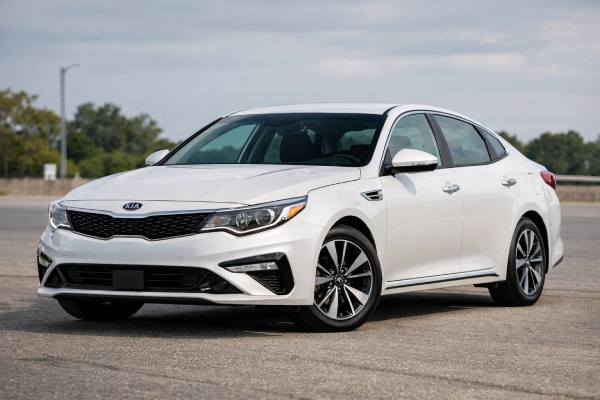

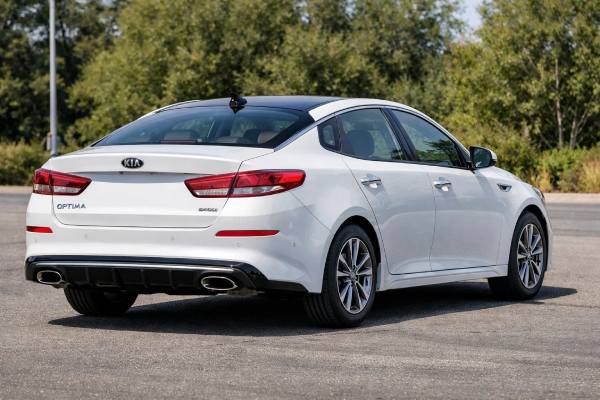
The 2019–2020 facelift version of the Kia Optima (JF) with the G4KH 2.0-liter turbo petrol engine is the “quick-but-grown-up” choice in the Optima range. You get strong low-rpm pull, a refined six-speed automatic, and a chassis that leans toward comfort without feeling vague at motorway speeds. The appeal is simple: it delivers near-GT pace for everyday driving while keeping the cabin quiet and the ride settled over broken surfaces.
Ownership, however, is about more than the headline power. This turbo direct-injection setup rewards consistent oil service, careful warm-up habits, and attention to cooling and ignition health. If you shop smart and keep maintenance on schedule, the Optima 2.0 T-GDi can be a satisfying long-distance car with enough performance to feel special, even when loaded with passengers and luggage.
What to Know
- Strong mid-range torque makes overtakes easy without constant downshifts.
- Comfortable suspension and multi-link rear setup suit long trips and rougher roads.
- Practical body packaging (especially Sportswagon) keeps it usable as a family car.
- Turbo GDI ownership needs disciplined oil changes and quality fuel to stay happy.
- Typical service interval is 6 months or 6,000 miles (10,000 km), whichever comes first.
Contents and shortcuts
- Kia Optima JF facelift explained
- Kia Optima JF G4KH specs
- Kia Optima JF trims and ADAS
- Common faults and service actions
- Upkeep costs and buying checklist
- On-road performance and efficiency
- Rival comparison and alternatives
Kia Optima JF facelift explained
For the 2019–2020 facelift years, the Optima (JF) tightened its identity: a mid-size, comfort-focused car with an upscale cabin feel, generous equipment, and (in G4KH form) a genuinely quick turbo petrol option. In markets that offered it, the 2.0 T-GDi sat at the top of the range and often came tied to sportier “GT” positioning—less about track driving and more about effortless pace on real roads.
The engineering story starts with the engine character. The G4KH is a 2.0-liter inline-four with turbocharging and direct injection (GDI). What you feel from the driver’s seat is torque that arrives early and stays strong through the mid-range. That makes the car relaxed in traffic and confident on slip roads: you can build speed without wringing the engine out. The six-speed automatic is also part of the “big-car” vibe—smooth creep, predictable kickdown, and fewer odd ratio jumps than some modern multi-gear boxes.
Chassis-wise, the Optima uses a MacPherson strut front end and a multi-link rear, a layout chosen for stability and ride quality. It’s not the lightest car in this class, but that mass helps with calm motorway manners and noise control. In higher trims, you may find features like electronically controlled suspension (market dependent), which can sharpen body control without turning the ride harsh.
Why the facelift matters for buyers today: parts availability and software maturity tend to improve late in a model cycle. You also get later-spec infotainment and driver assistance packages in many regions. Still, this is a turbo GDI car, so the ownership experience depends heavily on service habits. The Optima rewards careful maintenance more than a basic naturally aspirated engine would—especially if the car has seen lots of short trips, long oil intervals, or inconsistent fuel quality.
Kia Optima JF G4KH specs
Below are the key specs that matter for shopping, servicing, and setting expectations. Figures can vary slightly by market, body style (sedan vs Sportswagon), wheels/tyres, and test cycle (NEDC vs WLTP). Use the tables as a high-confidence baseline for the 2.0 T-GDi automatic, front-wheel-drive configuration.
Powertrain and efficiency
| Item | Specification |
|---|---|
| Code | G4KH |
| Engine layout and cylinders | Inline-4, DOHC, 16 valves (4 valves/cyl) |
| Bore × stroke | 86 × 86 mm (3.39 × 3.39 in) |
| Displacement | 2.0 L (1,998 cc) |
| Induction | Turbocharged (intercooled) |
| Fuel system | Gasoline Direct Injection (GDI) |
| Compression ratio | 10.0:1 |
| Max power | 241 hp (180 kW) @ 6,000 rpm |
| Max torque | 353 Nm (260 lb-ft) @ ~1,350–4,000 rpm |
| Timing drive | Chain |
| Rated efficiency (varies by cycle) | Around 8.2 L/100 km (NEDC mixed) or ~9.3 L/100 km (WLTP combined) |
| Real-world highway @ 120 km/h (75 mph) | Often ~7.8–9.0 L/100 km (30–36 mpg US equivalent), depending on speed, tyres, temperature, and load |
Transmission and driveline
| Item | Specification |
|---|---|
| Transmission | 6-speed automatic |
| Drive type | FWD |
| Differential | Open |
Chassis, brakes, and dimensions
| Item | Specification |
|---|---|
| Suspension (front / rear) | MacPherson strut / multi-link |
| Steering | Electric power steering (rack type) |
| Turning circle (kerb-to-kerb) | 5.45 m |
| Brakes (front / rear) | Vented discs 330 × 30 mm (front, GT) / vented discs 314 × 20 mm (rear, GT) |
| Wheels and tyres (common performance fitment) | 235/45 R18 |
| Ground clearance | ~125 mm (market dependent) |
| Length / width / height | 4,855 / 1,860 / ~1,460–1,470 mm (body and trim dependent) |
| Wheelbase | 2,805 mm |
| Kerb (curb) weight | ~1,680 kg (Sportswagon GT) |
| GVWR | ~2,190 kg |
| Payload (GVWR − kerb) | ~510 kg (approx.) |
| Fuel tank | 70 L (18.5 US gal approx.) |
| Cargo volume (VDA) | Sedan ~510 L; Sportswagon ~552 L (seats up) |
Performance and capability
| Item | Specification |
|---|---|
| Acceleration (0–100 km/h) | ~7.6 s (Sportswagon GT) |
| Top speed | ~232 km/h (144 mph) |
| Towing capacity | Up to ~1,400 kg braked; ~700 kg unbraked (market dependent) |
Fluids and service capacities (owner-useful guidance)
Public spec sheets rarely publish full service-fill volumes for every market, so treat the points below as planning guidance and verify on the vehicle’s service information for your VIN:
- Engine oil: use the manufacturer-approved spec and a viscosity suited to your climate; typical turbo 2.0 GDI oil-change fills are often in the ~5 L range.
- Coolant: use the correct long-life coolant type; many mid-size turbo petrol systems fall in the ~7–8 L refill range after a full drain.
- Automatic transmission fluid: use the exact OEM fluid spec; full dry fills can be several liters, but service drains are usually partial.
- A/C refrigerant: varies by body style and system; confirm the under-bonnet label.
Key torque specs also vary by wheel size and hardware revision, but for routine work you should always confirm:
- Wheel lug nuts: commonly in the 90–110 Nm range on this class of vehicle.
- Drain plugs / filter housings: follow OEM torque; overtightening is a common cause of stripped threads and leaks.
Safety and driver assistance (high-level)
| Item | Specification |
|---|---|
| Euro NCAP | 5-star rating for Optima generation tested; Adult 89%, Child 86%, Safety Assist 71% (test protocol-year dependent) |
| IIHS (US-market reference) | Strong crash-test performance overall; headlight ratings vary widely by trim; forward crash prevention ratings depend on system version and options |
| Typical ADAS availability by trim/market | AEB/FCA, lane support (LKAS), blind-spot monitoring (BSD), rear cross-traffic alert (RCTA), smart cruise control (ACC/ASCC), traffic-sign info (SLIF) |
Kia Optima JF trims and ADAS
Most buyers searching for the 2.0 T-GDi version are really shopping the “top” Optima—often GT or GT-linked trims—so equipment tends to be generous. Still, Optima trims vary by country, and the important differences aren’t just leather vs cloth; they’re the functional pieces that affect running costs and daily use: headlight technology, brake size, wheel/tyre package, and which driver-assistance sensors are installed.
Trims and options that matter
Common patterns you’ll see in listings:
- GT / performance-oriented trim: typically pairs the 2.0 T-GDi with the 6-speed automatic, larger brakes, and 18-inch wheels with 235/45 tyres. Some markets add electronically controlled suspension and sport interior cues.
- GT-Line / high equipment trim (non-GT in some regions): may look similar but can come with smaller brakes, different suspension tuning, or different powertrains. Don’t assume “GT-Line” automatically means G4KH.
- Luxury-oriented upper trims: usually focus on comfort tech—heated/ventilated seats, premium audio, panoramic roof, and driver convenience features.
Quick identifiers when viewing a car:
- Wheels/tyres: 235/45 R18 often signals the sportier setup.
- Brake hardware: performance trims may have visibly larger front discs and sport styling details.
- Cluster and drive modes: some markets include GT-specific display themes or a performance-oriented instrument view.
- Exhaust and exterior cues: dual outlets and more aggressive bumpers are common on GT versions.
Safety ratings and how to interpret them
Safety ratings can be confusing because they depend on test year and region. The Optima generation earned a maximum Euro NCAP star rating when tested, with strong adult and child protection scores and good safety-assist performance for the period. That’s meaningful, but it doesn’t guarantee every used car has the same active-safety equipment—ratings often assume certain systems are standard or widely fitted.
If you’re comparing cars, treat ratings as:
- A structural baseline (how well the car protects occupants), and
- A technology snapshot (what systems existed at the time and how effective they were under test conditions).
Safety systems and ADAS (what to look for)
The Optima’s core safety kit generally includes:
- Multiple airbags including front, side, and curtain coverage (and in some markets, a driver knee airbag).
- Stability and traction systems: ESC and related braking logic.
- Child-seat fixtures: ISOFIX/LATCH points and tethers (configuration varies by market).
Driver assistance is where trims diverge. Depending on year and market, you may see:
- Forward Collision-Avoidance Assist (AEB/FCA): reduces crash risk in traffic; make sure warning lights are off and calibration is current.
- Lane Keep Assist (LKAS): helpful on motorways, but sensitive to windscreen replacement and camera alignment.
- Blind-Spot Detection (BSD) and Rear Cross-Traffic Alert (RCTA): useful in busy parking areas and lane changes.
- Smart cruise control (ACC/ASCC): increases long-distance comfort; verify smooth speed control and clean radar operation.
After windscreen replacement, bumper repair, alignment work, or suspension changes, confirm that any camera/radar systems are calibrated correctly. A “no warning lights” test drive is a good start, but the best proof is a scan report and service invoice showing calibration completion.
Common faults and service actions
The Optima 2.0 T-GDi can be a solid long-term car, but it has the typical reality of a modern turbo direct-injection engine: it’s less forgiving of delayed oil service and neglected small issues. Below is a practical way to think about problems—by prevalence, severity, and the conditions that trigger them.
Common (watch closely)
- Ignition coil and spark plug wear (low to medium cost):
Symptoms: misfire under load, rough idle, flashing check-engine light, hesitation on boost.
Likely cause: plug gap growth, coil breakdown, or oil contamination.
Remedy: replace plugs at the correct interval and heat range; replace weak coils; inspect for oil in plug wells. - Carbon build-up on intake valves (medium cost, mileage dependent):
Direct injection sprays fuel into the cylinder, not across the intake valves, so deposits can build over time.
Symptoms: rough cold starts, reduced response, intermittent misfires, poorer fuel economy.
Remedy: intake cleaning (often walnut blasting) when symptoms appear; shorten oil intervals and ensure PCV system health. - PCV and crankcase ventilation issues (low cost if caught early):
Symptoms: oil seepage, idle changes, higher oil use, occasional smoke.
Remedy: inspect and replace the PCV valve if sticking; check hoses for softening or collapse.
Occasional (depends on use and maintenance)
- Turbo plumbing and boost leaks (medium cost):
Symptoms: loss of power, whooshing sounds, underboost codes, inconsistent acceleration.
Likely cause: loose clamps, split hoses, intercooler joint leaks.
Remedy: pressure test intake tract; replace degraded couplers and clamps. - High-pressure fuel system sensitivity (medium cost):
Symptoms: extended cranking, hesitation, lean codes, poor top-end power.
Remedy: verify fuel quality, check injectors and high-pressure pump function, confirm software is current. - Cooling system wear (medium cost if ignored):
Symptoms: coolant smell, slow loss of coolant, overheating under load.
Remedy: address leaks early; keep coolant fresh per schedule; verify fans operate correctly.
Rare but high-severity (do not ignore)
- Bottom-end bearing or lubrication-related engine damage (high cost):
This is the “big ticket” risk category seen across several turbo GDI families in the industry.
Symptoms: knocking noises, oil pressure warnings, metallic debris, persistent misfire with noise.
Remedy: immediate diagnosis; do not continue driving; verify any applicable service campaigns/updates are complete.
Software, calibrations, and service campaigns
Modern Optimas rely on software for drivability and safety systems. Updates may address:
- Shift logic, throttle mapping, or idle stability
- Sensor plausibility faults (boost, O2, knock, fuel pressure)
- ADAS behavior and fault detection thresholds
When buying used, ask for proof of:
- Completed recall/service actions (printout or dealer invoice), and
- A recent scan report showing no stored powertrain or ADAS faults.
Even if the car drives well, an unaddressed campaign can matter for long-term reliability and resale. Use an official VIN-based lookup and compare it to the service history.
Upkeep costs and buying checklist
If you want the Optima 2.0 T-GDi to stay smooth and strong, plan maintenance like you would for any turbo performance daily: frequent oil service, clean ignition, and proactive fluid care. The good news is that the car’s layout is straightforward for routine work. The bad news is that “generic used-car” maintenance habits (long oil intervals, cheapest fuel, ignoring misfires) can get expensive.
Practical maintenance schedule (distance/time)
Use this as a real-world baseline, then confirm with your market’s official schedule:
- Engine oil and filter: 6,000 miles (10,000 km) or 6 months is a sensible turbo interval; shorten for short trips, hot climates, or frequent boost.
- Cabin air filter: every 12 months or 15,000–20,000 km (more often in dusty cities).
- Engine air filter: inspect every service; replace about 20,000–30,000 km depending on conditions.
- Spark plugs (turbo): often 60,000–100,000 km depending on plug type and market schedule; earlier if tuned or driven hard.
- Coolant: follow long-life interval guidance; consider a proactive change around 5 years if the car sees heavy use or uncertain history.
- Automatic transmission fluid: a preventative drain-and-fill around 60,000–90,000 km can extend shift quality, especially in hot or stop-start use.
- Brake fluid: every 2 years, regardless of mileage.
- Brake pads and rotors: inspect at every service; heavier cars on 18-inch wheels can wear fronts faster.
- Tyre rotation and alignment: rotate every 10,000–12,000 km; align if you see uneven wear or steering pull.
- 12 V battery testing: test yearly after year 3; replace preventatively around 4–6 years in cold climates.
Fluids and consumables (what to insist on)
- Use the correct OEM-approved engine oil spec for a turbo GDI engine and your climate. Cheap oil and long intervals are a false economy.
- Use the correct ATF specification; “universal” fluids can cause shift issues over time.
- Use quality fuel from reputable stations; turbo GDI engines are sensitive to knock control and deposit formation.
Used-buyer inspection checklist
Bring this list to a viewing and you’ll catch most expensive surprises:
- Cold start behavior: listen for unusual knock, check for rough idle, and confirm smooth warm-up.
- Boost delivery: under full throttle, power should build cleanly with no hesitation or misfire.
- Transmission quality: check for flare, harsh 2–3 or 3–4 shifts, and delayed engagement when selecting Drive or Reverse.
- Cooling health: confirm stable temperature, no coolant smell, and fans cycling normally.
- Oil condition and consumption clues: inspect for fresh oil around the valve cover and turbo area; ask how often the owner tops up.
- Brakes and tyres: uneven wear can signal alignment issues; pulsation can mean warped rotors.
- ADAS warnings: make sure no camera/radar warnings appear; confirm features work on a test drive.
- Paperwork: full service history, proof of recalls/service actions, and consistent oil service timing.
Durability outlook
A well-maintained Optima 2.0 T-GDi can be a dependable long-distance car. The winning formula is simple: treat it like a turbo engine (shorter oil intervals, careful attention to misfires and cooling), and it usually returns the favor with strong performance and refined daily manners.
On-road performance and efficiency
Drive the Optima 2.0 T-GDi back-to-back with a typical mid-size family sedan, and the difference is immediate: it doesn’t need revs to feel quick. The turbo delivers meaningful torque early, so the car moves with a “bigger engine” feel when pulling away, climbing hills, or overtaking. That suits the Optima’s comfort-first personality—fast progress without drama.
Ride, handling, and NVH
- Ride quality: the Optima’s suspension is tuned for compliance. It filters sharp edges well, especially on motorways and rough urban asphalt. The multi-link rear helps keep the car settled over mid-corner bumps.
- Handling balance: it’s predictable rather than playful. The front end grips well for a family car, but you’ll feel the weight if you push hard. On 18-inch tyres, grip improves but impact harshness can rise slightly.
- Steering feel: typically light-to-medium effort with a consistent on-center response. It’s designed for stability and ease, not sports-car feedback.
- Cabin noise: at cruising speeds, wind and road noise are generally well controlled for the class. Tyre choice matters more than many owners expect—some replacement tyres can noticeably increase roar.
Powertrain character
- Throttle response: strong once the turbo is in its sweet spot; initial response is smooth rather than snappy.
- Transmission behavior: the 6-speed automatic tends to prioritize smoothness. In normal driving it shifts unobtrusively; under hard acceleration it holds gears sensibly without constant hunting.
- Drive modes (where fitted): sportier modes typically sharpen throttle mapping and hold gears longer; comfort modes aim for early upshifts.
Real-world efficiency (what owners actually see)
Test-cycle numbers can look optimistic or inconsistent because of the transition from NEDC to WLTP. In daily use, expect fuel economy to vary widely with speed and boost demand:
- City driving: often 10–13 L/100 km (18–24 mpg US equivalent), especially with short trips.
- Highway at 100–120 km/h: often 7.8–9.0 L/100 km (26–30 mpg US equivalent).
- Mixed driving: often 9–11 L/100 km (21–26 mpg US equivalent).
Cold weather and short trips can add a meaningful penalty because the engine spends more time warming up and the turbo encourages brief high-load bursts.
Performance metrics that shape expectations
- 0–100 km/h: around 7.6 seconds is quick for a comfort-focused mid-size car.
- Top speed: around 232 km/h gives plenty of motorway headroom (where legal).
The more important “everyday” metric is passing response: from about 60–120 km/h, the Optima pulls confidently with a single downshift. That’s where the car feels most different from lower-powered trims.
Rival comparison and alternatives
In the 2019–2020 window, the Optima 2.0 T-GDi sits in an interesting spot. It isn’t the newest platform in the segment, but it offers a strong equipment-to-price ratio and a refined driving experience. Here’s how it typically compares to common rivals, using real buyer priorities rather than brochure hype.
Versus Volkswagen Passat and Skoda Superb (2.0 TSI)
- Strengths of the VW-group cars: often feel a touch more “Germanic” in steering precision and cabin ergonomics; broad engine and gearbox choices; strong parts ecosystem in many regions.
- Where the Optima fights back: generous standard equipment on top trims, a comfortable ride, and a smooth, torquey power delivery that doesn’t feel strained. In some markets it can be better value used.
Who should choose which:
Pick Passat/Superb if you want maximum trim and powertrain variety. Pick Optima if you want a well-equipped, refined turbo car without climbing to premium-brand prices.
Versus Ford Mondeo (where available)
- Mondeo strengths: often excellent chassis balance and steering feel; good long-distance comfort.
- Optima strengths: typically quieter cabin and a more “upmarket” interior atmosphere in higher trims, plus strong torque delivery.
Buyer tip: condition matters more than brand here—service history and drivetrain health should decide.
Versus Mazda6 (petrol)
- Mazda6 strengths: sharp steering, light feel, strong reliability reputation in many markets (especially naturally aspirated petrol).
- Optima strengths: more effortless torque and acceleration in G4KH form; often more features for the money on upper trims.
Who should choose which:
If you prefer a naturally aspirated feel and simpler long-term mechanicals, Mazda6 is appealing. If you want stronger straight-line pace and a relaxed turbo character, Optima wins.
Versus Honda Accord and Toyota Camry (region dependent)
- Accord strengths: efficient powertrains and strong driving dynamics in some generations; robust safety credentials.
- Camry strengths: reputation for low drama ownership, especially in non-turbo setups.
- Optima strengths: blend of comfort and performance with a premium equipment feel in top trims.
The practical verdict
Choose the Optima 2.0 T-GDi if:
- You want a mid-size car that feels genuinely quick in everyday driving.
- You value comfort and refinement more than “sport sedan” sharpness.
- You can commit to disciplined turbo-engine maintenance.
Consider a rival instead if:
- You want maximum fuel economy above all else (a hybrid competitor may suit better).
- You prefer the simplest possible long-term mechanical setup (naturally aspirated petrol often wins here).
- Local parts availability and specialist support for Kia turbo models is limited in your area.
References
- fiche-technique-famille-optima.pdf 2016 (Technical Specification)
- optima-sw-specification.pdf 2019 (Specification Sheet)
- 2019 Kia Optima 2019 (Safety Rating)
- Five-star safety ratings for all-new Kia Optima and Sportage 2015 (Safety Rating)
- Recalls 2025 (Recall Database)
Disclaimer
This article is for informational purposes only and is not a substitute for professional diagnosis, inspection, or repair. Specifications, torque values, fluid types and capacities, service intervals, and procedures can vary by VIN, market, model year, and installed equipment. Always verify details using official service documentation for your specific vehicle and follow manufacturer procedures.
If this guide helped, please consider sharing it on Facebook, X (Twitter), or your favorite forum/community to support our work.