


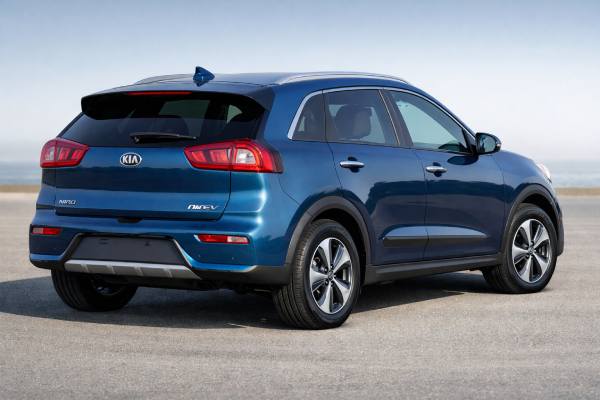
The 2018–2019 Kia Niro EV (DE) with the 150 kW (201 hp) front motor is the “big-battery” version of the first-generation Niro lineup—built for drivers who want EV torque and commuting range without stepping up to a larger crossover. Its strengths come from smart packaging: a low, floor-mounted battery that keeps the cabin practical, and a simple single-speed drive unit that avoids the shift logic and clutch wear found in many hybrids.
Ownership is mostly about staying ahead of two EV realities: heat and electricity. Battery temperature control, charging habits, and coolant condition matter more here than oil changes ever did. If you treat it like an appliance—regular inspections, clean charging hardware, and timely fluid services—it’s one of the easiest ways to get quiet, efficient daily transport with long-distance capability that still feels familiar to drive.
Owner Snapshot
- Strong real-world highway efficiency for a compact crossover when driven at steady speeds.
- Smooth, immediate torque delivery that makes city driving relaxed and confident.
- Practical cabin and cargo packaging for an EV of this size.
- Plan on routine coolant and brake-fluid services even without an engine.
- Inspect every 15,000 km or 12 months to keep small issues (12 V battery, brakes, seals) from becoming inconvenient.
What’s inside
- Kia Niro EV (DE) 150 kW explained
- Kia Niro EV (DE) 201 hp specs
- Kia Niro EV (DE) equipment and safety
- Reliability watchlist and service actions
- Upkeep plan and buyer checklist
- Performance feel and real range
- Best alternatives in this class
Kia Niro EV (DE) 150 kW explained
This version of the Niro EV is the one most shoppers mean when they say “e-Niro 64 kWh.” It uses a permanent-magnet synchronous motor (PMSM) driving the front wheels through a single-speed reduction gear. The result is simple and predictable: press the pedal, it goes—no gear changes, no rev flare, and very little drivetrain drama.
From an engineering perspective, the Niro EV’s biggest win is balance. It isn’t a low-slung hatchback EV, but it still benefits from battery mass mounted low across the floor. That lowers the center of gravity compared with the hybrid Niro and gives the EV a more planted feel in quick lane changes and roundabouts. It also helps ride comfort over larger bumps because the body doesn’t “bob” as easily.
The second key trait is thermal management. On long drives or repeated fast-charging sessions, battery and power electronics temperature control determines how consistent the car feels. In practice, this is why two identical Niro EVs can feel very different on the same trip: one car may hold charging power longer, while another tapers earlier if the battery is cold, hot, or the system is trying to protect itself.
In day-to-day ownership, think of the Niro EV as a set of connected systems rather than “engine + gearbox.” Your main wear items are tyres, brakes (often lightly used because regen does much of the slowing), suspension joints, and the 12 V battery. The high-voltage (HV) battery is designed for long service life, but it still benefits from consistent habits—especially avoiding unnecessary full charges when you don’t need them and not storing the car at very high state of charge for long periods.
For 2018–2019 buyers, the shopping priorities are usually:
- Thermal comfort equipment (heat pump in some markets/trims) because it can reduce winter range loss and improve cabin warm-up efficiency.
- Charging convenience (AC onboard charger capability and a healthy charge port) because home/work charging is what makes an EV effortless.
- Documented maintenance for coolant and brake fluid, plus proof that any campaigns or service actions were completed.
Kia Niro EV (DE) 201 hp specs
Powertrain, battery, and efficiency
| Spec | Value |
|---|---|
| Motor type | PMSM (front axle) |
| Drive type | FWD |
| Max power | 201 hp (150 kW) |
| Max torque | 395 Nm (291 lb-ft) |
| Transmission / drive unit | Single-speed reduction gear |
| Traction battery (gross) | 67.1 kWh |
| Traction battery (usable) | 64.0 kWh |
| Battery chemistry | Lithium-ion polymer |
| Thermal management | Liquid-cooled battery and power electronics |
| Heat pump | Optional (depending on equipment) |
| Official range standard | WLTP |
| WLTP rated range | 455 km (283 mi) |
| WLTP efficiency | 15.9 kWh/100 km (256 Wh/mi) |
| Real-world highway @ 120 km/h (75 mph) | 20.7 kWh/100 km (333 Wh/mi) |
| Real-world highway range @ 120 km/h (75 mph) | 300 km (186 mi) |
Charging and connectors
| Spec | Value |
|---|---|
| AC connector | Type 2 |
| DC connector | CCS2 |
| Charging port location | Front side (middle) |
| Onboard charger (AC) | 7.2 kW |
| DC fast-charge peak | 75 kW |
| Typical DC charge window (recommended use) | 10–90% SOC |
Chassis, dimensions, and capacity
| Spec | Value |
|---|---|
| Suspension (front / rear) | MacPherson strut / multi-link |
| Steering | Electric power steering (EPS) |
| Brakes (front / rear) | Ventilated disc / disc |
| Wheels and tyres | 215/55 R17 |
| Length / Width / Height | 4375 / 1805 / 1560 mm (172.2 / 71.1 / 61.4 in) |
| Wheelbase | 2700 mm (106.3 in) |
| Turning circle | 10.6 m (34.8 ft) |
| Kerb (curb) weight | 1812 kg (3995 lb) |
| GVWR | 2230 kg (4916 lb) |
| Payload | 418 kg (922 lb) |
| Cargo volume (seats up) | 475 L (16.8 ft³) |
| Cargo volume (seats down) | 1405 L (49.6 ft³) |
Performance
| Spec | Value |
|---|---|
| 0–100 km/h (0–62 mph) | 7.8 s |
| Top speed | 167 km/h (104 mph) |
Safety ratings and driver assistance
| Spec | Value |
|---|---|
| Euro NCAP rating | 5 stars |
| Adult occupant | 91% |
| Child occupant | 80% |
| Vulnerable road users | 70% |
| Safety assist | 81% |
Kia Niro EV (DE) equipment and safety
Trim names and option logic vary by country, but the 2018–2019 Niro EV (DE) generally splits into a few predictable “equipment personalities”: a value-oriented trim with the key EV hardware, a comfort-focused trim with upgraded infotainment and climate features, and a tech-heavy trim that adds advanced driver assistance and premium lighting.
Instead of memorizing trim names, it’s often more useful to shop by the features that change ownership quality:
1) Cabin comfort and winter efficiency
- Heated seats and steering wheel are more than luxury in an EV—they reduce the need for high cabin heat, which helps range.
- A heat pump (when fitted) can reduce energy use for cabin heating compared with resistive heating, especially in cool-but-not-freezing conditions.
- Look for a predictable HVAC response: fast windshield clearing, quiet blower operation, and stable cabin temperature on long drives.
2) Charging convenience
- Confirm the car reliably accepts AC charging at home/work. If your routine depends on AC charging speed, the onboard charger rating matters.
- Inspect the charge-port door, latch feel, rubber seals, and the area around the connector for signs of water ingress or repeated impact.
- A healthy charge experience should be boring: plug in, it starts, it finishes, and the app (if equipped) reports cleanly.
3) Infotainment and connectivity
- Early software can feel slower than newer EVs. What matters is stability: no repeated reboots, no frozen screens, and consistent Bluetooth behavior.
- Navigation can influence trip planning because EV charging stops depend on routing. Even if you use phone navigation, factory navigation can still matter for integrated EV menus and energy displays.
Safety systems and ratings
The Niro platform earned strong crash-test results, but driver assistance availability depends heavily on equipment. In 2018–2019, you’ll commonly see:
- AEB (automatic emergency braking) for city and higher-speed scenarios (availability depends on package).
- Lane support (lane keep assist and/or lane following assist) that reduces steering workload on highways.
- Blind-spot monitoring and rear cross-traffic alert on higher trims, which is especially helpful in a quiet EV that can “sneak” through parking lots.
What to check during a test drive
- Make sure the forward camera and radar-based systems behave consistently: no unexplained warnings, no “sensor blocked” messages in normal weather, and predictable adaptive cruise control (if fitted).
- Confirm all exterior lighting functions correctly. Headlight performance matters more in an EV because quiet cruising can encourage more nighttime driving comfort.
If you want one quick identifier of a well-equipped car, look for the combination of: full ADAS suite, LED headlights, and the comfort items you’ll use daily (heated features and strong defrost performance). Those are the features you miss every single drive if they’re not there.
Reliability watchlist and service actions
The Niro EV’s core drivetrain is mechanically simple, but reliability is still real work—because “EV reliability” often means preventing minor faults from disrupting charging or daily usability. For the 2018–2019 DE cars, the best approach is to sort risks by how often they show up and how painful they are when they do.
Common (low to medium cost, high annoyance if ignored)
12 V battery weakness
- Symptoms: random warning lights, failure to “ready,” infotainment resets, or the car refusing to unlock reliably.
- Likely cause: a tired 12 V battery or parasitic draw behavior combined with short trips.
- Remedy: test the 12 V battery under load, confirm charging behavior, and replace proactively if borderline. Many “mystery EV problems” are simply 12 V voltage instability.
Brake hardware corrosion and noise
- Symptoms: scraping sounds, uneven braking feel, or rusty rotors that don’t clean up after a drive.
- Likely cause: strong regenerative braking reduces friction-brake use, so the pads don’t regularly scrub the rotors.
- Remedy: periodic firm brake applications from speed (when safe) and regular inspection/cleaning of slide pins and pad hardware.
Occasional (medium cost, can strand charging or reduce performance)
Charging interruptions and port issues
- Symptoms: charging stops unexpectedly, connector won’t latch smoothly, or charging begins slowly and faults out.
- Likely causes: worn latch mechanisms, dirty pins, water intrusion at the port area, or temperature-related charging protection.
- Remedy: physical inspection and cleaning, seal replacement if needed, and verifying firmware updates where applicable.
Coolant flow warnings and inverter coolant service actions
- Symptoms: cluster messages about inverter coolant level/flow even when the reservoir looks normal.
- Likely cause: restricted flow from debris in coolant passages or related circulation issues.
- Remedy: follow the official service procedure for flushing/replacement and confirm the correct coolant type is used afterward.
Rare (higher cost, usually drivability-related)
Drive-unit noise
- Symptoms: persistent whine, rumble, or growl that changes with speed and load.
- Likely cause: bearing wear or reduction-gear issues.
- Remedy: document the noise clearly on a test drive and have a specialist evaluate. Small noises can be normal, but new or worsening noise deserves attention.
HV isolation or moisture-related faults
- Symptoms: HV warnings, reduced power, or fault codes after heavy rain or washing.
- Likely cause: moisture ingress at connectors, seals, or underbody covers.
- Remedy: inspect seals, underbody shields, and connector condition; avoid “guesswork” repairs—HV diagnostics should be systematic.
Recalls, campaigns, and how to verify completion
For a used purchase, don’t rely on memory or seller claims. Ask for:
- A dealer printout of campaign/recall status by VIN.
- Invoices showing software updates or service actions performed.
- Evidence of coolant and brake-fluid service intervals being followed.
The practical takeaway: the Niro EV is usually dependable when its cooling and charging systems are maintained like critical equipment. Most “EV horror stories” come from neglected service actions, a weak 12 V battery, or a charging-port problem that was ignored until it became a daily headache.
Upkeep plan and buyer checklist
Even without engine oil, a 2018–2019 Niro EV still needs a real maintenance plan. The goal is not just longevity—it’s keeping the car consistently chargeable, quiet, and warning-light-free.
Practical maintenance schedule (normal use)
Every 15,000 km or 12 months
- General inspection (suspension joints, CV boots, underbody covers, coolant hoses).
- Brake inspection: pad thickness, rotor condition, caliper slide lubrication, and parking brake function.
- Tyre rotation and alignment check (EV torque and weight can accelerate shoulder wear).
- Cabin air filter inspection/replacement as needed (helps HVAC efficiency and windshield clearing).
- 12 V battery test (voltage, load test, and charging behavior).
Every 30,000 km or 24 months
- Replace cabin air filter if not already done regularly.
- Brake fluid replacement is commonly scheduled on a time basis; confirm your market schedule and don’t stretch it. EVs still depend on hydraulic braking when you need a full stop.
Every 60,000 km or 36 months (typical for this platform)
- Motor/inverter coolant service per maintenance schedule. Use only the correct coolant type—this is not the place for “close enough.”
As-needed items (but plan ahead)
- Tyres: rotate early and often; EVs can hide tyre wear because the drivetrain is quiet.
- Wiper blades and washer fluid: simple, but critical for safety and camera-based driver assistance.
Essential torque and fluid decision points
Because official specs vary by VIN and equipment, focus on what you can verify at purchase:
- Whether the car has documented coolant service with the correct coolant type.
- Whether wheel fasteners and suspension work were performed correctly (look for even tyre wear and stable straight-line tracking).
- Whether any underbody shields were removed and refitted properly (missing fasteners can cause noise and water exposure).
Used-buyer checklist (EV-specific and practical)
Battery health and real usability
- Check displayed range at a known state of charge (SOC) and compare it with your climate and tyre size expectations.
- Test fast-charging behavior if possible: stable initiation, normal ramp-up, and predictable tapering.
- Look for consistent energy-use readings on a mixed route; extreme consumption can hint at HVAC faults, dragging brakes, or tyre issues.
Charging hardware
- Inspect the charge port, door hinge, latch, and seals.
- Verify AC charging at your expected power level.
- Confirm the car completes a full charging session without repeated fault messages.
Cooling and HVAC
- Ensure cabin heating is strong and stable and that defrost performance is quick.
- If equipped with a heat pump, confirm it actually produces warm air efficiently and doesn’t cycle oddly.
Chassis and corrosion
- Inspect subframes, brake lines, and the battery enclosure area for corrosion, especially if the car lived in salty winters.
- Listen for suspension knocks over sharp edges; EV weight can wear bushes earlier than you expect.
Which version to buy
For most people, the best 2018–2019 choice is the trim that combines:
- The ADAS features you want,
- The winter comfort equipment you’ll actually use,
- A clean service record that proves coolant and brake-fluid intervals were followed.
A well-documented car is usually a better bet than a “higher trim” with missing maintenance history.
Performance feel and real range
The 150 kW Niro EV doesn’t chase sports-car drama, but it delivers the kind of speed you use every day. The most noticeable difference versus the hybrid Niro is effortlessness: merging, overtaking, and climbing grades happen with less noise and fewer decisions from the driver. Throttle response is immediate, and because there’s no shifting, acceleration feels smooth and continuous.
Ride, handling, and NVH (noise, vibration, harshness)
The battery’s low placement helps body control. In steady highway cruising, the car feels stable and calm, and wind noise usually becomes the main sound source. On rougher urban pavement, the Niro EV’s extra mass can make sharp impacts feel more pronounced than in lighter cars, especially on larger wheels. Tyres also matter more than you might expect: the wrong tyre choice can add both road roar and measurable consumption.
Braking feel is a key “EV personality” point. Regenerative braking reduces pad wear, but it also changes pedal behavior. A good example feels consistent: regen slows the car smoothly, and the friction brakes blend in without a sudden grab. If you feel a step-change in braking force or a pulsing sensation, it can indicate calibration quirks, rotor condition issues, or tyres that have lost grip consistency.
Powertrain character and drive modes
In Normal mode, torque delivery is predictable and easy to modulate in traffic. Eco mode typically softens throttle response and prioritizes efficiency, which can be ideal for winter range management. Sport mode (where available) sharpens response and can make the front tyres work harder—especially in the wet—so tyre condition matters.
Real-world efficiency and range
For 2018–2019 drivers, the headline number is not the WLTP rating—it’s what the car does at real motorway speeds. A useful reference point is steady-state highway driving around 120 km/h, where consumption around 20–21 kWh/100 km translates to roughly 300 km of usable highway range in mild conditions. That’s enough for many intercity trips with one sensible charging stop.
Cold weather changes the math. Expect higher consumption from:
- Cabin heating demand,
- Cold battery efficiency losses,
- Wet roads and winter tyres.
If your use is mostly city and suburban, regen helps a lot and the car can feel surprisingly efficient. If your use is mostly fast motorway driving, planning becomes about charging access and weather, not just battery size.
Charging in real life
The Niro EV is easiest when you treat public fast charging as occasional and home/work AC charging as the baseline. A healthy routine looks like:
- Daily charging to a practical target (often 70–90% depending on your needs),
- Full charges reserved for trips,
- Fast charging used strategically during longer journeys.
The best ownership experience comes from matching your charging setup to your daily miles, not from chasing maximum charging speed on paper.
Best alternatives in this class
The 2018–2019 Niro EV 150 kW sits in a sweet spot: compact crossover packaging, real long-distance range, and familiar driving manners. Its rivals tend to beat it in one area while giving up something else. Here’s how to compare in a way that matters in ownership.
If you want faster charging and a more “modern EV” feel
Some competitors deliver stronger peak charging performance and newer infotainment logic, which can reduce trip time on long motorway routes. The trade-off is often cost, firmer ride tuning, or less practical interior packaging. If you road-trip frequently and rely on public fast charging, prioritize:
- Charging stability (not just peak kW),
- Navigation and charging integration,
- Battery preconditioning behavior in winter.
If you want maximum cabin space per euro
Boxier, taller compact EVs may offer more rear-seat headroom and cargo height. The compromise can be higher consumption at motorway speeds and less composed handling in crosswinds. For families, check:
- Real rear-seat comfort (knee room, seat height, window line),
- Child-seat access and ISOFIX usability,
- Boot shape rather than liters alone.
If you want the lowest running risk on used buys
Some rivals have extremely simple thermal layouts or huge market volume, making parts and independent service knowledge easier to find. However, those same cars may have:
- More road noise,
- Less refined driver assistance,
- Smaller batteries for the same price point in the used market.
If you live in a cold climate
This is where equipment matters more than brand. A Niro EV with the right heating setup and properly maintained coolant systems can feel “easy” in winter. A poorly equipped EV without efficient heating can feel like a constant range negotiation. When cross-shopping, prioritize:
- Heat pump availability (if relevant to your region),
- Defrost strength and cabin warm-up speed,
- Proven winter efficiency from real owners or controlled tests.
Quick decision guide
Choose the 2018–2019 Niro EV 150 kW if you want:
- A calm, familiar crossover with strong real-world range,
- Simple drivetrain behavior and smooth acceleration,
- Practical daily charging and low routine maintenance.
Choose a rival instead if your priority is:
- The shortest possible fast-charge stops on long trips,
- Maximum interior volume above all else,
- A specific driver-assistance system or infotainment ecosystem you already prefer.
In short, the Niro EV wins when you value balanced ownership—good range, usable space, and predictable behavior—over headline-grabbing charging specs or aggressive performance branding.
References
- Kia eNiro 19-20MY (DE EV) 2019 (Maintenance Schedule)
- Kia 7-Year Warranty | Kia Ireland 2026 (Warranty Guide)
- Official Kia Niro 2016 safety rating 2016 (Safety Rating)
- Kia e-Niro 64 kWh (2018-2022) – tech specs and prices | EVspecs 2026 (Technical Data)
- KIA e-Niro (2019) | Consumo y recarga – km77.com 2019 (Real-World Test Data)
Disclaimer
This article is for informational purposes only and is not a substitute for professional inspection, diagnosis, or repair. Specifications, service intervals, torque values, and procedures can vary by VIN, market, software level, and equipment. Always verify details using official manufacturer documentation and qualified service support for your exact vehicle.
If this guide helped you, consider sharing it on Facebook, X (Twitter), or your preferred forum to support our work.