
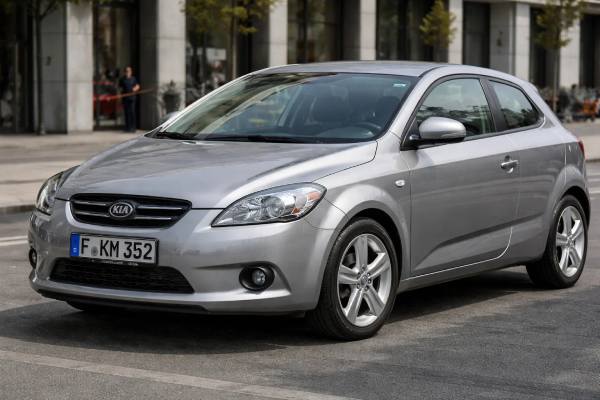
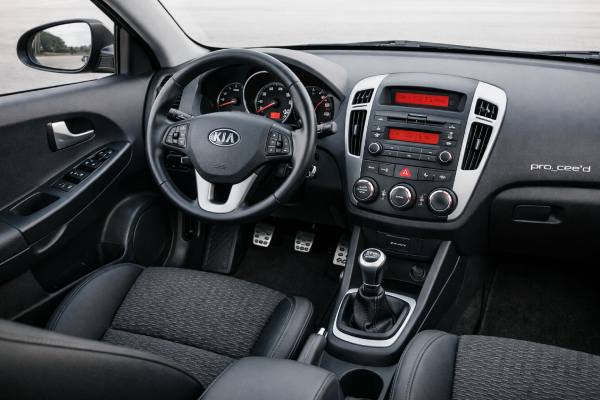
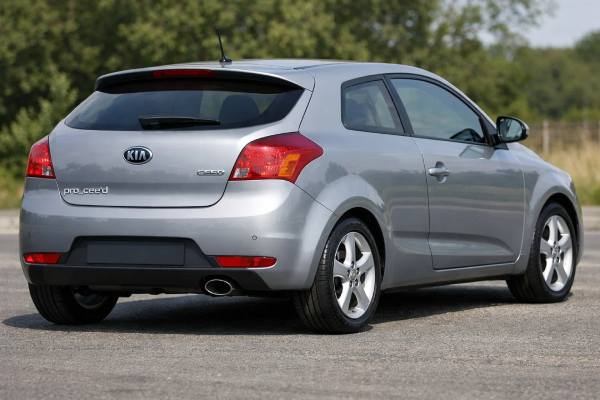
If you want the Kia Pro Cee’d (ED) with the 90 hp 1.6 CRDi diesel, you’re usually shopping for one thing: a compact hatch that can cover distance cheaply without feeling fragile. This version pairs a modest output tune with a strong mid-range torque band, so it works best as a calm, long-legged commuter rather than a hot hatch substitute. The upside is simple—low fuel use, solid range from the 53 L tank, and generally straightforward mechanicals for the era. The trade-offs are also typical diesel ones: short trips can accelerate intake and EGR deposits, neglected fuel filtration can get expensive, and clutch/dual-mass flywheel wear depends heavily on driving style. With the right maintenance history and a quick pre-purchase inspection, this Pro Cee’d can still be a practical, durable daily.
Essential Insights
- Strong low-rpm pull for city and highway cruising, even with the 90 hp tune
- Excellent long-range efficiency; a 53 L tank supports long intervals between fill-ups
- Rear multi-link suspension gives stable, mature handling for a compact hatch
- Avoid neglected examples: diesel fuel-system repairs can be costly if filters and service are skipped
- Plan on engine oil and filter service about every 20,000 km (12 months) in normal use (short-trip driving benefits from shorter intervals)
Guide contents
- Kia Pro Cee’d ED diesel profile
- Kia Pro Cee’d ED D4FB spec tables
- Kia Pro Cee’d ED trims and safety
- Diesel weak points and fixes
- Service schedule and purchase checklist
- Torque feel and motorway economy
- Rivals and smart alternatives
Kia Pro Cee’d ED diesel profile
The 2007–2009 Pro Cee’d (ED) in 1.6 CRDi 90 hp form is the “quietly capable” choice in the range. It’s not built to impress with acceleration numbers; it’s built to hold speed with low fuel use, stay composed on rough roads, and keep running with sensible upkeep. The engine (D4FB family) is a small-displacement common-rail turbodiesel tuned for economy and torque rather than peak output. In daily driving, that matters more than the horsepower figure suggests: the car steps away cleanly from low rpm and feels relaxed once rolling, especially in higher gears.
Chassis-wise, the Pro Cee’d benefits from a European-focused setup with a rear multi-link suspension instead of a simpler torsion beam. That usually translates into better mid-corner stability, more predictable behavior on broken pavement, and less skittishness over bumps at speed. Steering assist is electrically driven, with a notably tight turning circle for city parking. Braking hardware is “real hatchback” grade as well, with discs at both ends on many trims.
Where ownership gets interesting is how diesel-specific systems behave with age. This era of diesel engineering is robust when used correctly, but it has patterns:
- Short trips and cold starts raise the odds of intake and EGR deposits.
- Market-dependent equipment like a particulate filter (DPF) can turn stop-start commuting into a maintenance trigger if regeneration cycles never complete.
- A neglected fuel filter can shorten injector life, and injector repairs are not budget-friendly.
The good news is that the Pro Cee’d’s fundamentals are sensible: the cabin and controls are simple, the drivetrain is conventional (FWD with a manual gearbox), and parts availability is generally strong across Europe. If you’re buying one today, the best examples are usually those that lived a highway-heavy life with documented services, clean oil history, and evidence of routine filter changes. A lower-mileage car that did only short trips can be the riskier buy.
Kia Pro Cee’d ED D4FB spec tables
Below are the key specifications for the Kia Pro Cee’d (ED) 1.6 CRDi 90 hp (2007–2009). Exact figures can vary by market, emissions equipment, wheels, and gearbox version, but these are the representative specs for the 90 hp diesel tune.
Powertrain and efficiency
| Item | Specification |
|---|---|
| Engine code | D4FB |
| Layout and cylinders | Inline-4, DOHC, 16 valves (4 valves/cyl) |
| Bore × stroke | 77.2 × 84.5 mm (3.04 × 3.33 in) |
| Displacement | 1.6 L (1,582 cc) |
| Induction | Turbocharged (VGT-type), intercooler |
| Fuel system | Common-rail direct injection |
| Compression ratio | 17.3:1 |
| Max power | 90 hp (66.4 kW) @ 4,000 rpm |
| Max torque | 240 Nm (177 lb-ft) @ 1,900–2,750 rpm |
| Timing drive | Chain (inspect for noise/timing correlation issues with age) |
| Rated efficiency (typical combined) | ~4.7 L/100 km (50 mpg US / 60 mpg UK) |
| Real-world highway @ 120 km/h (75 mph) | ~5.3–5.9 L/100 km (40–44 mpg US / 48–53 mpg UK) |
Transmission and driveline
| Item | Specification |
|---|---|
| Transmission | 5-speed manual (most 90 hp cars) |
| Drive type | FWD |
| Differential | Open |
Chassis and dimensions
| Item | Specification |
|---|---|
| Suspension (front/rear) | MacPherson strut / multi-link |
| Steering | Motor-driven electric power steering |
| Steering ratio (overall) | ~13.2:1 |
| Turning circle (kerb-to-kerb) | ~10.34 m (33.9 ft) |
| Brakes (front/rear) | Disc 280 mm (11.0 in) / disc 278 mm (10.9 in) |
| Most common tyre size | 205/55 R16 (rim 16 in) |
| Ground clearance | ~150 mm (5.9 in) |
| Length / width / height | 4,235 / 1,790 / 1,480 mm (166.7 / 70.5 / 58.3 in) |
| Wheelbase | 2,650 mm (104.3 in) |
| Kerb (curb) weight | ~1,250–1,320 kg (2,756–2,910 lb) |
| GVWR | ~1,780–1,860 kg (3,924–4,101 lb), market-dependent |
| Fuel tank | 53 L (14.0 US gal / 11.7 UK gal) |
| Cargo volume | ~340 L (12.0 ft³) seats up / ~1,300 L (45.9 ft³) seats down (method varies by market) |
Performance and capability
| Item | Specification |
|---|---|
| 0–100 km/h (0–62 mph) | ~13.0–13.5 s |
| Top speed | ~170–175 km/h (106–109 mph) |
| Braking distance (dry, good tyres) | ~40–44 m from 100–0 km/h (typical class range) |
| Towing capacity | Often ~1,200 kg (2,646 lb) braked / ~450 kg (992 lb) unbraked (verify by VIN/market) |
| Payload | Typically ~450–560 kg (992–1,235 lb), depending on trim and GVWR |
Fluids and service capacities (typical)
| Item | Specification |
|---|---|
| Engine oil | Diesel-rated oil; viscosity commonly 5W-30 or 5W-40 depending on climate; low-SAPS oil required if equipped with DPF |
| Engine oil capacity | ~5.3 L (5.6 US qt) with filter |
| Coolant | Ethylene glycol-based coolant; typically 50/50 mix |
| Coolant capacity | ~6–7 L (6.3–7.4 US qt), verify for your VIN |
| Manual transaxle fluid | MTF meeting manufacturer spec |
| Manual transaxle capacity | ~1.9–2.0 L (2.0–2.1 US qt) |
| A/C refrigerant | R-134a (most markets) |
| A/C charge | Check under-hood label (often ~500–550 g / 18–19 oz) |
| A/C compressor oil | Check under-hood label/service manual |
| Key torque specs (decision-useful) | Wheel lug nuts commonly ~88–110 Nm (65–81 lb-ft); verify exact spec for your wheels |
Safety and driver assistance (typical for 2007–2009)
| Item | Specification |
|---|---|
| Crash ratings | Euro NCAP: 5 stars (era-specific protocol; not directly comparable to modern tests) |
| IIHS / headlight rating | Not typically applicable for this model/market |
| Core safety systems | ABS and EBD common; stability control (ESP) often trim/market dependent |
| ADAS | None in the modern sense (no AEB/ACC/LKA in this era) |
Kia Pro Cee’d ED trims and safety
Trim naming on the Pro Cee’d (ED) varies by country, but most markets offered a familiar ladder: an entry trim, one or two mid-level trims, and a better-equipped top trim with comfort and appearance upgrades. For the 1.6 CRDi 90 hp, the main mechanical differences usually aren’t the engine itself—they’re the wheels/tyres, the availability of stability control, and convenience features that affect ownership (like climate control type, audio system, and seat materials).
Here’s what to look for when you’re trying to identify equipment quickly on a used car:
- Wheels and tyres: Many 90 hp cars sit on 15 or 16-inch wheels (common sizes include 195/65 R15 and 205/55 R16). Larger 17-inch packages exist but were less common on the 90 hp tune. Bigger wheels can sharpen steering response but often add noise and can slightly reduce economy.
- Brakes and chassis: The platform commonly uses disc brakes front and rear, with the multi-link rear suspension helping stability on uneven roads. That’s one reason the Pro Cee’d often feels more planted than some budget rivals of the same era.
- Gearbox pairing: The 90 hp diesel is most often matched with a 5-speed manual, which keeps costs down and fits the engine’s torque band. If you see something unusual (different gear count or a swap), confirm it matches the car’s documentation.
Safety equipment and what changed over time
For 2007–2009, “driver assistance” mostly means core stability and braking systems, not camera/radar features. Typical equipment includes:
- ABS (anti-lock braking system) to help maintain steering control during hard braking.
- EBD (electronic brakeforce distribution) to balance braking between axles under varying load.
- ESP/ESC (stability control) depending on trim and market. Some cars have it as standard; others list it as an option or package item.
Airbag fitment varies by trim. Many cars include at least front airbags, while higher trims may add side and curtain airbags. When checking a used car, confirm:
- The airbag warning light behaves correctly at start-up.
- Seats and pillars show no signs of prior deployment repairs.
- Child-seat provisions (ISOFIX/LATCH) are present and undamaged if you rely on them.
Crash-test context
This generation achieved strong period crash performance in European testing, but it’s important to interpret that correctly. A high star rating in 2007 does not guarantee modern levels of pedestrian protection or advanced crash-avoidance tech. Treat it as a solid structural baseline, then focus your buying decision on condition, tyres, and brake health—all of which matter more in real-world stopping and control than an old badge on a brochure.
Diesel weak points and fixes
A well-kept D4FB 1.6 CRDi can run a long time, but it rewards owners who stay ahead of maintenance. The most useful way to think about reliability is by prevalence and cost tier, because not every issue is equally likely or equally painful.
Common (expect to see on higher-mileage cars)
- EGR valve and intake deposits (low to medium cost)
Symptoms: uneven idle, sluggish response, smoke under load, recurring warning lights.
Likely cause: soot and oil mist build-up, especially with short trips and lots of idling.
Remedy: inspection and cleaning, or replacement if the valve sticks; address boost leaks and tired crankcase ventilation if deposits return quickly. - Turbo control and boost leaks (medium cost)
Symptoms: weak pull, limp mode, overboost/underboost fault codes, whooshing noise.
Likely cause: split boost hoses, sticky actuator mechanism, vacuum leaks.
Remedy: smoke test and hose replacement; verify actuator movement and vacuum integrity; confirm the intercooler isn’t weeping heavily. - Clutch and dual-mass flywheel wear (medium to high cost)
Symptoms: vibration at idle, rattling when engaging/disengaging, slipping under load, shudder in higher gears.
Likely cause: repeated low-speed torque loading, city driving, towing beyond comfort.
Remedy: clutch kit replacement; flywheel replacement if out of spec (don’t cheap out if symptoms point to the DMF).
Occasional (depends on fuel quality and service habits)
- Injector sealing or injector wear (medium to high cost)
Symptoms: hard starts, diesel smell, rough running, knock, excessive smoke.
Likely cause: sealing issues, contamination, or wear from poor filtration.
Remedy: leak-off testing, seal service, injector refurbishment/replacement as required; strict fuel filter discipline afterward. - DPF-related complaints (medium cost, only if equipped)
Symptoms: warning light, rising oil level, frequent fan operation, poor economy.
Likely cause: repeated interrupted regenerations from short-trip usage.
Remedy: change driving pattern (longer steady runs), check sensors and EGR function; use correct low-SAPS oil; avoid “delete” shortcuts that create inspection and legal problems.
Rare but worth watching (high consequence)
- Cooling system neglect leading to overheating (high cost)
Symptoms: temperature spikes, coolant loss, heater performance changes.
Likely cause: aged coolant, leaks, stuck thermostat, tired radiator cap.
Remedy: pressure test, renew weak components, and follow coolant service intervals.
Software, calibrations, and service actions
On older diesels, drivability issues are often improved by ECU updates (idle quality, cold-start behavior, emissions control logic). You don’t need to chase internet rumors—just ask for dealer service history and confirm whether the car has had relevant updates. If a car has intermittent limp mode, a correct diagnosis should include:
- scanning for stored fault codes,
- checking live boost and rail-pressure data,
- verifying vacuum supply and sensor plausibility.
Finally, recalls and campaigns vary by country. The safest, most accurate approach is always a VIN-based recall check plus documented proof of completion in the service record.
Service schedule and purchase checklist
A diesel Pro Cee’d stays inexpensive when you treat maintenance as a routine, not a reaction. The schedule below is a practical baseline for the 1.6 CRDi 90 hp, with adjustments for harsh use (short trips, cold climate, heavy city traffic).
Practical maintenance schedule (distance/time)
- Engine oil and oil filter: about every 20,000 km or 12 months in normal use; consider 7,500–10,000 km or 6 months if the car does frequent short trips.
- Cabin air filter: about every 20,000 km (sooner in dusty cities or if HVAC airflow drops).
- Engine air filter: inspect regularly; replace roughly every 30,000 km (sooner in dust).
- Fuel filter: replace roughly every 30,000 km (high payoff item for injector longevity).
- Brake fluid (and clutch fluid where shared): replace about every 2 years to protect ABS/ESP components and maintain pedal feel.
- Coolant: first long interval is common on these cars, then shorter repeats; treat 5 years/100,000 km as a sensible milestone and follow with shorter intervals afterward based on the coolant type used.
- Manual transaxle fluid: not always listed as frequent, but a refresh around 100,000–120,000 km can improve shift feel and longevity.
- Serpentine/aux belt and hoses: inspect at every service; replace if cracked, glazed, or noisy.
- Battery testing (12 V): test annually once the battery is past 4–5 years; weak voltage causes diesel starting complaints that mimic bigger problems.
- Brakes and tyres: inspect pad thickness, rotor condition, and tyre wear at least every 15,000–20,000 km; align if edge wear appears.
Fluids and decision-useful notes
- Use a diesel-rated engine oil; if the car has a DPF, choose low-SAPS oil to protect the filter.
- Always bleed and refill coolant with the correct spec and mix ratio; air pockets cause overheating.
- Stick to quality fuel and keep the fuel filter interval strict—common-rail systems dislike contamination.
Buyer’s checklist (what to inspect before you pay)
- Service history: look for consistent oil services and proof of fuel filter changes. Gaps matter more than mileage.
- Cold start behavior: it should start promptly without heavy smoke. Long cranking suggests glow plug, compression, or fuel-pressure issues.
- Clutch and flywheel: feel for shudder, listen for rattles at idle, and test a full-throttle pull in a higher gear for slip.
- Boost and limp mode: test drive up a hill; power should build smoothly without sudden drop-offs.
- Cooling system: check coolant level, hose condition, and any signs of oil/coolant mixing.
- Suspension and steering: listen for front drop link knocks and check rear multi-link bush wear (uneven tyre wear can hint at neglected alignment).
- Rust and water leaks: inspect hatch seams, door bottoms, and rear light areas; damp cargo floors suggest seal issues.
Long-term, the best buys are typically clean, high-mileage motorway cars with complete records—not “low-mileage, only used in town” diesels.
Torque feel and motorway economy
The 90 hp 1.6 CRDi Pro Cee’d isn’t fast, but it is easy to drive well. The engine’s character is defined by its torque plateau: once you’re in the mid-range, it pulls with less effort than a similar-era petrol of the same output. Around town, that means fewer downshifts; on the highway, it means the car holds speed on gentle grades without constant throttle corrections.
Ride, handling, and NVH
- Ride quality: The suspension generally feels settled at speed, especially compared with simpler rear-axle designs. Sharp bumps still come through—this is a compact hatch—but the body stays controlled.
- Handling balance: With the multi-link rear, the car tends to track cleanly through long bends. It won’t rotate like a performance hatch, but it also doesn’t feel nervous.
- Steering: Electric assist is light during parking and firms up at speed. Feedback is adequate for daily driving; it’s not a “talkative” system, but it’s predictable.
- Noise and vibration: Expect typical small-diesel traits—more idle vibration than petrol and a slightly louder cold start. At motorway speed, tyre choice matters a lot; 16-inch touring tyres usually keep the cabin calmer than aggressive 17-inch setups.
Powertrain behavior
Throttle response is strongest once boost is established. In a higher gear at low rpm, it can feel flat until the turbo wakes up—so smooth driving means staying within the engine’s comfortable band rather than lugging it. The 5-speed manual suits the tune, but it does mean engine speed can be a bit higher than a 6-speed car at the same cruise speed, depending on final drive.
Real-world economy
In mixed use, this diesel commonly rewards steady driving:
- City-heavy use: higher consumption if trips are short and cold starts frequent; the engine never reaches its most efficient temperature window.
- Highway cruising (100–120 km/h): typically excellent, with economy strongly influenced by wind, tyres, and roof racks.
- Winter penalty: expect a noticeable increase in fuel use when temperatures drop and the heater load rises—especially if the car is used for short commutes.
If your driving profile is mostly urban and short, a petrol version can actually be the simpler long-term choice. If you do consistent distance driving, the diesel’s economy and torque feel are exactly what make it worthwhile.
Rivals and smart alternatives
When you compare the Pro Cee’d (ED) 1.6 CRDi 90 hp to rivals, the key question is not “Which is quickest?” It’s “Which fits my driving pattern and maintenance tolerance?” This Kia’s strengths—efficient cruising, stable chassis, and generally sensible ownership costs—stack up well, but some alternatives may suit certain buyers better.
How it compares in real ownership terms
- Versus similar-era diesel hatchbacks: Many competitors deliver comparable economy, but not all match the Pro Cee’d’s planted feel from the multi-link rear. If you value highway stability and predictable handling, the Kia holds its own.
- Versus newer small diesels: Newer diesels can be quieter and may offer 6-speed gearing that lowers cruise rpm, but they often add more complex emissions hardware. If you want simplicity, the older 90 hp tune can be easier to live with—especially if your car is not heavily emissions-equipped.
- Versus petrol alternatives: If your driving is mostly short, stop-start, and low-speed, a petrol hatch can be less demanding. For many owners, avoiding diesel-specific deposit and regeneration concerns is worth the extra fuel spend.
Who should choose this Pro Cee’d diesel?
This car is a strong fit if you:
- drive regular longer trips (or frequent highway miles),
- want excellent range and good real-world economy,
- prefer a compact hatch that feels stable and grown-up on rough roads,
- are willing to maintain it on schedule (especially filters and fluids).
You may be happier in a petrol model (or a newer hybrid) if you:
- do mostly short commutes with lots of cold starts,
- want modern driver-assistance features,
- don’t want diesel-specific maintenance considerations.
The practical verdict
A clean, well-documented Pro Cee’d (ED) 1.6 CRDi 90 hp remains a smart used buy when it’s matched to the right use case: distance driving and steady commuting. It won’t feel special in a sprint, but it can feel very satisfying over a year of ownership—because the fuel bill stays low and the car does its job without drama.
References
- cee’d product Guide 2007 (Product Guide)
- ED English 1.qxd 2006 (Owner’s Manual)
- Kia Recalls | Kia Europe 2025 (Recall Database)
- cee’d 2006-2015 | Models | Official Media Site NEWSROOM 2025 (Manufacturer Information)
- euroncap_kia_ceed_2007_5stars.pdf 2007 (Safety Rating)
Disclaimer
This article is for informational purposes only and is not a substitute for professional diagnosis, inspection, or repair. Specifications, torque values, service intervals, and procedures can vary by VIN, market, model year, and equipment (including emissions hardware). Always confirm details using official service documentation for your exact vehicle and follow qualified technician guidance when needed.
If this guide helped, please consider sharing it on Facebook, X, or your favorite forum to support our work.