
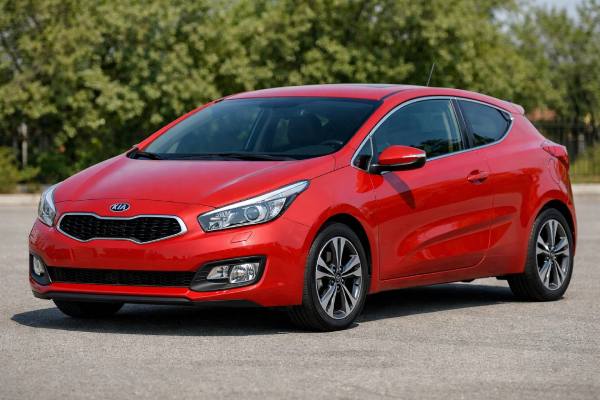
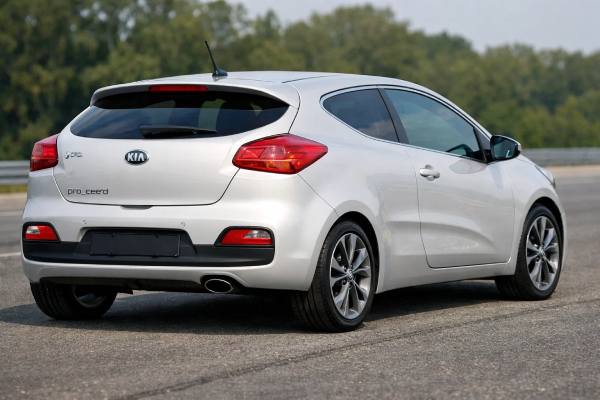
The 2012–2015 Kia Pro Cee’d (JD) with the 1.4 Gamma MPi engine is the “simple petrol” option in the range: naturally aspirated, multi-port injection, and paired mainly with a 6-speed manual. In real ownership terms, that combination tends to reward drivers who value predictable behavior and lower day-to-day risk over headline performance. The engine is happiest when you treat it like a small-displacement unit—keep momentum, use revs when merging, and stay on top of oil quality.
Where this Pro Cee’d often stands out is chassis balance. On most European-market cars, the JD platform’s suspension tuning gives a stable, confidence-building feel at motorway speeds without feeling harsh around town. The trade-off is that the 1.4 MPi can feel breathless when fully loaded, and neglected maintenance (especially long oil intervals) can turn “simple” into “annoying.”
Fast Facts
- Solid, low-drama petrol drivetrain if you keep oil fresh and fix small leaks early.
- Confident motorway manners for a compact 3-door, with predictable steering and braking feel.
- Usually cheaper to service than turbo petrols and many diesels (fewer heat-related parts).
- Watch for EPS steering clunks, tired suspension bushings, and coil/plug misfires as miles add up.
- Practical baseline interval: engine oil and filter every 10,000–12,000 km (6,000–7,500 mi) or 12 months, whichever comes first.
Navigate this guide
- Kia Pro Cee’d JD 2012–2015 detailed overview
- Kia Pro Cee’d JD 1.4 MPi specs and technical data
- Kia Pro Cee’d JD trims, options, and safety tech
- Reliability issues and known service actions
- Maintenance plan and buying checklist
- Real-world driving and performance notes
- How it stacks up against key rivals
Kia Pro Cee’d JD 2012–2015 detailed overview
Think of the 1.4 Gamma MPi Pro Cee’d as the “durable commuter spec” wrapped in a sportier 3-door body. The engineering story is straightforward: a naturally aspirated inline-four with multi-port injection (MPi) prioritizes smooth operation, consistent fueling, and lower sensitivity to intake-valve deposits than many direct-injection engines. That doesn’t make it maintenance-free—but it often means fewer expensive surprises compared with small turbo petrols as the car ages.
What you get in everyday use
- Linear throttle response: Power builds predictably with rpm. There’s no turbo surge, and traction is easy to manage in wet conditions with normal tyres.
- A “rev it to use it” character: At 100 hp, it’s adequate rather than quick. Passing and steep grades typically require a downshift, especially with passengers or luggage.
- Balanced chassis feel: The JD platform is generally stable at speed. Many cars were set up for European roads with a planted rear end and a calm ride over long distances.
Who it suits best
- Drivers doing mixed city and suburban mileage, who value lower running-cost volatility and don’t want diesel complexity.
- Buyers who want a compact hatch that feels “grown up” at 110–130 km/h (65–80 mph), even if acceleration isn’t the headline.
- Owners comfortable with routine service planning, rather than stretching intervals.
What it is not
- Not the best choice if you routinely carry heavy loads, live in mountainous areas, or demand effortless overtakes. You can do those things—but you’ll work the gearbox.
- Not immune to age-related electrical and chassis issues. As with many compacts of this era, rubber bushings, sensors, and steering components become the deciding factors after ~8–12 years.
A useful mental model: this Pro Cee’d is often at its best when you buy it for condition and history, not for the brochure spec. A well-maintained 1.4 MPi with tidy suspension and clean electrical behavior can feel “newer” than a higher-output variant that has been neglected.
Kia Pro Cee’d JD 1.4 MPi specs and technical data
The figures below reflect typical European-market 2012–2015 Pro Cee’d (JD) cars with the 1.4 MPi 100 hp configuration. Exact numbers can vary by market, tyre/wheel package, and homologation cycle, so treat them as a strong baseline and verify against your VIN-specific documentation.
Powertrain and efficiency
| Item | Specification |
|---|---|
| Code | Gamma MPi (commonly referenced as 1.4 Gamma MPi) |
| Engine layout and cylinders | Transverse inline-4, DOHC, 4 valves/cyl |
| Displacement | 1.4 L (1,368 cc) |
| Bore × stroke | 72.0 × 84.0 mm (2.83 × 3.31 in) |
| Induction | Naturally aspirated |
| Fuel system | MPi (multi-port injection) |
| Compression ratio | ~10.5:1 (typical for this family) |
| Max power | 100 hp (74 kW) @ ~6,300 rpm (market dependent) |
| Max torque | Typically in the 130–140 Nm range (varies by calibration) |
| Timing drive | Chain (inspect for noise/stretch symptoms as mileage rises) |
Rated efficiency (typical):
- Combined often lands around 6.0–6.5 L/100 km (≈ 36–39 mpg UK / 31–35 mpg US) depending on test cycle and wheels.
- Real-world motorway at 120 km/h (75 mph) is commonly ~6.0–7.0 L/100 km if the car is healthy and aligned.
Transmission and driveline
| Item | Specification |
|---|---|
| Transmission | Usually 6-speed manual (varies by market) |
| Drive type | FWD |
| Differential | Open |
Chassis and dimensions
| Item | Typical specification (varies by wheel/trim) |
|---|---|
| Suspension (front/rear) | MacPherson strut / multi-link (common EU spec) |
| Steering | Electric power steering (EPS) |
| Brakes | 4-wheel discs on many trims; sizes vary by package |
| Wheels/tyres (popular sizes) | 195/65 R15, 205/55 R16, 225/45 R17 |
| Length / width / height | ~4,310 / 1,780 / 1,430 mm (169.7 / 70.1 / 56.3 in) |
| Wheelbase | ~2,650 mm (104.3 in) |
| Turning circle (kerb-to-kerb) | ~10.6 m (34.8 ft) |
| Kerb weight | Commonly ~1,200–1,300 kg (2,646–2,866 lb) |
| Fuel tank | ~53 L (14.0 US gal / 11.7 UK gal) |
| Cargo volume | Often quoted around ~380 L seats up (VDA), larger with seats down |
Performance and capability (typical)
| Item | Typical figure |
|---|---|
| 0–100 km/h (0–62 mph) | ~12–14 s (depends on gearing, tyres, conditions) |
| Top speed | ~180–185 km/h (112–115 mph) |
| Payload / towing | Market- and trim-dependent; check your VIN plate and handbook |
Fluids and service capacities (decision-useful ranges)
The official numbers vary by engine variant and market, but these ranges help you plan service work and cost:
| Fluid | Typical spec / note |
|---|---|
| Engine oil | Commonly ACEA A5/B5 or A3/B4 depending on market; 5W-30 is common (verify for your region) |
| Oil capacity | Often ~3.3–3.6 L (3.5–3.8 US qt) with filter (verify by engine variant) |
| Coolant | Ethylene glycol coolant; often 50/50 premix target |
| Brake fluid | DOT 4 (typical) |
| A/C refrigerant | Often R134a on this era; charge varies by system |
Kia also publishes model-family oil grades and capacities guidance for various markets.
Kia Pro Cee’d JD trims, options, and safety tech
Trim naming varies heavily by country, but most 2012–2015 Pro Cee’d (JD) lineups follow a familiar structure: a value-focused base grade, one or two mid trims with comfort upgrades, and an upper trim that adds convenience tech and larger wheels.
Trims and options that change ownership
Wheel and tyre packages (cost and ride impact)
- 15-inch (e.g., 195/65 R15): Usually the most comfortable and often the cheapest tyre to replace. Also helps the 1.4 feel a little less strained.
- 16-inch (205/55 R16): Common “sweet spot” for looks vs ride.
- 17-inch (225/45 R17): Sharper response, but potholes and tyre cost increase; alignment becomes more important to avoid inner-edge wear.
Cabin and convenience options
- Heated seats and steering wheel (cold-climate value add).
- Rear parking sensors and camera (the 3-door’s rear visibility makes this more useful than you’d think).
- Dual-zone climate on higher trims in some markets.
- Infotainment upgrades (navigation head units differ by year and region; check Bluetooth behavior and mic quality during a test drive).
Quick identifiers during inspection
- Wheel size and brake hardware often hint at trim level.
- Look for factory sensor blanks vs installed sensors in bumpers.
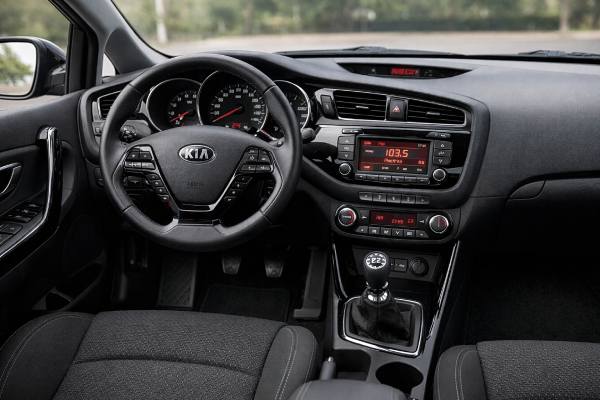
- Check steering wheel controls and instrument cluster display type (basic vs mid/high).
Safety ratings and what they mean here
For the JD-generation Cee’d family, Euro NCAP awarded a 5-star rating under the 2012 protocol, with strong adult and child occupant performance and a high Safety Assist score for the time. Kia’s own release for the new-generation Cee’d cited Adult Occupant 89%, Child Occupant 88%, and Safety Assist 86%. ([kia.sk][1])
Independent summaries for the 2012 Euro NCAP results commonly show Pedestrian 61% under that test regime. ([Touring Club Schweiz][2])
A practical takeaway: structurally, the platform is sound for its era, and stability-control availability across the range matters in real-world avoidance events. But crash-test scores do not remove the need to check tyres, brakes, and alignment—those are what decide whether you avoid the crash in the first place.
Driver assistance (ADAS) reality check
On most 2012–2015 Pro Cee’d trims, expect limited modern ADAS:
- ESC (electronic stability control) is a key baseline item.
- Parking aids vary by trim.
- True AEB/ACC/lane-centering features were not typically widespread on this generation and period in many markets.
Focus your buying decision less on “ADAS checkboxes” and more on: airbag warning lights, correct steering feel, strong brake pedal, and evidence that the car wasn’t neglected.
Reliability issues and known service actions
The 1.4 MPi Pro Cee’d’s reputation is generally helped by its mechanical simplicity, but age and usage patterns still create predictable fault clusters. Below is a practical map by prevalence and cost tier; treat it as a checklist for diagnosis and negotiation.
Common (expect to see some of these)
EPS steering clunk (low–medium cost)
- Symptoms: Knock/clunk through the steering over small bumps; sometimes more obvious in cold weather.
- Likely cause: Wear in steering column coupler/bushing or intermediate components (varies by build).
- Remedy: Replace the worn coupler/bushing or affected column component; confirm no play in tie rods and ball joints afterward.
Ignition misfires (low cost if caught early)
- Symptoms: Rough idle, hesitation under load, flashing MIL in severe cases.
- Likely cause: Worn spark plugs, tired coil packs, or oil contamination in plug wells (from a seep).
- Remedy: Plugs at the correct heat range and gap; swap coils to confirm if the misfire follows; fix any oil seep before it ruins coils.
Suspension wear (medium cost, creeps up gradually)
- Symptoms: Front-end thumps, vague steering, uneven tyre wear, instability on braking.
- Likely cause: Control-arm bushings, drop links, top mounts, rear multi-link bushings depending on mileage/roads.
- Remedy: Replace worn items in matched pairs, then do a proper alignment.
Occasional (depends on climate and driving pattern)
Timing chain stretch/noise (medium–high cost if ignored)
- Symptoms: Rattle on cold start, correlation codes, roughness that doesn’t match ignition issues.
- Likely cause: Extended oil intervals, wrong oil spec/viscosity for climate, sludge.
- Remedy: Diagnose via noise pattern and scan data; replace chain/tensioner/guides if out of spec. The “simple engine” still needs clean oil.
Cooling system aging (medium cost)
- Symptoms: Slow warm-up (stuck-open thermostat), overheating under load (rare), coolant smell.
- Likely cause: Thermostat wear, radiator/condenser fin damage, hose aging.
- Remedy: Pressure test, inspect for seepage at joints, replace thermostat/pump as indicated, then bleed correctly.
Brake hardware issues (low–medium)
- Symptoms: Rear brake drag, uneven pad wear, vibration.
- Likely cause: Sticking caliper sliders, corrosion, old brake fluid.
- Remedy: Service sliders, replace hardware, flush fluid on schedule, verify parking brake adjustment.
Rare but worth screening
Catalyst or oxygen sensor faults (medium cost)
- Usually secondary to misfires or oil consumption. Fix the root cause first, then re-check readiness monitors.
Recalls, TSBs, and how to verify
Because recall campaigns vary by market, don’t rely on internet lists alone. Use:
- Official VIN checks (national Kia owner portals where available).
- Dealer service history printouts.
- Evidence of software updates if drivability issues were previously addressed.
If you cannot verify completion, assume you may need a dealer check—and price the car accordingly.
Maintenance plan and buying checklist
A good 1.4 MPi Pro Cee’d is usually the one that followed boring routines. The schedule below is intentionally practical and slightly conservative for mixed driving and shorter trips.
Practical maintenance schedule (distance/time)
- Engine oil and filter: every 10,000–12,000 km (6,000–7,500 mi) or 12 months. Short-trip cars benefit from the shorter end.
- Engine air filter: inspect every 15,000 km; replace around 30,000 km (18,000 mi) or sooner in dusty areas.
- Cabin filter: every 15,000–20,000 km (9,000–12,000 mi) or yearly (helps HVAC performance and reduces windshield fogging).
- Spark plugs: commonly 60,000 km (37,000 mi); confirm exact plug type and interval for your calibration.
- Brake fluid: every 2 years, regardless of mileage.
- Coolant: follow the official coolant type and interval for your market; many long-life coolants run several years, but aging hoses and thermostat health matter as much as the fluid itself.
- Manual gearbox oil (if serviceable per market guidance): consider around 80,000–120,000 km (50,000–75,000 mi) if you want long-term shift quality.
- Drive belts and hoses: inspect at every major service; replace if cracked, noisy, or oil-soaked.
- Tyres: rotate every 10,000–12,000 km (6,000–7,500 mi); align yearly or after suspension work.
- 12 V battery: test annually after year 4; replacement commonly 4–6 years depending on climate.
Kia publishes model-family guidance for engine oil grades and capacities; confirm your exact engine and market spec before buying fluids.
Buyer’s guide: what to check in 30 minutes
Paperwork
- Stamped/dated service record that matches mileage progression.
- Evidence of brake fluid changes and regular oil service (not just “when the light came on”).
Engine bay
- Oil level and condition (heavy varnish/sludge smell is a warning sign).
- Coolant level and signs of dried coolant residue at hose joints.
- Listen for cold-start chain rattle (brief noise can be normal; persistent rattling is not).
Driving test
- Steering: any clunking over small bumps? Any notchiness near center?
- Brakes: straight stops from 60–100 km/h; check for vibration and pull.
- Gearbox: smooth engagement in 2nd and 3rd under load; no crunching.
- Cabin: check all window switches, central locking, infotainment pairing, and AC performance.
Underside (if possible)
- Look for leaking dampers and torn bushings.
- Check for corrosion on subframes, brake lines, and exhaust joints (climate-dependent).
Long-term durability outlook
If the car has:
- consistent oil changes,
- tidy cooling system behavior,
- quiet steering and healthy suspension,
…it’s reasonable to expect this powertrain to age well in normal use. The typical “end-game” costs are more often chassis refresh (bushings, dampers, brakes) than catastrophic engine failure—provided you don’t ignore misfires or oil neglect.
Real-world driving and performance notes
The 1.4 MPi Pro Cee’d is best understood as a momentum car. It’s not slow in a dangerous way, but it rewards a driver who plans gaps and uses the gearbox.
Ride, handling, and NVH
- Straight-line stability: Generally confident on the motorway. With good tyres and correct alignment, it tracks cleanly and doesn’t feel nervous in crosswinds for a compact hatch.
- Cornering balance: Neutral and predictable at normal speeds. The rear end usually feels secure rather than “floaty,” especially compared with older torsion-beam setups.
- Steering feel: EPS makes parking easy, but feedback is filtered. If you feel knocking, looseness, or inconsistent self-centering, assume steering/suspension wear and investigate.
- Cabin noise: Expect moderate road noise on coarse asphalt. Larger wheels (17″) typically add impact harshness and can raise noise levels.
Powertrain character
- Throttle response: Clean and linear; no turbo lag, but also no “extra shove” at low rpm.
- Where the power is: You’ll often use the upper midrange for merges and overtakes. Short-shifting early can make it feel flat.
- Transmission behavior: The manual suits the engine well. Any reluctance into gear when cold can be normal, but persistent notchiness may point to worn mounts, old gearbox oil (where serviceable), or clutch hydraulics.
Real-world efficiency expectations
In mixed driving, many owners see:
- City-heavy: ~7.5–9.0 L/100 km (31–26 mpg UK / 24–20 mpg US) depending on traffic and trip length.
- Highway 100–120 km/h: ~6.0–7.0 L/100 km (47–40 mpg UK / 39–34 mpg US) with normal loads.
- Cold weather: expect a meaningful penalty on short trips (slow warm-up dominates).
Two practical tips that materially affect consumption:
- Keep tyres at the correct pressures (underinflation hurts both economy and steering feel).
- Fix dragging brakes and tired alignment early; they quietly waste fuel.
Selective performance metrics that matter
- 0–100 km/h: often lands around the low-to-mid teens in seconds. That’s enough for daily driving, but it explains why maintaining speed on inclines matters.
- Passing ability: The key is downshifting. If you try to pass in too high a gear, it will feel like the car “refuses” rather than accelerates.
If your use case involves frequent high-speed overtakes, consider whether a 1.6 petrol or a turbo petrol variant fits better—then weigh the maintenance complexity trade-off.
How it stacks up against key rivals
In the 2012–2015 European compact segment, the Pro Cee’d 1.4 MPi competed less on speed and more on ownership logic—warranty culture, sensible packaging, and a chassis that doesn’t feel cheap.
Versus Volkswagen Golf and SEAT León (similar era)
- Kia advantage: Often lower purchase price for similar mileage; straightforward MPi drivetrain can be less intimidating than some turbo/direct-injection setups as the cars age.
- Rival advantage: Many Golfs/Leóns offer stronger small turbo engines with easier overtakes and potentially better highway economy when lightly loaded.
- Decision tip: If you do mostly motorway and carry people often, the Kia’s 1.4 may feel underpowered compared with a 1.4 TSI-type rival.
Versus Ford Focus and Opel/Vauxhall Astra
- Kia advantage: Predictable mechanical layout and typically easy independent-shop servicing; stable motorway feel.
- Rival advantage: Focus often wins on steering feedback; Astra availability and parts pricing can be favorable in some regions.
- Decision tip: Choose on condition of suspension and steering. A fresh Focus drives brilliantly; a tired one feels worse than a well-kept Kia.
Versus Hyundai i30 (platform cousin)
- Kia advantage: Pro Cee’d styling and 3-door body appeal; often similar mechanical parts availability.
- Rival advantage: More body styles and sometimes broader trim availability.
- Decision tip: Treat them as siblings—buy the one with the better service history and cleaner chassis.
Who should pick the Pro Cee’d 1.4 MPi?
Pick it if you want:
- a compact hatch with a calmer “grown up” feel,
- a petrol engine that is simple by modern standards,
- and a car you can keep reliable with routine maintenance and early fixes.
Skip it (or choose a stronger engine) if:
- you regularly drive fully loaded,
- you want effortless passing without downshifts,
- or you’re shopping mainly for performance.
References
- Kia C’eed – Crash Test 2012 2012 (Safety Rating)
- New-generation Kia cee’d awarded top safety score by EuroNCAP – Kia Slovakia s.r.o. 2012 (Safety Rating)
- Käyttöohjekirjat | Kia Finland 2025 (Owner’s Manual)
- Engine Oil Grades and Capacities 2016 (Service Manual)
Disclaimer
This article is for informational purposes only and is not a substitute for professional diagnosis, inspection, or repair. Specifications, torque values, service intervals, and procedures can vary by VIN, market, engine calibration, and installed equipment. Always verify details using your official owner’s manual and service documentation for your exact vehicle.
If this guide helped, please consider sharing it on Facebook, X (Twitter), or your favorite forum to support our work.