
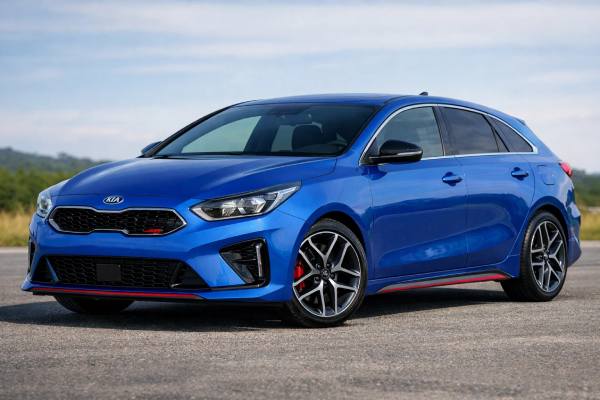
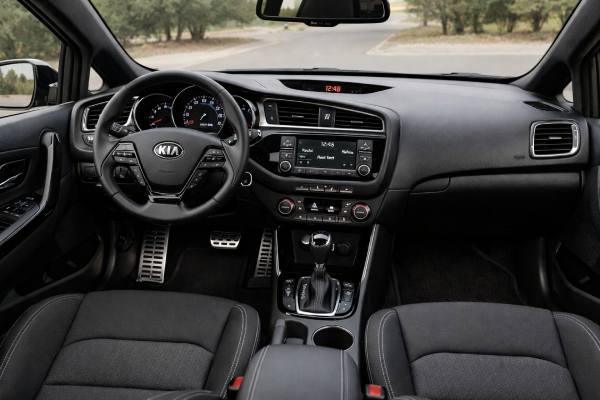

The 2019–2021 Kia ProCeed GT (CD) is a rare mix: a sleek shooting-brake body with genuine hot-hatch pace. Its 1.6 T-GDi turbo petrol (201 hp) delivers quick, repeatable performance without needing high revs, while the chassis stays composed enough for long motorway trips. Where many sporty compacts trade practicality for style, the ProCeed GT keeps a large boot and an easy loading shape, so it works as an everyday car.
Ownership quality is mostly about managing heat and maintenance discipline. This direct-injection turbo uses a timing chain and a gasoline particulate filter (GPF), and it rewards the basics: correct oil, good warm-up habits, and spark plugs on time. Choose the gearbox that fits your commute—manual for simplicity and predictable engine braking, or 7DCT for fast passing and relaxed traffic driving—then keep software and fluids current so the whole package stays sharp as miles add up.
Owner Snapshot
- Strong midrange torque makes real-world overtakes effortless, even with passengers and luggage.
- Practical “sport wagon” cargo space without the height and weight of a crossover.
- 7DCT is quick, but heavy stop-start creeping can accelerate clutch wear if driven like a torque-converter auto.
- Plan for direct-injection intake cleaning risk over time if most driving is short-trip or low-load.
- Typical service interval is 15,000–16,000 km (10,000 mi) or 12 months (verify by VIN and market).
What’s inside
- ProCeed GT CD in depth
- ProCeed GT CD numbers and capacities
- ProCeed GT CD equipment and safety tech
- Known problems and recalls
- Service plan and buying tips
- Road manners and performance
- GT shooting brake alternatives
ProCeed GT CD in depth
The ProCeed GT is best understood as a “fast tourer” rather than a raw track special. It shares its fundamentals with the Ceed family, but the GT layer adds the parts that matter for enthusiastic road driving: more power, stronger braking hardware, and a chassis tune that feels planted at speed. You sit low, the roofline is dramatic, and the car looks more premium than its price point suggests—yet it still offers the everyday usefulness that makes a sporty compact easy to justify.
The headline engineering choice is the 1.6 T-GDi turbo petrol from Kia’s Gamma II family. In this 201 hp tune, it’s designed to deliver a broad torque band that works well with taller cruising gears. That matters because the ProCeed GT is often used for mixed driving: city commuting during the week, then motorway or mountain roads on weekends. The engine’s character fits that rhythm—responsive, quick to build boost, and happier when you keep it within its midrange rather than revving it like an old-school naturally aspirated hot hatch.
Body style is the second big story. The shooting-brake shape gives you a long roof and a wide hatch opening, so luggage and bulky items are easier than in a typical sporty hatch. It also tends to feel more stable on the motorway than shorter-bodied rivals, especially in crosswinds, because the wheelbase and rear overhang help the car “settle” at speed. The trade-off is rear headroom: adults fit fine, but taller passengers will notice the sloping roofline.
From an ownership perspective, the GT’s advantages are practical and financial. You get a performance level that’s fast enough to feel special, while still staying within the maintenance envelope of a mainstream compact—no exotic tires, no complicated AWD system, and widely available service parts. The main caveat is that this is a modern, emissions-controlled direct-injection turbo. It will not tolerate neglected oil quality, constant short trips, or repeated hard driving without cooldown periods as gracefully as a simpler engine.
If you’re shopping used, the “right” ProCeed GT is the one with evidence of careful warm-up habits, consistent oil services, and correct spark plug intervals—because those basics directly protect the turbocharger, timing chain system, and long-term combustion cleanliness.
ProCeed GT CD numbers and capacities
This section focuses on practical, owner-facing technical data for the 2019–2021 ProCeed GT (CD) with the 1.6 T-GDi (201 hp). Exact figures can vary slightly by homologation version, wheel/tyre package, and market equipment, so treat these as planning numbers and confirm against VIN-specific documentation.
Powertrain and efficiency
| Item | Specification |
|---|---|
| Code | Gamma II 1.6 T-GDi (commonly referenced as G4FJ in related applications) |
| Engine layout and cylinders | Inline-4, 4 cylinders; DOHC; 4 valves/cyl |
| Bore × stroke | ~77.0 × 85.4 mm (3.03 × 3.36 in) |
| Displacement | 1.6 L (1,591 cc) |
| Induction | Turbocharged + intercooler |
| Fuel system | Gasoline direct injection (GDI) |
| Compression ratio | ~10.0:1 |
| Max power | 201 hp (150 kW) @ 6,000 rpm |
| Max torque | 265 Nm (195 lb-ft) @ 1,500–4,500 rpm |
| Timing drive | Chain |
| Rated efficiency (typical WLTP combined) | ~7.0–7.6 L/100 km (31–34 mpg US / 37–40 mpg UK) |
| Real-world highway @ 120 km/h (75 mph) | Often ~7.0–8.0 L/100 km (29–34 mpg US / 35–40 mpg UK) depending on temperature and tyres |
Transmission and driveline
| Item | 6MT | 7DCT |
|---|---|---|
| Transmission | 6-speed manual | 7-speed dual-clutch |
| Drive type | FWD | FWD |
| Differential | Open (brake-based traction control) | Open (brake-based traction control) |
Chassis and dimensions
| Item | Value (typical for ProCeed CD) |
|---|---|
| Suspension (front/rear) | MacPherson strut / multi-link |
| Steering | Electric power steering, rack-and-pinion |
| Brakes (front/rear) | Ventilated discs / discs (GT hardware varies by market) |
| Wheels/Tyres (most common) | 225/40 R18 |
| Ground clearance | ~135 mm (5.3 in), trim-dependent |
| Length / width / height | 4,605 / 1,800 / 1,422 mm (181.3 / 70.9 / 56.0 in) |
| Wheelbase | 2,650 mm (104.3 in) |
| Turning circle (kerb-to-kerb) | ~10.6 m (34.8 ft) |
| Fuel tank | 50 L (13.2 US gal / 11.0 UK gal) |
| Cargo volume (VDA) | ~594 L (21.0 ft³) seats up / ~1,545 L (54.6 ft³) seats folded |
Performance and capability
| Metric | 6MT | 7DCT |
|---|---|---|
| 0–100 km/h (0–62 mph) | ~7.6 s | ~7.5 s |
| Top speed | ~230 km/h (143 mph) | ~225 km/h (140 mph) |
| Braking distance (100–0 km/h) | tyre- and test-dependent; plan ~35–38 m typical for the class |
Fluids and service capacities (planning values)
| Item | Typical notes |
|---|---|
| Engine oil | Often 5W-30 or 0W-30 in approved specs; capacity commonly ~4.5–5.0 L (4.8–5.3 US qt) |
| Coolant | Long-life ethylene glycol coolant; total system often ~6–7 L |
| 7DCT fluid | Service-by-procedure; use only the specified DCT fluid |
| A/C refrigerant | Often R-1234yf in EU markets; charge amount is vehicle-specific (check under-hood label) |
| Key torque specs | Wheel nuts commonly ~88–108 Nm (65–80 lb-ft); drain plug and undertrays vary by VIN |
Safety ratings and driver assistance (baseline context)
The Ceed-family platform achieved a five-star Euro NCAP result in 2019 under the applicable test version, with strong adult and child occupant performance; results can vary depending on optional safety packs and equipment level.
ProCeed GT CD equipment and safety tech
For 2019–2021, ProCeed range structure is usually simple: GT-Line for style-focused buyers and GT for performance. In many markets, the ProCeed GT is “fully loaded” by default compared with mainstream trims, which helps used buyers: you spend less time decoding option codes and more time verifying condition and history.
Trims, options, and the differences that actually matter
While cosmetics are obvious (GT badging, sportier bumpers, larger wheels), the functional differences that affect ownership are more important:
- Wheel and tyre package: GT cars typically wear 18-inch wheels with 225/40 R18 tyres. They sharpen response but increase tyre cost and make pothole impacts more noticeable. If your roads are rough, inspect for bent rims and inner sidewall damage.
- Brakes and heat capacity: GT-specific brake hardware generally improves fade resistance in repeated hard stops. In used cars, look for uneven pad deposits (shudder under braking) from aggressive use without proper bedding.
- Seats and driving position: GT seats usually add bolstering that reduces fatigue on twisty roads. Check for cracked bolsters and seat-heater operation, as repairs can be pricey.
- Infotainment tiers: Depending on market year, you may see larger screens, upgraded navigation, premium audio, and connected services. Make sure key features work (Bluetooth, camera, parking sensors) because infotainment fixes can be more expensive than traditional mechanical repairs.
Safety ratings and what to confirm on your car
The Ceed family was tested by Euro NCAP in 2019. A key nuance for shoppers is that some versions were evaluated with standard safety equipment and again with an optional safety pack, which can change the star rating and “Safety Assist” performance. In practical terms, the structure and airbags may be similar, but the active safety score improves when the car has the correct camera/radar suite.
When shopping used, confirm which driver assistance features are actually installed, not just listed in a generic brochure. The features that tend to matter most day-to-day are:
- AEB (automatic emergency braking): sometimes with pedestrian/cyclist detection depending on equipment
- ACC (adaptive cruise control): helpful on motorway commutes; verify smooth operation and no radar faults
- Lane support: lane keeping assist and lane following behavior on better-equipped cars
- Blind-spot and rear cross-traffic alerts: reduce stress in tight city parking
ADAS service reality: recalibration and false warnings
Modern driver assistance is sensitive to repair quality. After windscreen replacement (camera), front bumper work (radar), alignment changes, or suspension repairs, the car may require ADAS calibration. On a test drive, watch for intermittent warnings, lane camera dropouts, or ACC disabling itself—those can indicate a misaligned sensor, a windscreen not matched to the camera, or a simple software update that was skipped.
As an advantage, the ProCeed GT’s safety tech is mature rather than experimental. The systems are generally predictable when correctly calibrated, and they tend to add real value on long trips.
Known problems and recalls
The ProCeed GT’s reliability story is mostly positive when it’s maintained correctly, but it’s not a “set and forget” performance car. A direct-injection turbo engine and a dual-clutch option bring a few predictable patterns. The key is to separate common annoyances from rare, expensive failures—and to buy a car that shows evidence of correct servicing.
Common (more frequent) issues
- Ignition coils and spark plug sensitivity (low to medium cost):
Symptoms: misfire under load, rough idle, hesitation, check-engine light.
Likely cause: plug wear, incorrect plug type, coil degradation accelerated by heat.
Remedy: replace plugs at the official interval (often ~60,000 km / 40,000 mi for turbo GDI), use the correct heat range, and replace coils as needed. - Direct-injection intake valve deposits (medium cost, mileage-dependent):
Symptoms: cold-start stumble, loss of crisp throttle response, uneven idle at higher mileage.
Likely cause: GDI fuel doesn’t wash intake valves; deposits build faster with short trips and low-load driving.
Remedy: professional intake cleaning (often walnut blasting) if symptoms and inspection justify it. - GPF and short-trip behavior (medium cost, usage-dependent):
Symptoms: higher fuel use, frequent fan operation, occasional warning lights.
Likely cause: repeated short trips preventing full aftertreatment temperature cycles.
Remedy: regular longer drives, correct oil spec, and diagnosis before replacing expensive parts.
Occasional issues
- Turbo control or boost leaks (medium cost):
Symptoms: underboost codes, inconsistent acceleration, whooshing noises.
Likely cause: charge pipe/intercooler leaks, control solenoid issues.
Remedy: smoke test and targeted repair—avoid guesswork parts swapping. - 7DCT low-speed shudder or hesitation (medium to high cost if neglected):
Symptoms: judder in creeping traffic, harsh engagement on inclines.
Likely cause: clutch adaptation out of range, driver “riding” the clutches, or software needing update.
Remedy: adaptation reset/relearn and software updates first; confirm correct fluid/service procedure if the transmission has been opened.
Rare but high-severity risks
- Cooling system neglect and heat soak damage (high cost):
Symptoms: coolant loss, overheating history, persistent knock under load.
Likely cause: ignoring small leaks, using incorrect coolant mixtures, or repeated hard driving with immediate shutdown.
Remedy: pressure test and fix leaks early; use sensible cooldown after hard runs.
Recalls, TSBs, and how to verify completion
Because recall scope depends on VIN and market, verification should be official:
- Use the manufacturer VIN recall portals (EU and UK tools exist) and keep a screenshot or printout for your records.
- Ask the seller for dealer invoices that show campaign closure.
- If the car has active ADAS features, confirm that any sensor-related service included calibration paperwork.
Practical pre-purchase advice: run a diagnostic scan and look for stored misfires, fuel-trim anomalies, turbo underboost history, and transmission temperature or clutch adaptation warnings. These don’t automatically mean “don’t buy,” but they should shape price and negotiation.
Service plan and buying tips
A ProCeed GT that has been serviced “by the book” can be a dependable, fast daily. A ProCeed GT that has seen skipped oil changes or cheap spark plugs can become an expensive project. The goal is to set a conservative, practical service plan that protects the turbocharger, timing chain system, and aftertreatment—then use that plan as a buying checklist.
Practical maintenance schedule (distance/time)
Because service intervals vary by market, treat this as a robust baseline for most owners:
| Item | Normal use | Hard use (short trips, frequent boost, hot climate, track days) |
|---|---|---|
| Engine oil and filter | 15,000–16,000 km (10,000 mi) / 12 months | 8,000–10,000 km / 12 months |
| Cabin air filter | 15,000–30,000 km / 12–24 months | 15,000 km / 12 months |
| Engine air filter | 30,000–60,000 km / 24–48 months | 30,000 km / 24 months |
| Spark plugs | ~60,000 km (40,000 mi) | 40,000–50,000 km if driven hard |
| Brake fluid | Every 2 years | Every 2 years (do not stretch) |
| Coolant | Per VIN schedule; inspect yearly | Inspect yearly; replace early if contaminated |
| Tyre rotation + alignment check | 10,000–15,000 km | 10,000 km |
| 12 V battery test | Annually after year 3 | Annually after year 2–3 |
Fluids, specs, and “small details” that prevent big costs
- Oil quality matters more than brand: Use the correct approved spec and viscosity for your market. Turbo GDI engines run hot and can shear low-quality oil quickly.
- Don’t stretch plug intervals: Misfires under boost can damage the catalytic system and stress the GPF.
- Use cooldown habits: After a hard run, drive gently for a few minutes before shutdown. This reduces turbo heat soak and oil coking risk.
Buyer’s guide: what to inspect before you commit
Service history (non-negotiable for a GT):
- Consistent oil changes (time and distance).
- Spark plug receipts, not just “serviced” stamps.
- Evidence of correct tyres and regular alignment (uneven wear is common on sporty setups).
Road test checks:
- Full-throttle pull in a higher gear: look for clean acceleration with no misfire.
- Steady cruise, then gentle acceleration: watch for hesitation or surging.
- Braking from motorway speeds: feel for vibration that suggests warped discs or pad deposits.
7DCT-specific checks:
- Hill start and parking maneuvers: no excessive shudder.
- Smooth engagement when pulling away gently (no “grabby” behavior).
- Confirm any transmission service documentation, especially if the car has been used in heavy traffic.
Long-term durability outlook
If you maintain it like a performance car—oil, plugs, and heat management—the ProCeed GT ages well. If you treat it like a basic commuter and stretch intervals, the engine and aftertreatment systems will remind you that “GT” has real operating requirements.
Road manners and performance
On the road, the ProCeed GT feels like a mature hot hatch in a more practical shape. It’s quick enough to surprise people who assume it’s only a styling exercise, but it remains stable and quiet enough to cover long distances without fatigue. The steering is generally light-to-moderate in effort, with clean responses rather than heavy “sports car” weight. The car’s balance is safe and confidence-inspiring—more fast-road than tail-happy—which suits the front-drive layout and the wide torque band.
Powertrain character: how the 1.6 T-GDi delivers speed
The 1.6 T-GDi’s advantage is usable torque. You don’t need to chase redline to make progress; the engine pulls strongly from the midrange, and that’s exactly where you live during real overtakes. With the 7DCT, shifts are quick and the car feels especially effective in 60–120 km/h passing, because it can drop to the right gear instantly. With the manual, you get more predictable low-speed behavior and stronger engine braking downhill, but you’ll do more shifting to stay in the sweet spot.
Key performance expectations for a healthy car:
- 0–100 km/h: about 7.5–7.6 seconds depending on gearbox
- Top speed: about 225–230 km/h depending on gearbox and market
Ride, handling, and NVH (noise, vibration, harshness)
The GT’s 18-inch tyre package tightens response and improves turn-in, but it also increases sharp-impact harshness. On smooth roads it feels planted; on broken surfaces you’ll hear more tyre noise and feel more “edge” through the cabin. If comfort matters, tyre choice (touring vs ultra-high-performance compounds) can make a bigger difference than many owners expect.
Braking feel is typically consistent, but sporty driving can create pad deposits that feel like warped discs. If the steering wheel shakes during braking, it’s often worth trying a proper rebedding procedure before replacing parts.
Real-world fuel economy (typical owner ranges)
A 201 hp turbo petrol is efficient when cruising, but it won’t match a diesel at motorway speeds. Typical real-world ranges:
- City: ~9.0–11.0 L/100 km (21–26 mpg US / 26–31 mpg UK)
- Highway 100–120 km/h: ~7.0–8.5 L/100 km (28–34 mpg US / 33–40 mpg UK)
- Mixed: ~8.0–9.5 L/100 km (25–29 mpg US / 30–35 mpg UK)
Driving style is the multiplier. Frequent boost, short trips, and cold weather can push numbers up quickly, while warm, steady cruising can be surprisingly reasonable for the power level.
GT shooting brake alternatives
The ProCeed GT sits in a small niche: sporty, stylish, and practical—but not premium-priced and not oversized. The best rivals depend on what you value most: performance per dollar, cabin refinement, cargo shape, or brand prestige.
When the ProCeed GT is the smarter pick
- Practical performance: It offers genuine speed while keeping a big, usable boot—something many hot hatches and compact coupes don’t match.
- Mainstream running costs: No complex AWD, no adaptive air suspension, and generally accessible service parts.
- Long-distance comfort: It behaves like a stable tourer, not a jittery city-only performance car.
Rivals that can beat it on specific priorities
- Volkswagen Golf GTI and Golf Variant alternatives (where available): Often more polished infotainment ecosystems and a broader tuning community, but used prices can be higher for similar condition.
- Skoda Octavia vRS: More square cargo space and rear room; less dramatic styling, but a very rational fast family car.
- Peugeot 308 SW (sport trims): Comfortable ride and efficient engines; verify long-term engine and electrical history carefully.
- Hyundai i30 Fastback N (where available): More raw, track-ready character and stronger emotional “N” identity; can ride firmer and cost more in consumables.
- Mercedes CLA Shooting Brake (petrol): Premium feel and strong highway refinement, but higher parts and service costs—especially as mileage climbs.
A practical way to choose
- If you commute in heavy traffic: the ProCeed GT with 7DCT is convenient, but consider whether a torque-converter competitor would feel smoother in constant crawling.
- If you carry people often: look hard at rear headroom and rear door access—some boxier estates are simply easier with adult passengers.
- If you want the best value used: the ProCeed GT often shines, especially when you find a well-documented example with careful servicing.
In short, the ProCeed GT’s advantage is balance. It’s fast enough to feel special, practical enough to justify, and mainstream enough to maintain—provided you respect the maintenance needs of a modern turbo GDI engine.
References
- The new Kia ProCeed and Ceed GT 2019 (Press Kit)
- Official Kia Cee’d 2019 safety rating 2019 (Safety Rating)
- Five-star Euro NCAP safety rating for full Ceed model range 2019 (Press Release)
- Kia Recalls | Kia Europe 2026 (Recall Check)
- Kia Car Owners Manual | Kia UK 2026 (Owner’s Manual Portal)
Disclaimer
This article is for informational purposes only and is not a substitute for professional inspection, diagnosis, or repair. Specifications, torque values, fluid types, capacities, service intervals, and procedures vary by VIN, market, model year, and installed equipment—verify everything against your official owner’s manual and service documentation before purchasing parts or performing work.
If you found this guide useful, please consider sharing it on Facebook, X (Twitter), or your preferred community to support our work.