

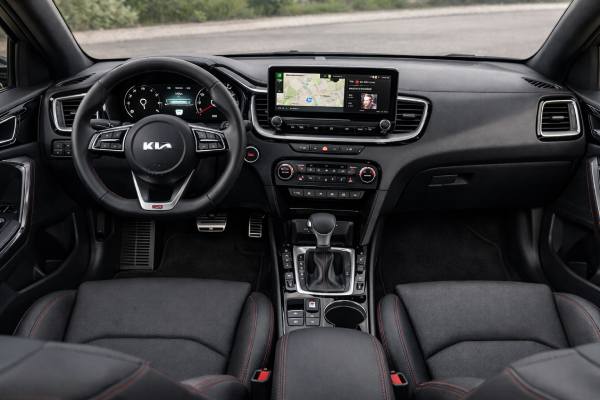

The facelifted Kia ProCeed CD with the Smartstream 1.5 T-GDi is the “fast enough, practical enough” sweet spot of the range. You get a modern turbo four with strong mid-range torque, plus the ProCeed’s shooting-brake body that trades a little rear headroom for a long, usable cargo bay. For many owners, the appeal is simple: it drives more like a compact hatch than a wagon, but it swallows family luggage like a bigger car.
From an engineering and ownership view, the key themes are thermal management (turbo and coolant health), direct-injection habits (oil quality and intake cleanliness), and transmission choice (6-MT vs 7-DCT) because it shapes both reliability and running costs. If you buy smart and maintain it on time, this 1.5-liter ProCeed can be a low-drama daily with an unusually versatile rear load space.
Quick Specs and Notes
- Strong everyday pull for a 1.5-liter turbo, especially from 1,500–3,500 rpm, without needing high revs.
- Shooting-brake body delivers a big, square boot and low load lip—excellent for strollers, tool cases, and airport runs.
- Efficient at steady speeds when tyres and alignment are right; short trips can raise fuel use and oil dilution risk.
- If equipped with the 7-DCT, avoid repeated creeping and heavy stop-start abuse to reduce clutch heat and shudder.
- Plan engine oil service every 10,000–15,000 km (6,000–9,000 mi) or 12 months (whichever comes first), depending on your market and duty cycle.
Explore the sections
- Kia ProCeed CD facelift overview
- Kia ProCeed 1.5 T-GDi specs
- Kia ProCeed trims and safety tech
- Reliability patterns and known faults
- Maintenance plan and buying tips
- Road feel and real economy
- Rivals and best alternatives
Kia ProCeed CD facelift overview
Think of the facelift ProCeed 1.5 T-GDi as a Ceed with a longer, lower tail and a slightly sportier brief. The “shooting brake” roofline is the headline: it gives you an unusually long cargo floor for the class, yet keeps the car’s footprint city-friendly. The trade-off is mainly above the rear seats—taller passengers may notice the sloping roof sooner than they would in a conventional wagon.
The Smartstream 1.5 T-GDi engine is the other big story. In many markets it replaced the older 1.4 T-GDi, aiming for cleaner emissions and better real-world efficiency while maintaining similar punch. It’s a direct-injected turbo petrol, so it rewards owners who treat oil quality as a “wear item,” not just a line on a service invoice. Short trips and long idle periods matter more on this engine than on an older port-injected unit because fuel and moisture can accumulate in the oil more easily.
As a daily driver, the ProCeed’s strengths come from balance rather than extremes:
- Useful performance without drama. The turbo torque makes it easy to merge and overtake without constant downshifts.
- Stability and confidence. The longer rear body adds straight-line composure, especially at motorway speeds, and the chassis feels planted on quality tyres.
- Practical packaging. The boot is long and wide, and the rear opening is friendly to bulky items.
Where owners need to stay realistic is running conditions and options. Big wheels can look great but add tyre cost, road noise, and rim-damage risk on rough surfaces. If you choose the 7-speed dual-clutch transmission (DCT), the car feels modern and quick when moving, but it also needs the right driving habits in heavy traffic—lots of creeping and half-throttle inching is where DCTs tend to show their weak side.
Bottom line: the facelift ProCeed 1.5 T-GDi is a practical, efficient, mildly sporty compact—best for drivers who want wagon usefulness without stepping up to a larger class.
Kia ProCeed 1.5 T-GDi specs
Specifications vary by market, trim, tyre package, and transmission. The tables below reflect the facelift ProCeed CD with the Smartstream 1.5 T-GDi in typical European configurations. Treat any number as “verify by VIN” if you are ordering parts, fluids, or torque specs.
Powertrain and efficiency
| Item | Specification |
|---|---|
| Engine family | Smartstream T-GDi |
| Code | Varies by market (verify by VIN/engine label) |
| Layout | Inline-4, turbocharged, direct injection (GDI) |
| Displacement | 1.5 L (≈ 1,482 cc) |
| Induction | Turbo |
| Fuel system | Direct injection (GDI) |
| Compression ratio | Varies by version (verify by VIN) |
| Max power | 158 hp (≈ 118 kW) @ rpm (varies) |
| Max torque | Typically ≈ 250–255 Nm (≈ 184–188 lb-ft) @ low rpm (varies) |
| Timing drive | Chain (typical for this family; verify by VIN) |
| Rated efficiency | Commonly mid-5 to mid-6 L/100 km WLTP combined, depending on tyres and gearbox |
| Real-world highway @ 120 km/h (75 mph) | Often ~6.5–7.5 L/100 km if tyres and alignment are healthy |
Transmission and driveline
| Item | Specification |
|---|---|
| Transmission | 6-speed manual or 7-speed DCT (market dependent) |
| Drive type | FWD |
| Differential | Open (traction control manages slip) |
Chassis and dimensions
| Item | Specification |
|---|---|
| Front suspension | MacPherson strut (typical Ceed platform layout) |
| Rear suspension | Multi-link (common on higher trims/engine outputs; verify by market) |
| Steering | Electric power steering (rack-assist) |
| Brakes | Four-wheel discs (diameters vary by trim) |
| Popular tyre sizes | Often 225/45 R17 or 225/40 R18 (varies by trim/market) |
| Ground clearance | Varies by wheel/tyre and market; treat as “check spec sheet” |
| Length / Width / Height | Approximately 4,605 mm / 1,800 mm / ~1,420 mm (market dependent) |
| Wheelbase | Approximately 2,650 mm |
| Turning circle | Typically around 10.5–11.0 m (kerb-to-kerb; varies) |
| Kerb weight | Often ~1,350–1,450 kg (trim and gearbox dependent) |
| Fuel tank | Commonly ~50 L |
| Cargo volume | Typically ~594 L seats up; ~1,500+ L seats down (method varies) |
Performance and capability
| Item | Typical value (varies by trim/gearbox) |
|---|---|
| 0–100 km/h (0–62 mph) | ~8.5–9.5 s |
| Top speed | ~200–210 km/h (124–130 mph) |
| Towing capacity | Market dependent; often ~1,200–1,500 kg braked (verify by VIN plate) |
| Payload | Market dependent; check door-jamb sticker / handbook |
Fluids and service capacities (decision-grade guidance)
| Item | Typical guidance (verify by VIN/service literature) |
|---|---|
| Engine oil | Often 0W-30 or 5W-30 meeting ACEA/API requirements; capacity commonly ~4.0–4.5 L (≈ 4.2–4.8 US qt) |
| Coolant | Long-life ethylene glycol mix (often 50:50); capacity varies |
| DCT fluid | Depends on DCT type and service plan; some are “inspect/conditional change” |
| A/C refrigerant | Type and charge vary by model year and market |
| Key torque specs | Use official service data only (critical fasteners can vary by subframe and brake package) |
Safety and driver assistance (headline)
| Item | Typical for Ceed/ProCeed platform (verify by trim/year) |
|---|---|
| Crash ratings | Euro NCAP rating exists for the platform; results can differ with and without optional safety pack |
| ADAS | AEB, lane support, driver attention alerts, and optional ACC depending on trim/pack |
| Airbags | Commonly includes front, side, and curtain airbags (count varies by market) |
If you want one “spec takeaway” that matters in real ownership: the ProCeed 1.5 T-GDi is quick enough to feel relaxed at motorway speeds, but its costs are driven more by tyres, transmission choice, and oil discipline than by the engine size.
Kia ProCeed trims and safety tech
Trim names vary by country, but the facelift ProCeed 1.5 T-GDi typically sits in the middle of the lineup: more equipment than entry versions, and less hardware than the full GT. When you shop, focus less on the badge and more on the mechanical and safety content that affects long-term satisfaction.
Trims and options that change the driving experience
Transmission choice (6-MT vs 7-DCT).
- The manual tends to be simpler and can be cheaper to keep long term if you do a lot of low-speed traffic.
- The 7-DCT feels quicker and keeps the engine in its torque band, but it can be less tolerant of repeated creeping and hill-hold inching.
Wheel and tyre packages.
Moving from 17-inch to 18-inch wheels usually brings sharper steering response, but also:
- more road noise,
- higher tyre cost,
- higher risk of sidewall damage and bent rims on potholes.
Lighting and visibility packages.
Full LED headlamps are a meaningful upgrade for night driving. If your market offers adaptive high-beam or cornering functions, they improve comfort but can add calibration sensitivity after front-end repairs.
Infotainment and audio.
A larger head unit and premium audio are comfort upgrades, but they also increase the importance of software updates—especially for Bluetooth stability, navigation glitches, and camera integration.
Safety ratings: what they mean in practice
For the underlying Ceed family, Euro NCAP results have historically shown a clear split between cars tested with a driver-assistance safety pack and those without it. Practically, this means:
- A well-equipped ProCeed with AEB and lane support aligns with the best crash-avoidance outcomes for the platform.
- A lower-spec car may still have solid structure and airbags, but can score lower overall because it lacks key assist systems.
When you compare cars, ask the seller to show the build sheet or equipment list that confirms:
- autonomous emergency braking (AEB) with pedestrian and cyclist detection (where applicable),
- lane keeping assist (LKA) or lane following assist (LFA),
- blind-spot monitoring (BSD) and rear cross-traffic alert (RCTA),
- adaptive cruise control (ACC) if you do long motorway runs.
ADAS ownership notes (often overlooked)
- Windscreen replacements matter. Cameras behind the glass often need calibration. A “cheap windscreen” can become expensive if the camera bracket is wrong or calibration is skipped.
- Bumper repairs matter. Radar sensors can be sensitive to bumper alignment and paint thickness. After even minor impacts, confirm that ACC/AEB functions correctly.
- Tyres matter more than you think. Mixed tyre brands or uneven wear can trigger stability-control intervention and reduce braking consistency, especially in wet conditions.
A simple buyer move: take a short test drive on a quiet road and confirm lane support, AEB warnings (if safe to simulate), parking sensors/camera, and cruise behavior are smooth and error-free.
Reliability patterns and known faults
Overall, the facelift ProCeed 1.5 T-GDi tends to be a solid ownership proposition when serviced on time. The issues that do appear are usually “systems and use-case” problems rather than catastrophic engine failures—meaning the car’s reliability depends heavily on how it’s driven and maintained.
Below is a practical map of what to watch, grouped by prevalence and cost impact.
Common (usually low to medium cost)
- Infotainment freezes or sensor quirks
Symptoms: intermittent reboots, Bluetooth drops, camera delay, random warning chimes.
Likely cause: software bugs, weak 12 V battery health, or connector sensitivity.
Remedy: ensure the 12 V battery tests strong; apply official infotainment updates; clean and reseat connectors if needed. - Brake noise and rotor surface issues
Symptoms: squeal, vibration under light braking after rain or parking.
Likely cause: pad compound, light corrosion, or uneven transfer layer.
Remedy: bedding procedure, pad swap, and ensuring rear brakes aren’t sticking; avoid riding the brakes downhill. - Suspension wear in rough use
Symptoms: clunks over bumps, vague steering, uneven tyre wear.
Likely cause: worn anti-roll bar links/bushes, rear bush wear, alignment drift.
Remedy: replace worn links/bushings, then align—don’t align first and hope it goes away.
Occasional (medium cost, timing dependent)
- Direct injection intake deposits (carbon build-up)
Symptoms: rough idle, hesitation, reduced efficiency over time.
Likely cause: GDI engines don’t wash intake valves with fuel, so deposits can accumulate, especially with short trips.
Remedy: quality oil and timely changes; periodic “hot run” use; intake cleaning (chemical or walnut blasting) if symptoms appear. - Turbo and boost-control niggles
Symptoms: boost oscillation, loss of power, whistle or rattle, intermittent fault codes.
Likely cause: boost solenoid wear, wastegate actuator play, vacuum/charge-air leaks.
Remedy: smoke test for leaks, check diverter valve operation, verify wastegate linkage. - Cooling system seepage
Symptoms: slow coolant loss, sweet smell, residue around plastic housings.
Likely cause: gasket shrinkage, hose clamps, thermostat housing seepage.
Remedy: pressure test, replace the leaking housing or hose, and refill with the correct coolant mix.
Occasional to rare (can be higher cost)
- 7-DCT drivability complaints (if equipped)
Symptoms: shudder on take-off, hesitation, overheating warnings in traffic, harsh engagement.
Likely cause: clutch heat management, adaptation values, or mechatronic control behavior.
Remedy: software updates and adaptation reset where applicable; change driving habits (avoid creeping); investigate for fluid contamination or actuator faults if persistent. - High-pressure fuel system issues
Symptoms: hard starts, misfires under load, fuel pressure codes.
Likely cause: high-pressure pump wear, injector issues, contaminated fuel.
Remedy: confirm fuel pressure targets, check injector balance, replace components as needed.
Recalls, TSBs, and service actions: how to stay safe
Because recall scope varies by VIN and market, the best practice is procedural:
- Run the VIN through the official recall checker for your region.
- Ask the seller for proof (invoice or dealer printout) that recall work is complete.
- Verify software updates if your car has modern ADAS or a newer infotainment unit.
A useful mindset: most modern “reliability” is software, sensors, and heat. If the car has clean service history, correct tyres, and updated software, it usually behaves like a mature platform.
Maintenance plan and buying tips
A good maintenance plan for the ProCeed 1.5 T-GDi is less about exotic parts and more about consistency. Turbo petrol engines live or die on oil quality, correct spark, and stable cooling. Use the schedule below as a practical baseline, then adjust to your handbook and local conditions.
Practical maintenance schedule (typical guidance)
- Engine oil and filter: every 10,000–15,000 km (6,000–9,000 mi) or 12 months
Short trips, cold climates, and lots of idling justify the shorter interval. Turbo + GDI benefits from fresh oil more than most owners expect. - Cabin air filter: every 15,000–30,000 km (9,000–18,000 mi) or yearly
Replace sooner if you drive in dusty areas or heavy city pollution. - Engine air filter: inspect every service; replace around 30,000–45,000 km (18,000–28,000 mi)
A clogged filter can raise consumption and stress the turbo. - Spark plugs: commonly 60,000 km (37,000 mi)–100,000 km (62,000 mi) depending on plug type
Misfires under load are often plug or coil related—don’t stretch intervals. - Coolant: commonly 5–10 years (varies)
Replace on time because modern cooling systems use plastic housings that dislike neglected coolant chemistry. - Brake fluid: every 2 years
This is one of the best “cheap safety upgrades” you can do. - Brake pads and rotors: inspect every 15,000 km (9,000 mi)
Especially if you drive hills or tow. - Tyre rotation and alignment: rotate every 10,000–12,000 km (6,000–7,500 mi); align if wear is uneven or after suspension work
Alignment saves money on tyres and improves stability. - 12 V battery test: annually after year 3–4
Many odd electronics faults trace back to a tired battery. - Transmission service:
- Manual: inspect for leaks; change fluid if shifting feels notchy or per handbook interval.
- 7-DCT: follow the official plan; if you do heavy city use, ask a dealer about fluid checks and software updates.
Fluids: what to insist on
- Engine oil: use the exact specification in your handbook (viscosity and ACEA/API class). The correct spec matters for turbo heat and emissions hardware.
- Coolant: use the specified long-life coolant and correct mix ratio. Mixing coolant types is a common “slow-damage” mistake.
- Brake fluid: use the specified DOT rating; don’t assume “any DOT 4” is identical.
Buyer’s guide: inspection checklist that actually catches problems
Service history and usage
- Look for regular oil changes and documented annual services.
- Ask about typical trip length. A car used mostly for 3–5 km commutes is harder on oil and the exhaust aftertreatment.
Powertrain
- Cold start: listen for uneven idle, extended cranking, or warning lights.
- Under load: check for clean boost delivery without surging.
- After a hard pull: confirm no burnt smell, coolant odor, or hesitation.
Transmission
- Manual: check for smooth engagement, no clutch slip, and consistent pedal feel.
- DCT: test creeping and hill start behavior; excessive shudder is a red flag.
Chassis and tyres
- Inspect tyre wear patterns (inner-edge wear suggests alignment or bush wear).
- Drive over small bumps with the radio off; repeated clunks mean suspension work is coming.
Electronics and ADAS
- Confirm camera, sensors, lane support, and cruise behave consistently with no warnings.
If you want the most durable long-term setup, prioritize: complete service history, sensible wheel size (often 17-inch), and a usage profile that includes regular longer drives.
Road feel and real economy
The ProCeed’s “personality” is defined by three things: its lower roofline, the torque-rich 1.5 turbo, and how your wheel/tyre package filters the road.
Ride, handling, and noise
Ride quality:
On 17-inch wheels the car usually feels composed—firm but not harsh. On 18-inch wheels, sharp edges (potholes, broken tarmac) become more noticeable, and tyre roar can rise on coarse asphalt. The longer rear body helps straight-line stability, especially in crosswinds, but it also means rear suspension condition matters; worn rear bushes can make the car feel “busy” at motorway speeds.
Steering and balance:
Electric steering is typically light in town and steadier on the highway. The front end feels predictable, and the chassis likes smooth inputs. With good tyres, it holds a line confidently through long bends. With mismatched tyres or poor alignment, it can lose that calmness quickly—so tyres are not a place to cut corners.
Braking feel:
Pedal response is usually easy to modulate. If you feel vibration under light braking, suspect pad deposits or rotor condition before assuming “warped discs.”
Powertrain character
The 1.5 T-GDi’s best trait is usable torque without constant downshifts. Expect:
- Strong mid-range: ideal for overtakes and short motorway merges.
- Light turbo lag: usually most noticeable only if you demand full torque from very low rpm.
- Gearbox influence:
- The manual can feel more connected and is often smoother in bumper-to-bumper traffic.
- The DCT is quick when rolling but can hesitate slightly at very low speeds or when you alternate between throttle and brake in short bursts.
Real-world efficiency
Real-world fuel use varies more with use case than most buyers expect:
- City and short trips: typically the least efficient. Expect higher consumption because the engine spends more time cold and the turbo’s enrichment strategies appear more often.
- Motorway 100–120 km/h (60–75 mph): usually the sweet spot when tyres are properly inflated and alignment is correct.
- Mixed driving: often lands in a “middle band” where smooth throttle use matters more than speed alone.
A helpful owner habit is to treat efficiency as a health check:
- If consumption rises suddenly, look for underinflated tyres, alignment drift, sticking brakes, or a failing oxygen sensor—before blaming “seasonal fuel.”
For drivers who do frequent long motorway runs, this ProCeed is a comfortable, stable cruiser. For mostly short commutes, plan tighter oil intervals and accept that consumption will be less impressive.
Rivals and best alternatives
The ProCeed 1.5 T-GDi competes in a crowded space: compact hatches and wagons that promise practicality without the size of a mid-size estate. Its unique angle is style plus a genuinely useful boot.
Where the ProCeed stands out
- Body style with real utility: Many “sporty” alternatives lose cargo usefulness. The ProCeed keeps a long load bay and wide opening.
- Torque-forward daily performance: The 1.5 turbo delivers easy overtakes without needing a larger engine.
- Equipment value: In many markets you can find strong safety and comfort features without climbing to performance-model prices.
Common rivals and how they differ
Volkswagen Golf Variant / Skoda Octavia Combi (1.5 TSI class)
- Often feel more refined in cabin materials and road isolation.
- ProCeed may feel more “driver-focused” in styling and seating position, but the VW-group wagons can offer more rear headroom and, in some trims, more sophisticated driver aids.
Ford Focus (EcoBoost equivalents)
- Frequently delivers sharper steering feel and cornering agility.
- Boot practicality depends on body style; the Focus wagon is strong, but the ProCeed’s long cargo floor is still a highlight.
Peugeot 308 SW (turbo petrol)
- Usually shines in cabin design and ride comfort.
- Powertrain feel can be more “peaky” depending on engine; ProCeed tends to feel more linear in the mid-range.
Toyota Corolla Touring Sports (hybrid)
- The best rival for low-stress city efficiency and stop-start conditions.
- On the motorway, the ProCeed’s turbo petrol can feel quieter under load and more traditional in response, while the Toyota wins on urban fuel use.
Which buyers should choose what?
- Choose the ProCeed 1.5 T-GDi if you want a stylish wagon-like body, strong mid-range performance, and you’re willing to maintain it like a modern turbo (oil discipline, correct tyres, software updates).
- Choose a hybrid wagon if your driving is mostly city and short trips and you value low-speed efficiency above all else.
- Choose a more traditional compact wagon if rear-seat headroom and maximum comfort over rough roads matter more than design.
In short, the ProCeed isn’t the “best at everything” option—but it is one of the most convincing blends of design and usable space in the segment, especially with the 1.5 turbo’s flexible performance.
References
- Kia Ceed range gets extensive design, tech and powertrain upgrades 2021 (Press Release)
- Official Kia Cee’d 2019 safety rating 2019 (Safety Rating)
- Kia Recalls | Kia Europe 2026 (Recall Database)
- Kia Car Owners Manual | Kia UK 2026 (Owner’s Manual Portal)
- Car Safety Recalls | What They Are & What To Do | Kia UK 2026 (Recall Guidance)
Disclaimer
This article is for informational purposes only and is not a substitute for professional diagnosis, inspection, or repair. Specifications, torque values, service intervals, and procedures can vary by VIN, market, model year, and equipment; always verify details using official Kia service documentation for your exact vehicle.
If you found this guide helpful, please consider sharing it on Facebook or X to support our work.