
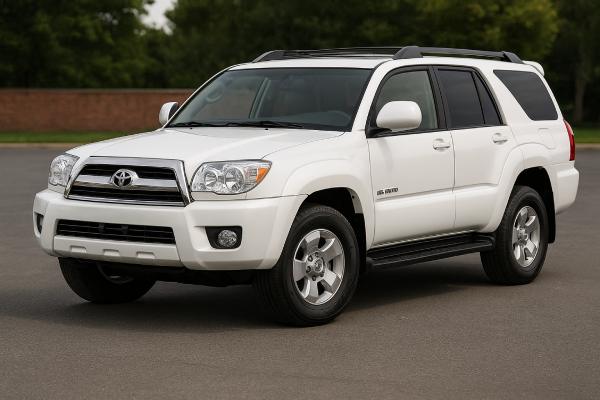
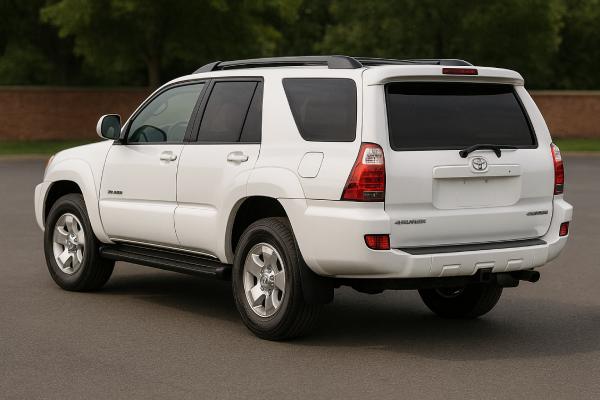
The 2006–2009 Toyota 4Runner 4WD (chassis code UZN215 for the V8) is a midsize, body-on-frame SUV from the fourth 4Runner generation. This article focuses on the facelifted V8 model years after Toyota’s mid-cycle refresh, when the 4.7-liter 2UZ-FE gained variable valve timing and adopted the newer SAE rating protocol, settling at 260 hp. In the brand’s lineup it sat below the Land Cruiser in size and price, yet shared the classic ladder frame, low-range capability, and long-distance durability that made Toyota’s trucks popular with families, commuters, and overland travelers alike. You’ll find a full-time 4WD system with a Torsen center differential, a strong 5-speed automatic, and a tow rating that comfortably handles camping trailers or a pair of dirt bikes. We cover the North American configuration in detail: powertrain, dimensions, performance, safety ratings, known issues, maintenance, and what to check before you buy. If you’re comparing a late fourth-gen 4Runner to a contemporary crossover or a rival ladder-frame SUV, the sections below will help you decide quickly and maintain confidently.
Fast Facts
- Proven 4.7-liter V8 with timing chain, smooth torque (414 Nm / 306 lb-ft) and relaxed highway manners.
- Full-time 4WD with locking center differential and low range; strong cooling and frame for towing and trails.
- Cabin and chassis age well; parts availability and aftermarket support remain excellent in North America.
- Watch for rust on frame and suspension hardware in road-salt regions; inspect brake lines and crossmembers.
- Oil and filter every 5,000 mi (8,000 km) or 6 months is a sensible baseline for mixed use.
Navigate this guide
- Model overview (2006–2009)
- Specifications and technical data
- Trims, options, safety, and ADAS
- Reliability, issues, and service actions
- Maintenance schedule and buyer’s guide
- Driving impressions and performance
- How the 4Runner compares
4Runner V8 facelift: model overview (2006–2009)
The facelifted fourth-gen 4Runner arrived for 2006 with revised front and rear styling, updated lighting, and important mechanical and feature refinements that matter to used buyers. The headline change for V8 models was the 2UZ-FE with VVT-i and revised SAE certification; output published as 260 hp (194 kW) and 306 lb-ft (414 Nm). More important than the number is the broad, quiet torque curve that suits daily driving, towing, and long climbs. The A750F five-speed automatic is a robust truck transmission with a conservative calibration; it prefers holding gears over shift-hunting, which helps in headwinds or on grades.
Every V8 4Runner in this period uses a full-time 4WD system with a Torsen (torque-sensing) center differential. In normal driving it apportions torque between axles for surefooted behavior on dry or wet pavement. When conditions demand, drivers can lock the center differential for a 50:50 split, then engage low range for crawl control in technical sections. Toyota’s A-TRAC brake-based traction control mimics limited-slip behavior at individual wheels; Hill-Start Assist (HAC) and Downhill Assist Control (DAC) add confidence on steep transitions.
Chassis fundamentals are classic truck: a fully boxed ladder frame, double-wishbone front suspension, and a solid rear axle with four links and a Panhard rod. Spring and damper tuning balance highway comfort with trail composure; optional X-REAS cross-linked shocks (Sport Edition) reduce pitch and roll in quick transitions without making the ride brittle. Steering is hydraulic, with a reassuring on-center feel. Brakes are four-wheel discs with ABS, electronic brake-force distribution, and brake assist.
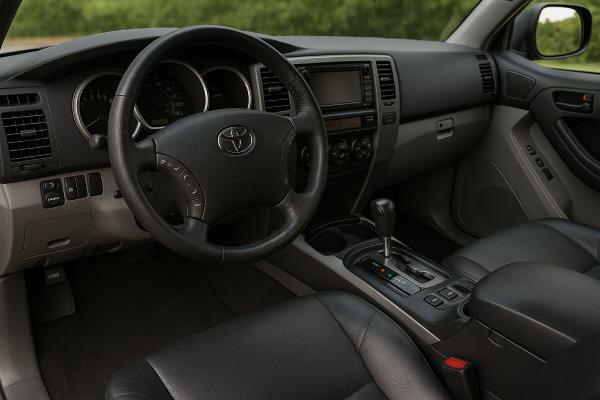
Inside, the facelift sharpened ergonomics and materials, and kept the 4Runner’s simple, glove-friendly controls. Seating is comfortable for four adults and a child; some examples have a compact third row, but most V8 buyers favored the two-row layout for cargo space and tow prep. Despite age, the cabin resists rattles if maintained. The packaging wins on real-world usability: a power rear glass for long cargo, a split-fold rear bench, and tie-downs that take abuse.
For shoppers, the appeal is straightforward: a genuinely capable, tow-ready SUV that drives calmly on the interstate, fits in a garage, and has a deep pool of service knowledge and parts. The trade-offs are predictable too—trucklike fuel economy and, in road-salt states, the need to scrutinize underbody corrosion thoroughly.
Specifications and technical data
Engine and performance (2UZ-FE VVT-i)
- Code / layout: 2UZ-FE, 90° V8, aluminum heads, cast-iron block
- Displacement: 4.7 L (4,663 cc)
- Induction / fueling: Naturally aspirated, sequential multi-port injection
- Compression ratio: ~10.0:1
- Rated output: 260 hp (194 kW) @ ~5,400 rpm
- Rated torque: 414 Nm (306 lb-ft) @ ~3,400 rpm
- Timing drive: Chain (no scheduled belt replacement)
- Fuel requirement: Regular unleaded (AKI 87); premium not required
- Emissions equipment: Three-way catalysts, front/rear O2 sensors, EVAP system
- Fuel tank: 87 L (23.0 gal)
Transmission and driveline
- Gearbox: A750F 5-speed automatic with lock-up converter
- Full-time 4WD with Torsen center differential; driver-selectable center-diff lock; 2-speed transfer case (H4F / H4L / L4L)
- Final drive ratios (typical): 3.91–3.73 depending on axle code and tire package
- Rear differential: Open (A-TRAC brake-actuated torque control)
- Tow rating (properly equipped): up to 3,175 kg (7,000 lb)
Chassis and dimensions
- Frame: Fully boxed ladder frame
- Suspension (front / rear): Double wishbone / 4-link solid axle with coil springs; optional X-REAS shock system (Sport)
- Steering: Hydraulic rack-and-pinion
- Brakes: 4-wheel discs with ABS, EBD, Brake Assist
- Wheels/tires (common): 265/65R17 or 265/60R18; alloy wheels
- Length / width / height: ~4,800 mm (189.0 in) / 1,880 mm (74.0 in) / 1,760 mm (69–70 in, roof rack dep.)
- Wheelbase: 2,790 mm (109.8 in)
- Ground clearance: ~230 mm (9.1 in)
- Approach / departure angles: approx. 30° / 26° (tire/package dependent)
- Turning circle (curb-to-curb): ~11.4 m (37.4 ft)
- Curb weight: ~2,085–2,150 kg (4,595–4,740 lb) by trim/equipment
- GVWR: ~2,770–2,790 kg (6,110–6,150 lb)
- Cargo volume: ~1,195 L (42.2 cu ft) seats up / ~2,127 L (75.1 cu ft) seats folded
Fluids and service capacities (typical)
- Engine oil (with filter): ~6.2–6.6 L (6.6–7.0 qt); 5W-30 or 5W-20 meeting current API spec
- Engine coolant (total system): ~11–13 L (11.6–13.7 qt), long-life ethylene glycol (Toyota Super Long Life Coolant, pink)
- Automatic transmission (A750F): Toyota WS ATF; drain-and-fill ~3.5–4.0 L (3.7–4.2 qt), full dry capacity much higher
- Transfer case: Toyota gear oil or ATF per label on case; capacity ~1.3–1.6 L (1.4–1.7 qt)
- Front differential (IFS): SAE 75W-90 GL-5; ~1.3–1.5 L (1.4–1.6 qt)
- Rear differential: SAE 75W-90 GL-5; ~2.6–3.0 L (2.7–3.2 qt)
- Wheel lug nuts: 113 Nm (83 lb-ft)
- Engine oil drain plug: ~39 Nm (29 lb-ft) (typical)
Notes: Exact fluid grades and fill volumes vary by axle code, service procedure (drain vs. overhaul), and year. Always confirm with service literature for your VIN.
Performance and economy
- 0–60 mph (97 km/h): ~7.8–8.2 s (stock tires, unladen)
- Top speed (governed): ~112 mph (180 km/h)
- EPA-type economy (4WD V8): around 15 mpg combined (14 city / 17 highway) ≈ 15.7 L/100 km combined
- Real-world highway at 120 km/h (75 mph): typically 16–18 mpg (13.1–14.7 L/100 km) depending on tires, wind, and load
- Towing: up to 3,175 kg (7,000 lb) with factory tow equipment; payload commonly ~600–700 kg (1,300–1,500 lb) including passengers and cargo
- Roof load: ~75–100 kg (165–220 lb) with OEM rails/crossbars; check rack label
Trims, options, safety, and driver assistance
Trims and options (facelift years)
- SR5: Core trim with cloth seats, 16/17-inch alloys, manual HVAC, power rear glass, roof rails, A-TRAC, HAC/DAC on 4WD, tow prep widely available.
- Sport Edition: Adds hood scoop, unique wheels, X-REAS cross-linked dampers for flatter cornering, sport cloth, silver interior accents; often JBL audio and sunroof.
- Limited: Leather, dual-zone automatic climate control, JBL synthesis audio, 18-inch wheels, heated front seats, optional navigation, and refined trim details.
Mechanical differences to know
- All V8s use full-time 4WD with a lockable Torsen center differential and low range.
- X-REAS (Sport) improves body control without punishing ride quality; shock replacement is more involved due to cross-link plumbing—many owners convert to conventional shocks at refresh time.
- Factory tow package brings a Class IV receiver, 7-pin wiring, and a heavy-duty alternator; the V8 cooling package is stout even in hot climates.
Safety ratings snapshot (applies to 2003–2009 design with minor year-to-year equipment changes)
- IIHS: Strong results in moderate overlap frontal and original side testing; head restraints/seats of this era are rated lower than modern designs.
- Airbags and restraints: Dual-stage front airbags, front seat side airbags, and full-length side curtain airbags were widely available; pretensioners and force limiters on front belts.
- Child seats: LATCH anchors in the second row; top tether points provided—verify accessibility with your specific seat.
- Stability/braking: Toyota Vehicle Stability Control (VSC) standard; ABS with EBD; Brake Assist.
- Driver assistance of the era: No automatic emergency braking or lane-keeping; DAC/HAC are hill-control features specific to 4WD use, not highway ADAS.
Year-to-year highlights (facelift window)
- 2006: Mid-cycle refresh styling; equipment reshuffles; V8 rated under updated SAE method (260 hp).
- 2007–2008: Audio and option package tweaks; USB and Bluetooth were not universal—check head unit if those matter.
- 2009: Final year of the generation; minor trim/feature adjustments as Toyota prepared the fifth-gen changeover.
Quick identifiers: VIN 8th character T commonly denotes the 4.7 V8 in this era; axle code sticker in the driver-door jamb lists ratio; look for a “center diff lock” switch on V8 4WD consoles (proof of full-time system).
Reliability, common issues, and service actions
The V8 4Runner is widely regarded as one of Toyota’s most durable SUVs. Age, mileage, and climate are bigger drivers of repairs than design flaws. Use the map below—common → occasional → rare—and pay attention to cost tier and mileage bands.
Engine and fueling
- Common | Low–Medium: Seeping valve cover gaskets (150–220k mi / 240–350k km). Symptom: oil smell, wetness at head/block seam. Fix: replace gaskets; inspect PCV.
- Occasional | Low: PCV valve aging leads to slight oil consumption. Fix: replace PCV; use correct oil grade and interval.
- Occasional | Low–Medium: Throttle body and MAF contamination. Symptom: unstable idle, hesitation. Fix: careful cleaning, relearn idle.
- Rare | Medium: Cracked exhaust manifolds (more in cold/salt regions). Symptom: ticking on cold start. Fix: manifold replacement; consider upgraded hardware.
Cooling and HVAC
- Common | Medium: Radiator aging (200k+ mi / 320k+ km) can lead to seepage at end tanks. Fix: quality radiator, new hoses, fresh coolant.
- Occasional | Medium: Heater T-fittings and core tubes corrode; sweet smell, fogging. Fix: replace fittings, flush system.
Driveline and 4WD
- Common | Low–Medium: Front CV axle boots split with age/lift kits. Fix: reboot or replace axles; align after.
- Occasional | Medium: Transfer case or differential weep at seals. Fix: reseal; verify breathers are clear.
- Occasional | Medium: A-TRAC ABS wheel-speed sensor wiring fatigue after off-road use. Symptom: warning lamps, disabled aids. Fix: harness/sensor replacement; recalibrate.
- Rare | Medium–High: A750F torque converter shudder at very high mileage with contaminated ATF. Fix: staged ATF service; if persistent, converter replacement.
Suspension, steering, and brakes
- Common | Low–Medium: Lower control arm rear bushings, ball joints, sway-bar links/bushings wear (age, loads). Fix: quality bushings/arms; torque at ride height.
- Occasional | Low: X-REAS shock seepage/failure (Sport Edition) after 10–15 years. Fix: replace X-REAS or convert to conventional dampers.
- Common | Low–Medium: Rear hatch glass regulator wear; window slows or binds. Fix: regulator/motor service and track lubrication.
Body, electrical, and corrosion
- Common | Medium–High (salt regions): Frame and crossmember rust, especially rear frame rails, rear lower control arm mounts, body mounts, and spare-tire well. Fix: thorough inspection; rust remediation; in severe cases, section repair or vehicle avoidance.
- Occasional | Low: Liftgate harness fatigue causing intermittent license plate light or wiper issues. Fix: repair loom; weatherproof.
- Occasional | Low: Sunroof drains clog; water ingress. Fix: clear drains; check headliner and A-pillar airbags before work.
Recalls and service actions to verify
- Airbag inflator (Takata): Many 2003–2009 4Runners were included in staged replace-by-VIN inflator campaigns. Always run the VIN through both the manufacturer’s and federal lookup tools and demand paperwork proof of completion.
- Miscellaneous manufacturer communications: Over its life Toyota issued technical communications on topics like accessory audio, window operation, and trim concerns. These are not universal defects but checking for updates helps.
Pre-purchase checks
- Full service history (oil, coolant, transmission/transfer/diff fluids, brake fluid).
- Underside rust assessment: frame rails, crossmembers, brake/fuel lines, rear axle housing, skid plate mounts.
- 4WD function: verify smooth engagement of center-diff lock and low range on a loose surface.
- Cooling system pressure test and dye inspection.
- Braking: even rotor surfaces, no soft pedal from pending line leaks.
- Door seals and sunroof drains after a car-wash test.
Maintenance schedule and buyer’s guide
Practical maintenance schedule (distance / time, whichever comes first)
- Engine oil & filter: 5,000 mi / 6 months (8,000 km / 6 months). Use quality oil and OEM-quality filter.
- Engine air filter: Inspect 10,000 mi (16,000 km); replace 30,000–45,000 mi (48,000–72,000 km) depending on dust.
- Cabin air filter: 15,000–20,000 mi (24,000–32,000 km) or annually.
- Spark plugs (iridium): 90,000–120,000 mi (145,000–193,000 km).
- Coolant (SLLC pink): 100,000 mi (160,000 km) initial, then every 50,000 mi (80,000 km) / 5 years.
- Automatic transmission (WS): Inspect condition every 30,000–45,000 mi; conservative drain-and-fills at 60,000–90,000 mi (96,000–145,000 km) are prudent in mixed/tow use.
- Transfer case & diffs (75W-90 GL-5 or as labeled): 30,000–60,000 mi (48,000–96,000 km), sooner with frequent water crossings/towing.
- Brake fluid: Flush every 2–3 years.
- Brake pads/rotors: Inspect each tire rotation; replace as needed.
- Serpentine belt: Inspect annually from 60,000 mi (96,000 km); replace at first cracking/noise.
- Hoses (coolant, PCV, vacuum): Inspect annually; replace age-hardened parts.
- Alignment and tire rotation: Rotate every 5,000–7,500 mi (8,000–12,000 km); align with any tire change, lift, or steering work.
- 12-V battery: Load-test yearly from year 4; typical life 4–6 years.
- Rust prevention: Annual underbody washdown and protective coating in salt states; treat stone chips promptly.
Fluid cheat sheet (essentials)
- Engine oil: 5W-30 or 5W-20, API SN+/SP or newer; capacity ~6.2–6.6 L (6.6–7.0 qt).
- Coolant: Toyota Super Long Life Coolant (pink), premixed.
- ATF: Toyota WS (World Standard).
- Axles/transfer case: GL-5 75W-90 gear oil (verify transfer case label; some were ATF-filled).
- Power steering: ATF (Dexron-type), check cap label.
- Brake fluid: DOT 3 or DOT 4.
Essential torque values (selected)
- Wheel lug nuts 113 Nm (83 lb-ft)
- Front caliper bracket bolts ~123 Nm (91 lb-ft)
- Rear caliper bracket bolts ~98 Nm (72 lb-ft)
- Spark plugs ~18 Nm (13 lb-ft) on clean, dry threads (always confirm plug manufacturer spec)
Buyer’s guide checklist
- Frame and lines: Tap frame rails and rear crossmember with a pick; inspect brake/fuel lines at clips for scaly rust.
- 4WD system: Engage center-diff lock and low range on gravel; listen for binding on pavement (shouldn’t bind with center diff unlocked).
- Suspension wear: Look for torn lower-control-arm rear bushings, play in ball joints, leaky dampers; budget for a four-corner refresh on higher-mileage trucks.
- X-REAS status (if equipped): Check for oily lines at the shock bodies; a failed corner often justifies converting to conventional dampers.
- Cooling system: Cold-start pressure test; any pink crust near radiator end tanks or water pump weep hole deserves attention.
- Electrics: Test rear window (key and dash switch), rear hatch lock, and sunroof; scan for codes (pending ABS/VSC codes won’t always light the dash immediately).
- Tires and alignment: Uneven inner-edge wear points to toe/camber issues or worn bushings.
- Towing history: Look for added coolers, wiring splices, and receiver rust; verify transmission service if used for frequent towing.
- Documentation: Proof of airbag recall closure, fluid services, and any rust remediation adds value.
Durability outlook
With sensible maintenance and rust prevention, the V8 4Runner commonly surpasses 200,000–300,000 miles (320,000–480,000 km) with original major components. Accessory items (alternator, starter, radiator) are typical age-related replacements. The platform’s simplicity and parts commonality with other Toyota trucks keep total cost of ownership predictable.
Driving impressions and performance
Ride, handling, and NVH
On the highway, the 4Runner tracks straight with a calm, slightly firm ride, especially on 17-inch tires with appropriate load index. There’s body motion in quick transitions—it’s a body-on-frame truck—but it settles quickly. X-REAS-equipped Sport models feel flatter in sweepers and off-ramps. Wind and road noise are well controlled for the era; at 70–75 mph (113–120 km/h), the engine turns low rpm in fifth and remains subdued. Over sharp city impacts the suspension is resilient rather than brittle; proper tire pressures matter for ride and steering feel.
Powertrain character
The 2UZ-FE’s appeal is its low-rpm torque and smoothness. Throttle tip-in is gentle; rolling response is confident without drama. The A750F’s logic prefers holding gears rather than frequent downshifts—useful with trailers or when cresting rolling terrain. In town, the powertrain is refined; on long grades, a manual downshift to fourth maintains speed without hunting. There’s no turbo lag to manage, and heat rejection is handled by generous cooling area and fluids.
Real-world economy
Expect mid-teens mpg in mixed driving for a healthy 4WD V8 on stock tires: roughly 15–17 mpg (13.8–11.8 L/100 km). At a steady 75 mph (120 km/h), 16–18 mpg (14.7–13.1 L/100 km) is typical with a clean air filter, proper alignment, and non-aggressive all-terrain tires. Big roof baskets, lift kits, and mud-terrain tires can reduce highway economy by 2–3 mpg (≈1–1.5 L/100 km).
Key metrics
- 0–60 mph: around 8 seconds (unladen, stock diameter tires).
- Passing (50–80 mph / 80–130 km/h): confident in fourth; anticipate and roll into throttle earlier than a modern turbo V6.
- Braking feel: Solid pedal, predictable initial bite; performance depends on rotor condition and pad compound.
- Turning circle: ~11.4 m (37.4 ft)—handy for trail switchbacks and parking structures.
Traction and control
Full-time 4WD with the Torsen center diff inspires confidence on mixed-friction pavement. In snow or loose gravel, A-TRAC quickly clamps a spinning wheel to send torque across the axle. Lock the center differential for consistent 50:50 drive on deep snow or sand; select low range for steep descents and use DAC sparingly for slow, controlled drops. Tire choice transforms winter and trail behavior—quality all-terrains in OE size keep steering accurate and braking distances reasonable.
Load and towing
With a brake-controller and weight-distributing hitch (as appropriate), towing a 2,000–5,000 lb (900–2,300 kg) trailer is well within the platform’s comfort zone. Expect a 20–35% fuel-economy penalty at highway speeds. Watch transmission temperatures on long, hot climbs; staged ATF drain-and-fills and clean coolers maintain margin. Rear-suspension air bags aren’t necessary for moderate tongue weights if springs and shocks are healthy.
How the 4Runner stacks up to rivals
Versus Nissan Pathfinder (R51 V6/V8, 2005–2012)
The Pathfinder offers available V8 power and a low range, but its independent rear suspension and packaging skew more toward family duty than trail articulation. The 4Runner rides more solidly loaded, with simpler long-term maintenance under heavy use. Rust risks exist on both; the Toyota’s aftermarket support is deeper.
Versus Jeep Grand Cherokee (WK 2005–2010)
Grand Cherokee V8s can feel quicker and plusher; Quadra-Drive systems with electronic LSDs are excellent in low-traction scenarios. Long-term ownership costs and electronics gremlins often favor the Toyota, especially past 150k miles. For frequent technical off-road use, both are capable; for “use it forever” reliability, the 4Runner is the safer bet.
Versus Ford Explorer (U251 2006–2010)
Explorer moved toward crossover comfort in this era, with a softer chassis calibration and independent rear suspension (V8 available). It tows well but lacks the Toyota’s trail composure and aftermarket. If you prioritize third-row utility and a softer ride, Explorer competes; for durability on poorly maintained roads, 4Runner excels.
Versus Toyota Sequoia (first gen facelift)
If you regularly haul a full family and tow at the upper end of the 4Runner’s rating, the Sequoia’s larger cabin and longer wheelbase bring stability. The trade-offs are size, weight, and fuel use. The 4Runner is easier to park and set up for backcountry camping.
References
- Gas Mileage of 2008 Toyota 4Runner 2008 (Fuel Economy)
- 2008 Toyota 4Runner 4-door SUV 2008 (Safety Rating)
- Check for Recalls: Vehicle, Car Seat, Tire, Equipment 2025 (Recall Database)
- Look up Safety Recalls & Service Campaigns by VIN 2025 (Recall Lookup)
- Toyota Manuals and Warranties | Toyota Owners 2025 (Owner’s Manual)
Disclaimer
This guide is for informational purposes and is not a substitute for professional diagnosis or repair. Specifications, torque values, service intervals, and procedures vary by VIN, model year, market, and equipment. Always verify against your vehicle’s official service documentation and follow manufacturer safety instructions. If you found this helpful, please consider sharing it with fellow owners and enthusiasts on Facebook or X/Twitter to support xcar’s work.