
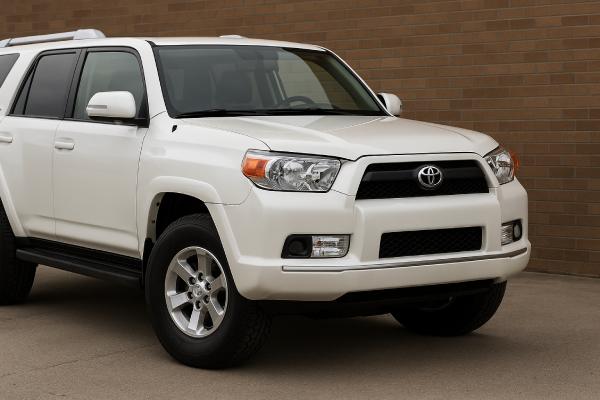
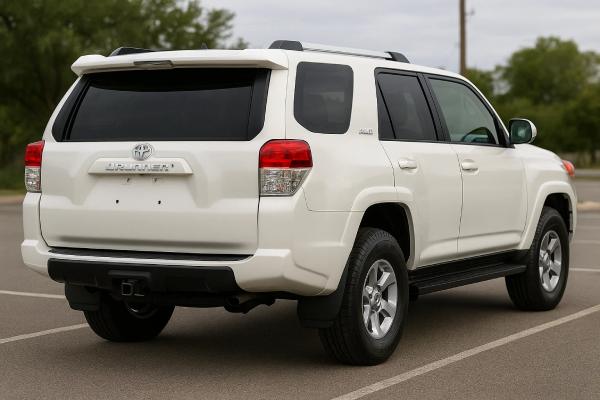
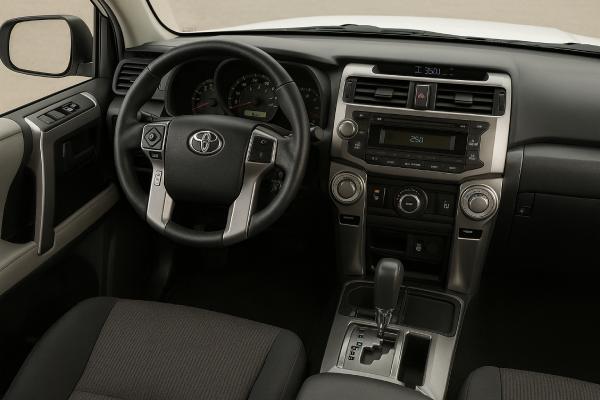
The 2010–2013 Toyota 4Runner 4WD (GRN285) with the 1GR-FE 4.0-liter V6 sits squarely in the midsize, body-on-frame SUV class. It’s the fifth-generation 4Runner, sold across North America with part-time 4×4 on SR5 and Trail and a full-time, Torsen-center-diff system on Limited. This update brought dual VVT-i to the V6 (rated 270 hp), a five-speed automatic, and a stiffer frame with coil-sprung solid rear axle—prioritizing durability, off-road control, and long-term serviceability over the car-like manners of crossover SUVs. If you’re cross-shopping, think of it as a truck-based alternative to unibody rivals: slower and thirstier, but exceptionally robust, tow-capable, and confidence-inspiring off-road. This guide focuses on the 4WD V6 2010–2013 configuration: what it is, how it’s built, how it performs and wears, what to watch for, and how to maintain and buy wisely.
At a Glance
- Proven body-on-frame SUV with robust 4×4 hardware (rear locker on Trail; full-time 4WD with Torsen center differential on Limited).
- Durable 1GR-FE V6 (timing chain, dual VVT-i) paired with a stout A750 5-speed automatic.
- Cabin/cargo practicality: two-row layout with generous 47.2 cu ft (rear seats up) and up to 89.7 cu ft (folded).
- Caveat: fuel economy is modest; expect ~17/22 mpg (city/highway) for 4WD and higher consumption when lifted or on aggressive tires.
- Typical service rhythm: engine oil 0W-20 every 10,000 miles/12 months (severe use: 5,000 miles/6 months).
Explore the sections
- 4Runner GRN285: the essentials
- 4Runner 1GR-FE specs
- 4Runner trims, options, safety
- Reliability and known issues
- Maintenance and buying guide
- Driving impressions and economy
- 4Runner vs key rivals
4Runner GRN285: the essentials
If you’re looking at a 2010–2013 4Runner 4WD, you’re considering one of the last midsize SUVs that still uses a ladder frame. That matters. The frame isolates the cabin from trail impacts, resists twisting with a roof-rack and hitch loaded up, and tolerates accessories—skid plates, sliders, lifts—without the fatigue risks common to crossovers. Toyota paired the frame with independent double-wishbone front suspension and a four-link, coil-sprung solid rear axle. On-road it rides firmly but remains composed; off-road it keeps wheels in contact and accepts bigger sidewalls and armor.
Power is the 1GR-FE V6 (dual VVT-i from 2010 on): an all-aluminum, chain-driven DOHC with port fuel injection and a broad torque plateau. Output is 270 hp (201 kW) and ~377 Nm (278 lb-ft). It’s mated to the A750F five-speed automatic. This transmission is conservative in shift logic, prioritizing heat control and longevity over snappy response; manual-gate control helps on grades or trails.
Driveline is where trims differ most. SR5 and Trail have a part-time 4×4 transfer case (2H, 4H, 4L). Limited runs a full-time 4×4 transfer case with a locking Torsen center differential for true 4H on dry pavement and a locked mode for loose surfaces. The Trail also brings off-road electronics (terrain modes, hill aids), a real rear differential lock, and, when equipped, KDSS (a hydraulic sway-bar system) that increases axle articulation off-road without giving up on-road roll control.
Inside, the fifth-gen’s packaging is straightforward, with durable plastics, easy-clean surfaces, and an upright driving position. Cargo is a strong suit: ~47 cu ft behind the second row and almost 90 cu ft with it folded. The optional third row in some trims is occasional-use only; most 4WD shoppers favor two-row versions for cargo and departure angle. Towing is rated up to 5,000 lb with a 500-lb tongue load, enough for a small camper or boat, but be honest about frontal area and payload—especially once you add people, gear, and a roof rack.
Bottom line: this era of 4Runner trades speed and sipping fuel for mechanical simplicity, service access, and trail reliability. If that’s your use case—bad weather, dirt, distance—it fits.
4Runner 1GR-FE specs
Engine and Performance
| Item | Detail |
|---|---|
| Code / architecture | 1GR-FE, 4.0-L V6, aluminum block/heads, DOHC 24-valve, dual VVT-i |
| Displacement | 3,956 cc (4.0 L) |
| Induction / fueling | Naturally aspirated, port fuel injection |
| Compression ratio | ~10.4:1 |
| Rated output | 270 hp (201 kW) @ 5,600 rpm |
| Rated torque | 377 Nm (278 lb-ft) @ 4,400 rpm |
| Emissions standard | U.S. LEV/Tier-2/Bin-5 era compliant |
| Timing | Chain (no fixed replacement interval) |
| Fuel tank | 87 L (23.0 gal) |
| Aerodynamics | ~Cd 0.36 (trim/tyre dependent) |
Transmission and Driveline
| Item | Detail |
|---|---|
| Transmission | Aisin A750F 5-speed automatic with manual gate |
| 4×4 system (SR5/Trail) | Part-time: 2H/4H/4L, manual or electronic selector |
| 4×4 system (Limited) | Full-time: Torsen center differential, lockable; 4H/4L |
| Rear differential | Open (SR5/Limited); electronic locking differential on Trail |
| Low-range ratio | ~2.57:1 |
| Transfer-case modes | 2H (PT only), 4H (open/center-differential), 4H locked (Limited), 4L (all) |
| Tow rating | Up to 2,268 kg (5,000 lb) with weight-carrying hitch; 226 kg (500 lb) tongue |
Chassis and Dimensions
| Item | Detail |
|---|---|
| Platform | Body-on-frame, coil-sprung solid rear axle |
| Front / rear suspension | Double-wishbone IFS; 4-link live axle (KDSS optional on Trail) |
| Steering | Rack-and-pinion, hydraulic assist |
| Brakes | 4-wheel discs (front ventilated ~13.3 in; rear ~12.3 in), ABS, EBD, BA |
| Wheels/tyres (typical) | 17-in (SR5/Trail), 20-in (Limited); AT or HT tyres per trim |
| Ground clearance | 244 mm (9.6 in) |
| Approach / departure | ~25° / ~24° (varies with trim/tyres; Trail improves) |
| L × W × H | ~4,825 × 1,925 × 1,790 mm (189.9 × 75.8 × 70.5 in, approx.) |
| Wheelbase | 2,789 mm (109.8 in) |
| Turning circle | 11.4 m (37.4 ft) |
| Curb weight (range) | ~2,120–2,180 kg (4,675–4,805 lb) |
| GVWR | ~2,858 kg (6,300 lb) |
| Cargo volume | 1,337 L (47.2 cu ft) seats up · 2,540 L (89.7 cu ft) seats down |
Fluids and Capacities
| System | Spec | Approx. capacity |
|---|---|---|
| Engine oil | 0W-20 (API/ILSAC), synthetic | 6.2 L (6.6 qt) with filter |
| Coolant | Toyota Super Long Life (pink) | ~10.5 L (varies by trim/HVAC) |
| Automatic transmission | Toyota ATF WS | ~10.7 L (service fill less) |
| Transfer case | 75W-90 GL-5 (or Toyota equivalent) | ~1.0 L (PT); similar for FT |
| Front / rear differential | 75W-90 GL-5 | ~1.5 L / ~3.0 L (approx., check fill) |
| Brake fluid | DOT 3 (Toyota spec) | Fill to mark |
| Wheel lug nuts (torque) | — | 113 Nm (83 lb-ft) |
| Oil drain plug (torque) | — | ~40 Nm (30 lb-ft) |
Performance and Economy
| Metric | Typical figure |
|---|---|
| 0–60 mph (test) | ~7.6–8.2 s (trim/tyres/load dependent) |
| Top speed (governed) | ~112–115 mph (180–185 km/h) |
| EPA fuel economy (4WD V6) | 17/22/19 mpg (city/hwy/combined) |
| Real-world highway at 75 mph | ~19–21 mpg (11.2–12.4 L/100 km) on stock tyres |
| Payload (max) | ~737 kg (1,625 lb) |
| Roof load | ~54 kg (120 lb) with OEM rails/crossbars |
Notes on ranges. Dimensions, angles, and masses vary slightly by trim, wheel/tire package, and options (sunroof, third row, KDSS, etc.). Off-road accessories and lifts meaningfully affect weight, aero, braking, and consumption.
4Runner trims, options, safety
Trims and key mechanical differences (2010–2013)
- SR5 4WD (part-time 4×4): 17-inch wheels, cloth or leather, basic off-road aids (A-TRAC, downhill assist), optional sunroof and third row. No factory locker.
- Trail (a.k.a. Trail Edition): part-time 4×4 plus rear diff lock, Crawl Control/Multi-Terrain Select, unique bumpers/fascias, water-resistant seat fabric, optional KDSS hydraulic sway-bar system for articulation.
- Limited (full-time 4×4): Torsen center differential with a lock function; 20-inch wheels; X-REAS-type shock cross-link deleted for this generation (you’ll see it on some contemporaries) but tuning differs; leather, JBL audio, dual-zone climate, keyless start.
Year-to-year highlights (within 2010–2013)
- 2010 launch brought the 270-hp dual VVT-i V6 and substantial chassis update.
- Minor feature/package reshuffles followed (audio/nav, Bluetooth, interior trims). Core powertrain and tow ratings stayed constant.
Options / identifiers
- Badging & tells: “Trail” label, hood scoop (Trail), 20-inch wheels and chrome for Limited, 17-inch wheels and black/gray detailing for Trail. The Limited’s full-time 4×4 is the easiest way to differentiate on a test drive (no 2H position).
- VIN/build: GRN285 indicates V6 4WD for this generation; option codes on the door jamb and build sheet confirm locker/KDSS.
Infotainment & seating
- Two-row layout is standard; optional third row (SR5/Limited) is kid-sized and reduces cargo floor height. Audio ranges from base head unit to JBL with nav; steering-wheel controls and Bluetooth arrive early, but smartphone integration is basic by modern standards.
Safety ratings in brief
- IIHS: Good in moderate overlap front, side, and head restraints, Acceptable in roof strength for pre-Nov-2012 builds. Small-overlap wasn’t in scope for this era.
- NHTSA: Rollover risk is the limiting factor for tall, BOF SUVs; check a specific VIN for star ratings in that model year.
Safety systems and ADAS
- Airbags: front, front-seat side, full-length side curtains (coverage varies with third-row fitment).
- Chassis electronics: ABS with EBD and brake assist; A-TRAC (off-road traction control); VSC stability control; hill-start and downhill assist (trim-dependent).
- Child seats: LATCH anchors and top tethers at the outboard rear positions; confirm for third-row-equipped vehicles.
- Calibration notes: After windshield or sensor work, steering angle sensor and yaw rate sensor calibrations may be necessary; post-alignment calibration for advanced stability and Crawl Control logic is good practice.
Towing and hitches
- Class III/IV receiver is typical; ensure a 7-pin trailer connector and brake controller for heavier trailers. Observe tongue load and gross combined limits; a weight-distribution hitch can improve stability but must be compatible with the frame-mounted receiver.
Reliability and known issues
This 4Runner’s appeal is longevity. The 1GR-FE/A750F/part-time or full-time 4×4 combos are well-understood and rarely fail if serviced. That said, age and use patterns matter. Below is a practical map by prevalence and cost severity.
Common (low–medium severity)
- Front and rear brake wear/warpage: Heavy wheels/tires and mountain driving accelerate rotor wear. Symptom: steering shudder under braking or long downhill fade. Fix: quality rotors/pads, proper torque (113 Nm / 83 lb-ft) on lug nuts, fluid flush (DOT 3) at 2–3 years, consider upgraded pads for towing.
- Suspension consumables: Front lower control arm bushings, ball joints, and rear links age out by 100–150k miles, sooner with off-road use. Symptoms: clunks, wander, uneven tire wear. Fix: OE-quality arms/joints; re-torque bushings at ride height; alignment afterward.
- Driveshaft “thump” after stop: Prop-shaft slip yoke stick-slip can cause a gentle bump. Fix: clean and re-grease with moly grease; replace slip-yoke if worn.
- Exhaust manifold tick on cold start: Occasional gasket leaks or cracked manifolds. Fix: inspect and replace gasket/manifold; reuse hardware only if corrosion-free.
Occasional (medium severity)
- Water pump seepage (V-belly area): pink residue or slow coolant loss around 90–140k miles. Fix: replace pump; renew coolant; check idler bearings.
- Alternator aging: Dust and heat can weaken diodes/bearings; voltage sag with loads. Fix: test under load, replace with OE-quality unit; inspect belt.
- Wheel bearings: Off-road and water crossings load bearings. Symptoms: growl with speed, play. Fix: press-in bearing/hub service.
Less common (can be high severity if ignored)
- ATF heat under heavy towing: A750F is stout but heat kills fluid. Symptoms: shift flare, dark/burnt ATF. Fix: conservative towing speeds, downshift to maintain converter lock, consider an auxiliary cooler if you tow in mountains; service ATF sooner.
- Rear diff / transfer case seals: Age and heat harden seals. Symptoms: wet housing edges; fluid level down. Fix: replace seals, verify breather operation, refill with 75W-90 GL-5.
- Frame and hardware corrosion (salt states): The fifth-gen resists rust better than many body-on-frame peers, but plows and beach driving still corrode brake lines, fasteners, and rear crossmembers. Fix: thorough underbody wash, annual inspection, surface prep and coating; avoid foam-trapping accessories.
Software / calibration
- ECU/TCU reflashes from this era addressed drivability finesse and EVAP diagnostics rather than major faults. After battery replacement, allow idle relearn; verify throttle and transmission adaptations settle with mixed driving.
Recalls, TSBs, extended coverage
- This period saw targeted recalls (e.g., accessory remote-starter concerns in 2012) and broader Toyota campaigns across models. Always run the VIN for open campaigns and confirm completion with paperwork.
- Pre-purchase: Ask for a complete service history, proof of differential/transfer case fluid changes, and any TSB-related reprogramming or component replacements.
Pre-purchase checks (request/perform)
- Frame rails, rear crossmember, brake/fuel lines: look for flaking rust and damp spots.
- Transfer case and differential housings: check for wet seals; confirm smooth 2H/4H/4L engagement (PT) or center-diff lock (Limited).
- Cooling system: pink crust around the pump or radiator seams.
- Suspension: torn boots, KDSS cylinder leaks (if equipped), sway-bar link play.
- Electronics: Crawl Control/Multi-Terrain Select, locker actuation (Trail), key fob, rear window.
- Road test: no driveline vibration to 120 km/h (75 mph); no shudder on moderate-to-hard braking; transmission locks the converter in 4th/5th under steady load.
Maintenance and buying guide
Practical maintenance schedule (time/distance = whichever comes first)
- Engine oil & filter (0W-20): 10,000 miles / 12 months (severe: 5,000 / 6). Use a quality synthetic and OE-grade filter; verify level after refill (~6.6 qt / 6.2 L).
- Engine air filter: inspect at 15,000 miles; replace 30,000–45,000 miles (trail/dust: sooner).
- Cabin filter: 12 months / 15,000 miles; sooner in dusty/pollen seasons.
- Coolant (Toyota SLLC, pink): first at 100,000 miles / 10 years, then 50,000 miles / 5 years thereafter.
- Spark plugs (iridium): 120,000 miles / 12 years; inspect coils/boots for tracking.
- Fuel filter: in-tank on these years; monitor pump noise and trims; replace only with symptoms or during pump service.
- Drive/serpentine belt & hoses: inspect annually from 60,000 miles; replace 90,000–120,000 miles or at first cracking/noise.
- Automatic transmission (ATF WS): “lifetime” in brochure; for longevity, 60,000–90,000 miles service is prudent, earlier if towing. Use WS only; verify temp-based fill procedure.
- Transfer case & differentials (75W-90 GL-5): 30,000–60,000 miles depending on tow/off-road duty; check breathers.
- Brake fluid (DOT 3): 24–36 months; more often in humid or coastal climates.
- Brake pads/rotors: inspect each tire rotation; replace rotors with significant thickness variation/blueing.
- Tyre rotation: 5,000–7,500 miles; keep even wear, maintain ~35 psi (load-dependent).
- Alignment check: annually or after any suspension work/off-road trip that jars the steering.
- Valve clearances: shim-over-bucket design; no scheduled adjustment, but listen for tickers at high mileage.
- 12-V battery: load-test annually after year 4; typical life 4–6 years.
- Body/drains: clean sunroof and tailgate drains; wash underbody after salt/sand.
Fluid specs, capacities, and critical torques (quick reference)
- Engine oil: 0W-20 API/ILSAC, ~6.6 qt (6.2 L) with filter. Drain plug ~30 lb-ft (40 Nm).
- Wheel lug nuts: 83 lb-ft (113 Nm)—use a torque wrench; improper torque contributes to rotor warpage.
- ATF: Toyota WS only; fill at target temp; check with scan tool if possible.
- Gear oils: 75W-90 GL-5 front/rear/transfer; fill to the hole; capacities vary slightly—always use the fill-till-drip rule on level ground.
Buyer’s guide: what to seek/avoid
- Best all-rounder: Trail with KDSS for mixed highway/off-road; keep stock-ish tire sizes for braking/consumption.
- Snow-belt commuters: Limited for full-time 4WD (no dry-pavement binding) and nicer NVH.
- Avoid: poorly lifted examples (questionable geometry, driveline angles), rusty frames, or trucks with unknown gear-oil history if used for towing/overlanding.
- Reconditioning items to budget: tires (ATs age out around 5–6 years), brakes, shocks/struts by 100–150k, belts/hoses, battery, and any leaking seals.
- Durability outlook: With fluids on time and salt managed, 300k-mile powertrains are common. Electronics are simple by modern standards; parts availability is excellent.
Driving impressions and economy
Ride, handling, and NVH
On stock 17-inch wheels and P-metric all-terrains, the 4Runner rides firmly but controls impacts well. Body motions are deliberate rather than floaty; big undulations are ironed out by the long-travel rear axle. Steering is medium-weight and consistent, with modest on-center feel—truck-honest rather than sporty. Brakes are progressive if kept cool; long grades demand downshifts to preserve rotor temperature. Cabin noise is acceptably low at 65–75 mph, with wind noise around the A-pillars noticeable on roof-racked trucks.
Powertrain character
The 1GR-FE’s best trait is linearity. Throttle response is predictable from idle to 4,500 rpm, with a mild step in pull as cam timing advances. The five-speed’s logic is conservative: early upshifts in Normal, reluctant kickdowns to avoid heat. Using the manual gate (or Sport mode where present) transforms steep-grade behavior: hold 4th to keep the converter locked, then drop to 3rd for engine braking. The Limited’s full-time system feels the most planted on rain-slick highways; the Trail’s locker and A-TRAC give it a distinct low-speed traction advantage off-road.
Real-world economy
Expect 17–18 mpg mixed in stock form; 19–21 mpg at a steady 70–75 mph on highway in calm weather. Lift, roof gear, and mud-terrain tires can knock 2–4 mpg off. Winter warm-up and snow tires push city numbers into the mid-teens. For frequent towing or high headwinds, plan for 25–40% higher consumption than unloaded highway figures.
Key performance metrics
- 0–60 mph: high-7s to low-8s in typical trims on all-season tires; Trail with ATs/leaded racks trends slower.
- 50–80 mph passing: adequate; pre-select 4th for immediate response.
- 100–0 km/h braking: stable and straight with quality pads/rotors; performance depends heavily on tire compound and weight.
- Turning circle: 37.4 ft—tight for a BOF SUV, useful on trails and in parking.
Traction and control
- Part-time 4×4 (SR5/Trail): Use 2H on dry pavement, 4H only on low-μ surfaces (rain, snow, gravel). 4L for steep climbs, technical trails, or heavy launches.
- Full-time 4×4 (Limited): Everyday 4H with open center diff; engage center-lock on loose surfaces; 4L as needed.
- A-TRAC uses ABS to brake a spinning wheel and send torque across the axle; it’s slower than a mechanical LSD but very effective when driven smoothly.
- KDSS, where fitted, decouples sway bars off-road for articulation; on-road, it runs them effectively “connected” for roll control—best of both worlds, with minimal maintenance needs.
Towing/load behavior
Up to 5,000 lb is realistic with a small camper or boat. Keep speeds moderate, use 4th on grades to maintain converter lock, and watch trans temps if you’ve fitted larger tires. Braking with trailer brakes feels secure; over the rating or with high frontal area, stability drops quickly. Expect +30–50% fuel use when towing a boxy load at freeway speeds.
4Runner vs key rivals
Jeep Grand Cherokee (WK2, 2011–2013)
- Pros: Strong V8 option, more modern interior, available air suspension, better on-road handling.
- Cons: Unibody makes it quieter but generally less tolerant of heavy armor/lifts; some powertrain/electrical gremlins reported in early years; rear cargo isn’t as square.
- Verdict: If you want premium feel and V8 punch, WK2 wins. For long-haul dirt reliability with simple service, the 4Runner is the safer bet.
Nissan Xterra (2nd gen, through 2015)
- Pros: Lighter, cheaper used, manual-trans availability earlier in the run, good approach angle.
- Cons: Smaller cabin/cargo, discontinued support, fewer comfort features, and lower tow rating.
- Verdict: A value trail rig if you fit inside; 4Runner is roomier, quieter, and holds value better.
Ford Explorer (5th gen, 2011–2013)
- Pros: Family features, smoother ride on pavement, better EPA numbers.
- Cons: Crossover architecture, limited low-range capability; long-term durability of some driveline components can lag with towing/off-road abuse.
- Verdict: Great family appliance if you rarely leave pavement. 4Runner if you actually wheel, tow on dirt, or need frame-based robustness.
Toyota FJ Cruiser (2010–2014)
- Pros: Shorter wheelbase, great factory off-road geometry, shared 1GR-FE/A750 drivetrain.
- Cons: Worse visibility, smaller cargo and rear access.
- Verdict: FJ is the playful trail toy; 4Runner is the livable, pack-it-all truck for mixed roles.
Subaru Outback / similar AWD wagons
- Pros: Excellent mpg and road manners, lower load floor, lower buy-in.
- Cons: No low range or truck-class frame; less tolerant of hits and heavy racks.
- Verdict: For snow-road duty, an Outback is fine. For two-tracks, towing on washboard, or armor, the 4Runner’s truck bones win.
References
- Gas Mileage of 2010 Toyota 4Runner 2010 (EPA Ratings)
- 2010 Toyota 4Runner 4-door SUV 2010–2013 (Safety Rating)
- 2010 4Runner – Owners’s Manual 2010 (Owner’s Manual)
- Check for Recalls: Vehicle, Car Seat, Tire, Equipment – NHTSA 2025 (Recall Database)
Disclaimer
This article is for informational purposes and isn’t a substitute for professional diagnosis, safety inspections, or OEM repair procedures. Specifications, torque values, and maintenance intervals can vary by VIN, trim, and market equipment. Always confirm against your vehicle’s official Toyota service documentation and current technical bulletins before performing work.
If this guide helped, please consider sharing it with friends on Facebook or X/Twitter—thank you for supporting xcar’s work.