
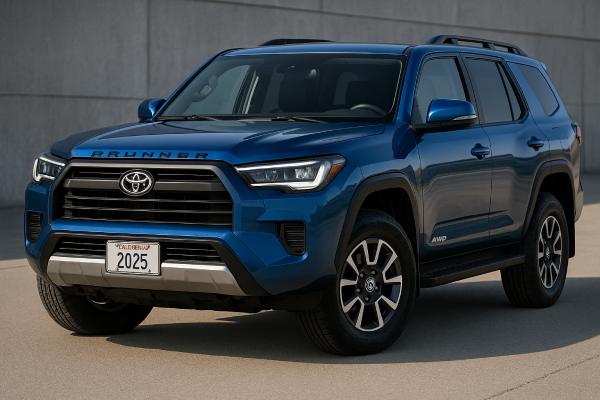
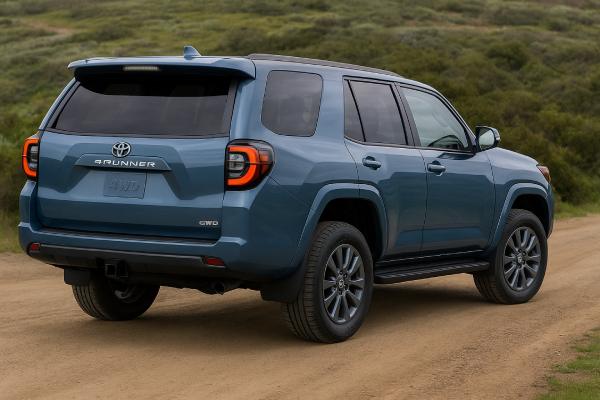
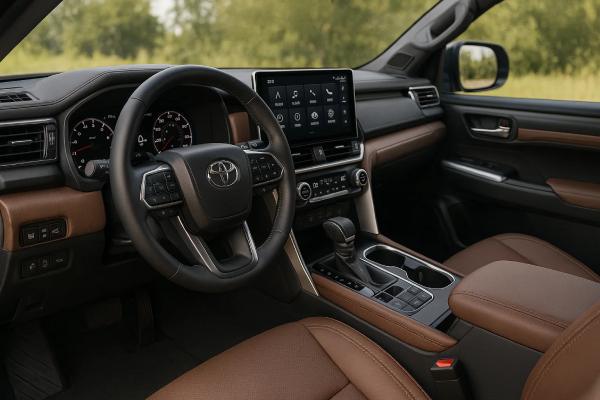
The sixth-generation Toyota 4Runner (chassis code N500) brings this body-on-frame, five-door midsize SUV into the modern era while keeping its core mission intact: a dependable, highly capable utility vehicle that can be used every day and taken far off the pavement on weekends. This guide covers the 4WD gasoline model with the 2.4-liter turbocharged “i-FORCE” four-cylinder (T24A-FTS), rated at 278 hp (207 kW). It rides on Toyota’s TNGA-F ladder frame with a two-speed transfer case (most trims) and an available full-time 4WD system with a locking center differential on select grades. Buyers also see a broader grade strategy, improved cabin tech, and a thoughtful set of driver-assistance features. We focus on the North American market, model years 2025–present. If you’re cross-shopping a Jeep Wrangler, Ford Bronco, or the related Toyota Land Cruiser, you’ll find the 4Runner slots as the toughest three-row-capable option of the group, with a simpler ownership proposition than many rivals. Below you’ll find the specs, what to watch for, how it drives, and which trims make the most sense.
Fast Facts
- Robust ladder frame, two-speed transfer case, and available rear locker deliver real trail capability.
- New 2.4-liter turbo (278 hp, 317 lb-ft) pairs with an 8-speed automatic for better drivability and towing up to 6,000 lb (2,722 kg).
- Full-time 4WD with locking center differential offered on premium grades; part-time 4WD standard on off-road-focused trims.
- Watch service history for driveline fluids; plan transfer case and differential oil changes on time if you tow or wheel.
- Typical oil change: every 10,000 miles (16,000 km) or 12 months with 0W-20 full-synthetic (shorten to 5,000 miles/8,000 km under heavy use).
What’s inside
- Detailed Overview
- Specifications and Technical Data
- Trims, Safety, and Driver Assistance
- Reliability and Known Issues
- Maintenance and Buyer’s Guide
- Driving and Performance
- How 4Runner Compares to Rivals
4Runner 4WD N500 overview
The sixth-generation 4Runner continues Toyota’s proven recipe: a tough ladder frame, straightforward controls, and hardware that earns its off-road reputation rather than leaning on software. The N500 platform is closely related to the current Land Cruiser and Tacoma, sharing a boxed-steel TNGA-F chassis. Under the hood is Toyota’s 2.4-liter, direct-injected, intercooled turbocharged four-cylinder (engine code T24A-FTS) paired with an 8-speed automatic. Output is 278 hp (207 kW) and 317 lb-ft (430 Nm), delivered with a broad torque plateau that makes the truck feel stronger than the old V6 at typical road speeds.
Two 4WD configurations are available depending on trim. Most off-road-oriented grades use a part-time 4WD transfer case with 2H/4H/4L, automatic limited-slip function (Auto LSD), A-TRAC brake-based traction, and, on certain trims, an electronically controlled rear differential lock. Select premium grades offer a full-time 4WD system with a locking center differential for seamless use on mixed-grip roads (think winter commuting) and a low range for technical terrain. Beyond driveline choices, the 4Runner adds modern features that matter on the trail—an available stabilizer-bar disconnect, Multi-Terrain Select modes, and Crawl Control—while the cabin moves to a 12.3-inch digital cluster on many trims, a large touch display, and better seat ergonomics. Towing is rated up to 6,000 lb when properly equipped, and a power rear glass remains a beloved 4Runner signature.
Owners stepping from the 2010–2024 generation will notice tighter body control, improved noise isolation, more useful camera views for obstacles, and a safer baseline of active features. Yet the formula remains refreshingly familiar: a real frame, real low range, and honest, serviceable components.
Specifications and Technical Data — 4Runner 4WD
Engine and Performance
| Item | Detail |
|---|---|
| Engine code | T24A-FTS (i-FORCE) |
| Displacement | 2.4 L (2,393 cc) |
| Induction & fueling | Turbocharged, intercooled; direct + port injection |
| Compression ratio | ~10.5:1 (nominal) |
| Rated output | 278 hp (207 kW) @ ~6,000 rpm |
| Rated torque | 317 Nm (430 lb-ft) @ ~1,700–3,600 rpm (broad plateau) |
| Timing drive | Chain |
| Fuel requirement | Regular unleaded (AKI 87) recommended |
| Fuel tank | ~80 L (21.1 US gal) |
| Aerodynamics (typical) | Cd ~0.35–0.37 (varies by trim and tires) |
Transmission and Driveline
| Item | Detail |
|---|---|
| Transmission | 8-speed automatic with lockup torque converter |
| 4WD systems | Part-time 4WD (2H/4H/4L) on most off-road trims; full-time 4WD with locking center differential on select premium grades |
| Low range | ~2.6:1 (typical Toyota 2-speed case; ratio varies slightly by calibration) |
| Rear differential | Open; electronic locking on TRD Off-Road, TRD Pro, Trailhunter (availability varies by package) |
| Traction aids | A-TRAC brake traction, Auto LSD (rear), Crawl Control, Multi-Terrain Select |
| Final drive | ~3.9–4.3 (varies by grade and tire package) |
Chassis and Dimensions
| Item | Detail |
|---|---|
| Platform | TNGA-F body-on-frame, boxed steel ladder frame |
| Suspension | Front: double-wishbone; Rear: multi-link, solid axle with Panhard rod |
| Stabilizer | Available front stabilizer-bar disconnect (electro-mechanical) |
| Steering | Electric power-assisted rack-and-pinion |
| Brakes | 4-wheel discs, multi-mode ABS, EBD, brake assist; parking brake electronic |
| Wheels/tires | 17–20 in wheels; all-terrain options on off-road grades (up to ~33-in tire OD) |
| Wheelbase | 2,850 mm (112.2 in) |
| Length x width x height | ~4,950 x 1,980 x 1,845 mm (194.9 x 77.9 x 72.6 in) typical by trim |
| Ground clearance | ~206–257 mm (8.1–10.1 in), by tire/suspension |
| Angles (approx.) | Approach up to ~33°, departure up to ~24°, by trim |
| Curb weight | ~2,125–2,260 kg (4,685–4,985 lb) typical equipment-dependent |
| GVWR | ~2,755–2,755+ kg (6,075+ lb), grade-specific |
| Turning circle | ~12.0 m (39.4 ft) |
| Cargo volume | Up to ~2,555 L (90.2 cu ft) seats folded; ~1,370 L (48–45 cu ft) behind second row (varies with third row and spare location) |
Fluids and Capacities
| System | Spec / Capacity | Notes |
|---|---|---|
| Engine oil | 0W-20 full synthetic; ~5.0–5.5 L (5.3–5.8 qt) | Use API SP / ILSAC GF-6 |
| Coolant | Toyota Super Long Life; ~8–10 L | Premixed pink SLLC |
| ATF | Toyota WS; ~7–9 L service fill | Use level/temperature check procedure |
| Transfer case | 75W-90 GL-5; ~0.8–1.2 L | Change more often if off-road/tow |
| Front/Rear diff | 75W-90 GL-5; ~1.0–1.6 L each | Rear diff capacity varies with locker |
| Brake fluid | DOT 3 or DOT 4 | Flush on time; moisture sensitive |
| Power steering | Electric assist | No service fluid |
| Tire pressures | ~230–260 kPa (33–38 psi) | Adjust for load/trail airing-down |
Performance and Economy
| Metric | Result (typical) |
|---|---|
| 0–60 mph (0–100 km/h) | ~7.5–7.9 s (by tire/trim; internal testing typical) |
| Top speed (governed) | ~112–115 mph (180–185 km/h) |
| Towing | 6,000 lb (2,722 kg) max with proper equipment |
| Payload | ~1,400–1,600 lb (635–725 kg) by trim |
| Roof load | ~165–220 lb (75–100 kg) dynamic; higher static for tents/racks |
| EPA-style (projected/typical) | 19/25/21 mpg (city/hwy/combined) 4WD; 20/26/22 mpg 2WD; convert: 12.4/9.4/11.2 L/100 km (4WD) |
| Real-world highway @ 75 mph (120 km/h) | ~22–24 mpg (10.7–9.8 L/100 km) on A/T tires; ~1–2 mpg higher on highway-oriented tires |
Figures vary by grade, tire, aero add-ons (racks), altitude, and calibration. Always verify the door-jamb or owner’s manual for your VIN-specific limits.
Trims, Safety, and Driver Assistance
Trim and option structure (high-level):
- SR5 (PT 4WD available): Cloth or SofTex, 8-speed auto, part-time 4WD with 2-speed case, 12.3-inch touchscreen on many builds, power rear glass, towing prep. Optional third row.
- TRD Sport / TRD Sport Premium (PT 4WD available): Road-biased suspension tuning, larger wheels/tires, SofTex Premium adds heaters and more convenience.
- TRD Off-Road / TRD Off-Road Premium (PT 4WD): Rear locker available/standard (package-dependent), Multi-Terrain Select, Crawl Control, available stabilizer-bar disconnect, skid plates, A/T tires.
- Limited (FT 4WD available): Full-time 4WD with a locking center differential available/standard by sub-grade, adaptive suspension option, premium interior; optional third row.
- TRD Pro (PT 4WD standard): Off-road suspension with TRD tuning, A/T tires, skid plates, rear locker, trail hardware, heritage styling; roof rack on some builds.
- Trailhunter (PT 4WD): Factory overlanding setup with ARB/Old Man Emu hardware, off-road lighting, onboard air, high-clearance bits.
- Platinum (FT 4WD available/standard): Range-topping comfort with full-time 4WD availability, premium audio, more active safety and convenience features.
Mechanical identifiers by trim (quick tells):
- Full-time 4WD (Limited/Platinum builds): “4H” displays without “2H,” and a “center diff lock” indicator in cluster; shifter shows 4H/4L and diff-lock button.
- Part-time 4WD (TRD/Trail): 2H/4H/4L positions; “RR DIFF LOCK” switch on locker-equipped trucks; stabilizer-bar disconnect button on select trims.
- VIN/build codes: Door-jamb axle/trans labels, window sticker, and build sheets show transfer case codes and axle ratios.
Safety ratings snapshot:
- IIHS has begun publishing ratings for 2025 builds; headlight performance varies by trim and lamp package, with higher trims earning stronger results. Comprehensive crash ratings continue to roll out as test schedules progress.
- NHTSA star ratings may publish later in the cycle; shoppers should plan to check both agencies as ratings update.
Safety equipment and ADAS:
- Toyota Safety Sense 3.0 standard: Pre-Collision System with pedestrian/bicyclist detection, Lane Departure Alert with steering assist, Lane Tracing Assist (on equipped models), Road Sign Assist, Dynamic Radar Cruise Control.
- Additional systems: Blind Spot Monitor with Rear Cross-Traffic Alert (availability by grade), front/rear parking sensors, surround-view and Multi-Terrain Monitor cameras, downhill assist control (DAC).
- Airbags and structure: Advanced multi-stage front airbags, side-impact and side-curtain coverage, driver knee and front passenger protection, anti-whiplash head restraints, and a stiffer, higher-strength TNGA-F structure.
- Child-seat provisions: Lower anchors and tether points in outboard second-row seats; verify third-row anchor availability on 7-seat configurations.
- Calibration notes: After windshield, radar, or camera replacement/repair, alignment and calibration are required; budget time at a qualified shop with the correct targets and scan tools.
Reliability and Known Issues
It’s early days for the N500 4Runner, and the platform builds on Toyota’s conservative hardware. That said, new powertrains and electronics bring predictable teething items. Below is a practical early-watchlist, grouped by prevalence and cost exposure.
Engine and fueling (ICE-specific):
- Turbo plumbing (occasional, low–medium): Hiss/whistle, oil mist, or boost-related drivability points to loose clamps or a minor hose issue. Remedy: inspect charge pipes and clamps; torque to spec and re-seat.
- PCV and oil management (rare, low): Elevated oil consumption early in life can result from ring seating and PCV behavior. Remedy: follow factory oil spec and break-in; monitor consumption; update PCV valve if a revised part appears.
- Cold-start NVH (occasional, low): Brief rattle or injector tick on DI engines is typically characteristic. Remedy: confirm no DTCs; verify heat shields and mounts.
Cooling and thermal management:
- Auxiliary heat exchangers (occasional, low–medium): Off-road package trucks with added coolers may collect debris. Remedy: periodic fin cleaning; ensure no bent fins restricting flow.
Driveline and 4WD system:
- Transfer case engagement feel (common, low): Part-time systems may bind on mixed-traction pavement if 4H is used inappropriately. Remedy: use 2H on dry pavement; shift to 4H only on loose/slippery surfaces; lock/unlock center diff appropriately on FT 4WD trucks.
- Rear differential breather and seals (occasional, low–medium): Off-roading, water crossings, or long hot tows can stress breathers and seals. Remedy: confirm breather function; inspect for seepage; replace seals if weeping.
- Front CV boots (occasional, medium): Lifted trucks or aggressive trail use can nick boots. Remedy: inspect after trips; replace boots promptly to protect joints.
Chassis and corrosion points:
- Frame and hardware (occasional, low–medium): New coatings are improved, but trail rash and winter brines still attack skid-plate bolts, control-arm cams, and hitch hardware. Remedy: wash underbody; apply corrosion inhibitor; anti-seize critical fasteners.
- Sway-bar disconnect mechanism (rare, low–medium): If not exercised, linkages may stick. Remedy: cycle monthly; lubricate per guidance; replace actuator/link if necessary.
Electrical and infotainment:
- Camera system sensitivity (occasional, low): Mud/snow can obscure multi-terrain cameras and sonar sensors. Remedy: clean lenses; run sensor health checks after impacts.
- Software updates (ongoing): Expect refinements for cluster/infotainment and ADAS. Remedy: request ECU/ADAS/infotainment calibration checks during service; apply TSB flashes when available.
Recalls, campaigns, and TSBs:
- Always run a VIN recall check before purchase and at service intervals. Keep dealer printouts for completed campaigns. Expect typical early-model TSBs covering software stability, camera alignment, and minor hardware fasteners. If you buy used, ask for a complete TSB/recall history and proof of completion.
Pre-purchase checklist (used or dealer swap):
- Full maintenance log from day one (oil, diff and transfer case services if any, tire rotations).
- Underside inspection for trail damage, bent skid plates, or pinched brake lines.
- Verify locker operation (on equipped trims) and confirm smooth 2H↔4H↔4L transitions on a loose surface.
- Check for aftermarket lifts/wheels; confirm alignment, driveline angles, and steering centering.
- Scan for codes; ensure ADAS calibrations are up to date after glass or body repairs.
Maintenance and Buyer’s Guide
Service schedule (typical usage):
- Engine oil/filter: Every 10,000 miles (16,000 km) or 12 months with 0W-20 full synthetic; severe service (towing, dusty trails, short trips) every 5,000 miles (8,000 km).
- Engine air filter: Inspect 10,000 miles (16,000 km); replace 30,000–40,000 miles (48,000–64,000 km) sooner if dusty.
- Cabin filter: 15,000–20,000 miles (24,000–32,000 km).
- Spark plugs: Iridium ~60,000–100,000 miles (96,000–160,000 km) depending on part number and use.
- Coolant (SLLC): First at 100,000 miles (160,000 km) / 10 years, then every 50,000 miles (80,000 km) / 5 years.
- ATF (WS): “Lifetime” under light use, but prudent at 60,000–90,000 miles (96,000–145,000 km) if towing/hot climates; drain-and-fill with correct temp procedure.
- Transfer case & differentials (75W-90 GL-5): 30,000–50,000 miles (48,000–80,000 km) if off-road/towing; up to 60,000–100,000 miles (96,000–160,000 km) otherwise.
- Brake fluid: Flush every 2–3 years regardless of miles.
- Serpentine/aux belts & hoses: Inspect at each service; replace 90,000–120,000 miles (145,000–193,000 km) or at first signs of cracking/noise.
- Alignment and tire rotation: Rotate every 5,000–7,500 miles (8,000–12,000 km); check alignment after any hard trail use or curb impact.
- 12-V battery test: Annually after year three; replace at 4–6 years typical.
Essential torque values (common fasteners):
- Wheel lug nuts: ~131 Nm (97 lb-ft).
- Oil drain plug: ~39–44 Nm (29–33 lb-ft) with new washer.
- Rear diff drain/fill: ~49–64 Nm (36–47 lb-ft) (verify cover type); front diff similar.
- Skid-plate fasteners: 20–30 Nm (15–22 lb-ft) typical (varies by panel).
Always confirm VIN-specific specs in the service manual.
Fluids recap:
- Engine oil: 0W-20 API SP/ILSAC GF-6.
- ATF: Toyota WS only.
- Driveline oils: 75W-90 GL-5.
- Coolant: Toyota SLLC (pink).
- Brake fluid: DOT 3/4.
Buyer’s Guide: what to look for
- Which trim? If you drive winter roads daily, the Limited or Platinum with full-time 4WD and locking center differential is compelling. If you wheel regularly, the TRD Off-Road or TRD Pro adds a rear locker, A/T tires, and trail-tuned suspension; Trailhunter suits overlanding with integrated accessories.
- Two vs. three rows: The third row is compact and best for occasional use; consider how often you’ll carry six or seven before prioritizing it.
- Tires matter: All-terrain rubber transforms traction but adds noise/consumption; highway all-seasons improve ride and mpg.
- Towing setup: Ensure a brake controller and correct hitch class; confirm the cooling package, mirrors, and payload margin on the door-jamb label.
- Aftermarket lifts: Quality kits retain alignment range and driveline angles; budget for UCAs and a professional alignment.
- Long-term outlook: With routine fluids and sensible use, expect classic 4Runner longevity. Electronics are more complex than before, but Toyota’s parts and documentation support are strong.
Driving and Performance
On-road balance:
The N500 4Runner rides with more control than the prior generation. The chassis feels tighter over broken pavement, and the 8-speed gearbox keeps the turbo four in its torque band, avoiding the old V6’s frequent hunting. Steering is light at parking speeds and firms appropriately on the highway, with a touch more on-center precision than before. Cabin noise is acceptable for a ladder-frame SUV; A/T-equipped grades add a mild hum at speed that most owners view as a fair trade for grip.
Powertrain character:
Peak numbers tell only part of the story. The 2.4-liter builds torque early, so city driving and two-lane passing improve. Turbo lag is minimal once rolling, though tip-in can feel different from the outgoing naturally aspirated V6; Sport mode sharpens response. The 8-speed’s programming is conservative in Normal and more decisive in Sport; it downshifts smartly on grades and locks the converter early to control temps.
4WD behavior and traction tools:
- Part-time 4WD offers classic robustness. Use 2H on dry pavement, 4H on loose surfaces, and 4L for steep climbs/descents. The available rear locker is a true traction multiplier across cross-axle obstacles.
- Full-time 4WD adds a locking center differential, enabling all-weather use in 4H without driveline bind and low-range authority when needed.
- A-TRAC and Multi-Terrain Select blend wheel-speed and brake-based control to claw forward where open diffs would spin. The stabilizer-bar disconnect increases front axle articulation at low speeds, keeping tires planted.
Braking and stability:
Pedal feel is consistent with a firm bite from the larger discs. Stability control is well-tuned; it relaxes appropriately in off-road modes and can be curtailed for sand or snow starts. On steep descents, Downhill Assist Control holds speed without excessive brake odor.
Efficiency in practice:
Real-world results cluster around low-20s mpg on highway runs with highway tires at 70–75 mph (11–10 L/100 km), dropping a few mpg with aggressive A/T rubber, lift kits, racks, or roof tents. Cold weather, short trips, and headwinds are the main penalties. Towing a 3,000–4,000 lb (1,360–1,815 kg) trailer typically reduces economy by ~30–40%.
Load and towing:
With a balanced hitch setup, correct trailer brake gain, and transmission temp monitoring, the 4Runner tows predictably. The ladder frame resists flex, and the 8-speed’s ratios help on grades. Expect slower uphills with boxy campers; keep speeds moderate to avoid heat stack in hot headwinds.
How 4Runner Compares to Rivals
Toyota Land Cruiser (J250): Shares the TNGA-F foundation and much of the cabin tech. The Land Cruiser leans premium and uses a hybridized powertrain as standard, with a full-time 4WD Torsen-type center differential. If you want full-time 4WD and a more refined ride out of the box—and don’t need the 4Runner’s trim variety—the Land Cruiser is the upmarket twin.
Ford Bronco: Charismatic, modular, and available with lockers front and rear plus sway-bar disconnect. On-road NVH is improved over the Wrangler, but long-term ownership costs and corrosion resistance vary by build/use. Bronco excels for open-air fun and rock play; 4Runner counters with simpler ownership, a closed cabin, and towing stability.
Jeep Wrangler (JL/JLU): Best-in-class articulation and aftermarket, with available 4:1 low range and locking diffs front/rear. It’s superb on technical routes but can be noisier and less composed on long highway trips. If you plan daily commuting plus frequent overlanding, the 4Runner’s refinement and cargo packaging are easier to live with.
Chevrolet Colorado ZR2 / GMC Canyon AT4X (midsize pickup): If a bed suits you, these offer long-travel dampers and serious hardware. The 4Runner is quieter inside, can seat more, and packages gear securely; the trucks win when you need an open bed and higher desert-running speeds.
Subaru Outback Wilderness / midsize crossovers: Better fuel economy and ride comfort on pavement, but no low range or ladder frame. If you only see graded trails and snow, a crossover may suffice. If you want repeated low-range work, real underbody protection, and easier upfitting, the 4Runner is the correct tool.
References
- The All-New 2025 Toyota 4Runner: The Icon That Inspires Exploration 2024 (Press Release)
- 2025 Toyota 4Runner Refines Adventure Ready Heritage 2024 (Press Release)
- 2025 Toyota 4Runner 2025 (Safety Rating – Headlights and Ongoing Testing)
- Check for Recalls: Vehicle, Car Seat, Tire, Equipment 2025 (Recall Database)
Disclaimer
This article is for informational purposes only and is not a substitute for professional diagnosis, repair, or VIN-specific service information. Specifications, torque values, capacities, safety ratings, and maintenance intervals can vary by VIN, model year, trim, and market equipment. Always verify details against your vehicle’s owner’s manual, the official service manual, and current manufacturer and regulatory sources before performing service or making purchase decisions.
If you found this guide helpful, please consider sharing it on Facebook or X/Twitter to support xcar’s work.