
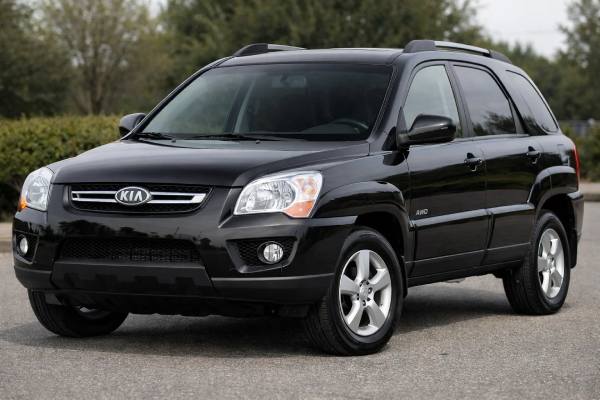
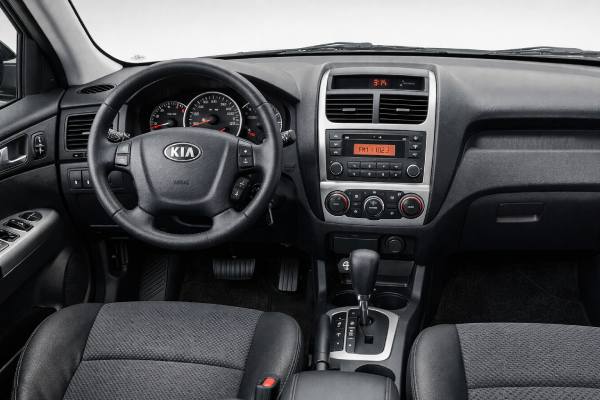
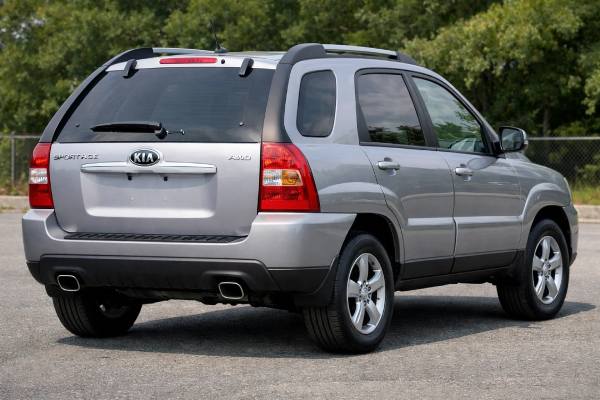
The facelifted 2008–2010 Kia Sportage FWD with the 2.0-liter D4EA diesel sits in a sweet spot for buyers who want a compact SUV that still feels simple to own. It belongs to the KM generation, the point where Sportage fully embraced car-like road manners, a roomy cabin, and everyday ease instead of the older rough-road-first formula. In 150 hp form, the diesel gives this front-wheel-drive version a stronger mid-range than the early 113 hp unit, while keeping weight and mechanical complexity lower than the AWD models.
That combination still makes sense today. You get useful torque, solid family packaging, and parts familiarity shared with the related Hyundai Tucson. The trade-off is that age now matters more than spec. A good one can still be a practical long-distance budget SUV. A neglected one can quickly need a timing-belt job, diesel fuel-system work, suspension refreshes, and rust repair. For this model, condition and documented maintenance are everything.
Quick Specs and Notes
- The 150 hp diesel feels noticeably stronger in everyday driving than the earlier lower-output 2.0 CRDi.
- Front-wheel drive keeps running costs lower than AWD and removes the rear driveline from the service list.
- Cabin space, rear-seat access, and cargo flexibility remain strong for a compact SUV from this era.
- The biggest ownership risks are missed timing-belt service, clogged EGR and DPF hardware, and corrosion underneath.
- Kia’s legacy service guide lists 12,500 miles or 12 months for 2008–2010 diesel Sportage models.
What’s inside
- Kia Sportage KM facelift diesel
- Kia Sportage KM numbers and capacities
- Kia Sportage KM equipment and crash tech
- Failure patterns and factory fixes
- Service calendar and smart buying
- Road feel and tested economy
- Where it beats its peers
Kia Sportage KM facelift diesel
The 2008 facelift did not turn the KM Sportage into a different vehicle, but it sharpened the version that most diesel buyers actually wanted. Styling changes were modest, yet the more important gains sat underneath the ownership story: a stronger diesel tune in many markets, cleaner detail changes, broader safety availability, and a more polished overall feel than the 2005–2007 launch cars.
In this front-wheel-drive 150 hp form, the Sportage makes a clear case for itself. It is not a serious off-roader and does not pretend to be. Instead, it is a compact diesel SUV designed for real family use: commuting, motorway trips, wet-weather confidence, and enough cargo flexibility for daily life. That matters because the FWD layout gives up little for buyers who stay on paved roads. It removes the rear differential, coupling hardware, prop shaft, and extra service points found on AWD versions. That usually means lower weight, slightly better economy, and fewer old-age faults to chase.
The D4EA diesel is the heart of the facelift model’s appeal. In 150 hp trim it feels appropriately matched to the body, with much stronger mid-range response than the earlier 113 hp unit. You still hear it at idle, and it still behaves like an older common-rail diesel, but it gives the Sportage the easy overtaking strength that the early engine sometimes lacked. It also suits the vehicle’s calm, useful character. This is not a sporty SUV, but it is not underpowered in the way many entry-level crossovers of the period could be.
The rest of the package is still persuasive today. Cabin packaging is good, the rear doors open wide, and the load area is practical even if the official cargo figures vary by market and measuring method. Visibility is also a real advantage. The glass area is generous, the seating position is naturally upright, and the body is easy to place in traffic or in a narrow parking space.
The key warning is simple: this is now a condition-led buy. A cared-for facelift Sportage can still feel solid, quiet enough, and mechanically straightforward. A tired one will show its age through injector noise, DPF complaints, worn front suspension, tired clutch hydraulics, and rust around the rear underside. That gap between a good car and a cheap car is larger than the brochure ever suggested. The model is fundamentally sound, but only if the maintenance history backs it up.
Kia Sportage KM numbers and capacities
The table below focuses on the 2008–2010 facelifted FWD diesel with the 150 hp D4EA engine. Some figures vary by country, emissions calibration, tyre package, and gearbox, so the safest rule is to treat these as typical market values and confirm the exact VIN before ordering parts or quoting workshop data.
Powertrain and efficiency
| Item | Typical figure for 2008–2010 Sportage FWD 2.0 CRDi |
|---|---|
| Code | D4EA |
| Engine layout and cylinders | Front transverse inline-4, 4 cylinders |
| Valvetrain | DOHC, 4 valves per cylinder |
| Bore × stroke | 83.0 × 92.0 mm (3.27 × 3.62 in) |
| Displacement | 2.0 L (1,991 cc) |
| Induction | Turbocharged, variable-geometry in most 150 hp applications |
| Fuel system | Common-rail direct injection |
| Compression ratio | About 17.7:1 |
| Max power | 150 hp (110 kW) @ about 4,000 rpm |
| Max torque | About 304 Nm (224 lb-ft) @ about 1,800–2,500 rpm |
| Timing drive | Belt |
| Rated efficiency | Commonly about 6.4–6.9 L/100 km (36.8–34.1 mpg US / 44.1–40.9 mpg UK) |
| Real-world highway @ 120 km/h | About 6.8–7.5 L/100 km |
Transmission and driveline
| Item | Typical figure |
|---|---|
| Transmission | 6-speed manual most common |
| Automatic option | 4-speed automatic in some markets |
| Drive type | FWD |
| Differential | Open |
Chassis and dimensions
| Item | Typical figure |
|---|---|
| Front suspension | MacPherson strut |
| Rear suspension | Independent multi-link |
| Steering | Hydraulic power steering |
| Brakes | Front vented discs, rear discs |
| Most common tyre sizes | 215/65 R16 or 235/60 R16 |
| Ground clearance | About 190 mm (7.5 in) |
| Length / width / height | 4,350 / 1,840 / about 1,695–1,730 mm (171.3 / 72.4 / 66.7–68.1 in) |
| Wheelbase | 2,630 mm (103.5 in) |
| Turning circle | About 10.9 m (35.8 ft) |
| Kerb weight | About 1,580–1,660 kg (3,483–3,660 lb) |
| GVWR | About 2,140–2,200 kg (4,718–4,850 lb) |
| Fuel tank | 58 L (15.3 US gal / 12.8 UK gal) |
| Cargo volume | About 330 L seats up / roughly 1,350–1,400 L seats folded, depending on method and market |
Performance and service data
| Item | Typical figure |
|---|---|
| 0–100 km/h (0–62 mph) | About 11.0–11.6 s |
| Top speed | About 180–184 km/h (112–114 mph) |
| Towing capacity | Up to about 1,800 kg (3,968 lb) braked / 750 kg (1,653 lb) unbraked, market dependent |
| Payload | About 540–620 kg |
| Engine oil | ACEA C3 5W-30, 5.9 L (6.2 US qt) |
| Coolant | Ethylene-glycol type for aluminium systems, about 8.7 L (9.2 US qt) |
| Manual transmission oil | API GL-4 SAE 75W-85, about 2.1 L (2.2 US qt) |
| Automatic transmission fluid | SP-III type, about 7.8 L (8.2 US qt) |
| Brake and clutch fluid | DOT-3 or DOT-4 |
| Wheel nut torque | 88–107 Nm (65–79 lb-ft) |
The most useful published service figures for owners are the 12,500-mile or 12-month service interval, the ACEA C3 5W-30 oil recommendation, the 5.9-liter oil fill, and the 8.7-liter coolant capacity. Those numbers make it easier to sanity-check workshop estimates and parts lists.
Kia Sportage KM equipment and crash tech
Trim naming on the facelifted Sportage still changed from one market to another, so it is more useful to think in layers of equipment than in one universal trim ladder. The 150 hp FWD diesel usually sat in the middle or upper-middle of the range. That meant buyers often got the stronger diesel, better trim fabric, alloy wheels, air conditioning or climate control, and a more complete safety package than the lower petrol models.
Entry-level facelift cars were still fairly plain. They usually came with cloth seats, manual climate control, simpler audio, and the smaller wheel packages. Mid-grade versions added 16-inch alloys, cruise control, steering-wheel controls, better seat trim, and sometimes rear parking sensors. Better-equipped examples could bring heated front seats, leather or part-leather trim, automatic climate control, a sunroof, auto lights, and upgraded audio. The mechanical differences were usually limited because this article’s car is the FWD diesel, not the AWD line. Most variation came from wheel size, transmission choice, and safety equipment rather than suspension or gearing changes.
A few quick identifiers help on used listings:
- 215/65 R16 tyres often point to the more comfort-oriented setups.
- 235/60 R16 packages usually suggest higher trim or appearance options.
- A leather steering wheel, steering-wheel buttons, and automatic climate-control display usually signal a better-specified cabin.
- ESC, curtain airbags, and heated seats are worth confirming by equipment, not by seller assumption.
Safety is where the facelift car improved its standing. Euro NCAP’s 2009 Kia Sportage 2.0 diesel EX earned five stars under the 2009 protocol, with strong scores for adult and child occupant protection and a notably good safety-assist result for its time. IIHS testing for the same generation also gave the Sportage acceptable scores for moderate-overlap frontal impact and side impact, but poor for roof strength and good for head restraints. That mix is an honest summary of the car: sound by late-2000s compact-SUV standards, but clearly below modern expectations, especially in rollover-related structure.
The available safety systems were period-correct rather than advanced. Front airbags were standard. Many facelift diesels added front side airbags and curtain airbags, along with ABS and stability control. ISOFIX anchor points were part of the family-SUV brief. What you do not get is any real ADAS. There is no autonomous emergency braking, no adaptive cruise control, no lane-centering, no blind-spot warning, and no traffic-sign recognition. That makes the car simpler to repair after bodywork, but it also means the driver remains the entire driver-assistance system.
Failure patterns and factory fixes
The facelifted D4EA Sportage is generally tougher than its cheapest used examples suggest, but it has a clear pattern of predictable age-related faults. The easiest way to understand them is by prevalence and cost.
Common and usually low to medium cost
EGR and intake contamination are the classic diesel problems here. The symptoms are flat response, lumpy running at lower revs, smoke under load, and weak regeneration behavior on DPF-equipped cars. The likely root cause is soot mixed with oil residue through the EGR and intake path. The usual remedy is intake and EGR cleaning, a check of boost hoses and vacuum controls, and then a road test that confirms the turbo and airflow system are behaving properly.
Glow plugs, fuel filters, and injector leak-off also become more relevant as mileage rises. Hard starting, clattery cold running, or uneven idle often comes from a combination of age-related fuel-system wear rather than one dramatic fault. Start diagnosis with leak-off testing and fuel supply integrity before condemning injectors.
Common and more expensive
Timing-belt neglect remains the big mechanical risk. A well-serviced D4EA can cover high mileage, but it should never be bought on vague promises that “the belt was probably done.” Missing proof means the full belt, tensioner, idler, and ideally water-pump job becomes immediate. On manual cars, the clutch and dual-mass flywheel are the next major line item. Rattle at idle, shudder on take-up, or slip under full-torque load usually points to wear in that assembly rather than a minor adjustment issue.
DPF behavior depends heavily on use. Cars driven on short cold trips often develop frequent regeneration requests, rising fuel consumption, or limp-home complaints. The core remedy is not simply parts replacement. It is confirming exhaust back-pressure, sensor accuracy, thermostat behavior, and the car’s real duty cycle.
Chassis and body
The KM chassis is sturdy enough, but front lower-arm bushes, anti-roll-bar links, top mounts, and wheel bearings are all regular used-car items. Steering usually stays serviceable, yet worn tyres and tired front-end bushes can make the car feel more vague than it really is. Corrosion is not usually catastrophic in the way it was on the first-generation Sportage, but rear underbody metalwork, brake lines, subframe areas, and fuel-tank hardware still deserve close inspection.
Factory fixes and campaigns
A U.S.-market safety recall covered 2008–2009 Sportage vehicles for HECU connector corrosion that could lead to a short circuit and possible engine-bay fire. The official remedy was inspection plus connector-cover replacement, or HECU replacement if corrosion was present. That does not automatically mean every European diesel is affected, but it is a useful warning to inspect the ABS and HECU area carefully on salt-exposed facelift cars. A separate service campaign also added anti-corrosion material to certain 2005–2010 Sportage underbodies in salt-belt states, reinforcing the need for a careful underside check.
Service calendar and smart buying
The official legacy schedule gives 2008–2010 diesel Sportage models a 12,500-mile or 12-month service interval, whichever comes first. That is a useful baseline, but for an older turbo-diesel used SUV, a more conservative approach is the smarter one. Shorter oil changes and closer inspection of wear items usually save money later.
| Item | Practical interval | Why it matters |
|---|---|---|
| Engine oil and filter | 6,000–8,000 miles or 12 months | Protects turbocharger and suits older diesel use |
| Engine air filter | Inspect every service, replace 15,000–20,000 miles | Sooner in dusty use |
| Cabin filter | 12 months | Helps heater and A/C performance |
| Fuel filter | About every 20,000–30,000 miles or 24 months | Cheap protection for injectors and pump |
| Timing belt, tensioners, and idlers | Around 60,000–75,000 miles or 5 years if history is unclear | Missing proof means do it now |
| Coolant | About every 5 years, then shorter cycles after that | Helps protect radiator, heater core, and water pump |
| Auxiliary belt | Inspect every service | Replace at first cracking or noise |
| Manual gearbox oil | 40,000–60,000 miles | Often ignored, easy to refresh |
| Automatic ATF | 40,000–50,000 miles | Important if fitted and used for towing |
| Brake fluid | Every 2 years | Moisture hurts ABS components and pedal feel |
| Brake inspection | Every service | Rear calipers can seize before pads are fully worn |
| Tyre rotation and alignment | 6,000–8,000 miles | Good early warning for bush or bearing wear |
| Battery test | Annually after year 4 | Weak batteries create many false diesel complaints |
The most useful fluid values for decision-making are straightforward. The facelift diesel takes 5.9 liters of ACEA C3 5W-30 oil and 8.7 liters of coolant, while the manual gearbox uses about 2.1 liters of GL-4 75W-85. Wheel nut torque is 88–107 Nm. Those figures are enough to check whether a workshop invoice looks reasonable before you approve extra work.
When buying, inspect in this order:
- Timing-belt history and diesel-specific service invoices.
- Cold start, idle quality, and smoke under load.
- Signs of DPF stress, especially if the car has lived on short trips.
- Clutch bite point and flywheel noise.
- Front suspension play, uneven tyre wear, and brake binding.
- Rust around the rear underbody, brake lines, fuel-tank area, and HECU region.
- Air conditioning, heated seats, window motors, central locking, and dash warning lights.
The best buy is usually a manual FWD diesel on standard wheels with a full paper trail. The one to avoid is the shiny high-spec car with no proof of belt work, mixed budget tyres, and a seller who says the warning light “comes and goes.” Long term, these can be durable SUVs, but only when the boring maintenance has been done on time.
Road feel and tested economy
The facelift Sportage diesel is one of those SUVs that feels more convincing on the road than its simple spec sheet suggests. It is not fast, but the 150 hp engine gives it enough strength to feel properly useful. Around town, the seating position, thin pillars, and straightforward controls make it easy to place. The steering is light, the clutch is usually progressive on healthy cars, and the front-drive layout keeps the vehicle feeling simple rather than heavy.
Ride quality is good for the class and age. It absorbs broken surfaces without the sharp edge that some mid-2000s rivals carried on larger wheels. Straight-line stability is also solid, which is why this model still makes sense as a motorway commuter. Push harder into bends and you find the limits quickly. There is body roll, the steering does not offer much feedback, and the Sportage prefers smooth, tidy inputs. That is not a criticism. It matches the vehicle’s purpose.
The diesel engine is the main dynamic upgrade over the earlier 113 hp version. It still sounds like an older common-rail unit at idle, but once warm it settles into a useful torque band that suits overtaking and carrying passengers. Turbo lag is present below the main torque plateau, but it is modest. The 6-speed manual is the gearbox to have because it makes better use of the engine’s mid-range and gives the facelift car a more relaxed highway stride. Automatics are easier in traffic, but they dull the engine’s strongest trait.
Real-world economy is one of the better reasons to buy this version:
- City: about 7.8–9.0 L/100 km, or 30.2–26.1 mpg US and 36.2–31.4 mpg UK.
- Highway: about 6.0–7.0 L/100 km, or 39.2–33.6 mpg US and 47.1–40.4 mpg UK.
- Mixed use: about 6.7–7.8 L/100 km, or 35.1–30.2 mpg US and 42.1–36.2 mpg UK.
- Cold-weather short-trip penalty: often 0.5–1.0 L/100 km worse.
- Moderate towing or full-load penalty: often about 20–30 percent more fuel.
That economy assumes a healthy thermostat, clean intake path, correctly functioning DPF system, and sensible tyre choice. Worn injectors, underinflated tyres, or interrupted regens can move the figures noticeably in the wrong direction.
In short, the 150 hp facelift diesel does not turn the Sportage into a driver’s SUV. What it does is give the chassis the level of shove it always wanted. For most owners, that matters more.
Where it beats its peers
The facelifted FWD Sportage diesel works best when you compare it with late-2000s compact SUV rivals that buyers still cross-shop today on the used market. Its strongest argument is not that it dominates the class. It is that it often delivers enough of what buyers need for less money upfront.
| Rival | Rival’s main advantage | Sportage’s reply |
|---|---|---|
| Hyundai Tucson 2.0 CRDi | Near-identical engineering with slightly stronger familiarity in some markets | Often lower asking prices for similar hardware |
| Honda CR-V 2.2 i-CTDi | Better refinement and stronger premium feel on long trips | Simpler value case and usually cheaper entry cost |
| Toyota RAV4 D-4D | Stronger reputation and resale confidence | Better purchase value for similar space |
| Nissan X-Trail dCi | Boxier practicality and stronger rough-road image | Easier urban size and more crossover-like road manners |
Its closest real benchmark is the Hyundai Tucson. The platform relationship matters because it means the Sportage is not some oddball alternative. It is a sister product with similar fundamentals, similar packaging, and similar service logic. When both are in equal condition, the Kia often wins on price. That alone makes it worth serious consideration.
Against a CR-V diesel, the Kia feels less polished in steering response, cabin finish, and highway hush. Against a RAV4, it loses on badge confidence and the emotional comfort many buyers associate with Toyota durability. But used cars are not bought on reputation alone. They are bought on the mix of condition, equipment, price, and likely repair cost. That is where the FWD Sportage diesel still has a case.
The biggest edge comes from choosing the right version. The front-wheel-drive manual 150 hp facelift model avoids the extra mass and service needs of AWD, yet still gives better real-world drivability than the lower-output early diesel. That means you get one of the most sensible configurations in the KM range: enough torque, enough space, lower mechanical complexity, and a solid pool of shared parts knowledge.
So where does it beat its peers? Mostly in value, simplicity, and the balance between diesel punch and manageable ownership. It does not beat the best rivals in every category. But for a buyer who wants a practical diesel SUV without paying extra for hardware they do not need, it can still be one of the smarter used buys in the class.
References
- Engine Oil Grades and Capacities – Kia 2023 (Service data)
- 7.2 Kia Service Intervals V25.12.xlsx 2026 (Service data)
- KIA Sportage 2009 (Safety Rating)
- 2009 Kia Sportage 2009 (Safety Rating)
- Part 573 Safety Recall Report 16V-815 2016 (Recall Database)
Disclaimer
This article is for informational purposes only and is not a substitute for professional diagnosis, inspection, or repair. Specifications, torque values, service intervals, procedures, and fitted equipment vary by VIN, market, trim, emissions version, and transmission, so always verify critical details against official service documentation for the exact vehicle.
If this guide helped you, please consider sharing it on Facebook, X, or other social platforms to support our work.