
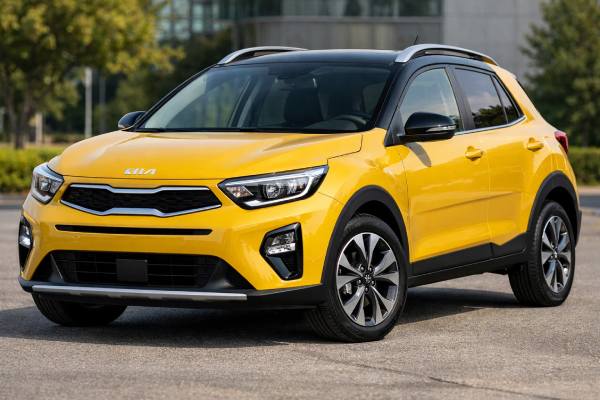
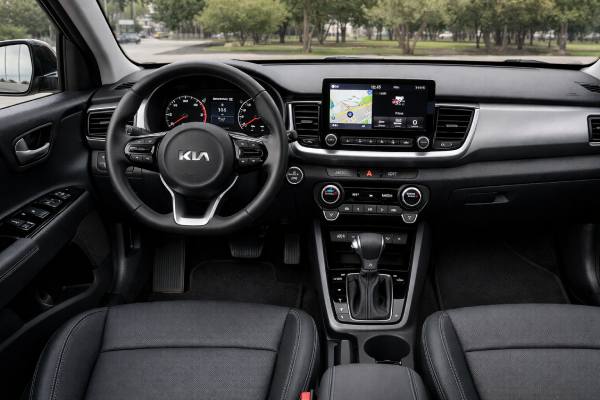
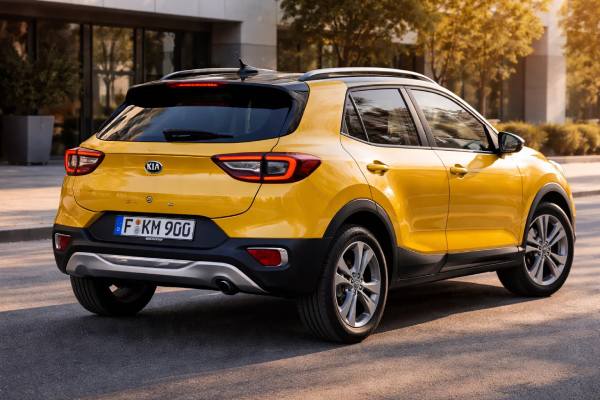
The facelift-era Kia Stonic 1.0 T-GDi is the version that makes the small crossover feel most complete. It keeps the YB platform’s tidy footprint, useful cargo space, and easy urban manners, but adds a more modern turbocharged Smartstream petrol engine and, in many markets, 48V mild-hybrid support. That makes a real difference in day-to-day driving. Compared with the older naturally aspirated petrol versions, this drivetrain gives the Stonic stronger low-end flexibility, easier overtaking, and better fuel efficiency without turning the car into a high-cost performance model. The facelift also matters because Kia improved the cabin tech and widened the availability of active safety equipment. The main caution is complexity. This is no longer the simplest Stonic to own, since direct injection, turbocharging, mild-hybrid hardware, and sometimes a dual-clutch transmission all raise the stakes if servicing is delayed. For buyers who want the most rounded modern Stonic, this is the one to understand.
What to Know
- The 1.0 T-GDi facelift feels much stronger in everyday driving than the old non-turbo petrol models.
- It keeps the Stonic’s compact size and practical 352 L boot while adding better infotainment and broader safety tech.
- Mild-hybrid support and the turbo engine help efficiency, especially in mixed and suburban use.
- This version is more maintenance-sensitive than the old 1.4 MPi, so oil history matters.
- A sensible oil-service rhythm is every 10,000 miles or 12 months, whichever comes first.
Start here
- Kia Stonic YB Facelift Snapshot
- Kia Stonic YB 1.0 T-GDi Data
- Kia Stonic YB Grades and ADAS
- Failure Risks and Service Actions
- Maintenance Plan and Buyer Checks
- Real-World Performance and Economy
- Kia Stonic vs Small SUV Rivals
Kia Stonic YB Facelift Snapshot
The facelift Stonic is still easy to understand once you strip away the market-by-market variation. Underneath, it remains a light B-segment crossover with front-wheel drive, compact outside dimensions, and a conventional chassis layout. It uses MacPherson struts at the front, a torsion-beam rear axle, and electric power steering. What changed in the facelift era is the drivetrain, safety equipment, and cabin technology. Kia pushed the Stonic closer to the rest of its newer small-car range by fitting the Smartstream 1.0-liter turbo petrol, broadening mild-hybrid support in many markets, and upgrading the infotainment and driver-assistance package.
For buyers searching specifically for the “120 hp” Stonic, the first important point is that the official numbers are not perfectly uniform across markets. Some current Kia market sheets list the higher-output facelift engine at around 120 PS, others at roughly 115 PS, and some show output in kilowatts rather than in metric horsepower. In real ownership terms, these cars sit in the same practical family: 998 cc, three cylinders, turbocharged, direct injection, front-wheel drive, and usually paired with either a six-speed manual or a seven-speed dual-clutch automatic, depending on the region and trim.
That matters because this version changes the Stonic’s character more than the facelift styling does. The older naturally aspirated Stonics were honest but fairly slow. The turbo facelift car finally gives the platform the sort of low- and mid-range pull that suits a small crossover. It still is not a fast car, but it feels far less strained in normal overtaking and hill work. In the real world, that is the difference between a car that feels merely acceptable and one that feels correctly matched to its role.
The second big change is equipment. The facelift-era Stonic is usually easier to recommend because it can bring a much better spread of active safety systems, improved multimedia, and more polished trim. At the same time, it is no longer the simplest Stonic to own. The older 1.4 MPi appealed because it was mechanically plain. This version adds more systems that need disciplined servicing and better diagnostic care when something goes wrong.
So the facelift 1.0 T-GDi should be seen as the most rounded modern Stonic rather than the cheapest-risk Stonic. If you want easier torque delivery, better technology, and a more current feel, it is the right one. If you value the least complicated long-term ownership above everything else, the older naturally aspirated model still has an argument.
Kia Stonic YB 1.0 T-GDi Data
The smartest way to read the facelift Stonic’s technical data is to treat it as a family of closely related market variants rather than one single global specification. The higher-output 1.0 T-GDi versions share the same basic engineering theme, but exact numbers can move a little depending on region, wheel size, gearbox, and emissions calibration.
| Powertrain and efficiency | Facelift Kia Stonic YB 1.0 T-GDi high-output |
|---|---|
| Code | Smartstream 1.0 T-GDi 48V mild-hybrid family |
| Engine layout and cylinders | Inline-3, DOHC, 4 valves per cylinder, 71.0 × 84.0 mm (2.80 × 3.31 in) |
| Displacement | 1.0 L (998 cc) |
| Induction | Turbocharged |
| Fuel system | Direct injection |
| Compression ratio | About 10.5:1 to 11.5:1 depending on market data |
| Max power | 115–120 PS (84.6–88 kW) @ 6,000 rpm |
| Max torque | 172 Nm (127 lb-ft) manual; up to 200 Nm (148 lb-ft) DCT in some versions |
| Timing drive | Chain |
| Rated efficiency | About 5.0–5.7 L/100 km (47.1–40.2 mpg US / 56.5–49.6 mpg UK) combined |
| Real-world highway @ 120 km/h | Usually about 6.0–6.7 L/100 km |
| Transmission and driveline | Facelift Kia Stonic YB |
|---|---|
| Transmission | 6-speed manual or 7-speed dual-clutch automatic |
| Drive type | FWD |
| Differential | Open |
| Chassis and dimensions | Facelift Kia Stonic YB |
|---|---|
| Suspension (front/rear) | MacPherson strut / coupled torsion beam axle |
| Steering | Electric power steering; turning circle about 10.4 m (34.1 ft) |
| Brakes | 280 mm ventilated front discs (11.0 in), 262 mm rear discs (10.3 in) |
| Wheels/Tyres | 195/55 R16 or 205/55 R17 most common |
| Ground clearance | About 165–183 mm (6.5–7.2 in), wheel dependent |
| Length / Width / Height | About 4,165–4,175 / 1,760 / 1,500–1,520 mm (164.0–164.4 / 69.3 / 59.1–59.8 in) |
| Wheelbase | 2,580 mm (101.6 in) |
| Kerb weight | About 1,225–1,270 kg (2,701–2,778 lb) |
| GVWR | About 1,680–1,710 kg (3,704–3,770 lb) |
| Fuel tank | 45 L (11.9 US gal / 9.9 UK gal) |
| Cargo volume | 352 / 1,155 L (12.4 / 40.8 ft³), VDA |
| Performance and capability | Facelift Kia Stonic YB |
|---|---|
| 0–100 km/h | About 10.4–10.8 s |
| Top speed | About 182–185 km/h (113–115 mph) |
| Braking distance | Not clearly published in the open factory material reviewed |
| Towing capacity | About 900 kg braked / 450 kg unbraked (1,984 / 992 lb) |
| Payload | Roughly 440–445 kg (970–981 lb), trim dependent |
| Fluids and service capacities | Facelift Kia Stonic YB |
|---|---|
| Engine oil | API SN Plus, 0W-20 in current Kia UK guidance; about 3.6 L (3.8 US qt) |
| Coolant | VIN-specific public fill data not consistently published across markets |
| Transmission/ATF | Verify by VIN and gearbox code |
| Differential / Transfer case | Not applicable |
| A/C refrigerant | Verify from under-bonnet label or workshop data |
| A/C compressor oil | Verify from workshop data |
| Key torque specs | Public open factory sources are limited; confirm wheel and chassis torques from the market-specific manual |
| Safety and driver assistance | Facelift Kia Stonic YB |
|---|---|
| Crash ratings | Euro NCAP 3 stars; Adult 85%, Child 84%, VRU 62%, Safety Assist 25% |
| IIHS / headlight rating | Not applicable |
| ADAS suite | AEB, lane keeping, lane following, driver-attention warning widely available; blind-spot support, rear cross-traffic support, and smart cruise depend on trim and market |
The most useful reading of these figures is practical. The facelift 1.0 T-GDi is not a high-performance crossover, but it delivers enough torque and enough efficiency to make the Stonic feel well judged. Its appeal lies in balance: modest size, useful luggage space, and genuinely better drivability than the simplest petrol versions.
Kia Stonic YB Grades and ADAS
One of the easiest ways to misunderstand the facelift Stonic is to assume all trims follow the same logic everywhere. They do not. Depending on the country, the same car may be sold in trim families such as Core, Vision, Spirit, GT-Line, Urban, Style, Sport, or S, each with a slightly different mix of wheels, safety systems, climate controls, and convenience equipment. That means a trim badge alone does not tell you enough. For buyers, the more useful method is to decode the car by its actual hardware.
Lower and mid-spec versions usually show the same general pattern. They tend to run on 16-inch wheels, use simpler seat trim, and keep the cabin layout more basic. Better-equipped versions often add 17-inch wheels, upgraded lighting details, more decorative trim, richer seat materials, and a stronger spread of parking and driver-assistance systems. GT-Line style models generally look the most distinctive, with sharper exterior trim and a more heavily styled cabin.
Mechanically, however, the facelift Stonic range is still fairly straightforward. The biggest differences are usually wheel size, tyre choice, gearbox availability, and ADAS content rather than major chassis changes. That is good news for ownership because it means the platform stays predictable. But it also means you need to buy the right equipment package the first time, because some of the most useful safety features do not appear on every version.
This is especially important because the facelift Stonic’s safety story is stronger in real life than the old headline rating suggests. The published Euro NCAP result still reflects the earlier Stonic test context and standard-equipment fitment, not the full potential of better-equipped facelift cars. In current-market form, many facelift Stonics can include:
- autonomous emergency braking,
- lane keeping assist,
- lane following assist,
- driver attention warning,
- speed-limit assistance,
- blind-spot monitoring or collision avoidance,
- rear cross-traffic warning or avoidance,
- parking camera and sensors,
- and, in some trims, smart cruise control.
That means two facelift Stonics with the same engine can differ quite a lot in daily safety value. A lightly equipped car may still feel basic. A well-specified one can feel genuinely modern.
There is one ownership catch. The more camera- and sensor-dependent the car becomes, the more important proper repair work becomes too. If the car has camera-based lane systems or front-collision support, ask whether any windscreen replacement was followed by calibration. If the nose has been repaired after even a modest parking impact, ask the same question. These systems are useful, but only if they still align correctly.
So the best facelift Stonic is not just the one with the right engine. It is the one with the right safety equipment, the right tyres, and the paperwork to prove those systems were maintained properly.
Failure Risks and Service Actions
The facelift 1.0 T-GDi does not yet have a long public reliability history in the same way the older Stonic versions do, simply because the 2023-on cars are still relatively new. That means the clearest way to judge it is by hardware and by known small turbo petrol behavior rather than by waiting for years of open long-term data.
The core reliability picture is mixed in a sensible way. The engine is modern, efficient, and well suited to the car, but it is also more demanding than the older naturally aspirated petrol. It uses direct injection, turbocharging, and in many cases a 48V mild-hybrid system. Some cars also add the seven-speed dual-clutch transmission. None of those systems is automatically a problem, but each one raises the cost of careless maintenance.
The watchpoints break down like this.
Common, low to medium cost
- Weak 12 V battery support or inconsistent stop-start behavior, especially on short-trip cars.
- Brake corrosion or uneven rear brake wear on lightly used cars.
- Software-related infotainment annoyances or warning-light glitches that need an update or reset rather than a hardware repair.
Occasional, medium cost
- DCT hesitation, shudder, or awkward crawling behavior in traffic if the gearbox has been used hard or allowed to overheat repeatedly.
- Ignition-related misfire under load from tired plugs or coil problems.
- Sensor or camera issues after windscreen replacement or minor front-end repair.
Longer-term higher-risk items
- Intake valve deposit build-up, because direct injection does not wash the backs of the valves with fuel.
- Timing-chain complaints if the engine has been run on poor oil or stretched service intervals.
- Turbocharger or boost-control issues if oil quality has been neglected or the engine has been heat-cycled hard without proper servicing.
The timing drive is a chain rather than a belt, which helps service planning, but “chain” does not mean “ignore it forever.” Cold-start rattle, timing-correlation faults, or a history of overdue oil changes matter more than age alone. On small turbocharged engines, clean oil is part of timing-system care.
The DCT deserves the same practical thinking. When healthy, it matches the engine well and makes the Stonic feel more modern. But it responds best to smooth use. Buyers should test for awkward clutch take-up, jerky reversing, or repeated shudder in stop-start traffic.
As for recalls and service actions, the right approach is VIN-based rather than rumor-based. Campaigns can vary by country, build date, and equipment. Before buying, ask for:
- full service history,
- proof of completed recall or field-service actions,
- battery test results if available,
- confirmation of any ADAS calibration after glass or front-end work,
- and evidence that oil changes were done on time, not simply “recently.”
For now, the facelift Stonic looks promising rather than troubled. But it is a car that rewards disciplined maintenance and punishes vague records faster than the older simple petrol Stonics do.
Maintenance Plan and Buyer Checks
The facelift Stonic 1.0 T-GDi is the kind of engine that responds well to preventive care. The published service rhythm commonly associated with this drivetrain is 10,000 miles or 12 months, whichever comes first, and that is the right baseline to follow. On short-trip, cold-climate, or mostly urban cars, it is wise to be more conservative rather than less. Small turbo petrol engines do not usually fail because owners changed the oil too often.
| Maintenance item | Practical interval |
|---|---|
| Engine oil and filter | Every 10,000 miles / 16,000 km or 12 months max |
| Engine air filter | Inspect every service; replace around 30,000–45,000 km |
| Cabin air filter | Every 12 months or about 15,000–20,000 km |
| Spark plugs | Inspect by 45,000–60,000 km; replace per VIN-specific schedule |
| Coolant | Check level and condition at each service; replace by official VIN schedule |
| Brake fluid | Every 2 years is a strong real-world target |
| Manual gearbox oil | Inspect for leaks at service visits; refresh by condition or VIN schedule |
| DCT service | Follow gearbox-specific workshop guidance; monitor behavior every service |
| Brake pads and discs | Inspect every service |
| Tyre rotation | About every 10,000 km |
| Alignment check | Yearly, and after pothole strikes or uneven tyre wear |
| 12 V battery test | Start annual testing from year 3 onward |
| Timing chain | No fixed belt-style interval; inspect when noisy or if timing faults appear |
| Auxiliary belt and hoses | Inspect every service |
The most useful decision-making specifications are the ones owners can act on:
- engine oil fill is about 3.6 L,
- current open Kia guidance lists API SN Plus 0W-20,
- brake fluid should be DOT 4,
- the engine uses a timing chain,
- and the rest of the fluid details should be confirmed by VIN because exact gearbox and market combinations vary.
The buyer’s inspection checklist should focus on the systems that matter most to long-term cost:
- Start the engine cold and listen for rattle, rough idle, or warning lights.
- Test the gearbox in slow traffic, parking maneuvers, and hill starts.
- Check tyre condition and whether all four tyres match.
- Inspect the rear brakes for corrosion and uneven wear.
- Test the camera, sensors, lane systems, and cluster warnings.
- Ask whether the windscreen has been replaced and whether calibration followed.
- Read the service records for intervals, not just dealer stamps.
- Look under the front bumper and undertrays for damage that may hint at past impact work.
The best facelift Stonic to buy is usually not the highest trim at any cost. It is the cleanest, best-documented one with the right safety equipment and a consistent oil-service history. Long-term durability looks good if the car is maintained on time. If it is not, the extra hardware that makes it attractive can also make it expensive.
Real-World Performance and Economy
The facelift 1.0 T-GDi is the version of the Stonic that finally feels properly matched to the body. It is not quick in a sporty sense, but it has enough mid-range torque to make daily driving easier and more relaxed than in the old non-turbo petrol cars. Official numbers vary a little by market and gearbox, but the high-output facelift versions usually reach 100 km/h in roughly 10.4 to 10.8 seconds and top out in the low-180 km/h range. That places the Stonic in a sensible middle ground for the class.
What matters more than the raw numbers is the way the drivetrain behaves. The turbocharged three-cylinder gives a stronger shove from low and medium revs than the older naturally aspirated engine, so the car no longer feels as if every overtake needs a full plan. The manual version remains a good fit if you want simpler ownership and a little more involvement. The DCT is often the nicer match for the crossover brief because it keeps the engine on boost more easily and makes commuting more relaxed. The downside is that it does not like being abused at crawling speeds.
In terms of ride and handling, the Stonic remains conventional in a good way. It is easy to place, stable on the motorway, and nimble in town. The steering is clean and light rather than deeply communicative, and the small turning circle helps in tight parking. Ride quality depends heavily on wheels. The 16-inch setup usually gives the best balance of compliance and steering precision. The 17-inch option improves the look but adds a little more impact harshness and tyre noise on broken surfaces.
Real-world fuel economy is one of the facelift engine’s strongest points. A realistic picture looks like this:
- city: about 6.8–7.8 L/100 km,
- steady highway: about 5.7–6.3 L/100 km,
- 120 km/h motorway use: about 6.0–6.7 L/100 km,
- mixed use: about 5.8–6.8 L/100 km.
These are useful numbers because they show the engine’s main advantage. The facelift 1.0 T-GDi is not only quicker than the old simple petrol Stonics. It is also more efficient when used properly. The mild-hybrid support helps in traffic and repeated light-throttle use, though the gains are more noticeable in mixed driving than in sustained fast motorway work.
Towing capacity is modest, so this is still a lifestyle crossover rather than a serious tow car. Under load, it remains competent but not effortless. That said, for commuting, family errands, and normal intercity travel, the facelift 1.0 T-GDi gives the Stonic the kind of drivability it always needed.
Kia Stonic vs Small SUV Rivals
The facelift Stonic’s place in the small-SUV class is easier to define than to advertise. It is not the most premium-feeling car here, not the roomiest, and not the sharpest to drive. What it does well is deliver a compact, easy-to-live-with package that feels modern enough in the areas owners actually notice: torque, visibility, technology, and daily operating cost.
Against a Volkswagen T-Cross 1.0 TSI, the Stonic often gives away some interior richness and rear-seat flexibility, but it usually fights back with simpler packaging and strong value when specified well. Against a Renault Captur TCe, the Kia can feel a little less polished inside, yet often easier to judge as a used buy because the layout is straightforward and the feature logic is clearer. Against a Peugeot 2008 1.2 PureTech, the Stonic loses some design drama and showroom flair, but many buyers will prefer its more conservative, less theatrical personality.
The closest comparison is often the Hyundai Bayon, which shares much of the same engineering philosophy. The Bayon leans harder into practicality and interior space, while the Stonic feels slightly tidier, a little more style-led, and sometimes more appealing if you want a small crossover that still behaves like a compact hatchback underneath.
Where the facelift Stonic really earns its place is as a balanced buy. It gives you:
- enough performance to feel current,
- enough efficiency to stay sensible,
- enough safety tech to remain competitive,
- and enough practicality to work as a family second car or main urban car.
It does not dominate any single category, but that is part of its strength. A well-equipped facelift Stonic with the higher-output turbo engine is often a better ownership proposition than a flashier rival with weaker safety equipment, a less convincing service record, or a powertrain you trust less. The key is specification. A good Stonic is genuinely easy to recommend. A badly specified one loses much of the point.
So who should choose it? The best fit is the buyer who wants a compact crossover that feels modern and efficient without becoming oversized or overcomplicated. The facelift 1.0 T-GDi version is the Stonic that best meets that brief, provided the service history is strong and the safety equipment is confirmed car by car.
References
- Stonic – Kia 2026 (Brochure and features)
- Der Kia Stonic. 2026 (Price list and technical data)
- Stonic – Kia 2024 (Price list and technical data)
- Official Kia Stonic safety rating 2017 (Safety Rating)
- Engine Oil Grades and Capacities 2023 (Service Guide)
Disclaimer
This article is for informational purposes only and is not a substitute for professional diagnosis, repair, or VIN-specific service guidance. Specifications, torque values, service intervals, procedures, software status, and equipment can vary by VIN, market, trim, and production date, so always verify details against the official owner documentation, workshop information, and dealer records for the exact vehicle.
If this guide was useful, please consider sharing it on Facebook, X/Twitter, or another platform to support our work.