
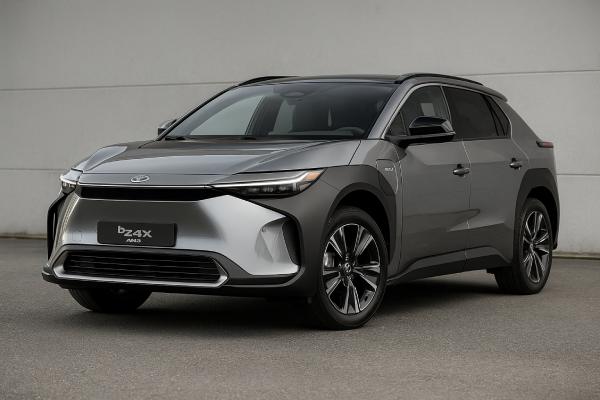
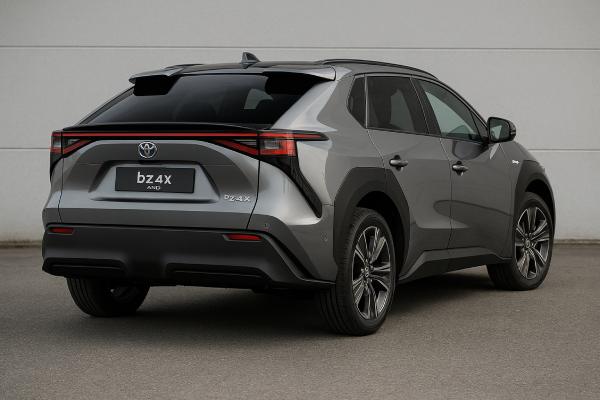
The Toyota bZ4X AWD (YEAM15) pairs two BluE Nexus 1YM eAxles with a 72.8-kWh lithium-ion pack to deliver 214 hp (160 kW), confident all-weather traction, and the kind of quiet, low-maintenance ownership experience many EV shoppers want. In North America, the dual-motor bZ4X is offered mainly as XLE and Limited trims; range varies by wheel package, and the AWD battery’s DC charging peak is lower than the FWD version. Ride quality is supple, noise isolation is good for the class, and the X-MODE traction logic borrowed from the Toyota/Subaru collaboration gives this compact SUV useful grip on snow and dirt. Owners care just as much about peace-of-mind: core active-safety tech comes standard, crash scores are strong, and Toyota’s conservative thermal management has favored battery longevity over headline-grabbing charge rates. Below you’ll find the details that matter—specs you can actually use, common ownership issues, service and fluids, real-world efficiency, and how it stacks up to key rivals—so you can decide if this specific AWD bZ4X fits your commute, climate, and budget.
Fast Facts
- Dual 1YM eAxles (front/rear 80 kW each), combined 214 hp (160 kW); X-MODE snow/mud traction modes.
- Real-world comfort bias: calm steering, compliant ride, low cabin noise; stable in crosswinds.
- Active safety standard; strong crash results. AWD DC fast-charge peak (~100 kW) is modest vs rivals.
- Typical tire rotation every 5,000–7,500 mi (8,000–12,000 km); cabin filter ~20,000–30,000 mi (32,000–48,000 km) or 2 years.
Explore the sections
- bZ4X AWD YEAM15 Overview
- bZ4X AWD Specs and Technical Data
- bZ4X AWD Trims, Options, Safety
- Reliability, Issues and Service Actions
- Maintenance and Buyer’s Guide
- Driving and Real-World Performance
- bZ4X vs Key Rivals
bZ4X AWD YEAM15 Overview
The AWD bZ4X (internal code YEAM15) is the dual-motor variant of Toyota’s compact e-TNGA-platform EV, using a pair of BluE Nexus 1YM eAxles—one at each axle—for through-the-road all-wheel drive. Each eAxle integrates motor, reduction gear, and inverter, simplifying packaging and reducing driveline losses. Output is 80 kW front + 80 kW rear, for a combined 160 kW (214 hp). A traction-focused X-MODE program (Snow/Dirt and Snow/Mud) coordinates the motors with brake-based torque control for low-μ surfaces.
For North America, the AWD pack is a lithium-ion battery designed for conservative thermal behavior and consistent performance. EPA-rated range depends mainly on wheel/tire package: the XLE AWD on 18-inch wheels sits higher, while Limited AWD on 20s trades some efficiency for looks and grip. The AWD hardware adds mass but improves step-off traction and wet/snow stability without the driveline drag of a mechanical prop shaft or transfer case.
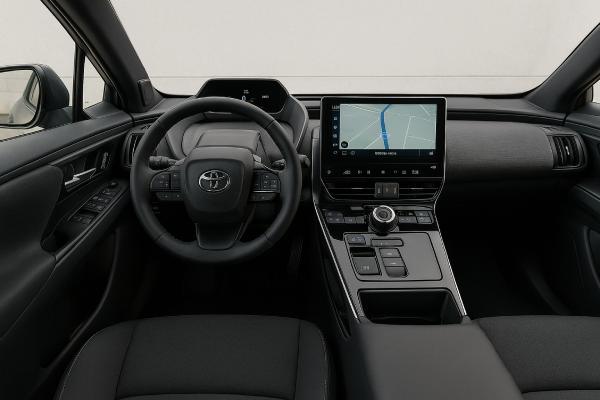
Inside, the seating position is SUV-upright with generous legroom for the class; cargo space is competitive and the flat floor helps rear passenger comfort. The interface is Toyota-familiar: straightforward physical controls for core functions and a learning-curve-light infotainment system with OTA update capability. A heat pump and heated surfaces reduce winter range hits in cold climates. Sound insulation is effective at suburban speeds; at highway speeds on coarse asphalt, tire roar is the dominant noise, especially on the 20-inch Limited.
The AWD’s headline compromise is DC fast-charging speed. Peak power is lower than many classmates, and the curve tapers conservatively. For road-trippers frequently hopping 150–250 miles between chargers, that matters. For commuters charging mostly at home Level 2, the difference recedes—especially given Toyota’s reputation for robust thermal strategies and low-drama ownership. If you prioritize all-weather stability, predictable range, and long-term durability over drag-race sprints and ultra-fast charging, the YEAM15 AWD calibration aligns with that brief.
bZ4X AWD Specs and Technical Data
Below are scannable, model-correct tables for the dual-motor AWD (YEAM15) sold in North America during 2022–2025. Values vary slightly by trim/wheel and model year updates; ranges show the bookends buyers are likely to encounter.
Powertrain and Efficiency (EV)
| Item | Detail |
|---|---|
| Code | YEAM15 (dual-motor AWD) |
| Motors | AC permanent-magnet synchronous (PMSM), BluE Nexus 1YM front + 1YM rear |
| System output | 214 hp (160 kW) combined |
| System torque | ~336 Nm (248 lb-ft) combined (front/rear 124 lb-ft typical per axle) |
| System voltage | ~355 V nominal |
| Battery | Lithium-ion, estimated 72.8 kWh gross (AWD pack) |
| Battery thermal | Liquid-cooled; heat-pump HVAC integrates with battery conditioning |
| Rated efficiency (combined) | ~20.1–20.5 kWh/100 km (≈ 32.4–33.0 kWh/100 mi) |
| Rated range (combined) | 357–367 km (222–228 mi), trim/wheel dependent |
| Real-world highway @ 120 km/h (75 mph) | Typical consumption 21–24 kWh/100 km (340–390 Wh/mi) in mild temps; expect 10–25% winter penalty depending on HVAC use |
| Aerodynamics | Cd ≈ 0.28–0.29 (trim and wheel dependent); frontal area ~2.6 m² (est.) |
Notes: Rated figures reflect EPA combined for the AWD variant on 18- vs 20-inch wheels. Real-world consumption varies with temperature, wind, topography, load, and tires.
Charging (AC/DC) and Driveline
| Item | Detail |
|---|---|
| Drive type | Through-the-road AWD (dual eAxles), brake-based torque vectoring |
| Traction modes | X-MODE Snow/Dirt; Snow/Mud; downhill assist |
| Onboard AC charger | 6.6 kW (2023); 7.6 kW (2024–2025) Level 2 |
| DC fast-charge peak | ~100 kW (AWD); higher on FWD variants |
| Typical replenishment | DC 10–80% ≈ ~60 min (AWD), temperature-dependent; AC 0–100% ≈ 9.5–12 h at 240 V / 32–40 A |
| Charge port | SAE J1772 (AC) + CCS1 (DC) combo |
Chassis and Dimensions
| Item | Detail |
|---|---|
| Platform | e-TNGA |
| Suspension (F/R) | MacPherson strut / multi-link, both with stabilizer bars |
| Steering | Electric rack-and-pinion (EPS), overall ratio ~14.1:1; ~2.8 turns lock-to-lock |
| Brakes (F/R) | Ventilated disc / ventilated disc; front diameter ~328 mm (12.9 in) |
| Wheels/Tires | XLE AWD: 18×7.5 in, 235/60R18; Limited AWD: 20×7.5 in, 235/50R20 |
| Length / Width / Height | 4690 / 1860 / 1650 mm (184.6 / 73.2 / 65.0 in) |
| Wheelbase | 2850 mm (112.2 in) |
| Turning circle | ~12.2 m (40.0 ft) curb-to-curb |
| Cargo volume | ~785–784 L seats up (27.7–27.9 ft³), ~1600 L seats down (≈ 56–58 ft³), method varies |
Performance and Capability
| Metric | Value |
|---|---|
| 0–100 km/h (0–62 mph) | ~6.7–6.9 s (typical instrumented) |
| 0–60 mph (0–97 km/h) | ~6.5–6.6 s (manufacturer/independent tests) |
| Top speed | ~160 km/h (99 mph) |
| Braking 100–0 km/h | Class-typical; brake feel consistent; regen blends smoothly |
| Towing capacity | No factory tow rating in North America (see Buyer’s Guide for market note) |
| Roof load | Check OEM crossbar rating; typically ~75 kg (165 lb) dynamic |
Fluids and Service Capacities (EV-relevant)
| System | Spec / Notes |
|---|---|
| Engine oil | Not applicable (BEV) |
| Coolant loops | Toyota Super Long Life Coolant (pink), sealed electric-drive and battery loops; inspect level/leaks; no routine drain interval published for early years |
| Reduction gear oils | eAxles are sealed; inspect for leaks/noise; no routine change specified |
| Brake fluid | DOT 3/4 equivalent; replace on time basis (see Maintenance) |
| A/C refrigerant | HFO-1234yf; charge amount per underhood label (varies by build/options) |
| A/C compressor oil | ND-OIL Electric type; quantity per service manual |
| Key torque spec | Wheel bolt torque 140 Nm (103 lb-ft) (verify after wheel service) |
Electrical
| Item | Detail |
|---|---|
| 12 V battery | AGM 12 V (form factor varies by build), DC-DC from HV battery |
| HV battery warranty | Typical: 8 years/100,000 miles (longer in some CARB states; verify by VIN) |
| Lighting | LED headlamps; headlight performance varies by trim/option packages |
Safety and Driver Assistance
| Item | Detail |
|---|---|
| Crash ratings | Strong results across major tests; see Safety section for year/trim specifics |
| Headlight rating | Varies by trim/options; better with higher-spec lighting package |
| ADAS suite | Standard Toyota active safety: automatic emergency braking (pedestrian/cyclist), adaptive cruise, lane tracing/centering, lane departure alert with steering assist, blind-spot monitoring, rear cross-traffic alert, rear AEB; parking assist and 360° camera available |
bZ4X AWD Trims, Options, Safety
Trims and option structure (North America, 2022–2025)
Two grades cover most AWD shoppers:
- XLE AWD (18-inch wheels): Fabric seats with heat, heat-pump HVAC, heated mirrors/wiper de-icer (package), power driver seat, wireless phone integration, Toyota’s latest multimedia with OTA updates, and the full core active-safety suite. Typical EPA range is the higher of the two AWD trims due to tire efficiency. A Weather Package commonly bundles heated front seats/steering wheel and a heat pump in early builds (content migration occurs across model years).
- Limited AWD (20-inch wheels): Leather-trimmed (or SofTex) seating surfaces, ventilated fronts, panoramic camera, available Advanced Park, power liftgate, larger infotainment/audio options (JBL), and additional driver-assists depending on packages. The 20-inch fitment trims range and adds a touch more tire noise on coarse pavement.
Mechanical and functional differences by trim
AWD hardware is consistent across grades: same dual 1YM eAxles, X-MODE modes, and brake-based torque distribution. Brake hardware is the same specification; suspension tuning differences are minor and primarily due to wheel/tire. The Limited’s 20-inch package improves initial turn-in and dry grip but is more range-sensitive in cold weather.
Year-to-year highlights (AWD, 2022–2025)
- 2022 (early build): Initial U.S. allocation; subject to the wheel-hub bolt recall campaign (addressed by hardware remedy).
- 2023: Full availability; AWD DC fast-charge peak remains ~100 kW; Level-2 onboard charger ~6.6 kW.
- 2024: Adds a dual-voltage portable charging cable availability and improved battery temperature control strategies for better DC performance in cold conditions; onboard AC charger rises to ~7.6 kW. Software UX and charging-screen feedback improve.
- 2025: Running refinements continue. Equipment mixes vary and dealer-installed hardware (e.g., roof bars) carry specific ratings—verify for your VIN and package.
Quick identifiers and build codes
- VIN decoding and parts catalogs show YEAM15 for dual-motor builds; single-motor FWD is typically XEAM10.
- The AWD eAxle type is 1YM front and rear (BluE Nexus); FWD uses 1XM.
- Wheel fitment: 5×114.3 PCD; Toyota uses wheel bolts (not studs/nuts) on this model—observe torque and retorque practices after wheel service.
Safety ratings (summary)
- IIHS: The bZ4X family posts Good crashworthiness in small overlap (driver and passenger), moderate overlap, and the updated side test (builds after a specific 2022 date). Headlight ratings vary by trim and equipment; pedestrian detection ratings are strong (day and night).
- NHTSA: The model line has earned a 5-Star Overall Vehicle Score in recent tests.
As always, match the exact rating to your model year and build date; headlamp and ADAS performance can vary with packages.
Safety systems and ADAS
- Standard: Automatic emergency braking with pedestrian/cyclist detection, lane departure alert with steering assist, lane centering (Lane Tracing Assist), adaptive cruise control, road sign assist, blind-spot monitoring with rear cross-traffic alert, rear automatic braking, rear seat reminder.
- Available: Panoramic View Monitor (360°), Advanced Park (automatic steering/braking into spaces), front/rear parking sonar with auto-braking, Digital Key (availability varies by year).
Service notes: After windshield replacement or suspension/steering work, ADAS camera and radar calibration may be required. If cameras or sensors are obscured by aftermarket accessories, performance may degrade.
Reliability, Issues and Service Actions
Overall take: Power electronics, motors, and thermal systems have shown the kind of uneventful behavior Toyota aims for. The most significant early issue affecting AWD models was hardware-related and addressed by a formal recall. Software updates have improved charging behavior in cold weather.
Known issues mapped by prevalence and cost
- Wheel hub bolt loosening (2022 build window)
- Prevalence/Severity: Common in the affected VIN range; high severity due to safety risk.
- Symptom → Cause → Remedy: Wheel-hub bolts could lose clamping force → hardware tolerance/torque relaxation issue on early builds → Recall repair replaces bolts (with washers) and wheels where applicable; follow-up torque checks apply.
- Owner action: Verify recall closure by VIN and obtain dealer documentation. Retorque checks after wheel/tire service are prudent (see torque spec in Specs).
- Slow DC fast-charging vs competitors (ongoing characteristic)
- Prevalence/Severity: Universal to AWD pack; low severity for home-chargers, medium for frequent road-trippers.
- Symptom → Cause → Remedy: Longer 10–80% times → conservative charge curve and lower AWD pack peak → firmware refinements and better battery temperature control on later years improve consistency in cold; hardware peak remains modest.
- Owner action: Precondition battery when available, start DC sessions at lower SOC in cold, and prefer reliable high-power sites to minimize taper.
- Cold-weather range sensitivity (EV-typical)
- Prevalence/Severity: Common to all EVs; medium owner impact in sub-freezing climates.
- Symptom → Cause → Remedy: Range drops in winter → HVAC/defrost loads; battery chemistry → use heat-pump, seat/steering heat, pre-condition while plugged in; keep tires at spec pressures; employ Eco drive mode in stop-and-go.
- 12-V battery complaints (occasional)
- Prevalence/Severity: Occasional; low to medium cost.
- Symptom → Cause → Remedy: No-start due to low 12-V state → short-trip use or parasitic draw during software updates → charge/test 12-V annually; replace within typical 4–6-year window with correct AGM form factor.
- Brake hardware corrosion in road-salt regions (occasional, EV-typical)
- Prevalence/Severity: Occasional; low to medium cost.
- Symptom → Cause → Remedy: Pulsation/drag after storage → infrequent hydraulic use due to regenerative braking → annual brake service/clean & lube in salt climates; flush fluid on time and ensure caliper slide freedom.
Powertrain electronics and battery health
- Toyota’s calibration favors longevity. In mixed-climate commuter use and proper charging habits (avoid persistent 100% parking; keep SOC mid-band for storage), degradation rates have been modest by class norms.
- For pre-purchase inspections, request an HV Battery State-of-Health report (dealer scan or third-party tools) and check for any BMS software updates applied.
Recalls, TSBs, and warranty extensions (high-level)
- Wheel hub bolt recall (2022): Safety campaign to replace hardware; “Do Not Drive” advisories were issued until remedy completion.
- Software/charging updates (2023–2024): Periodic calibrations for battery temperature control and charge-screen UI.
How to verify completion: Run the official VIN check and ask the selling dealer for the campaign printout; ensure recall, campaigns, and any extended coverage are closed. Keep paperwork with the vehicle records.
Pre-purchase checklist (AWD)
- Confirm: recall closure; full service history; tire date codes and even wear (AWD), brake service health, cabin filter condition, 12-V battery test, any ADAS calibrations after glass/suspension work.
- Road test: check straight-line tracking, low-speed creaks over diagonal bumps (bushing noise), HVAC/heat-pump effectiveness, and DC charging behavior if you have access to a fast charger.
Maintenance and Buyer’s Guide
Practical maintenance schedule (distance/time), AWD bZ4X (YEAM15)
(Intervals shown are typical; always verify by VIN and local service documentation.)
- Tires & alignment: Rotate every 5,000–7,500 mi (8,000–12,000 km) or at oil-change-like cadence; faster if you run square-shoulder EV tires. Check alignment yearly or after pothole hits—AWD sensitivity to staggered wear can grow energy use and noise quickly.
- Brake fluid: Replace every 2–3 years regardless of mileage. Hygroscopic fluid + EV regen means moisture can sit in lines.
- Friction brakes: Inspect every 12 months/12,000 mi (20,000 km). In salt regions, add a clean & lube service to prevent sticky slides; replace pads/rotors as needed.
- Cabin air filter: Replace 20,000–30,000 mi (32,000–48,000 km) or 24 months; sooner if HVAC flow drops or you drive dusty/pollen-heavy routes.
- HVAC desiccant & A/C service: Leak check at any visit; refrigerant is R-1234yf; charge/ND-OIL Electric quantities by label.
- Coolant (battery/drive-unit loops): Inspect for level and leaks at each service; replacement intervals vary by publication and may not be listed for early years—follow official guidance when service access is opened for other repairs.
- 12-V battery: Test yearly after year 3; typical replacement window 4–6 years.
- Driveline fluids (eAxles): Sealed units; no routine change specified; inspect for leaks, noise, or vibration.
- Body/chassis: Wash underbody after winters; treat chips early; check door seals for wind noise.
Fluids and values to know (decision-making)
- Brake fluid: DOT 3/4; torque for wheel bolts 140 Nm (103 lb-ft)—recheck after wheel service.
- Tire pressures: adhere to the door-jamb label; monitor more closely in winter (pressure drop vs temp).
- Jack/lift points: Follow manual diagrams; avoid battery tray intrusion—use puck adapters when required by your lift.
Buyer’s Guide—what to seek/avoid
- Seek:
- XLE AWD on 18-inch wheels if you value range and winter tire flexibility.
- Builds with updated battery temperature control (2024+) if you DC fast-charge often in cold climates.
- Vehicles with complete recall proof and a recent HV battery health report.
- Consider carefully:
- Limited AWD on 20-inch wheels if you face rough, noisy asphalt or long winter commutes—the ride/noise/range trade is real.
- High-mileage DC fast-charge road-tripper cars in persistent cold regions unless charging history is known and battery health confirmed.
- Avoid:
- Any car without documented wheel-hub recall completion.
- Vehicles showing uneven AWD tire wear (can hint at alignment or bushing issues).
Durability outlook
Toyota’s conservative thermal and charging strategy, proven e-axle suppliers, and straightforward chassis bodes well for long-term durability. Expect low routine service costs; watch tires (EV torque + AWD scrubs shoulders) and stay ahead of brake maintenance in salty climates.
Driving and Real-World Performance
Ride, handling, NVH
The bZ4X AWD favors comfort without feeling aloof. The steering is light at parking speeds and gains reassuring effort on-center. Body motions are well-controlled over expansion joints and broken pavement; the extra unsprung mass of the 20-inch package is noticeable but not punishing. At 65–75 mph (105–120 km/h), wind and motor noise are subdued; on coarse aggregate the 20-inch Limited transmits more tire roar than the 18-inch XLE. Crosswind stability is solid thanks to the battery’s low mounting and long wheelbase.
Powertrain character
Step-off is crisp in Normal mode, with linear pedal mapping and predictable regen blending into hydraulic braking. Sport mode sharpens initial response. Passing power from 50–80 mph (80–129 km/h) is adequate for the class; the AWD’s immediate torque masks the modest horsepower on urban merges. Regeneration is tuned for smoothness rather than aggressive one-pedal; you’ll typically ease into the brake pedal near the last 10–15 km/h (6–9 mph).
Real-world efficiency and range
In mixed suburban use in mild temperatures, owners often see consumption near the EPA combined band. At steady 120 km/h (75 mph), plan for ~10–20% lower range than the combined rating, more in headwinds or downpours. In deep winter, the heat-pump’s efficiency and seat/steering heaters help, but preconditioning while plugged in remains your best tool. Wheel choice matters: the 18-inch setup is the easiest path to meeting or beating the rated numbers.
Charging performance
- AC Level 2: Expect full charges overnight on a 40-amp circuit (7.6 kW onboard on later years), or by lunchtime at workplaces with 30–32-amp EVSEs.
- DC fast charging: The AWD pack’s ~100 kW peak means longer sessions than many rivals. The bZ4X is happiest when you arrive with the pack warm (after highway driving or after preconditioning) and plug in around 10–20% SOC. In cold weather, targeting 10–60% hops can be more time-efficient than trying to push to 80–90% in one go.
Traction and control
X-MODE programming is savvy in snow and loose surfaces, using fine motor torque control plus brake nips to keep the vehicle tracking. Hill-descent control is unobtrusive and effective on slippery declines. All-season OE tires limit ultimate snow grip; winter tires transform confidence, especially on the 18-inch wheels.
Load and towing
In North America, the bZ4X is not factory-rated to tow, so stability and thermal limits under trailer loads haven’t been validated locally. Roof systems are available with specific dynamic load ratings; mind cross-wind sensitivity with large rooftop boxes and expect a modest efficiency hit at highway speeds.
bZ4X vs Key Rivals
Hyundai Ioniq 5 AWD
- Strengths: 800-V architecture enables very fast DC charging; punchier acceleration; lounge-like interior.
- bZ4X advantage: Softer ride tuning, cabin quietness on 18-inch tires, conservative thermal strategy likely to aid long-term battery health, and Toyota dealer network breadth.
Kia EV6 AWD
- Strengths: Sportier chassis tuning; strong charging curve; broad trim ladder.
- bZ4X advantage: Friendlier ride/noise balance in daily driving; straightforward controls; traction logic that shines in snow with X-MODE.
Volkswagen ID.4 AWD
- Strengths: Spacious cabin, competitive pricing when incentives stack, decent DC speeds after updates.
- bZ4X advantage: Simpler, more consistent infotainment/controls; Toyota reliability perception; calm steering feel.
Tesla Model Y Long Range AWD
- Strengths: Best-in-class charging ecosystem; strong efficiency and performance; rich software features.
- bZ4X advantage: Softer ride, traditional control ergonomics, and owners who prefer legacy-brand service models. If your charging is mostly at home, the AWD bZ4X’s slower DC peak becomes less relevant.
Nissan Ariya e-4ORCE
- Strengths: Polished cabin; very smooth dual-motor torque control; competitive winter manners.
- bZ4X advantage: Better service network breadth in many regions; slightly gentler ride tuning; often sharper pricing on the XLE AWD vs Ariya’s well-equipped trims.
Bottom line: If your usage skews toward home charging, snow traction, and day-to-day comfort, the bZ4X AWD is a quietly effective choice. If you live on DC fast chargers or do frequent 500-mile days, consider competitors with faster curves—or look at FWD bZ4X builds with higher DC peaks if AWD isn’t essential.
References
- 2024 Toyota bZ4X – Engineered for Electrifying Exhilaration 2024 (Manufacturer)
- 2023 Toyota bZ4X 2025 (Safety Rating)
- Alternative Fuels Data Center: Vehicle Search 2023 (Official Data)
- Part 573 Safety Recall Report 22V-444 2022 (Recall Database)
- Torque Values for Alloy Wheels / Steel Wheels / Tyre & wheel assembly / Anti-Theft wheel lock nut / bolt 2025 (Technical Reference)
Disclaimer
This guide is for informational purposes and is not a substitute for professional diagnosis or repair. Specifications, torque values, capacities, and service intervals vary by VIN, market, build date, and equipment. Always verify against your vehicle’s official owner’s manual and service documentation before performing maintenance or repairs.
If this was helpful, please consider sharing it with fellow owners on Facebook or X/Twitter to support xcar’s work.