
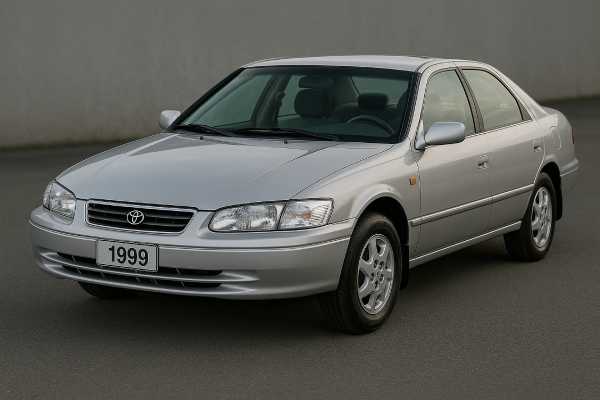
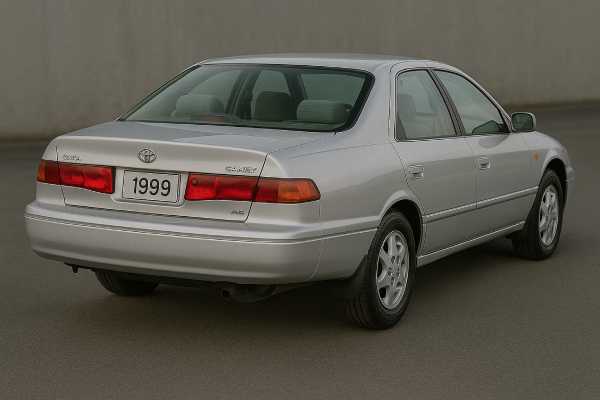
The 1999 facelift of the XV20-generation Toyota Camry with the 5S-FE 2.2-liter inline-four is the sweet spot for buyers who want simple engineering, low running costs, and long-term durability. The naturally aspirated, belt-driven DOHC four makes a modest 133 hp but delivers the kind of smooth, predictable torque and gearing that suit daily commuting and highway stints. It rides on a conservative MacPherson-strut chassis tuned for comfort first, with tidy body control and little drama. Inside, controls are straightforward, parts are plentiful, and the powertrain is known for going the distance with regular service.
The facelift brought small refinements—trim, equipment, and NVH polishing—without complicating the formula. Safety performance in its day was competitive, and basic driver aids like ABS were widely available. Ownership hinges on keeping up with timing-belt service, fluids, and a handful of age-related items (mounts, bushings, cooling plastics). If you’re shopping an honest midsize sedan with predictable costs, the SXV20 four-cylinder remains a pragmatic choice.
At a Glance
- Smooth, durable 5S-FE four-cylinder; straightforward belt-driven DOHC and easy access for routine service.
- Comfortable highway ride and low cabin fatigue; excellent parts availability and tooling support.
- Cabin and electronics are simple and robust; common wear items are inexpensive to replace.
- Watch timing-belt age/mileage and cooling-system plastics; inspect mounts and suspension bushings by 100,000 mi (160,000 km).
- Typical oil + filter interval: 5,000 mi / 6 months (8,000 km / 6 months) with API-SJ or better 5W-30.
Navigate this guide
- Camry SXV20 5S-FE overview
- SXV20 specs and tech data
- Trims, options, and safety
- Reliability and common issues
- Maintenance and buyer’s guide
- Driving and real-world performance
- How it compares to rivals
Camry SXV20 5S-FE overview
For 1999, Toyota refined the XV20-series Camry with detail updates to trim, NVH isolation, and equipment, while retaining the core mechanicals introduced for 1997. In the four-cylinder SXV20, the 5S-FE 2.2-liter aluminum-head/non-interference iron-block inline-four remains the heart of the car. Rated at 133 hp (99 kW) and roughly 200 Nm (147 lb-ft), it emphasizes drivability and low ownership cost over headline figures. The torque curve is broad for a naturally aspirated four of its era, aided by conservative cam timing and a long runner intake; around town, the car steps off cleanly without high revs, and the four-speed automatic’s wide 1st gear ratio helps in stop-and-go use.
The chassis is pure Camry: MacPherson struts at each corner, compliant springs and bushings, and geometry tuned for straight-line stability. Steering is hydraulic and light at parking speeds, with predictable weighting on the highway. Brakes are front vented discs with either rear drums (most four-cylinder trims) or rear discs on better-equipped models; ABS was widely fitted or available. Wheel/tire packages skew toward comfort and longevity: 15-inch alloys with 205/65 tyres were common, and many owners still value the tall sidewalls for ride quality and pothole tolerance.
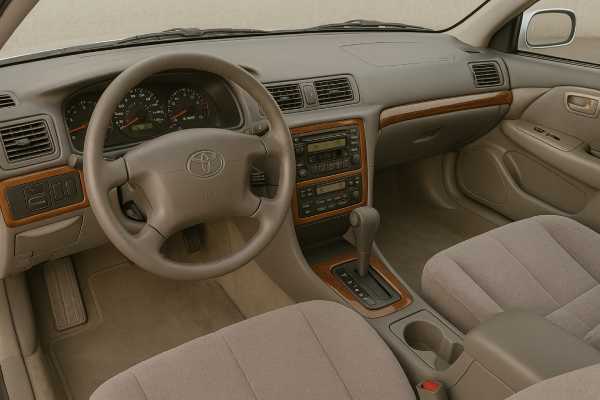
Inside, the facelift brought small improvements in materials, sound insulation, and feature availability while keeping familiar ergonomics—large rotary HVAC knobs, clear gauges, and durable switchgear. There’s excellent outward visibility, and the rear seat offers adult-friendly legroom for the class. Trunk space is generous, with a wide opening and low liftover.
From an ownership perspective, the SXV20’s appeal is repeatable reliability and predictable service—oil, belt, plugs, filters, coolant—without specialized tooling. Access to the timing belt, water pump, alternator, and accessory drives is straightforward, and parts interchange with other period Toyotas helps keep costs down. The weak points are age-related rather than design-flaw: coolant hoses and radiator end tanks (plastic), engine mounts that compress over time, and rubber suspension bushings that harden and crack. Address these proactively and the platform comfortably exceeds 200,000 miles (320,000 km).
Finally, safety performance for a late-1990s midsize sedan is solid, particularly in frontal crash tests of the period. Side-impact and modern active-safety systems weren’t yet standard in the class, so expectations should be set accordingly. If you value a car that “just works,” the 1999 four-cylinder Camry delivers exactly that with minimal fuss.
SXV20 specs and tech data
Below are baseline specifications for the 1999 facelift Camry four-cylinder (SXV20, 5S-FE), focused on North American configuration.
Engine and Performance
| Item | 5S-FE 2.2 inline-4 |
|---|---|
| Code | 5S-FE |
| Layout & valvetrain | Transverse I-4, DOHC, 16 valves (4 per cyl) |
| Displacement | 2.2 L (2,164 cc) |
| Bore × stroke | 87.1 × 90.9 mm (3.43 × 3.58 in) |
| Compression ratio | ~9.5 : 1 |
| Induction | Naturally aspirated |
| Fuel system | Multi-point port fuel injection (MPFI) |
| Max power | 133 hp (99 kW) @ ~5,200 rpm |
| Max torque | ~200 Nm (147 lb-ft) @ ~4,400 rpm |
| Timing drive | Belt (non-interference valve timing) |
| Emissions/efficiency standard | U.S. EPA era-appropriate tier |
| Rated economy (EPA window label, typical) | ~10.7 L/100 km city / 8.4 L/100 km highway (20 / 28 mpg US; 24 / 34 mpg UK) — automatic |
| Real-world highway @ 120 km/h (75 mph) | ~7.8–8.4 L/100 km (28–30 mpg US; 33–36 mpg UK), wind/topography dependent |
| Aerodynamics (typical) | Cd ~0.30–0.31; frontal area ~2.1 m² (22.6 ft²) |
Notes: Factory ratings vary slightly by trim and emissions package; the manual transmission typically improves highway consumption by ~0.5–0.7 L/100 km (1–2 mpg US).
Transmission and Driveline
| Item | Specification |
|---|---|
| Drive type | Front-wheel drive (FWD) |
| Manual transmission | 5-speed (S51) |
| Manual gear ratios | 1st 3.538 · 2nd 2.041 · 3rd 1.322 · 4th 0.972 · 5th 0.775 · Rev 3.583 |
| Manual final drive | 3.944 |
| Automatic transmission | 4-speed electronically controlled (A140E) |
| Auto gear ratios | 1st 2.810 · 2nd 1.531 · 3rd 1.000 · 4th 0.705 · Rev 2.296 |
| Auto final drive | ~3.94 |
| Differential | Open; no factory LSD |
Chassis and Dimensions
| Item | Specification |
|---|---|
| Suspension (front/rear) | MacPherson strut / MacPherson strut |
| Steering | Hydraulic rack-and-pinion; ~3.1 turns lock-to-lock |
| Brakes | Front 275 mm (10.8 in) vented discs; rear 229 mm (9.0 in) drums or ~269 mm (10.6 in) solid discs on some trims; ABS available |
| Wheels/tires (common) | 205/65 R15 on 15×6 in wheels (alloy or steel) |
| Ground clearance | ~140 mm (5.5 in) |
| Length × width × height | ~4,805 × 1,780 × 1,420 mm (189.2 × 70.1 × 55.9 in) |
| Wheelbase | 2,670 mm (105.1 in) |
| Turning circle (curb-to-curb) | ~11.1 m (36.4 ft) |
| Curb weight (typical) | ~1,385–1,410 kg (3,053–3,108 lb) |
| GVWR | ~1,910–1,950 kg (4,210–4,300 lb) |
| Fuel tank | 70 L (18.5 US gal / 15.4 UK gal) |
| Cargo volume (SAE) | ~400 L (14.1 ft³) — sedan |
Performance and Capability
| Metric | Manual | Automatic |
|---|---|---|
| 0–60 mph (0–97 km/h) | ~9.0–9.5 s | ~9.8–10.5 s |
| 0–100 km/h (0–62 mph) | ~9.5–10.0 s | ~10.5–11.0 s |
| Top speed (governed, typical) | ~190 km/h (118 mph) | ~185 km/h (115 mph) |
| Braking 100–0 km/h | ~39–42 m (128–138 ft), tyre-dependent | |
| Towing (braked) | Light-duty only; verify hitch rating; not a factory tow focus |
Fluids and Service Capacities
| Fluid | Spec (typical for 5S-FE) | Capacity* |
|---|---|---|
| Engine oil | API SJ or better, ILSAC; SAE 5W-30 preferred | ~3.7–3.9 L (3.9–4.1 qt) with filter |
| Coolant | Ethylene glycol long-life, 50/50 (Toyota Red/LLC era) | ~6.0–6.5 L (6.3–6.9 qt) |
| ATF (A140E) | Toyota ATF Type T-IV (or current supersession) | ~6–7 L (6.3–7.4 qt) total fill; drain/refill less |
| Manual trans (S51) | 75W-90 GL-4/GL-5 gear oil | ~2.0–2.2 L (2.1–2.3 qt) |
| Power steering | Dexron-type ATF (per period spec) | Fill to mark |
| Brake fluid | DOT 3 | Fill to mark |
| A/C refrigerant | R-134a | ~550–650 g (19–23 oz), model-dependent |
| A/C compressor oil | ND-OIL 8 (PAG) | ~120–150 mL (4–5 fl oz), service-dep. |
- Always verify by VIN/build and service manual.
Key torque values (typical):
- Wheel lug nuts: ~103 Nm (76 lb-ft)
- Spark plugs: ~18 Nm (13 lb-ft) on clean, dry threads (use crush-washer)
- Engine oil drain plug: ~27–30 Nm (20–22 lb-ft)
- Front caliper slider pins: ~25–35 Nm (18–26 lb-ft)
Electrical
| Item | Specification |
|---|---|
| Alternator output | ~80 A (era typical for I-4 trim) |
| 12V battery | Group size 24F/35 (varies), ~48–55 Ah; CCA per climate |
| Spark plugs | Nickel or platinum, gap ~1.1 mm (0.043 in) |
Safety and Driver Assistance
| Item | Detail |
|---|---|
| Crash ratings | Frontal crash performance rated well for the era; verify per test body and model year |
| Headlight rating | Modern headlight scoring not applied to this era |
| Airbags | Dual front; front side airbags optional late in cycle on some trims |
| ABS | Standard or optional by trim |
| Traction control | Available on select higher trims; uncommon on four-cylinder |
| Child-seat anchors | LATCH not yet standardized; uses pre-LATCH methods and top tether points where equipped |
Trims, options, and safety
Trims (typical North America, four-cylinder): CE (base), LE (volume), and XLE (premium). The four-cylinder powertrain is identical across trims; differences center on equipment and brakes.
- CE: Steel wheels, cloth, manual climate, front disc/rear drum brakes common, ABS optional.
- LE: Adds power accessories, upgraded audio, often alloy wheels and keyless; ABS more frequently fitted; rear drum or disc depending on package.
- XLE: Premium upholstery, automatic climate, more sound insulation, wood-tone trim, and commonly rear disc brakes; more convenience options.
Key option packages and identifiers:
- ABS and cruise control packages are common; look for ABS lamp self-test at key-on.
- Alloy wheels (15-inch) are a quick visual tell on LE/XLE.
- VIN/model code plate shows SXV20 for the 2.2-liter FWD; V6 cars carry MCV20.
- Rear disc brakes are visible through the wheel; drums have a solid backing plate.
- Side airbags (where fitted) add labels on seat bolsters.
Functional differences by trim/equipment:
- Brake hardware can differ (rear disc vs drum); stopping distances improve marginally with rear discs and specific pad compounds.
- Weight and tyre package influence ride and noise more than drivetrain; XLEs are slightly quieter due to extra insulation.
Safety ratings and context (model-year coverage):
- This generation achieved strong results in the period’s frontal offset testing for midsize sedans. Side and head restraint ratings common today weren’t universally conducted then.
- NHTSA star-ratings varied by configuration; if precise star values matter to you, check by year/body/airbag fitment using the official recall/rating portals.
- Headlights and active driver-assistance (AEB, ACC, lane keep) were not features of this era.
Safety systems and child-seat provisions:
- Dual front airbags standard; front side airbags were only available on later high trims and are rare on four-cylinders.
- ABS widely fitted; traction control uncommon with the 5S-FE.
- Child restraints: Pre-LATCH anchor solutions with top-tether points where equipped; ensure correct retrofit tether kits if needed.
- After service: If steering angle sensors or ABS components are disturbed (hub/bearing replacement; tone rings), perform basic calibration/checks per service manual.
Year-to-year notes (four-cylinder focus):
- 1999 facelift primarily refreshed trim, audio, and minor NVH; no major four-cyl powertrain change.
- Option bundling and ABS take-rate improved over earlier years; rear disc fitment more common on upper trims.
Reliability and common issues
The SXV20 four-cylinder’s reputation rests on a robust bottom end, conservative tuning, and simple ancillaries. Age and mileage now drive most concerns. Map the following by prevalence and severity to plan ownership.
Common / low-to-medium cost:
- Engine mounts compressed or torn (100k–150k mi / 160k–240k km):
Symptoms: Excess vibration at idle, clunks on shifts.
Cause: Rubber fatigue.
Remedy: Replace front/rear mounts as a set. Improves NVH and shifter feel. - Radiator end-tank seep / brittle hoses (10+ years):
Symptoms: Sweet coolant smell, crust at plastic-aluminum seam, low coolant.
Cause: Plastic end-tank aging and thermal cycles.
Remedy: Replace radiator and upper/lower hoses. Renew thermostat and cap if age unknown. - Valve cover gasket seep:
Symptoms: Oil film near timing cover, burning oil smell on exhaust.
Remedy: Replace gasket, inspect PCV valve and baffles. - Accessory belt squeal / idler noise:
Cause: Aged belts or bearings.
Remedy: Refresh belts and idler/tensioner bearings during timing-belt service.
Occasional / medium cost:
- Front strut mounts/bearings and control-arm bushings (100k–150k mi):
Symptoms: Knock over small bumps, alignment drift, feathered tyres.
Remedy: Strut assemblies with mounts; press-in or complete control arms with new bushings. Align after. - Rear wheel-cylinder seep (drum cars) or caliper slide seizure (disc cars):
Symptoms: Uneven rear braking, parking-brake imbalance.
Remedy: Rebuild/replace wheel cylinders; clean/grease slides; fit quality pads/shoes and hardware. - HVAC blend-door servo noise:
Symptoms: Clicking behind dash during temperature changes.
Remedy: Replace servo; recalibrate positions.
Rare / higher cost but notable:
- Head-gasket seep (high mileage, poor coolant history):
Symptoms: External seep or pressurizing coolant.
Remedy: Proper head-gasket service; deck check; renew head bolts and cooling components. Good coolant maintenance prevents most cases. - Automatic transmission wear (A140E) on neglected fluid:
Symptoms: Flare/hunt between 2-3, harsh downshifts.
Remedy: Sequential drain-and-fills with correct ATF; address throttle/kickdown cable adjustment (where applicable) and solenoids. With clean ATF and normal use, these transmissions are long-lived.
Software/calibrations (era-appropriate):
This platform predates modern over-the-air updates. Engine/TCU reflashes exist in service literature for driveability refinements but are not a central ownership theme; check dealer records if you notice idle quality or shift logic concerns.
Corrosion hotspots:
- Rear subframe mounts and brake-line runs in salted climates; lower door seams and wheel-arch lips. Underbody wash and periodic inspection go a long way.
Recalls, TSBs, extended coverage:
- Use the official VIN-based recall portals to check campaign status; this generation did not see the later, high-profile active-safety recalls affecting newer models.
- Ask for a dealer printout showing recall and TSB completion, plus any Customer Support Program notes relevant to your VIN.
Pre-purchase asks:
- Full service history, especially timing-belt (age and mileage), coolant, and transmission fluid.
- Brake and tyre dates; suspension refresh receipts.
- Charging system test results and 12V battery age.
- Proof of coolant system renewal (radiator, hoses, thermostat) within the last 5–8 years.
Maintenance and buyer’s guide
Practical maintenance schedule (distance/time = whichever comes first):
- Engine oil & filter: Every 5,000 mi / 6 months (8,000 km / 6 months) with API-SJ (or newer) 5W-30. Short-trip/cold-climate use benefits from the 5,000-mile interval.
- Engine air filter: Inspect at 15,000 mi (24,000 km); replace by 30,000 mi / 3 years or sooner in dusty service.
- Cabin (A/C) filter: If equipped, every 15,000–20,000 mi / 1–2 years.
- Spark plugs: Nickel plugs 30,000 mi / 3 years; platinum/long-life types 60,000 mi / 6 years. Gap ~1.1 mm.
- Fuel filter: External canister on some years; inspect/replace around 60,000–90,000 mi if serviceable; many are in-tank strainers—keep clean fuel and change as needed.
- Timing belt (5S-FE): Replace 60,000–90,000 mi / 6–9 years depending on documentation and climate. Do water pump, cam/crank seals (if seeping), tensioner, and idlers while you’re in there.
- Serpentine/aux belts & hoses: Inspect annually; replace 5–7 years or at first cracking/noise.
- Coolant: Long-life ethylene glycol 50/50; renew 2–3 years / 30,000–50,000 mi on older red LLC unless upgraded to later SLLC; always verify type before mixing.
- ATF (A140E): Drain-and-fill 30,000–60,000 mi depending on use; use Toyota T-IV (or current supersession). Avoid aggressive “flushes” on neglected units.
- Manual gearbox (S51): 75W-90 GL-4/GL-5 60,000–90,000 mi; check fill plug first.
- Brake fluid: DOT 3 every 2–3 years; bleed until clear.
- Brake pads/rotors: Inspect at every oil service; replace when pad thickness <3 mm or rotors below minimum.
- Power steering: Inspect annually; refresh ATF in reservoir every 60,000 mi (turkey-baster method acceptable with repeats).
- Alignment & tyre rotation: Rotate 5,000–7,500 mi; align annually or after suspension work; maintain 32–35 psi cold (check driver-door placard).
- Valve clearances: Not routinely adjustable on this engine; listen for abnormal tick—diagnose before condemning.
- 12V battery: Load test annually after year 4; typical replacement 5–7 years in temperate climates.
Fluid specs, capacities, and essential torques: see “Fluids and Service Capacities” and “Key torque values” in the Specs section above; verify by VIN.
Buyer’s checklist (what to inspect):
- Cooling system: Look for pink/green crust at radiator seams and thermostat housing; verify warm-up and stable operating temp.
- Mounts and bushings: Pry-bar test engine mounts; inspect front control-arm rear bushings and sway-bar links.
- Brakes: Even rotor faces, firm pedal, and equal park-brake hold. Rear drums should be dry; check backing plates for seep.
- Transmission: On automatics, drive from cold; watch for 2–3 shift flare and hot idle shudder. On manuals, check for synchro crunch 2nd/3rd.
- Steering: No pump groan at lock; no rack seep at boots.
- Electrical: Window regulators smooth, HVAC blower speeds working (resistor pack age can show).
- Body: Check lower door edges, arches, radiator support, and rear subframe mounts for corrosion—especially from salted-road regions.
- Paperwork: Timing-belt age/miles, coolant/ATF history, and recall/TSB completion printout.
Recommended configurations:
- LE or XLE with ABS for better resale and braking confidence.
- Manual transmission if you value slightly better economy and engagement; automatic for typical urban use and stronger resale pool.
- Avoid cars without timing-belt documentation in the last ~7–9 years unless priced to cover immediate belt, pump, and seals.
Durability outlook:
With basic maintenance, the 5S-FE routinely exceeds 200k–300k miles (320k–480k km). The weak points are modest, age-driven consumables; once refreshed, the platform resumes its low-touch character.
Driving and real-world performance
Ride and NVH: The SXV20 prioritizes calm isolation over sharp responses. Strut tuning and compliant bushings filter most joints and expansion gaps; body motions are deliberate but well-damped. On worn dampers, the car can float—fresh struts and mounts restore the intended control. Wind and road noise are low for the era, especially on LE/XLE trim with better insulation and 205/65R15 tyres at moderate pressures.
Handling and steering: Expect mild understeer and predictable breakaway; mid-corner bumps don’t upset the chassis. Steering is light and consistent—more about accuracy than “feel.” Tyres matter: a quality touring tyre significantly improves braking, wet grip, and stability without sacrificing comfort.
Braking: Front vented discs provide reliable, linear response. Rear drums are adequate for street use; rear discs add modest bite and heat capacity. ABS interventions are smooth. If the pedal feels long, flush old DOT 3 fluid and ensure rear adjusters are functioning.
Powertrain character: The 5S-FE’s appeal is in its smoothness and tractability rather than urgency. Throttle response is clean, with best pull in the mid-range. The four-speed automatic’s logic is conservative; it upshifts early in light throttle and avoids hunting if the throttle cable/TV mapping is correctly set. Kickdown is decisive enough for merging; on hills, a manual downshift to 3rd holds speed with less heat build-up. The five-speed manual is pleasant around town with a light clutch and broad 2nd/3rd gearing.
Key performance metrics (typical, street tyres):
- 0–60 mph: ~10.0 s automatic; ~9–9.5 s manual.
- 50–80 mph (passing): Sufficient with a downshift; plan merges accordingly.
- 100–0 km/h braking: ~39–42 m depending on tyres and brake condition.
- Turning circle: ~36 ft aids parking-lot maneuvering.
Real-world efficiency:
- City: ~10–11.8 L/100 km (21–24 mpg US; 25–29 mpg UK) with a healthy tune and tyres at spec.
- Highway (100–120 km/h / 60–75 mph): ~7.1–8.7 L/100 km (27–33 mpg US; 32–40 mpg UK), sensitive to wind and grade.
- Mixed: ~8.4–9.8 L/100 km (24–28 mpg US; 29–34 mpg UK).
Cold weather, short trips, and winter fuel blends can raise consumption by 10–20%.
Load and light towing:
This generation wasn’t aimed at heavy towing in four-cylinder form. With passengers and luggage, it remains stable, though grades may prompt frequent 3rd-gear operation to manage transmission temperatures. If towing a small utility trailer, use a quality hitch, keep total weight conservative, and service brakes and cooling before the trip.
What transforms the drive:
- Fresh struts/mounts and quality tyres return factory composure.
- Renewed engine mounts quash idle buzz and improve shift quality.
- Upgraded brake pads (quality street compounds) shorten stops without rotor stress.
How it compares to rivals
Honda Accord (1998–2002, I-4):
The period Accord four-cylinder feels a touch livelier and steers with more feedback, especially with a manual gearbox. However, some trims of that era experienced automatic-transmission longevity issues; the Camry’s A140E is typically steadier with regular ATF changes. Interior durability is a wash—both are strong—while parts pricing often favors Toyota in North America.
Nissan Altima (1998–2001):
Smaller inside and a bit noisier on the highway. The Altima’s KA24DE engine is robust, but chassis and cabin materials don’t match the Camry’s longevity. If budget is tight, the Altima undercuts on price; the Camry returns value in lower NVH and stronger resale.
Ford Taurus (1996–1999 Vulcan V6 or Duratec):
More power available, but packaging is fussier and electrical/body hardware gremlins are more common at this age. Ride comfort is competitive; steering and interior wear tend to lag Toyota’s. Parts availability is excellent for both; the Camry’s simpler service operations win for DIY.
Mazda 626 (1998–2002, 2.0/2.5):
Engaging chassis with lighter on-road feel, but U.S.-market automatic transmissions of the time can be a liability. Cabin and rust protection trail Toyota in salt states.
Bottom line:
The SXV20 four-cylinder Camry trades some engagement for serenity and staying power. If you prioritize low operating cost, predictable reliability, and ease of ownership over sportiness, it remains a benchmark among late-1990s midsize sedans.
References
- Gas Mileage of 1999 Toyota Camry 2025 (EPA Fuel Economy)
- 2001 Toyota Camry 2025 (Safety Rating)
- Vehicle Detail Search – 1999 TOYOTA CAMRY 4-DR W/SAB 2025 (Recall Database)
- TOYOTA CAMRY 2001 OWNER’S MANUAL Pdf Download | ManualsLib 2001 (Owner’s Manual)
Disclaimer
This guide is for informational purposes and is not a substitute for professional diagnosis, repair, or your vehicle’s official service information. Specifications, torque values, capacities, safety ratings, and maintenance intervals vary by VIN, market, emissions package, and equipment. Always confirm figures and procedures against the correct Toyota service manual and official documentation for your exact vehicle.
If you found this helpful, please consider sharing it on Facebook or X/Twitter to support xcar’s work. Thank you.