
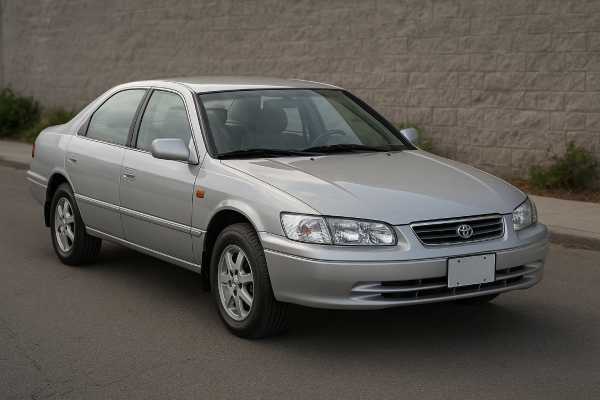
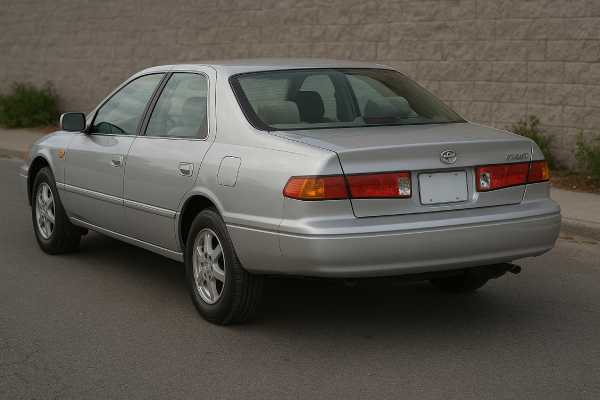
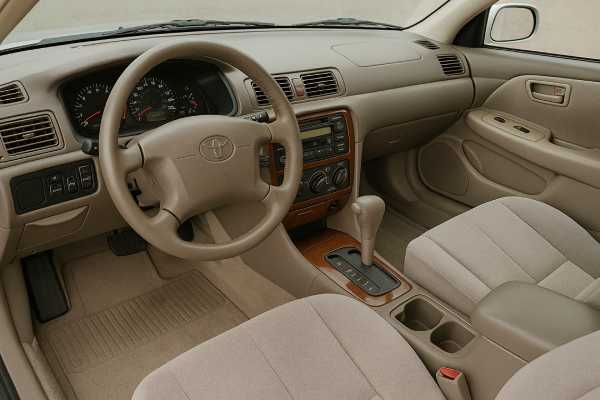
The 2000–2001 Toyota Camry (SXV20) with the 5S-FE 2.2-liter four-cylinder is a quiet, unpretentious sedan engineered for long life and low running costs. The facelift brought mild exterior changes and incremental refinement, but the core formula stayed the same: a smooth, non-interference belt-driven DOHC inline-four, simple front-wheel-drive hardware, and conservative chassis tuning that prioritizes comfort. Owners value the car’s durable powertrain, spacious cabin, and predictable road manners. While it lacks modern driver-assist tech and the crisp steering of some rivals, this generation’s excellence shows up in the long haul—starting reliably, sipping fuel reasonably, and requiring straightforward service with widely available parts. If you want a midsize that can handle daily duty for years with routine care, the SXV20 four-cyl is a compelling used buy. This guide focuses on the North American facelift years (model years 2000–2001) with the 2.2-liter 5S-FE, covering the specs that matter, maintenance schedules, known issues, and what to check before purchase.
Fast Facts
- Proven 5S-FE engine: durable, chain-free, non-interference design with broad parts availability.
- Comfortable ride and low NVH for its class; roomy 5-passenger cabin and 14.1 ft³ (400 L) trunk.
- Crashworthiness: strong moderate-overlap results for its era; limited active safety and ADAS.
- Watch for aging rubber (mounts/hoses), suspension bushings, and external oil leaks as mileage/years rise.
- Timing belt replacement at 90,000 miles (145,000 km) or 9 years; replace water pump and idlers together.
Explore the sections
- Camry 2.2 2000–2001 Overview
- Camry 5S-FE Specs
- Trims, Options, and Safety
- Reliability and Known Issues
- Maintenance and Buyer’s Guide
- Driving and Performance
- How It Compares to Rivals
Camry 2.2 2000–2001 Overview
The facelifted 2000–2001 Camry sits at the tail end of Toyota’s XV20 generation. It was designed around simple, proven engineering: a transversely mounted 5S-FE 2.2-liter four-cylinder driving the front wheels through either a five-speed manual or a four-speed automatic. The engine uses a toothed rubber timing belt (not a chain), twin overhead camshafts, and four valves per cylinder. It’s a non-interference design, meaning a broken belt usually won’t bend valves—still, replacement on schedule is critical. Output is rated at 136 hp (about 101 kW), which won’t thrill, but the engine’s linear torque and calm demeanor fit the Camry’s brief: easy commuting, low-stress highway travel, and manageable upkeep.
The facelift lightly revised lighting, bumpers, and trim, and improved noise isolation and feature mixes, especially on LE and XLE trims. Inside, you’ll find straightforward ergonomics, large controls, and clear gauges. Seat comfort is a strong suit, with wide cushions and relaxed posture. The back seat accommodates adults, aided by generous door openings and a flat floor hump compared with some rivals of the day.
Ride quality and refinement are where this Camry shines. The suspension’s tuning targets isolation rather than sport, using MacPherson struts front and rear, with soft spring rates and compliant bushings. Steering is light and predictable. Brakes are effective for the car’s mass, though pedal feel is tuned more for smoothness than bite. In period testing, the 2.2-liter returned solid fuel economy, and the car’s aerodynamics (drag coefficient around 0.30) help keep highway consumption down.
Safety content reflects its era. Dual front airbags were standard; anti-lock brakes (ABS) were optional on many 4-cylinder trims and more commonly found on higher grades or as part of packages. Side airbags were available in certain configurations late in the generation but are rare in the used market. Advanced driver-assist features such as automatic emergency braking or lane keeping were not offered. Even so, the body structure performed well in key crash assessments for that time, one reason these cars earned a reputation for sensible family duty.
As a used buy today, the SXV20 four-cylinder appeals because it’s mechanically straightforward. Routine service—fluids, filters, belts, brakes, and suspension wear items—keeps it healthy. Parts commonality across Toyota’s late-’90s/early-’00s platforms means that components are plentiful and often inexpensive. Owners should budget for age-related reconditioning (engine mounts, cooling hoses, struts, and bushings) and plan the timing-belt package proactively if there’s no proof of recent replacement.
Camry 5S-FE Specs
Below are focused, scannable data for the 2000–2001 Camry 2.2-liter (5S-FE) in North America. Figures reflect typical configurations; verify exact numbers by VIN and build.
Engine and Performance
| Item | Spec |
|---|---|
| Code | 5S-FE |
| Layout & cylinders | Inline-4, DOHC, 16 valves (4 per cyl) |
| Bore × stroke | 87.0 × 91.0 mm (3.43 × 3.58 in) |
| Displacement | 2.2 L (2,164 cc) |
| Induction | Naturally aspirated |
| Fuel system | Sequential multi-port fuel injection (MPFI) |
| Compression ratio | ~9.5:1 |
| Max power | 136 hp (≈101 kW) @ ~5,200 rpm |
| Max torque | ≈203 Nm (150 lb-ft) @ ~4,400 rpm |
| Timing drive | Rubber timing belt (non-interference) |
| Emissions/efficiency standard | EPA gasoline |
| Rated efficiency (EPA) | Typical 21–23 mpg city / 29–32 mpg highway (US); ≈9.8–8.1 L/100 km city / 7.8–7.4 L/100 km hwy depending on trim/transmission |
| Real-world highway @ 75 mph (120 km/h) | ~7.6–8.1 L/100 km (31–29 mpg US / 37–35 mpg UK) |
| Aerodynamics | Cd ≈ 0.30 |
Notes: Output and economy vary slightly with transmission and options. Federal/California emissions calibrations may differ marginally.
Transmission and Driveline
| Item | Spec |
|---|---|
| Transmission | 5-speed manual (S51) or 4-speed automatic (Aisin, commonly A541E family) |
| Drive type | Front-wheel drive (FWD) |
| Final drive | ~3.9 (varies by trans/trim) |
| Differential | Open |
| Refuel to full (typical) | ~5–7 minutes at pump |
Practical tip: If the automatic shifts flare or hunt, start with fresh ATF and filter where serviceable; many units respond well to a careful drain-and-fill with correct fluid.
Chassis and Dimensions
| Item | Spec |
|---|---|
| Suspension (front/rear) | MacPherson strut / MacPherson strut |
| Steering | Power-assisted rack-and-pinion; light effort |
| Brakes | Front ventilated discs; rear drums or solid discs (by trim/package) |
| Wheels/Tires (typical) | 195/70R14 (CE); 205/65R15 (LE); 205/60R16 available (packages) |
| Ground clearance | ~130 mm (5.1 in) |
| Length / Width / Height | ~4,790 mm (188.5 in) / ~1,780 mm (70.1 in) / ~1,410 mm (55.4 in) |
| Wheelbase | 2,670 mm (105.1 in) |
| Turning circle | ~10.8 m (35.4 ft) |
| Curb weight | ~1,360–1,415 kg (≈2,998–3,120 lb) depending on trim/transmission |
| GVWR | ~1,860–1,935 kg (≈4,100–4,265 lb) |
| Fuel tank | ~70 L (18.5 US gal / 15.4 UK gal) |
| Cargo volume (trunk) | 400 L (14.1 ft³), SAE |
Performance and Capability
| Metric | Value |
|---|---|
| 0–60 mph (0–97 km/h) | ~9.3–10.0 s (auto slower; manual quicker) |
| 0–100 km/h (0–62 mph) | ~9.8–10.5 s |
| Top speed | ~185–190 km/h (115–118 mph), speed-limited by tires/ECU |
| Braking 100–0 km/h (62–0 mph) | ~38–43 m (125–140 ft), tire-dependent |
| Towing capacity (braked) | Up to 910 kg (2,000 lb) with proper equipment |
| Payload | ~385–430 kg (850–950 lb), configuration-dependent |
| Roof load | ~68–75 kg (150–165 lb) with approved crossbars |
Fluids and Service Capacities
| System | Spec / Capacity |
|---|---|
| Engine oil | API SJ/SL 5W-30 preferred; capacity ≈3.6 L (3.8 US qt) with filter |
| Coolant | Toyota Long Life Coolant (red), ethylene-glycol; capacity ≈6.9 L (7.3 US qt) |
| Automatic transmission | Toyota ATF (period-correct Type T-IV where specified); service fill varies (~3–4 L / 3–4 qt) |
| Manual transaxle | GL-4/GL-5 gear oil (per service guide) |
| A/C refrigerant | R-134a; charge amount varies by option (~600–750 g typical) |
| A/C compressor oil | ND-Oil 8 (PAG46-type); small top-up only when components replaced |
| Key torque specs | Wheel lug nuts: ~103 Nm (76 lb-ft); oil drain plug: ~39 Nm (29 lb-ft); spark plugs: ~18–22 Nm (13–16 lb-ft) |
Always verify fluid specs and fill amounts for your exact VIN; some figures vary with options (A/C, ABS) and running changes.
Electrical
| Item | Spec |
|---|---|
| Alternator output | ~80–100 A (equipment-dependent) |
| 12 V battery | Group 24F form factor common; ~55–65 Ah; CCA varies by climate package |
| Spark plugs | Copper or single-platinum (per label); gap ~1.1 mm (0.043 in) |
Safety and Driver Assistance
| Category | Notes (2000–2001) |
|---|---|
| Crash ratings | Strong moderate-overlap frontal performance for 1997–2001 body; side and small-overlap tests were not applied to this generation at launch |
| Headlights | Halogen reflector; no projector or HID from factory on 4-cyl trims |
| Airbags | Dual front airbags standard; front seat side airbags rare (late availability/option) |
| ABS | Optional on many 4-cyl trims; more common on upper grades |
| ADAS | Not available (no AEB, ACC, lane support, BSD/RCTA) |
| Child seats | LATCH anchors not universal in this era; verify lower anchors/seat belt routing; top tether anchors often present in rear shelf |
Trims, Options, and Safety
Trim walk (typical for 4-cyl models):
- CE — The value leader. Cloth upholstery, manual A/C, basic audio, 14-inch steel wheels. Manual transmission available; ABS typically optional. Quick identifier: minimal chrome, hubcaps, fewer steering-wheel switches.
- LE — The mainstream pick. Adds power accessories, upgraded cloth, better audio, cruise, and often 15-inch wheels. ABS more frequently specified; keyless entry common. Quick identifiers: “LE” badge, body-color trim, more sound deadening.
- XLE — The comfort trim. Wood-tone accents, premium audio, automatic climate control, power driver’s seat, and more insulation. Many cars have ABS and rear disc brakes; 16-inch wheel packages appear on some late cars. Quick identifiers: “XLE” badge, alloy wheels, richer interior trim.
Key options and packages:
- ABS pack (highly recommended for used-market safety).
- Alloy wheel/tire packages (15–16 in).
- Power driver’s seat and upgraded audio (LE/XLE).
- Side airbags (late-run option; rare on 4-cyl—confirm via VIN/airbag labels).
- Cold-weather equipment in some regions (heavy-duty battery, washer de-icer).
Functional differences by trim:
- Brakes: CE cars commonly use rear drums; LE/XLE more often have rear discs when optioned with ABS.
- Tires and steering feel: Taller 14-inch tires on CE yield the softest ride; 15/16-inch packages sharpen response modestly.
- Noise isolation: LE/XLE tend to be quieter due to added insulation and higher-grade tires.
Safety ratings in brief:
- Crashworthiness: This body generation performed well in moderate-overlap frontal testing across 1997–2001. That reflects robust structure and good restraint performance for its time.
- NHTSA/NCAP era context: Government star ratings were less comprehensive then. Use modern expectations cautiously when comparing across eras.
- Child-seat provisions: Many vehicles offer top tether anchors; lower LATCH anchors may not be present on all seating positions. Inspect hardware and consult the owner’s manual for anchor locations and belt routing.
- Headlights: Output is adequate but not modern; fresh capsules and restored lenses help significantly.
Year-to-year changes (high level):
- 2000 model year: Facelifted exterior (lights, bumper trim), minor interior trim and feature realignment.
- 2001 model year: Largely carry-over with incremental package reshuffles; some cars show richer standard equipment late in the run.
Calibration and service implications:
- ABS components (tone rings/sensors) require clean installation and correct air gap after hub or axle work.
- Airbag/SRS: If any SRS components are replaced, follow the deployment loop checks and service manual reset procedures.
- Windshield replacements: Preserve correct mirror mount and defrost grid connections; some aftermarket glass can alter acoustic performance slightly.
Reliability and Known Issues
The 5S-FE and its associated driveline are fundamentally robust. Age, mileage, climate, and maintenance history now dominate outcomes. Below is a practical map of issues by prevalence and cost.
Engine/ancillaries
- Valve cover and cam/crank seals weeping — Common, low–medium cost.
Symptom: Oil film at the timing cover, valve cover gasket edges.
Cause: Hardened seals/gaskets with age/heat.
Fix: Replace gaskets and front seals, ideally during the timing-belt service. Clean PCV valve to reduce crankcase pressure. - Timing belt overdue — Common, medium cost, high consequence if ignored.
Symptom: Unknown belt age, squeaks, visible cracking.
Cause: Missed maintenance.
Fix: Replace belt, tensioner, idler(s), and water pump as a kit every 90k miles (145k km) or 9 years. Add thermostat and fresh coolant. - Motor mounts collapsed — Common, medium cost.
Symptom: Excess vibration at idle/shift shock.
Cause: Rubber deterioration.
Fix: Replace mounts (front/rear/side) with quality parts; restores refinement and protects exhaust flex and axles. - Idle air control (IAC) valve sticking / throttle body deposits — Occasional, low cost.
Symptom: Unstable idle, stalling when cold starts or A/C engages.
Cause: Varnish buildup.
Fix: Clean throttle body and IAC passages; relearn idle; inspect vacuum lines. - External coolant seep at water pump — Occasional, medium cost.
Symptom: Dried pink residue, coolant smell.
Cause: Aging pump seals/bearings.
Fix: Replace pump during timing-belt service; flush coolant.
Fuel/ignition
- Aged plugs/wires — Common, low cost.
Symptom: Misfires under load, rough idle.
Cause: Worn copper plugs and original leads.
Fix: Replace plugs (correct heat range and gap ~1.1 mm) and high-quality wires. Inspect coils (if equipped) on later ignition variants. - Dirty injectors — Occasional, low cost.
Symptom: Rough cold starts, light knock/ping.
Fix: Professional cleaning or quality additive, verify fuel pressure and vacuum leaks.
Transmission/driveline
- ATF neglect — Common, medium cost over time.
Symptom: Harsh/hunting shifts, torque-converter shudder at light throttle.
Cause: Old fluid losing friction modifiers.
Fix: Drain-and-fill (not power flush) with correct ATF; multiple services 500–1,000 miles apart can restore feel. Inspect mounts and axle joints. - Manual transaxle gear oil old — Occasional, low cost.
Symptom: Notchy cold shifts.
Fix: Replace with correct GL-spec oil; check clutch hydraulics and shifter bushings.
Chassis/suspension/brakes
- Struts/top mounts tired — Common, medium cost.
Symptom: Floaty ride, nose-dive, clunks over bumps.
Fix: Replace struts, mounts, and bumpstops as assemblies; align afterward. - Front control arm rear bushings cracked — Common, medium cost.
Symptom: Wandering on highway, brake shimmy.
Fix: Renew control arms or press new bushings; re-check alignment. - Rear drum brake adjustment (where equipped) — Occasional, low cost.
Symptom: Long pedal travel or uneven parking brake hold.
Fix: Adjust star wheel; service shoe hardware; verify cables.
Cooling/air-conditioning
- Radiator plastic tank seep — Occasional, medium cost.
Symptom: Pink/white crust near end tank seam.
Fix: Replace radiator; new hoses/clamps recommended. - A/C low performance — Occasional, variable cost.
Symptom: Warm air at idle.
Causes: Low refrigerant charge (slow leak), condenser fin corrosion, weak cooling fans.
Fix: Leak test, correct charge, confirm fan operation; replace O-rings/drier when opening system.
Electrical/trim
- Window regulators and lock actuators — Occasional, low–medium cost.
Symptom: Slow/no movement or bouncing.
Fix: Replace regulator/motor or actuator; ensure glass channels are lubricated. - Instrument backlighting bulbs — Occasional, low cost.
Fix: Replace bulbs; mind dimmer rheostat function.
Corrosion hotspots
- Rear subframe and brake lines in rust-belt climates; exhaust flanges; door bottoms if drains clog. Treat proactively and inspect at purchase.
Recalls/TSBs (era context):
- This generation pre-dates the Camry drive-by-wire era that drew later attention. Still, always run a VIN check for open recalls, and read dealer records. Items like floor-mat retention, airbag service campaigns, or component supplier notices can affect a given vehicle.
Pre-purchase checklist to request:
- Proof of timing belt + water pump service (date/miles).
- Cooling system service records (coolant type/interval).
- ATF service history (when and what fluid).
- Suspension reconditioning (struts, control-arm bushings, mounts).
- Brake system condition (line corrosion, rotor thickness, drum hardware, ABS function).
- Tire age (DOT week/year) and even wear; alignment printouts.
- SRS/ABS scan (no hidden codes after bulb check).
- VIN recall check and owner’s manual set; two keys.
Maintenance and Buyer’s Guide
Service schedule (practical):
- Engine oil/filter: Every 5,000–7,500 miles (8,000–12,000 km) or 6 months (use 5W-30; shorter intervals for severe service, short trips, or high heat).
- Engine air filter: Inspect at 12 months/15,000 miles; replace by 30,000 miles (48,000 km) or sooner in dusty areas.
- Cabin filter: If equipped, replace every 15,000–20,000 miles (24,000–32,000 km) or annually.
- Spark plugs: Copper: 30,000 miles (48,000 km); single-platinum/long-life: 60,000 miles (96,000 km). Verify type on emission sticker/owner’s manual.
- Timing belt kit + water pump: 90,000 miles (145,000 km) or 9 years (non-interference, but don’t defer). Replace tensioner/idlers, thermostat, and accessory belt(s).
- Serpentine/aux belts: Inspect each oil service; replace 60,000–90,000 miles if cracked or glazed.
- Coolant: Toyota Long Life Coolant (red)—refresh every 2–3 years or ~30,000 miles unless upgraded to Super Long Life (pink) with different interval. Fully bleed heater core.
- Automatic transmission fluid: Drain-and-fill with correct ATF every 60,000–90,000 miles (96,000–145,000 km); more frequent if towing/hot climate.
- Manual transaxle oil: Replace 60,000 miles; use specified GL-grade.
- Brake fluid: Replace every 2–3 years (DOT 3).
- Brake pads/rotors/drums: Inspect at each tire rotation; typical pad life 30–60k miles depending on use.
- Power steering fluid: Inspect yearly; refresh 60,000–90,000 miles (ATF-type fluid in many models).
- Wheel alignment & rotation: Rotate 5,000–7,500 miles; align annually or if uneven wear/steering drift.
- Valve clearances: Hydraulic lash on 5S-FE; no routine adjustment needed unless noise/fault codes.
- 12 V battery: Test annually after year 4; typical life 4–6 years.
- Exhaust/fuel system: Inspect hangers, flanges, and filter (where serviceable) each year; replace fuel filter if external and serviceable (many are in-tank/long-life).
Fluids and torques (at-a-glance):
- Engine oil: 3.6 L (3.8 qt) with filter; 5W-30 API SJ/SL.
- Coolant total: ~6.9 L; Toyota LLC (red), 50/50 mix.
- ATF drain/refill: ~3–4 qt typical; use Toyota-specified ATF (period T-IV where applicable).
- Wheel lug nuts: ~103 Nm (76 lb-ft).
- Oil drain plug: ~39 Nm (29 lb-ft).
- Spark plug gap: ~1.1 mm (0.043 in).
Buyer’s guide tips:
- Documentation first. Timing-belt proof, fluid services, and any suspension overhaul invoices matter more than shiny paint.
- Cold start test. Listen for belt squeal, lifter-like tick (often injector noise), exhaust leaks at flanges, and check for smoke.
- Heat-soak drive. After 20–30 minutes, assess idle stability (A/C on), transmission kickdown, and stop-and-go shift quality.
- Straight-line and braking. On a smooth road, check on-center tracking; during hard braking, watch for steering wheel shake (rotors/bushings).
- Underbody inspection. Look for rear subframe rust, brake line corrosion at clips, damp struts, and cracked bushings.
- Cooling system health. Radiator end-tanks (plastic) can seep; look for pink residue, and ensure the fans cycle properly.
- Electrical check. All windows/locks, backlighting, HVAC modes, and SRS/ABS lamps should work correctly (lamp test at key-on).
- Tires. Uneven wear points to alignment/bushing issues; verify production date (DOT code).
- Options you want. ABS is a worthwhile find; rear discs are a nice bonus; side airbags are scarce but valuable.
Which to seek/avoid:
- Seek: Well-maintained LE with ABS and documented timing-belt/water-pump service; any car with fresh struts/control-arm bushings feels “new” again.
- Avoid: Neglected examples with coolant cross-contamination, transmission shudder after full fluid exchange, or structural rust. If a car lacks service history and shows varnish inside the oil cap, budget accordingly.
Long-term durability outlook:
With regular fluids, a healthy cooling system, and fresh rubber parts, the 5S-FE/automatic combo routinely surpasses 200,000–300,000 miles (320,000–480,000 km). The limiting factors tend to be corrosion in harsh climates and deferred maintenance.
Driving and Performance
Ride, handling, NVH:
This Camry’s dynamic personality is calm and predictable. The chassis isolates small impacts, the body stays free of squeaks when bushings are healthy, and wind noise remains modest at highway speeds. Straight-line stability is excellent, helped by the wheelbase and gentle alignment settings. In corners, the car understeers progressively; there’s body roll, but it’s well-controlled if struts and sway-bar links are in good shape. Steering effort is light, with minimal kickback and average on-center feel by modern standards. Brakes provide consistent deceleration; pedal tuning favors smoothness over initial bite. Fresh pads, bled fluid, and quality tires transform confidence.
Powertrain character:
The 5S-FE won’t win sprints, yet it’s tractable. Throttle response is clean, with useful midrange for city traffic. The 4-speed automatic keeps revs low, upshifts early, and downshifts reliably with a decisive pedal push; there’s no turbo lag to manage, and the engine’s vibration is well-isolated at cruise. The manual gearbox (rarer) livens the car—gearing is widely spaced, and the engine’s torque plateau suits relaxed shifting.
Real-world economy:
Expect 27–32 mpg US (8.7–7.4 L/100 km) on steady highway drives depending on tires, load, and temperature; mixed commuting typically lands in the 23–28 mpg US (10.2–8.4 L/100 km) range. Winter blend fuels, short trips, and roof racks can reduce those numbers. Keeping tire pressures at spec (often ~29–32 psi cold), maintaining alignment, and using 5W-30 oil help preserve efficiency.
Selective metrics that matter:
- 0–60 mph: around 9.3–10.0 s in typical 4-cyl autos; the manual can trim several tenths.
- Passing (50–70 mph): adequate, plan downshifts on grades.
- 60–0 mph braking: ~125–140 ft depending on tires and brake condition.
- Turning circle: ~35.4 ft (10.8 m)—easy in tight lots.
Load and towing:
With tires and brakes in top shape and the cooling system healthy, towing up to 2,000 lb (910 kg) with the correct hitch and wiring is feasible. Expect a 15–30% fuel-economy penalty at highway speeds and longer stopping distances; keep speeds modest and leave extra following distance.
How It Compares to Rivals
Honda Accord (1998–2002, 2.3L I-4):
The Accord feels slightly more connected from the driver’s seat—heavier steering, firmer damping, and crisper turn-in. Cabin space is similar; trunk space is slightly smaller. Reliability is strong, though some automatics of that era can be weaker than Toyota’s. Feature content and interior materials are comparable. If you prioritize steering feel and a sportier edge, the Accord may appeal; if you want the quietest ride and the most isolation, the Camry tends to win.
Nissan Altima (1998–2001, 2.4L I-4):
Smaller inside, less refined at speed, and often noisier. Running costs are still reasonable, but long-term durability and interior wear typically favor the Camry. The Altima can feel livelier around town; the Camry is smoother and more comfortable on the highway.
Volkswagen Passat B5 (1998–2005, 1.8T/2.8 V6):
Sharper driving dynamics, available turbo torque, and upscale cabin design. Ownership costs are higher: more complex cooling systems, tighter packaging, and pricier parts. If you want European feel and are ready to maintain a turbo or V6 with care, the Passat is compelling. For a low-drama daily with predictable expenses, the Camry remains the sensible choice.
Chevrolet Malibu (1997–2003):
Often cheaper to buy, with lower initial outlay. Ride is decent, but interior durability, rust resistance, and long-term mechanical robustness usually favor the Camry. Parts availability is good for both; Toyota’s resale and reliability advantage are well-established.
Bottom line:
For a comfortable, low-stress daily driver with simple maintenance, the SXV20 Camry 2.2 remains a standout. It trades athleticism for serenity and longevity—and delivers exactly what many used-car buyers need: predictability.
References
- Gas Mileage of 2001 Toyota Camry 2001 (Fuel Economy)
- Gas Mileage of 2000 Toyota Camry 2000 (Fuel Economy)
- 2001 Toyota Camry 2025 (Safety Rating)
- Check for Recalls: Vehicle, Car Seat, Tire, Equipment 2025 (Recall Database)
- 2001 Camry – Owners’s Manual 2001 (Owner’s Manual)
Disclaimer
This article is for informational purposes and is not a substitute for professional diagnosis or repair. Specifications, torque values, capacities, and service intervals can vary by VIN, market, equipment, and running changes. Always confirm procedures and numbers with your vehicle’s official service documentation and labels. If you found this guide helpful, please consider sharing it on Facebook or X/Twitter to support xcar’s work.