
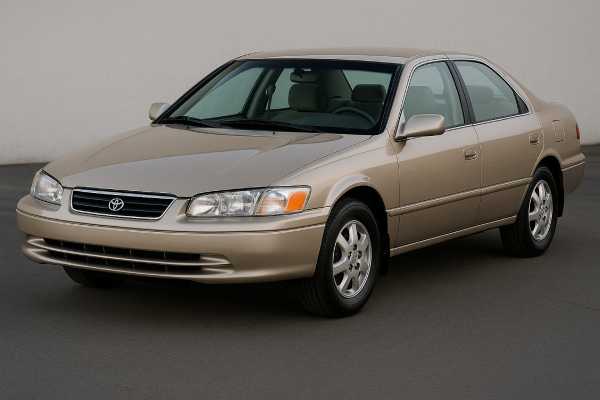
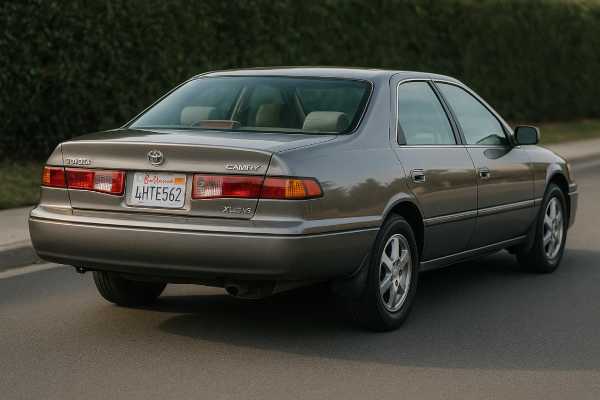
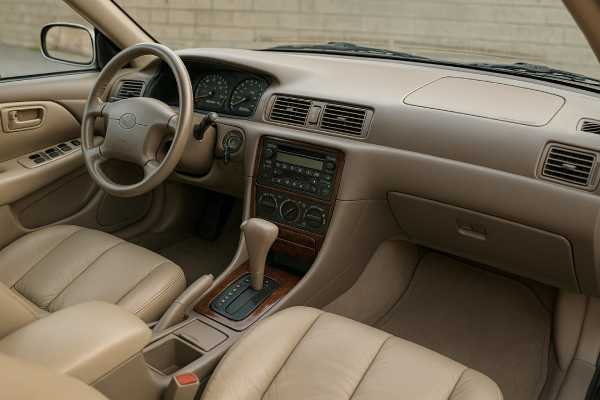
A late–1990s facelift brought the fourth-generation Toyota Camry (chassis code MCV20 for the V6) to its mature form: quiet, unpretentious, and engineered for longevity. The 1MZ-FE 3.0-litre V6 is the star—silky smooth, broad-torqued, and paired to a stout 4-speed automatic. While the design looks modest today, owners still praise the Camry’s isolation from noise and harshness, stable highway manners, and low running costs when serviced on time. The facelift refined cabin materials, improved corrosion protection, and expanded safety options (ABS, traction control, front side airbags). If you are considering a used example now, success comes down to documentation: timing-belt service, cooling-system care, and proof of regular oil changes matter far more than mileage alone. Properly maintained, these cars shrug off daily use, rough winters, and long commutes, delivering a comfortable, unfussy drive that defines the Camry reputation.
At a Glance
- Smooth 1MZ-FE V6 (194 hp, 209 lb-ft) with strong low-to-midrange torque; relaxed highway cruising.
- Quiet ride and durable chassis; simple 4-speed automatic that favors reliability over flash.
- Watch for neglected oil service on early-2000s Toyota V6s (sludge risk in poor-maintenance histories).
- Typical interval: timing belt and water pump every 90,000 miles / 145,000 km or 7 years.
Explore the sections
- Camry MCV20 V6 in detail
- Camry MCV20 specs and data
- Camry trims, options, safety
- Reliability, issues, and service
- Maintenance and buyer’s guide
- Driving, performance, and economy
- How Camry compares to rivals
Camry MCV20 V6 in detail
Toyota’s facelifted Camry of 1999–2001 represents peak “classic Camry”: conservative design, excellent isolation, and a powertrain engineered for the long run. The 1MZ-FE 3.0-litre V6 (non-VVT-i in North America during these years) produces 194 hp (145 kW) at 5,200 rpm and 209 lb-ft (283 Nm) at 4,400 rpm. It is an all-aluminium, 60-degree V6 with dual overhead cams and four valves per cylinder, running multi-port fuel injection and a timing belt. What drivers notice is not headline speed but the way this engine delivers effortlessness: a quiet, linear push from low rpm and a refined hum at cruise.
The transmission pairing is straightforward: a 4-speed electronically controlled automatic (ECT) that prioritizes smoothness and durability. No gimmicks—just calm, predictive shifts and a tall top gear for low engine speeds on the highway. The Camry’s ride character leans to comfort rather than sport; MacPherson struts at both ends are tuned for compliance, and electric-nothing simplicity (hydraulic power steering, vacuum-boosted brakes) keeps ownership predictable.
The 1999 facelift added subtle exterior updates, improved sound insulation, and available features such as front side airbags and traction control (TRAC) on V6 models with ABS. Interior ergonomics remain a high point: clear instruments, excellent outward visibility, and a back seat that genuinely accommodates adults. Cargo room is competitive and the flat, square trunk opening makes daily life easy.
Shopping today, condition and paperwork define value. Look for evidence of routine oil changes (5W-30), timing-belt and water-pump replacement, fresh coolant, and automatic transmission fluid service. Cars that lived an easy, well-documented life remain outstanding commuters. Those that missed basic maintenance can still be brought back, but budget proactively for fluids, belts, hoses, mounts, and suspension refresh.
Camry MCV20 specs and data
Figures reflect the North American 1999–2001 V6 sedan where applicable. Some items vary by trim, wheels/tyres, and options. Where ranges are shown, verify by VIN and build sheet.
Engine and Performance
| Item | Specification |
|---|---|
| Code | 1MZ-FE (non-VVT-i, NA) |
| Engine layout & cylinders | 60° V6, DOHC, 24 valves; 4 valves/cyl |
| Bore × stroke | 87.5 × 83.0 mm (3.44 × 3.27 in) |
| Displacement | 3.0 L (2,994 cc) |
| Induction | Naturally aspirated |
| Fuel system | Multi-port fuel injection (MPFI) |
| Compression ratio | 10.5:1 |
| Max power | 194 hp (145 kW) @ 5,200 rpm |
| Max torque | 283 Nm (209 lb-ft) @ 4,400 rpm |
| Timing drive | Belt (replace at interval) |
| Emissions / efficiency standard | EPA era Tier-1/LEV (market dependent) |
| Rated economy (EPA, combined) | 11.2 L/100 km (21 mpg US / 25 mpg UK) |
| Real-world highway @ 120 km/h | ~9.5–10.5 L/100 km (20–25 mpg US / 24–30 mpg UK), condition dependent |
| Aerodynamics | Cd ≈ 0.30 (sedan); frontal area not widely published |
Transmission and Driveline
| Item | Specification |
|---|---|
| Transmission | 4-speed automatic ECT (A541E) |
| Gear ratios (1/2/3/4/R) | 2.81 / 1.55 / 1.00 / 0.73 / 2.30 |
| Final drive ratio | ~3.62 (varies with package) |
| Drive type | Front-wheel drive (FWD) |
| Differential | Open |
| Refuel to full (petrol) | ~5 min typical service station |
Chassis and Dimensions
| Item | Specification |
|---|---|
| Suspension (front/rear) | MacPherson strut / MacPherson strut with trailing links |
| Steering | Hydraulic rack-and-pinion; power assisted |
| Brakes | V6 typically vented front disc ~275 mm (10.8 in); rear solid disc ~269 mm (10.6 in) or leading-trailing drum (trim dependent); ABS optional/standard by trim |
| Wheels/Tyres (common) | 205/65 R15 (15-in rims) or 205/60 R16 (16-in rims on upper trims) |
| Ground clearance | ~150 mm (5.9 in) |
| Length / Width / Height | ≈ 4,805 mm / 1,780 mm / 1,420 mm (189.2 / 70.1 / 55.9 in) |
| Wheelbase | 2,670 mm (105.1 in) |
| Turning circle (kerb-to-kerb) | ~11.0 m (36.1 ft) |
| Curb weight (typical V6 auto) | ~1,440–1,485 kg (3,175–3,275 lb) |
| GVWR | ~1,960–2,000 kg (4,321–4,409 lb), by trim |
| Fuel tank | 70 L (18.5 US gal / 15.4 UK gal) |
| Cargo volume (SAE) | ~400 L (14.1 ft³) seats up |
Performance and Capability
| Metric | Value |
|---|---|
| Acceleration 0–100 km/h (0–62 mph) | ~8.6–9.0 s (typical period tests; tyre/condition dependent) |
| Top speed | ~210 km/h (130 mph), gearing/ECU dependent |
| Braking 100–0 km/h (62–0 mph) | Typically low-40 m / ~130–145 ft on quality tyres (no factory claim) |
| Towing capacity | Not factory-rated in North America for this class; use hitch only for light accessories |
| Payload / roof load | Varies by trim; keep roof loads conservative (~45–68 kg / 100–150 lb) |
Fluids and Service Capacities
| System | Specification | Capacity (approx.) |
|---|---|---|
| Engine oil | API SJ/SL, SAE 5W-30 preferred | ~4.7 L (5.0 US qt) with filter |
| Coolant | Toyota Long Life Coolant (ethylene glycol); 50/50 to 60/40 mix | ~9.2 L (9.7 US qt) system fill (varies with drain method) |
| Automatic transmission (A541E) | Toyota ATF Type T-IV | ~3.5 L (3.7 US qt) for drain-and-fill; more if serviced via exchange |
| Power steering | ATF Dexron II/III (period spec) | As required |
| A/C refrigerant | R-134a | Charge varies; typically ~650–750 g (23–26 oz) |
| A/C compressor oil | ND-Oil 8 (PAG) | ~120–150 mL (4–5 fl oz), by compressor |
| Key torque specs | Wheel lug nuts: 103 Nm (76 lb-ft); engine drain plug ~44 Nm (33 lb-ft) typical; always confirm by manual |
Electrical
| Item | Specification |
|---|---|
| Alternator output | ~80–100 A (equipment dependent) |
| 12 V battery | Group 24F commonly fitted; ~550–650 CCA typical |
| Spark plugs | Double-platinum (e.g., Denso PK20TR11 / NGK BKR6EKPB11); gap 1.1 mm (0.043 in) |
Safety and Driver Assistance
| Item | Details |
|---|---|
| Crash ratings (IIHS) | Moderate overlap frontal: Good; applies to 1997–2001. No original-era side or roof tests. |
| Headlight rating (IIHS) | Not rated for this era |
| NHTSA | Model-year pages list star ratings and recalls; verify by VIN |
| Airbags | Dual front; front seat-mounted side airbags optional on many trims after facelift |
| ABS / Traction | ABS widely available; TRAC traction control available on many V6/ABS cars |
| ADAS | No AEB, ACC, lane-keeping; era-appropriate basic systems only |
Camry trims, options, safety
Trims and options (typical North America, 1999–2001):
- CE (value-oriented): Cloth, manual seats, 15-inch wheels, ABS optional (varies by year). V6 availability limited; most CE cars are four-cylinder.
- LE (volume): Power accessories, cruise control, remote entry, 15-inch wheels (16-inch optional later), split-fold rear seat on many. V6 optional; ABS common; side airbags optional.
- XLE (top): Automatic climate control, upgraded audio, wood-tone trim, available power sunroof, 16-inch wheels/tyres, more sound insulation. V6 popular; ABS standard on many, TRAC often bundled; side airbags optional.
Quick identifiers:
- VIN engine code for 1MZ-FE; build label in driver door jamb shows tyre and wheel data; ABS/TRAC telltales illuminate at key-on. Brake hardware (rear disc vs drum) varies by trim and package—many V6 XLE/LE cars have rear discs.
- Year-to-year tweaks: minor trim fabrics and audio updates; safety options (side airbags/ABS/TRAC) broadened post-facelift; cosmetic lighting and grille changes.
Safety ratings (summary):
- IIHS moderate-overlap frontal: Good (applies 1997–2001).
- NHTSA ratings vary with airbags and belts; check the model-year page and VIN for exact star ratings and any recalls.
- Child-seat/LATCH: Not the modern ISOFIX layout; uses era-correct tether anchors and seatbelt installs. Verify anchor kit presence for 1999–2000 cars.
Systems and after-service calibration:
- No camera/radar systems to calibrate. After airbag, ABS, or TRAC service, stack-up clearances and sensor gaps must meet the manual spec; clock-spring alignment is critical after steering wheel removal. ABS wheel-speed sensors are robust but dislike rusty tone rings—clean carefully if you have on-off ABS warnings.
Reliability, issues, and service
Overall reliability is excellent when the car is maintained on time. Prioritize service history over odometer alone.
Common → rare · severity/cost guides
- Common / low–medium cost:
- Timing-belt overdue → squeal, belt glazing, coolant seep at pump → Remedy: belt, idlers, tensioner, water pump as a set; fresh coolant; inspect cam/crank seals.
- Valve-cover gaskets → oil seep onto exhaust rear bank → Remedy: replace covers/gaskets; check PCV valve and hoses.
- Front strut mounts/bushings → clunk/creak at low speed → Remedy: struts, mounts, align; tyres often improve ride/noise.
- O2 sensors (pre-cat) → CEL, poor economy → Remedy: replace with quality parts; clear codes; verify no exhaust leaks.
- Occasional / medium cost:
- Cooling system aging → radiator plastic tanks and hoses harden ~15–25 years → Remedy: radiator, upper/lower hoses, thermostat, cap; inspect heater T-pipes; refill with Toyota-spec coolant and bleed.
- A541E fluid neglect → shift flare or delayed engagement → Remedy: staged drain-and-fills with ATF Type T-IV; pan inspection; solenoid/filter service if needed.
- Rear main or cam seal seep on high-mileage cars → Remedy: address during timing-belt or transmission-out work to save labor.
- Known but now mainly history-dependent:
- Engine oil gel (sludge) risk on poorly serviced engines (1997–2002 era V6/I4) → varnish/sludge under covers, stuck rings, low-pressure warnings → Remedy: enforce 5,000-mile/8,000-km oil changes with quality 5W-30, clean PCV, consider gentle short-interval solvent-free oil changes; severe cases require head work/engine replacement. Toyota supported customers via period Customer Support Programs; documentation varies by car.
- Rare / higher cost:
- Steering rack seep → low fluid over months → Remedy: rebuild/replace rack and lines; use correct ATF for power steering.
- ABS modulator fault (age/moisture) → persistent ABS light → Remedy: diagnostics; used tested unit can be cost-effective.
Corrosion hotspots:
- Rear subframe mounts and control-arm tabs in road-salt regions; the lower door hems and trunk lip; radiator support crossmember. Inspect with the car on a lift.
Recalls, TSBs, and extended coverage:
- Use the VIN with the official recall/vehicle page to confirm completion. Keep a printed dealer service history if available. Some campaigns addressed airbag modules, seat-belt anchorage, labels, and other era-typical items—coverage depends on production date and options.
Pre-purchase check shortlist:
- Written proof of timing belt + water pump replacement (date/mileage).
- Engine oil change regularity (miles/time).
- Coolant service history and radiator age.
- Transmission service documentation (ATF Type T-IV).
- ABS function and brake hardware condition (rear disc vs drum).
- Rust inspection on lift; suspension bushing health.
- HVAC performance (heater core flow, A/C vent temps).
- Two working keys and remote(s); factory alarm/immobilizer behaviour.
Maintenance and buyer’s guide
Baseline schedule (time/distance; adjust for severe use such as short trips, stop-and-go, extreme cold/heat, dusty roads):
- Engine oil & filter: Every 5,000 miles / 8,000 km or 6 months (5W-30 API SJ/SL). Old-school 7,500-mile intervals are not advisable for aged vehicles.
- Engine air filter: Inspect 15,000 miles / 24,000 km; replace by 30,000 miles / 48,000 km.
- Cabin filter (where fitted): Inspect 15,000–20,000 miles / 24,000–32,000 km; replace as needed (pollen seasons clog quickly).
- Coolant (Toyota Long Life): Replace every 3 years or 30,000 miles / 48,000 km. If converted to Toyota Super Long Life (pink), follow that coolant’s longer schedule after a complete flush.
- Spark plugs (double-platinum): Replace every 60,000 miles / 96,000 km. Use correct heat range and 1.1 mm (0.043 in) gap. Rear bank requires intake plenum removal—budget labor time.
- Timing belt & water pump: Every 90,000 miles / 145,000 km or 7 years. Replace idlers/tensioner; inspect cam/crank seals.
- Serpentine/aux belts & hoses: Inspect every service; replace 60,000–90,000 miles / 96,000–145,000 km or if cracked/glazed.
- ATF (A541E): Drain-and-fill every 60,000 miles / 96,000 km; avoid aggressive “flushes” on neglected units—do staged services.
- Brake fluid: Replace every 2–3 years.
- Brake pads/rotors & parking brake: Inspect each tyre rotation; clean/lube slide pins annually.
- Power steering fluid: Inspect annually; exchange 60,000–90,000 miles / 96,000–145,000 km.
- Wheel alignment & tyre rotation: Rotate 5,000 miles / 8,000 km; check alignment yearly or after suspension work.
- 12 V battery: Load-test yearly; replacement window often 4–6 years depending on climate.
- Evap/PCV system: Replace PCV valve 60,000 miles / 96,000 km; check evap hoses for cracking.
- Fuel filter: In-tank for this generation; replace only if pressure/flow concerns or during pump service.
Fluid pointers & capacities (decision-making):
- Engine oil: ~4.7 L (5.0 qt) with filter.
- Coolant: Up to ~9.2 L (9.7 qt) for a full system fill; block drains help—air-bleed thoroughly.
- ATF: A typical drain yields ~3.5 L (3.7 qt); repeat after short intervals to refresh the bulk fluid.
- Lug-nut torque: 103 Nm (76 lb-ft); re-torque after wheel service.
Buyer’s guide tips:
- Seek: Documented belt/pump service; clean, quiet cold start; smooth 1-2 upshift; straight-line braking with no ABS light; no coolant smell; dry valve-cover perimeter; even tyre wear; intact body seam sealer underneath.
- Avoid: Cars with overheating history, milky oil cap, persistent lifter tick (after warm), brown/varnished ATF, or random misfire codes under load (vacuum leaks, ignition wear).
- Smart upgrades: Modern tyres (quality all-season), new struts/mounts, fresh engine/trans mounts, upgraded head-unit with Bluetooth (keeping stock look if desired), and UV-rated headlamp lenses.
- Durability outlook: With documented maintenance, the 1MZ-FE/A541E combo routinely exceeds 200,000–300,000 miles (320,000–480,000 km). Budget for age-based refresh (suspension rubber, radiator, hoses, mounts) rather than major engine/transmission work.
Driving, performance, and economy
Ride, handling, NVH: The Camry isolates well. Road seams are softened, wind noise is low for the era, and the cabin remains composed over broken surfaces. Steering effort is light-to-medium with predictable on-centre feel; feedback is modest but trustworthy. Understeer arrives gently on all-season tyres, and stability at 70–75 mph (113–120 km/h) is a strong suit. Brakes are linear with decent initial bite; fresh, quality pads and rotors make a bigger difference than caliper swaps on these cars.
Powertrain character: The 1MZ-FE’s best work is between 2,000 and 4,500 rpm. Throttle response is clean, and the torque curve makes urban driving effortless. The 4-speed auto is unobtrusive—quick to lock the converter in steady cruise and conservative with downshifts unless you press deep. Kickdown is decisive enough for passing; there is minimal hunt on rolling highways if the car is on correct-size tyres and the throttle cable/ECT strategy is healthy. Expect a relaxed ~2,000 rpm at 65 mph (105 km/h) in top gear on stock tyre sizes.
Real-world efficiency:
- City: ~12–13.5 L/100 km (18–20 mpg US; 21–24 mpg UK) depending on trip length and climate.
- Highway (100–120 km/h / 60–75 mph): 8.8–10.5 L/100 km (22–27 mpg US; 26–32 mpg UK).
- Mixed: Around the EPA combined ~11.2 L/100 km (21 mpg US / 25 mpg UK).
Cold winters, short trips, and roof loads can add +1–2 L/100 km to these figures.
Key metrics that change the verdict:
- On good tyres and fresh suspension, the car stops from 100–0 km/h in the low-40-metre range (≈130–145 ft), tracks straight, and resists fade in everyday use. Acceleration to 100 km/h lands below 9 seconds in healthy V6 autos. None of this is “sporty”—and that is the point. The Camry’s competence feels invisible and easy.
Loads and towing: Toyota did not assign a North-American tow rating for this sedan generation; if you must carry, keep to light hitch accessories and moderate trunk/roof loads. Fully loaded cabins raise stopping distances and soften rear damping, but the platform remains stable if shocks and tyres are in good shape.
How Camry compares to rivals
Honda Accord V6 (1998–2002): Slightly sharper steering and a marginally firmer ride, but cabin noise is higher at highway speeds. Automatic transmission durability on neglected cars can be weaker than the Camry’s. Feature content is similar; Honda’s V6 is revvier, Toyota’s is smoother.
Nissan Maxima (A32/A33, 1995–2001): The driver’s choice for straight-line pace—especially later 222-hp cars. Steering and throttle feel are livelier, but insurance and maintenance can be higher. Road noise and ride harshness are a step up versus Camry. Interior plastics age less gracefully.
Ford Taurus (1996–2001, Duratec V6): Spacious, often less expensive to buy. Power is competitive on paper, but overall refinement, interior longevity, and long-term chassis durability typically favor the Camry. Parts are inexpensive; rust is the wildcard.
Volkswagen Passat (B5, 1998–2001): High perceived quality and solid highway stability; 30-valve V6 sounds great. However, ownership demands more attention to cooling system, front suspension links, and electrical quirks. Running costs are higher than the Toyota’s.
Bottom line: If you prioritise quiet, dependable, low-fuss motoring, the Camry MCV20 V6 still delivers. Rivals can be quicker, sharper, or flashier; few are as easy to own for as long.
References
- Fuel Economy of the 2001 Toyota Camry 2025 (EPA database)
- 2001 Toyota Camry 4-door sedan 2025 (Safety Rating)
- Vehicle Detail Search – 2001 TOYOTA CAMRY 4-DR | NHTSA 2025 (Recall Database)
- Scheduled Maintenance Guide 2001 (Owner’s Maintenance Schedule)
Disclaimer
This guide is for informational purposes only and is not a substitute for professional diagnosis or repair. Specifications, torque values, capacities, and service intervals vary by VIN, production date, market, and equipment. Always verify details against your vehicle’s official owner’s manual, service manual, and current technical bulletins before performing maintenance or repairs.
If this helped, feel free to share the article to support xcar—thank you.