
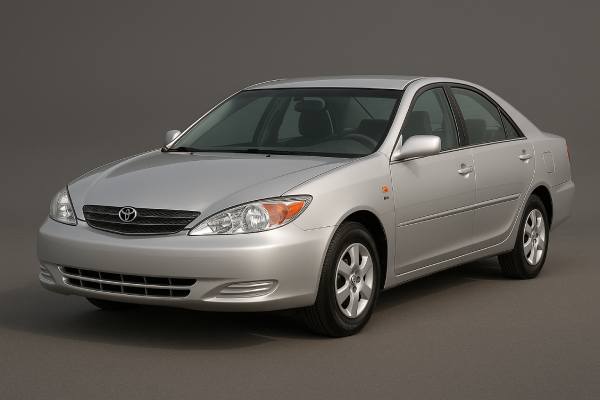
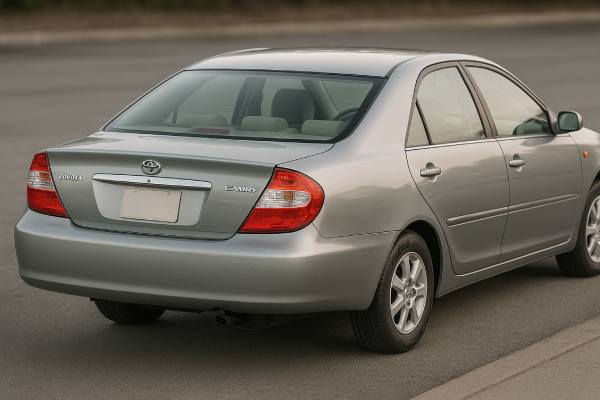
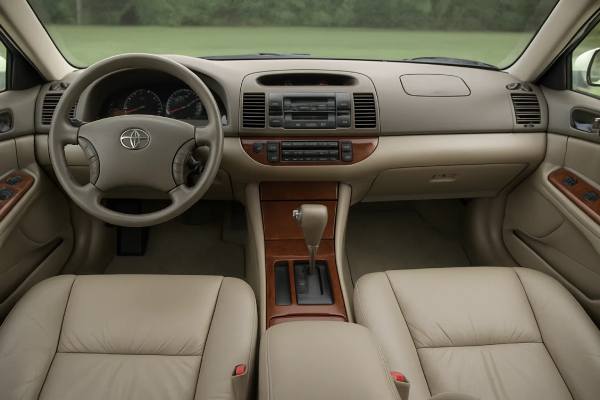
The XV30-generation Toyota Camry with the 2AZ-FE 2.4-liter four-cylinder arrived for 2002 and carried through 2004 as a mainstream, quiet, and exceptionally durable midsize sedan. Its mission was simple: family-car comfort with low running costs—and it hit that brief. The aluminum 2.4 uses chain-driven cams and port fuel injection, with a smooth torque curve that pairs well to the four-speed automatic. Inside, this Camry majors on space, straightforward controls, and a trunk that swallows real luggage. Safety improved during the run (notably side-impact structure for 2004 and available side and curtain airbags), while the SE trim sharpened the chassis without spoiling ride quality.
Ownership is about predictability: routine oil changes, occasional fluids, and suspension wear parts at higher mileage. The 2AZ-FE is generally long-lived, but early engines can suffer from head-bolt thread pullout or oil consumption if neglected; neither is inevitable when maintained sensibly and inspected pre-purchase. If you want an affordable, comfortable commuter that still feels tight at 150,000+ miles when serviced on time, this Camry belongs on the shortlist.
Fast Facts
- Spacious cabin and 16.7 ft³ (473 L) trunk; calm highway manners.
- Proven 2.4-liter chain-driven engine; smooth, linear torque for city use.
- Available side and curtain airbags (from 2004) and structural updates.
- Watch for coolant-adjacent head-gasket leaks (early 2AZ-FE) and fluid-starved transmissions.
- Oil and filter every 5,000–7,500 miles (8,000–12,000 km) or 6–12 months, based on use.
Explore the sections
- ACV30 Camry in Detail
- Camry 2.4 Specs and Data
- Camry Trims, Options and Safety
- Reliability and Known Issues
- Maintenance and Buyer’s Guide
- Driving and Performance Impressions
- Camry vs Key Rivals
ACV30 Camry in Detail
The 2002–2004 Camry (chassis code ACV30 for the 2.4) represents Toyota’s classic formula: conservative styling over a roomy, quiet shell with noise insulation in the firewall, floor, and wheel wells. The 2AZ-FE four-cylinder (2362 cc) complements that approach with low-rpm tractability and low ownership overhead. A wide opening trunk (16.7 ft³ / 473 L) and broad rear door apertures make it easy to live with for family, ride-share, or road-trip duty.
On the road, the Camry’s tuning prioritizes isolation: compliant spring and damper rates, soft engine mounts, and a light, low-effort steering rack. The SE trim offers firmer damping, stiffer bushings, and 16-inch wheel/tire packages that add precision without introducing harshness. Brake feel is progressive, with ventilated front rotors for heat management; ABS was widely fitted, and traction (TRAC) or stability (VSC) systems were available depending on year and package.
Safety is a headline item for this generation. All cars have dual front airbags and LATCH mounts; side-impact structure was revised for 2004, and many examples were ordered with side torso airbags (front) and side curtain airbags (front/rear). If safety is a priority, shopping 2004 models with the side/curtain airbag package is worthwhile.
Running costs remain modest. The 2AZ-FE uses a timing chain, iridium plugs, and simple port fuel injection; with quality fluids and filters, fuel economy of ~24 mpg combined (≈9.8 L/100 km) is typical for an automatic sedan of this era. Common wear items—strut mounts, control-arm bushings, wheel bearings—follow mileage and road quality more than brand quirks. All told, the ACV30 excels at quiet competence, which is exactly why so many survive with odometers deep into six figures.
Camry 2.4 Specs and Data
Below are targeted, scannable tables for the 2.4-liter four-cylinder Camry (2002–2004) with U.S./Canada market equipment. Values may vary slightly by trim and options.
Engine & Performance (ICE)
| Item | Spec |
|---|---|
| Code | 2AZ-FE |
| Layout & cylinders | Inline-4, DOHC, 16-valve, VVT-i (intake) |
| Bore × stroke | 88.5 × 96.0 mm (3.48 × 3.78 in) |
| Displacement | 2.4 L (2362 cc) |
| Induction | Naturally aspirated |
| Fuel system | Port fuel injection (PFI) |
| Compression ratio | ~9.6:1 |
| Max power | 157 hp (117 kW) @ ~5600 rpm |
| Max torque | ~220–221 Nm (162–163 lb-ft) @ ~4000 rpm |
| Timing drive | Chain |
| Rated economy (auto) | ~24 mpg combined / 21 city / 29 hwy (≈9.8 / 11.2 / 8.1 L/100 km) |
| Real-world highway @ 75 mph | ~28–31 mpg US (8.4–7.6 L/100 km), tire/terrain dependent |
| Aerodynamics | Cd ≈ 0.28–0.29 (typical for this body style) |
Transmission & Driveline
| Item | Spec |
|---|---|
| Transmission (auto) | 4-speed automatic, U241E (electronically controlled) |
| Transmission (manual) | 5-speed manual, E351 (rare) |
| Drive type | Front-wheel drive (FWD) |
| Differential | Open |
| Gear ratios (U241E) | 1st 2.847 · 2nd 1.552 · 3rd 1.000 · 4th 0.700 · Rev 2.343 |
| Final drive (typical 2.4) | ~3.94:1 |
Chassis & Dimensions
| Item | Spec |
|---|---|
| Suspension (front/rear) | MacPherson strut / MacPherson strut |
| Steering | Power rack-and-pinion; light-effort tuning |
| Brakes | Ventilated front disc; solid rear disc (trim-dependent) |
| Wheels/Tires | 205/65R15 (std), 215/60R16 (SE/option) |
| Ground clearance | ~140 mm (5.5 in) |
| Length / Width / Height | ~4805 / 1795 / 1490 mm (189.2 / 70.7 / 58.7 in) |
| Wheelbase | ~2720 mm (107.1 in) |
| Turning circle (curb-to-curb) | ~11.0 m (36.1 ft) |
| Curb weight (typical) | ~1390–1470 kg (3065–3240 lb) |
| Fuel tank | ~70 L (18.5 US gal / 15.4 UK gal) |
| Cargo volume (trunk) | 473 L (16.7 ft³), SAE |
Performance & Capability
| Item | Spec |
|---|---|
| 0–60 mph / 0–100 km/h | ≈8.8–9.2 s (auto), tire/grade dependent |
| Top speed | ≈190–200 km/h (118–124 mph), electronically limited |
| Braking 100–0 km/h | ≈39–43 m (128–141 ft), tire/condition dependent |
| Towing capacity | Light utility only; verify hitch rating and cooling; conservative owners limit to ≤450 kg (1000 lb) |
Fluids & Service Capacities (typical)
| System | Specification | Capacity (approximate) |
|---|---|---|
| Engine oil | API SL / ILSAC GF-3; 5W-30 typical | ~4.1 L (4.3 US qt) incl. filter |
| Engine coolant | Toyota Long Life / Super Long Life; 50/50 | ~6.5–7.0 L (6.9–7.4 US qt) total |
| Automatic transmission | Toyota ATF Type T-IV | Service refill ~3.5–4.0 L (3.7–4.2 qt) |
| Manual transmission | GL-4 gear oil (per spec) | ~2.1–2.4 L (2.2–2.5 qt) |
| A/C refrigerant | R-134a | ~0.52–0.56 kg (18–20 oz) |
| A/C compressor oil | ND-OIL 8 (PAG46) | ~120 mL (≈4 fl oz) |
Electrical
| Item | Spec |
|---|---|
| Alternator | ~100 A |
| 12V battery | Group 24F typical; ~58–65 Ah (≈550–650 CCA) |
| Spark plugs | Iridium (e.g., Denso SK20R11); gap ~1.1 mm (0.043 in) |
Safety & Driver Assistance
| Item | Details |
|---|---|
| Crash ratings | Strong moderate-overlap frontal results; side-impact performance depends on airbags and the 2004 body update |
| Airbags | Dual front standard; side torso front optional; side curtain optional (widely available from 2004) |
| Child seats | LATCH lower anchors and top tether points |
| ABS / TRAC / VSC | ABS widely fitted; TRAC/VSC availability varies by trim/year; more common on higher trims and later years |
Notes: Specs vary slightly by trim, equipment, and production updates. Always verify tire placards and under-hood labels on the specific car.
Camry Trims, Options and Safety
Trims (2002–2004)
- Base/LE: Cloth, 15-inch wheels, manual tilt steering, common power features; ABS common. LE added more audio and convenience content.
- SE: “Sport” calibration—firmer springs/dampers/bushings, thicker rear anti-roll bar, 16-inch alloys (typical 215/60R16), leather-wrapped wheel, unique seats and trim; steering feel is slightly tauter.
- XLE: More sound insulation and comfort content (auto climate, power driver’s seat, wood-tone trim, premium audio), 15- or 16-inch wheels, available moonroof.
Key option packages & identifiers
- Airbags: Seek cars with side torso airbags and side curtain airbags (common from 2004). Window-airbag tags at the headliner and airbag labels on seatbacks are easy visual tells.
- Audio: Upgraded JBL systems were offered; CD changers in-dash or in-trunk depending on year.
- Wheels/tires: SE alloys (16-inch) vs LE/XLE 15-inch steel/alloy.
- Stability control: TRAC/VSC availability varies; verify by dash switch and cluster lamps during key-on.
Year-to-year highlights
- 2002: Launch year for this body; side airbags optional, ABS widely available.
- 2003: Feature mix changes; added audio/trim options.
- 2004: Side-impact structural revisions; broader availability of curtain airbags; incremental NVH refinements.
Safety ratings and what they mean here
This generation earned strong moderate-overlap frontal results. Side-impact outcomes vary: vehicles without side airbags score poorly in side tests; with side airbags (and especially 2004+ with structure updates), results improve substantially. Head restraints and seat geometry are adequate for the era. If you can, target a 2004 car with the side + curtain package—especially for teen or multi-passenger use.
ADAS and child-seat notes
These cars predate modern driver-assist suites. You may find ABS and traction control; stability control is rarer. LATCH anchors and top tethers are present; fit of rear-facing seats is generally good thanks to legroom and door openings. After any body or windshield repair, verify airbag SRS lamp self-check and clear DTCs before returning the car to service.
Reliability and Known Issues
The 2AZ-FE Camry has a robust reputation when maintained. Below is a practical map of issues by prevalence and cost tier, with symptoms and remedies.
Engine (2AZ-FE)
- Head-bolt thread pullout (occasional; medium/high cost):
Symptoms: Coolant seepage at the right-rear of the head/gasket area; sweet smell, overheating.
Root cause: Aluminum block threads near a water jacket can strip if overheated or over-torqued.
Remedy: Proper repair is thread insert (Time-Sert-style) on all affected bolts or replacement short block. Pressure test cooling system during pre-purchase. - Oil consumption (occasional with age; low/medium cost):
Symptoms: Blue smoke on cold start, frequent top-offs.
Root cause: Stuck oil control rings from infrequent oil changes and heavy short-trip use.
Remedy: Use quality 5W-30, shorten intervals to 5,000 miles/6 months, perform piston soak/PCV refresh; ring service if severe. - Water pump seep / belt chirp (common, low cost):
Symptoms: Coolant trail at weep hole; accessory-belt noise.
Remedy: Replace pump and belt as a set; inspect idler/tensioner bearings. - Motor mounts and upper torque strut (common, low/medium):
Symptoms: Thump on engagement, cabin vibration at idle in Drive.
Remedy: Replace worn mounts; re-learn idle after battery disconnect.
Fuel/air and ignition
- MAF contamination and vacuum leaks (common, low):
Symptoms: Rough idle, P0171 lean code.
Remedy: Clean MAF with proper cleaner, smoke test for intake leaks, inspect PCV valve and hose. - Oxygen sensor aging (common, low):
Symptoms: P0135/P0141 heater codes, reduced fuel economy.
Remedy: Replace upstream/downstream sensors with OE-quality parts.
Cooling and HVAC
- Radiator end-tank seep (occasional, low/medium):
Symptoms: Pink crust near plastic end tanks.
Remedy: Replace radiator; renew coolant; bleed properly (heater on). - A/C magnetic clutch gap (occasional, low):
Symptoms: Intermittent cooling, A/C drops out hot.
Remedy: Measure/adjust clutch air gap or replace clutch pack; verify charge.
Transmission & driveline
- U241E shift flare / harshness (occasional, low/medium):
Symptoms: 2–3 flare or harsh engagements, especially cold.
Root cause: Aged ATF, accumulators, or calibration.
Remedy: Drain-and-fill with Toyota T-IV in short succession (2–3 services), inspect mounts, check for TCM calibration updates. - Wheel bearings (common with age, low/medium):
Symptoms: Droning that changes with load/steer.
Remedy: Replace hub assemblies; torque axle nuts to spec.
Suspension & brakes
- Strut mounts/top hats (common, low/medium):
Symptoms: Clunk over sharp inputs.
Remedy: Replace mounts with struts in pairs; align. - Control-arm rear bushings (common, medium):
Symptoms: Brake shimmy, toe change over bumps.
Remedy: New arms or press-in bushings; align.
Body & corrosion
- Subframe and seam rust (cold/salted regions; occasional):
Symptoms: Scaling on rear subframe and weld seams.
Remedy: Inspect thoroughly; underbody wash; address early.
Recalls, TSBs, extended coverage
Camry campaigns vary by VIN and equipment. Use the official recall lookup (VIN or plate) and ask the seller for dealer service printouts. Keep records for any SRS, seatbelt, or pedal/trim work, and verify airbag warning-light self-tests.
Pre-purchase checks to request
- Full service history with oil-change intervals and ATF service receipts.
- Cooling-system pressure test and block-test (if coolant odor seen).
- Brake thickness and rotor runout measurements; record alignment sheet.
- Evidence of timing-chain noise (listen at hot idle) and clean idle trims.
- Function of ABS and (if equipped) TRAC/VSC lamps during key-on.
- All keys present; master key needed for immobilizer programming.
Maintenance and Buyer’s Guide
Practical maintenance schedule (typical U.S./Canada use)
Intervals below combine time and distance; shorten for severe service (short trips, extreme temperatures, dust, frequent idling).
- Engine oil & filter: Every 5,000–7,500 miles (8,000–12,000 km) or 6–12 months; 5W-30 meeting API SL/ILSAC.
- Engine air filter: Inspect at 15,000 miles / 24,000 km; replace by 30,000 miles / 48,000 km when dirty.
- Cabin (A/C) filter: 15,000–30,000 miles (24,000–48,000 km) depending on environment.
- Spark plugs (iridium): 120,000 miles (193,000 km) typical; inspect earlier if misfire.
- Coolant: Factory fill long-life typically 100,000 miles/10 years initial, then 50,000 miles/5 years; replace sooner if contaminated.
- Automatic transmission (U241E): Drain-and-fill every 60,000–90,000 miles (96,000–145,000 km) or 6–8 years; use Toyota ATF T-IV; avoid generic “multi-vehicle” ATF.
- Manual transmission: Replace gear oil at ~60,000 miles (96,000 km).
- Brake fluid: Replace every 2–3 years regardless of mileage.
- Brake pads/rotors: Inspect every service; measure rotor thickness and runout; clean slide pins.
- Serpentine belt & tensioner: Inspect at 60,000 miles; replace by 90,000–100,000 miles as needed.
- PCV valve & hoses: Inspect/refresh by 100,000 miles (160,000 km).
- Wheel alignment & tire rotation: Rotate every 5,000–7,500 miles; annual alignment if you notice drift or uneven wear.
- 12V battery: Load test annually after year 4; replace proactively at 5–6 years in cold climates.
- Steering/suspension: Inspect strut mounts, control-arm bushings and ball joints each brake service.
Fluid specifications and capacities (decision-grade)
- Engine oil: 5W-30; ~4.3 qt (4.1 L) with filter.
- Coolant: Toyota Long Life / Super Long Life, 50/50; ~6.5–7.0 L system capacity.
- ATF: Toyota Type T-IV; service refill ~3.7–4.0 qt.
- A/C: R-134a (~18–20 oz) with ND-OIL 8.
- Tire pressures: Follow door-jamb placard; typical all-around 30–32 psi (207–221 kPa).
Buyer’s inspection checklist (bring this to the viewing)
- Cold start: Listen for timing-chain rattle, belt chirp, and exhaust leaks; watch idle trims on an OBD-II scan.
- Cooling system: Pressure test; look for crust at the head/block interface (rear passenger-side corner) and radiator end tanks.
- Transmission: On the road, check for 2–3 shift flare and TCC shudder; fluid should be pink/red, not burnt.
- Suspension/brakes: Feel for clunks over sharp bumps; brake pulsation under moderate stops; inspect strut mounts and rear control-arm bushings.
- Safety gear: Confirm airbag indicators cycle off; check seatbelt retractors and pretensioner anchors after any interior repair.
- Rust: Inspect rear subframe, pinch welds, fuel-filler area, and front subframe mounts in salted regions.
- Tires/wheels: Even tread wear; avoid mix-matched sizes or severe age cracking.
- Electrical: All windows/locks, HVAC blend doors, and cruise control.
What to seek / avoid
- Best pick: 2004 cars with side + curtain airbags; SE if you prefer firmer steering/handling, LE/XLE for comfort.
- Proceed carefully: Cars with coolant smell or visible seep at head-to-block; vehicles that have never had ATF service; neglected tires and brakes (may signal broader deferred maintenance).
- Long-term outlook: With routine fluids and minor chassis refreshes around 120k–160k miles, the ACV30 2.4 commonly reaches 200k–300k miles (320k–480k km) of serviceable life.
Driving and Performance Impressions
Ride, handling, NVH
On stock 15-inch tires the Camry glides over patched asphalt with minimal thump and a hushed cabin; wind noise is low at 70–75 mph (113–121 km/h). The steering ratio is on the slow/comfort side with modest on-center feel, but it tracks straight on the highway. Body roll is controlled but present; transient response improves on the SE thanks to stiffer bushings and 16-inch tires, while still riding compliantly over expansion joints.
Powertrain character
The 2AZ-FE’s best trait is usable low-to-midrange torque. Tip-in is linear, and there is no turbo lag to manage. The 4-speed automatic prefers early upshifts; kickdown is decisive enough for passing, and the engine remains quiet below 3,000 rpm. Manual cars feel lighter on their feet but are rare. The engine’s timing chain and coil-on-plug ignition help keep maintenance simple.
Observed efficiency
Owners typically see around 24–26 mpg US mixed (9.8–9.0 L/100 km), 28–31 mpg US highway (8.4–7.6 L/100 km) at 70–75 mph, and 20–23 mpg US city (11.8–10.2 L/100 km) depending on climate and traffic. Cold weather with short trips can trim these numbers by 10–20%. Keeping tires at placard pressures and using low-viscosity oil within spec helps.
Selective performance metrics
- 0–60 mph: ~8.8–9.2 s (auto); manual slightly quicker when launched cleanly.
- 50–80 mph passing: Sufficient; plan a downshift from 4th to 3rd for brisk response.
- 100–0 km/h braking: ~39–43 m depending on tires/pads; fresh fluid and quality pads markedly improve consistency.
- Load use: With four adults and luggage the Camry remains stable; braking distances lengthen predictably. For towing, keep to light utility only and mind trans temperatures on grades.
Traction & control
FWD traction is adequate in rain; in snow, a good set of winter tires is transformative. If equipped with TRAC/VSC, the systems are conservative but helpful pulling away from slick intersections. The SE’s firmer rear roll stiffness improves rotation without a nervous tail.
Camry vs Key Rivals
Honda Accord (2003–2004, 2.4 I-VTEC)
The Accord 2.4 makes similar power with a crisper top-end and a more engaging chassis. Road noise is higher and ride is firmer on some trims. Early-2000s automatic transmission concerns were more common on V6 models than the four. If you prize steering feel, the Accord edges it; for isolation and resale, the Camry holds serve.
Nissan Altima (2002–2004, 2.5 QR25DE)
Altima offers a larger back seat and stronger straight-line performance, but cabin materials and assembly aren’t at Camry levels. Known issues include pre-cat failures and oil consumption on some engines. If you want a sportier stance and do not mind cabin austerity, Altima appeals; otherwise Camry’s durability wins.
Mazda 6 (2003–2005, 2.3 MZR)
The Mazda is the driver’s choice: sharper steering and a tighter body. Its rear seat and trunk are smaller, and long-distance NVH is less polished. If handling tops your list, the 6 is charming; if you commute daily on imperfect roads, the Camry’s ride comfort and quietness will wear better.
Chevrolet Malibu (2004)
Great value on the used market and simple to service, but long-term durability and interior robustness are more variable. Camry’s resale and parts availability (OE and aftermarket) are superior, and the Toyota typically needs fewer big-ticket items as miles stack up.
Verdict
Among early-2000s midsize sedans, the ACV30 Camry is the safe, quiet bet: it may not be the sportiest, but it is the one you can count on to start every morning, carry five in comfort, and cost little per mile when you keep up with fluids and filters.
References
- Gas Mileage of 2002 Toyota Camry 2002 (EPA Fuel Economy)
- 2002 Toyota Camry 4-door sedan 2002–2006 (Safety Rating)
- Check for Recalls: Vehicle, Car Seat, Tire, Equipment | NHTSA 2025 (Recall Database)
Disclaimer
This article is for informational purposes and is not a substitute for professional diagnosis or repair. Specifications, torque values, capacities, and service intervals vary by VIN, model year, market, and equipment. Always verify procedures and values against your vehicle’s official service documentation and on-vehicle labels.
If this guide helped, please consider sharing it with fellow owners on Facebook or X/Twitter to support xcar’s work.