
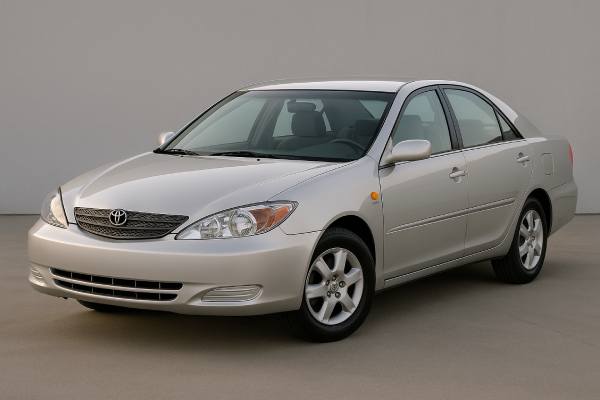
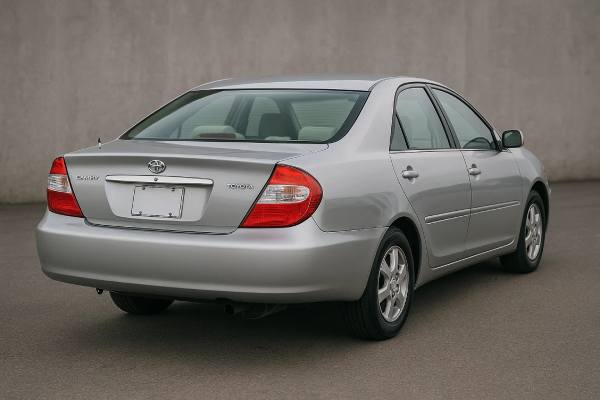
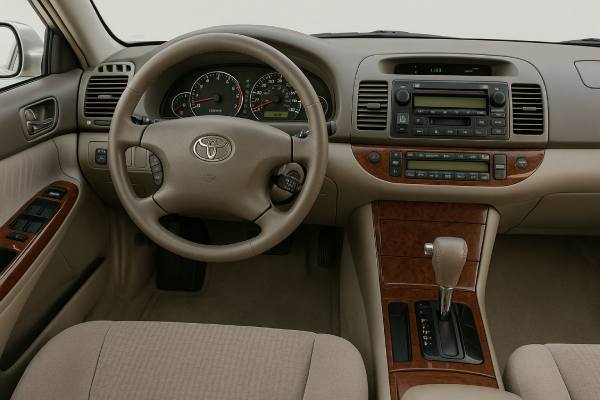
The sixth-generation Camry (chassis code MCV30 for the V6) is the template many midsize sedans still follow: large interior, quiet ride, and unburstable durability when maintained. The 1MZ-FE 3.0-liter V6 was the range’s refinement play—silky at idle, patient off the line, and confident at highway speeds. In this 2001–2004 window (sold mainly as 2002–2004 model years), output and equipment changed subtly by trim and market, but the core engineering remained: aluminum block and heads, dual overhead cams with four valves per cylinder, and Toyota’s variable valve timing (VVT-i) for broader torque. A 4-speed automatic and front-wheel drive were typical; the SE added firmer tuning and larger wheels without compromising everyday use. Safety performance improved midway through the run as side-structure updates arrived for 2004, especially meaningful when paired with the optional curtain and torso airbags. If you want a comfortable, long-life sedan with low running costs and parts availability almost everywhere, this is the pragmatic choice—just budget for routine timing-belt service and keep fluids fresh.
At a Glance
- Smooth, quiet V6 with relaxed highway character; abundant parts support and simple serviceability.
- Big-car cabin and trunk; ride comfort remains a standout on poor pavement.
- 2004 structure updates plus optional side airbags deliver strong crash protection when equipped.
- Watch timing-belt age/mileage and accessory-belt condition; address any fluid seepage early.
- Typical oil and filter service every 5,000 mi / 8,000 km (or 6 months), using the specified grade.
What’s inside
- Inside the MCV30 V6
- Camry V6 specs and data
- MCV30 trims, options, safety
- MCV30 reliability and fixes
- Care plan and buyer tips
- On-road performance and economy
- Camry V6 vs rivals
Inside the MCV30 V6
Toyota’s sixth-generation Camry moved the nameplate into true midsize territory. The MCV30 code denotes the 3.0-liter V6 variant using the 1MZ-FE engine with VVT-i on the intake cams. The block and heads are aluminum to save weight, with a timing belt driving the exhaust cams and a small gear set driving the intakes—an arrangement that keeps noise low and maintenance predictable. Compared with its predecessor, the MCV30 feels stiffer in the body, quieter at a cruise, and more efficient in packaging: adult-friendly rear legroom and a trunk large enough for two large suitcases plus a stroller.
The 1MZ-FE’s personality is understated—strong midrange pull rather than a dramatic top-end rush. Around town, light throttle and short gearing help the car glide away smoothly; at highway speeds, the engine settles under 2,500 rpm in top gear and becomes nearly invisible. A 4-speed electronically controlled automatic was the common pairing for this engine in the covered years. The SE trim tightens chassis responses with firmer springs/dampers and larger wheels, yet retains the platform’s signature ride compliance.
Safety content grew across the run. Anti-lock brakes were widely available, and traction/stability control (TRAC/VSC) could be specified on higher trims. Most important, Toyota hardened the side structure beginning in the 2004 model year; when combined with the optional front and rear head-curtain airbags and front torso airbags, the Camry achieved high marks in side-impact testing. If you are cross-shopping within this generation, prioritize cars that have the side-airbag package and documented recall completion.
Ownership highlights are predictably Toyota: straightforward fluids, easy access to filters and ignition components, and long-life consumables when quality parts are used. The V6 requires a timing-belt service on time and mileage, and proactive coolant and ATF changes keep the car feeling “tight” even as the odometer climbs. With rust prevention and suspension bushings refreshed as needed, an MCV30 V6 can realistically serve well past 200,000 miles / 320,000 km.
Camry V6 specs and data
Engine and Performance (1MZ-FE V6)
| Item | Spec |
|---|---|
| Code | 1MZ-FE (aluminum block/heads, VVT-i on intake cams) |
| Layout & valvetrain | 60° V6, DOHC, 24 valves (4 per cyl) |
| Displacement | 3.0 L (2,994 cc) |
| Induction & fuel | Naturally aspirated; sequential multi-port fuel injection |
| Compression ratio | 10.5:1 |
| Max power | 190–210 hp (142–157 kW), model-year/market dependent |
| Max torque | 267–298 Nm (197–220 lb-ft), typical peak ~4,400 rpm |
| Timing drive | Timing belt (exhaust cams) with inter-cam gear drive to intake cams |
| Rated economy (auto) | ~21 mpg combined (US) ≈ 11.2 L/100 km; ~18/27 mpg city/hwy (US) |
| Emissions/standard | Gasoline, OBD-II; compliant with contemporary EPA standards |
Transmission and Driveline
| Item | Spec |
|---|---|
| Transmission | 4-speed automatic, electronically controlled (typical pairing with 1MZ-FE in 2001–2004 window) |
| Drive type | FWD |
| Final drive | Model/trim dependent; open differential |
| Refuel time | Conventional gasoline; typical refill 5–10 minutes depending on pump rate |
Chassis and Dimensions
| Item | Spec |
|---|---|
| Suspension (F/R) | MacPherson strut / MacPherson strut |
| Steering | Rack-and-pinion, power assisted |
| Brakes | Front ventilated disc; rear disc (trim-dependent); ABS available |
| Wheels/Tires (common) | 16–17 in wheel packages; tires typically 205/65R16 to 215/60R16 (SE with sport sizes) |
| Ground clearance | Typical midsize sedan clearance; varies slightly by wheel/tire package |
| Length / Width / Height | ~4,815 mm / 1,795 mm / 1,480 mm (189.6 in / 70.7 in / 58.3 in) |
| Wheelbase | ~2,720 mm (107.1 in) |
| Turning circle | Approx. 11.3 m (37 ft), package-dependent |
| Curb weight | ~1,500–1,560 kg (3,307–3,439 lb), by trim/equipment |
| Fuel tank | 70 L (18.5 US gal / 15.4 Imp gal) |
| Cargo volume | ~473 L (16.7 ft³), sedan trunk |
Performance and Capability
| Metric | Typical Outcome |
|---|---|
| 0–100 km/h (0–62 mph) | ~8.0–8.5 s (road-test ranges with V6/auto) |
| Top speed | Governed to typical class norms |
| Braking 100–0 km/h | Class-competitive with quality tires; ABS tuning favors stability |
| Towing | Light-duty only (check local ratings and equipment; hitch/brake setup required) |
| Roof load | Use manufacturer crossbar ratings; avoid heavy dynamic loads |
Fluids and Service Capacities (high-level)
| System | Specification (typical) |
|---|---|
| Engine oil | 5W-30, API SL or better; typical refill ~4.7 L (5.0 US qt) with filter |
| Coolant | Toyota Super Long Life Coolant (pink); 50/50 premix; system capacity varies by trim |
| ATF (auto) | Toyota ATF Type T-IV (for period transmissions); service quantity varies (drain-and-fill vs. exchange) |
| A/C refrigerant | R-134a; charge quantity per under-hood label |
| Spark plugs | Long-life iridium; factory heat range; 1.0–1.1 mm (0.039–0.043 in) gap |
Electrical
| Item | Spec |
|---|---|
| Alternator | Sufficient output for HVAC/audio loads; exact amperage varies by equipment package |
| 12V battery | Group size common to class; verify CCA per climate |
| Ignition | Coil-on-plug |
Safety and Driver Assistance
| Area | Details |
|---|---|
| Crash ratings (side with airbags) | Strong side-impact results when equipped with optional curtains/torso airbags; good moderate-overlap frontal |
| Head restraints/seats | Mid-pack for the era |
| ADAS | Pre-AEB era: ABS available/standard by trim; TRAC/VSC available or standard on select V6 trims; no adaptive cruise or lane support |
Notes: Dimensions, weights, fuel capacity, and engine output vary slightly by trim, equipment, and market. Always verify by VIN and build sheet.
MCV30 trims, options, safety
Trim landscape (V6 focus). Common V6 grades included LE V6, XLE V6, and SE V6. The LE emphasized value and comfort; cloth seats, power features, and alloy wheels were typical. XLE layered on luxury touches—automatic climate control, upgraded audio, wood-tone accents—and often bundled side-airbag options. The SE V6 delivered a firmer chassis tune, unique wheels, and subtle bodywork tweaks; steering and damping feel notably more tied-down without sacrificing long-distance comfort.
Mechanical differences that matter. SE V6 cars often paired the sport suspension with larger wheel/tire packages that improve lateral grip and braking feel. Some V6 trims offered stability control (VSC) and traction control (TRAC), and these systems were standard in certain top-line packages. If you drive in snow/rain, seek a car with VSC/TRAC; the added yaw/traction management makes the car calmer in evasive maneuvers.
Year-to-year highlights. The most significant running change for the covered span is the 2004 side-structure update, which improved side-impact performance, especially on cars equipped with the optional curtain and torso airbags. Wheel designs, audio head units, and minor interior fabrics also evolved, but these are secondary to safety content when you are shopping used.
Safety equipment and ratings. Dual front airbags were standard. Side airbags—front torso and curtain—were optional in many trims and transformed the Camry’s side-impact performance from poor (without) to good (with). Four-channel ABS was widely fitted; brake assist and electronic brake-force distribution (EBD) supported panic stops. Head-restraint performance is fair-to-middling for the era; consider aftermarket seatback adjustments if you need more head support.
Child-seat and restraints. LATCH anchors are present in the rear outboard positions. The rear bench’s geometry is friendly to most infant and convertible seats, but always test-fit; base-to-buckle clearance and seat-track travel can vary by seat brand. The 2004 recall related to the passenger-seat buckle status switch (on certain power seats) is relevant for child-seat users—check recall completion before purchase.
Identifiers and build clues. VIN 5th–8th characters will confirm engine/transmission/driveline; the under-hood emissions label lists engine family and useful service info. The trunk floor and front strut towers carry option and color codes. SE-specific steering wheel, gauge accents, and seat fabrics are easy tells in the cabin; XLE’s auto-climate control and wood-tone trim are similarly obvious.
MCV30 reliability and fixes
Overall take: The 1MZ-FE V6 is a long-duration engine when kept on time-and-mileage maintenance. Failures tend to be maintenance-driven rather than design-driven. Cooling, belts, and seals deserve the most attention at age.
Common / occasional / rare patterns (with typical mileage/age):
- Common (100k–180k mi / 160k–290k km):
- Timing-belt age-out → belt cracking/noise; water pump seepage → Remedy: timing-belt kit with idler/tensioner and water pump; replace cam/crank seals if damp; reset base timing.
- Valve cover and cam seal weep → burning-oil smell on exhaust, damp front timing cover → Remedy: seals and valve-cover gaskets with proper torque; inspect PCV operation.
- Strut mount/bushing wear → front-end clunks, floaty ride → Remedy: quality struts/mounts/bushings; verify alignment afterward.
- A/C clutch gap or relay → intermittent cooling → Remedy: confirm clutch air gap, relay function; recharge only after verified leak check.
- Occasional (90k–150k mi / 145k–240k km):
- Radiator end-tank age cracks / heater-hose junctions → coolant odor or drop → Remedy: quality radiator, fresh clamps/hoses; renew thermostat and cap.
- Alternator output drop → battery light at idle with loads → Remedy: test/replace alternator; clean chassis/engine grounds.
- Rare but consequential:
- ATF neglect on 4-speed auto → torque-converter shudder, shift flare → Remedy: progressive drain-and-fills with the correct ATF; if no improvement, specialist evaluation.
- ABS tone-ring corrosion (road-salt states) → intermittent ABS light at low speed → Remedy: inspect tone rings and sensors; replace affected hub/sensor.
Recalls and service actions to verify (by VIN):
- Curtain shield airbags (2004 campaign) — twisted airbag near inflator may delay deployment; inspection/replacement campaign.
- Front passenger seat-belt buckle status switch (2004 campaign on certain power-seat cars) — may misreport status with specific rear-facing bases; dealer remedy replaces/retains the switch with proper retention.
Pre-purchase inspection checklist (prioritize):
- Proof of timing-belt replacement (date/mileage) and any water-pump/seal work.
- Engine bay dry? Check cam covers, front crank seal, oil cooler O-ring.
- Cooling system pressure test; radiator tanks and heater-hose junctions for age.
- ATF color/odor and service history; shift quality on extended drive, including steady-speed 40–50 mph light throttle.
- Suspension: struts/mounts, control-arm bushings, rear links, wheel bearings.
- Brakes: rotor thickness/runout; even pad wear; confirm ABS operation.
- Body: front subframe and rocker seams for corrosion (road-salt areas).
- Safety: side-airbag presence (look for “SRS Curtain Airbag” tags) and recall completion printout.
Cost outlook: Most preventative items are affordable with aftermarket/OE-equivalent parts. The timing-belt service is the big ticket, but it resets the clock on multiple wear items. Proper fluids and a fresh cooling system are the best investments for preserving this platform.
Care plan and buyer tips
Baseline schedule (time/distance; adjust for climate/severity):
- Engine oil + filter: every 5,000 mi / 8,000 km or 6 months (5W-30 meeting API SL or newer).
- Engine air filter: inspect 10,000 mi / 16,000 km; replace 30,000–40,000 mi / 48,000–64,000 km.
- Cabin filter: 15,000–20,000 mi / 24,000–32,000 km (sooner in dusty or urban stop-and-go).
- Coolant (SLLC pink): replace at 100,000 mi / 160,000 km or 8 years first, then every 50,000 mi / 80,000 km or 4–5 years.
- Spark plugs (iridium): 120,000 mi / 192,000 km typical; inspect earlier if misfire under load.
- Fuel filter: in-tank on most trims; service only if pressure/flow tests fail.
- Timing belt (plus water pump, idler, tensioner): 90,000–105,000 mi / 144,000–168,000 km or 7–8 years, whichever comes first.
- Serpentine/aux belt and hoses: inspect annually; replace with cracking, glazing, or swelling.
- ATF (auto): drain-and-fill every 30,000–60,000 mi / 48,000–96,000 km; use the specified ATF.
- Brake fluid: 2–3 years regardless of miles; moisture content check at annual service.
- Brake pads/rotors: inspect each tire rotation; measure rotor thickness and runout.
- Alignment + tire rotation: 5,000–7,500 mi / 8,000–12,000 km; watch inside edge wear on SE setups.
- 12V battery: load test annually after year 4; expect 5–7 years in moderate climates.
Key fluid notes (decision-makers):
- Oil capacity with filter is ~4.7 L (5.0 US qt).
- ATF must match the transmission spec (period units typically call for Toyota ATF Type T-IV).
- Coolant is Toyota Super Long Life (pink); avoid mixing types—if unknown, fully exchange.
Buyer’s short list (what to seek/avoid):
- Seek: documented timing-belt service; cars with side airbags (curtain/torso) and, ideally, VSC/TRAC; clean service history with regular coolant and ATF changes.
- Nice-to-have: SE V6 for slightly firmer handling; XLE V6 if you value quieter cabin and features.
- Avoid or price accordingly: overdue belt/cooling service; active coolant or ATF leaks; neglected suspension (clunks, uneven tire wear); incomplete recall history.
Longevity outlook: With routine maintenance and attention to seals and cooling, the MCV30 V6 is easily a 15–20-year, 200k-plus mile car. The powertrain shows little appetite for internal failures when fluids are kept clean and components are serviced preventively.
On-road performance and economy
Ride and NVH. The Camry’s calling card is calm isolation without float. Over expansion joints, the body’s secondary motions are quickly settled, and road roar is muted—especially on touring-oriented tires. Wind noise stays low at legal freeway speeds; the V6’s subdued hum only becomes prominent at deep throttle.
Steering and handling. Steering effort is light at parking speeds and gently weights up around center on the highway. Turn-in is measured rather than eager; the SE’s firmer calibration adds discipline in quick transitions and trims body roll. Stability control (where fitted) intervenes early on slick surfaces, prioritizing safe understeer. Brakes feel consistent and are easy to modulate; fresh fluid and quality pads restore “new-car” confidence on older examples.
Powertrain character. The 1MZ-FE prefers smoothness over theater. Step-off is clean, and midrange torque makes urban merges low-stress. Paired to the 4-speed automatic, kickdown is timely; plan your passes one beat earlier than you would in a modern 8- or 10-speed car. Keep the transmission serviced and the throttle body clean and the combination remains silk-gloved.
Real-world economy. Owners typically see high-teens mpg (US) in dense city use and mid-20s on the highway at 65–70 mph; 21 mpg combined is a realistic baseline for a healthy car on the stock wheel/tire packages. Expect a modest winter penalty in short-trip, cold-start driving. Tire choice and alignment matter: low-rolling-resistance touring tires and a fresh alignment can add 1–2 mpg on the same routes.
Useful metrics for the shopper. A strong V6/auto Camry will accelerate to highway speeds smartly (roughly eight seconds to 60 mph), track straight hands-off on a flat road, and stop without pulsing or pull. If a test drive reveals hunting between 3rd/4th at a steady 40–45 mph, budget an ATF service and, if needed, a shift-adapt reset.
Camry V6 vs rivals
Honda Accord V6 (2003–2004). The J-series 3.0 V6 is stronger on paper and livelier off the line, and later cars offered a 6-speed manual. Cabin space is similar, and handling feels more connected. However, some years of Accord automatic transmissions are sensitive to fluid neglect; camshaft-driven timing belt service is similar in cost to the Camry’s.
Nissan Altima 3.5 (2002–2004). Big power from the VQ35 and an edgier chassis tune make it the enthusiast’s pick in this trio. Interior finish and long-term cabin wear trail the Camry, and insurance costs can be higher. Front suspension bushings typically need earlier attention than Toyota’s.
Hyundai Sonata V6 (2002–2004). Attractive pricing and long warranties when new; used examples can be tempting value buys. Ride/handling and interior durability improved during this era but still lag Toyota and Honda. Parts availability is fine, but resale and brand-agnostic shop familiarity favor the Camry.
Why the Camry V6 endures. It is the least demanding to live with over a long ownership period: straightforward maintenance, excellent parts ecosystem, and a chassis that remains comfortable after a decade. If you want sport, the Accord V6 in manual guise wins. If you want pace, the Altima 3.5 is punchier. If you want predictability for the next 100,000 miles, the MCV30 V6 is still the safest bet.
References
- 2004 Camry Features and Specifications 2004 (Features and Specifications)
- 2004 Toyota Camry 2004 (Safety Rating)
- 2003 Toyota Camry 2003 (EPA Fuel Economy)
- 04V-595 2004 (Recall Database)
- 2004 Scheduled Maintenance Guide 2004 (Owner’s Maintenance Guide)
Disclaimer
This article is for informational purposes and is not a substitute for professional diagnosis or repair. Specifications, torque values, capacities, and service intervals vary by VIN, model year, market, and equipment. Always verify against your vehicle’s official service information and labels, and follow manufacturer procedures. If you found this guide useful, please consider sharing it with fellow owners on Facebook or X/Twitter—your support helps xcar keep producing detailed, people-first resources.