
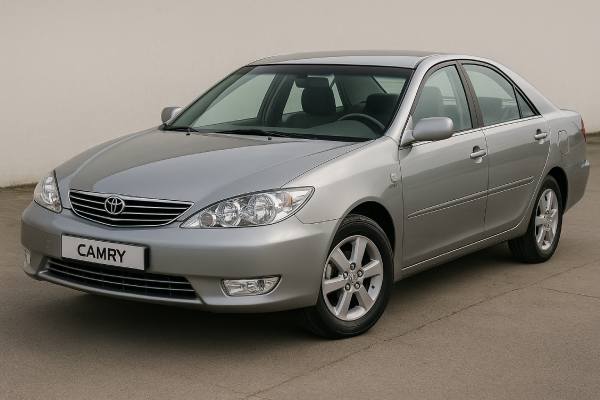
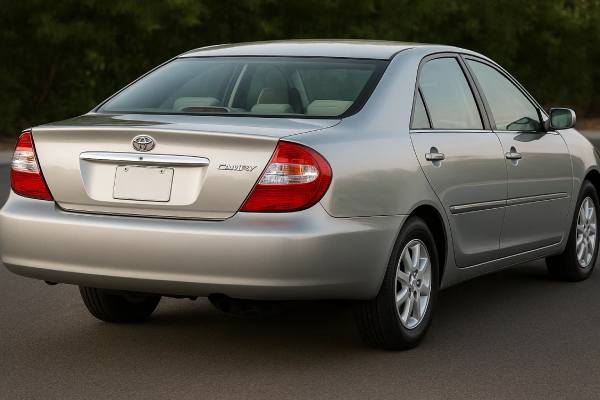
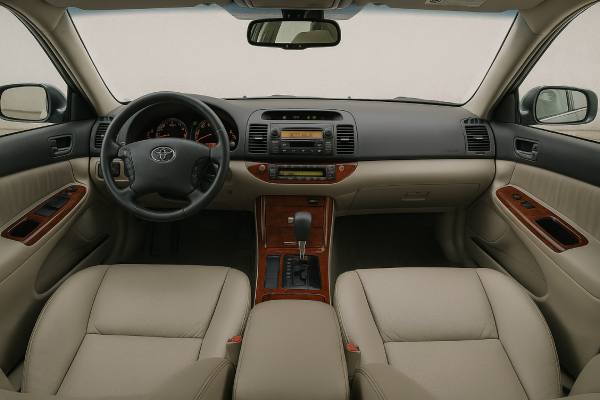
The 2005–2006 facelift of the XV30-generation Toyota Camry is one of those mid-cycle updates that quietly fixes small things and adds the right equipment without disturbing what made the car successful. In this case, the 3.3-litre 3MZ-FE V6 stayed the hero engine, but the calibration lined up with the facelifted styling, updated interior details, and improved safety content. Output sat at about 210 hp in this application—slightly below the earlier 225 hp tune found in some 2004 configurations, but still comfortably ahead of the four-cylinder cars and fully adequate for U.S. highway speeds with passengers and luggage.
What makes the 2005–2006 Camry V6 particularly attractive on the used market is the combination of: mature powertrain, typically higher trim levels, widely available side and curtain airbags, and the fact that these cars are now old enough that many have complete service histories. If you confirm the timing belt, coolant, and transmission fluid were done on time, you get a very comfortable, quiet, and still-easy-to-service family sedan. For shoppers comparing older Accords, Altimas, or Sonatas, the facelift V6 Camry is the low-risk play.
Top Highlights
- Refreshed XV30 with 3.3-litre 3MZ-FE V6 rated around 210 hp (2005–2006) for strong, quiet acceleration.
- Usually sold in better-equipped trims (XLE V6, SE V6) with side and curtain airbags, ABS, and available stability control.
- Proven Toyota V6/5-speed automatic combination; timing belt is the key scheduled item.
- Watch for age-related fluid neglect, oil seep at covers, and worn suspension mounts/bushings.
- Engine oil and filter every 5,000–7,500 miles (8,000–12,000 km) or 6–12 months depending on duty cycle.
What’s inside
- Facelift MCV31 overview
- MCV31 specifications and data
- Trims, options and safety 2005–2006
- Reliability and service actions
- Maintenance and buyer’s guide
- Driving and performance
- Camry 3.3 vs competitors
Facelift MCV31 overview
When Toyota facelifted the XV30 Camry for the 2005 model year, it kept the underlying platform and packaging but refreshed the exterior with revised front and rear treatments, updated lamps, and trim that aligned better with mid-2000s Toyota design. Inside, materials and colorways were cleaned up, and option packaging grew clearer: four-cylinder models aimed at value and fleet, V6 models aimed at comfort and higher features. The 3.3-litre MCV31 sits squarely in that second group.
The engine is the same 3MZ-FE family unit: an all-aluminium 60° DOHC V6 with 24 valves and VVT-i on the intake side. In this 2005–2006 Camry configuration, it’s rated at roughly 210 hp (157 kW) and about 220–230 lb-ft (300–312 Nm) of torque depending on emissions package and market. That is a tiny step down from the peak 225 hp applications but still more than enough to make the Camry feel eager at part throttle. What most owners notice is not the raw number but how easily the car responds with two or three people aboard—there is simply less waiting, less downshifting, and less engine noise than in 2.4-litre cars.
This V6 drives the front wheels through a 5-speed automatic transmission of the U151E family. By the facelift years, Toyota had good field experience with this gearbox. It likes clean ATF and does best with periodic drain-and-fills rather than lifetime use. Shifts are smooth and well spaced for North American speed limits. At 70 mph (113 km/h) it keeps revs relaxed, which helps both fuel economy and engine life.
Chassis hardware remains simple: MacPherson struts at both ends, anti-roll bars, power rack-and-pinion steering, four-wheel disc brakes (vented fronts) with ABS. This is one reason these cars are so easy to own at 20 years old—there is no air suspension, no active roll system, no complex multi-link rear to fight rust. When dampers and mounts age, you fit new ones and the ride is restored. Even the SE V6, which gets firmer settings and sportier wheel/tire packages, stays well inside the comfort envelope.
The facelift also coincides with wider installation of side torso and curtain airbags, plus increased availability of TRAC/VSC. That matters for value: many families and second-car buyers in 2025 want at least six airbags and some form of stability control. A 2005–2006 V6 Camry can tick those boxes, while a 2002 sedan next to it in the classifieds may not.
Overall, the 2005–2006 MCV31 is best understood as a peak-maturity XV30 Camry. It has the strong engine, the better-looking body, the more complete safety kit, and the same straightforward serviceability. If you can document the timing belt/water pump and transmission fluid, it is a very low-risk sedan.
MCV31 specifications and data
The tables below reflect a typical 2005–2006 Toyota Camry V6 (MCV31) with the 3.3-litre 3MZ-FE, 5-speed automatic, and front-wheel drive, in North American specification. Minor variations by trim, emissions family, and market are normal; always confirm by VIN and the under-hood emissions label.
Engine and Performance
| Item | Specification |
|---|---|
| Engine code | 3MZ-FE |
| Type | 60° V6, aluminium block and heads, DOHC, 24 valves |
| Displacement | 3.3 l (3,311 cc) |
| Bore × stroke | 92.0 × 83.0 mm (3.62 × 3.27 in) |
| Induction | Naturally aspirated |
| Valve timing | VVT-i on intake |
| Compression ratio | ≈10.8:1 |
| Max power | 210 hp (157 kW) @ ~5,600 rpm |
| Max torque | ≈ 220–230 lb-ft (300–312 Nm) @ ~3,600–3,900 rpm |
| Fuel system | Sequential multi-port fuel injection |
| Fuel | Regular unleaded, follow octane in owner’s manual |
| Timing drive | Belt, replace at interval |
| Emissions standard | U.S. federal / California variants, 2005–2006 |
| Rated economy (EPA era) | ~19–20 mpg US city / 28–29 mpg US highway (12.4–8.1 L/100 km) |
| Real-world highway @ 120 km/h (75 mph) | 8.5–9.5 L/100 km (25–28 mpg US), vehicle in good tune |
| Aerodynamic Cd | ≈0.29 (sedan) |
Why the 210 hp figure? The facelift years aligned power ratings with emissions and noise standards; the slight reduction is calibration, not a sign of a weaker long-term engine. In practice, owners will not feel the difference from a healthy 2004 225 hp car.
Transmission and Driveline
| Item | Specification |
|---|---|
| Transmission | 5-speed automatic, U151E family |
| Gear ratios (typical) | 1st 3.94 · 2nd 2.19 · 3rd 1.49 · 4th 1.00 · 5th 0.73 · Rev 3.14 |
| Final drive | ≈3.29–3.48 depending on calibration |
| Drive layout | Front-wheel drive |
| Differential | Open |
| ATF | Toyota ATF Type T-IV recommended for period |
| Refuel to full | <5 min at pump, 70 l tank |
Chassis and Dimensions
| Item | Specification |
|---|---|
| Platform | XV30, front engine / FWD |
| Front suspension | MacPherson strut, coil spring, anti-roll bar |
| Rear suspension | MacPherson strut, coil spring, anti-roll bar |
| Steering | Power rack-and-pinion |
| Brakes | Front ventilated discs, rear solid discs, ABS standard/available |
| Wheel/tire (common) | 16-in alloy, 215/60R16; SE may use sportier package |
| Length | ≈4,815 mm (189.6 in) |
| Width | ≈1,795 mm (70.7 in) |
| Height | ≈1,480 mm (58.3 in) |
| Wheelbase | 2,720 mm (107.1 in) |
| Ground clearance | ≈140 mm (5.5 in) |
| Turning circle | ≈11.3 m (37 ft) |
| Curb weight | ≈1,530–1,600 kg (3,373–3,527 lb) |
| GVWR | ≈2,000 kg (4,409 lb) |
| Fuel tank | 70 l (18.5 US gal / 15.4 UK gal) |
| Cargo volume (SAE) | 473 l (16.7 ft³) sedan trunk |
Performance and Capability
| Metric | Value |
|---|---|
| 0–60 mph (0–97 km/h) | ≈7.4–7.8 s (healthy car, normal load) |
| 0–100 km/h (0–62 mph) | ≈7.8–8.2 s |
| Top speed | Limited to sedan-appropriate level |
| 100–0 km/h braking | Low-to-mid 40 m on good tires |
| Towing | Light utility only; consult local rating and add trans service if towing regularly |
| Roof load | Keep to OE crossbar spec, ≈68 kg (150 lb) recommended ceiling |
Fluids and Service Capacities
| System | Specification | Capacity (approx.) |
|---|---|---|
| Engine oil | 5W-30, API SL/SM | ~5.0 l (5.3 US qt) with filter |
| Cooling system | Toyota Super Long Life (pink), 50/50 | ~7.0 l (7.4 US qt) |
| Automatic transmission | Toyota ATF Type T-IV | ~3.5–4.0 l (3.7–4.2 US qt) per drain-and-fill |
| Power steering | ATF-type fluid, check label | Fill to mark |
| A/C refrigerant | R-134a | ~0.55 kg (19 oz), confirm on label |
| A/C compressor oil | ND-Oil 8 / PAG46 | ~120 ml (4 fl oz) |
| Key torque values | Wheel lugs 103 Nm (76 lb-ft); drain plugs ~40–44 Nm (30–33 lb-ft) |
Electrical
| Item | Specification |
|---|---|
| Alternator output | ≈100 A (trim-dependent) |
| Battery | Group 24/24F typical, ≈550–650 CCA |
| Spark plugs | Long-life iridium, 1.0–1.1 mm (0.039–0.043 in) gap |
Safety and Driver Assistance
| Feature | Facelift 2005–2006 availability |
|---|---|
| Dual front airbags | Standard |
| Front seat-mounted side airbags | Standard or widely available |
| Side curtain airbags | Common on higher trims/packages |
| ABS with EBD | Standard/widely available |
| Traction control (TRAC) | Available/packaged with VSC |
| Vehicle Stability Control (VSC) | Available, very desirable on used market |
| Child-seat (LATCH) | Rear outboard |
| Headlights | Halogen, era-typical performance |
Trims, options and safety 2005–2006
In the facelift years, Toyota organised Camry trims in a way that makes V6 hunting quite straightforward. Most 3.3 cars will be LE V6, SE V6, or XLE V6, with option packages driving safety and convenience content.
LE V6 (3.3)
- Targeted at buyers who wanted the big engine without full luxury trim.
- Power driver seat, cruise, upgraded audio, automatic transmission.
- ABS expected.
- Side/curtain airbags may be optional—verify by inspection.
- Cloth interior, simpler wheel designs.
SE V6 (3.3)
- Sportier suspension tuning versus LE/XLE—firmer struts, slightly stiffer bars.
- Sport exterior cues: grille, spoiler, darker trim, sometimes 17-in wheels.
- Same core safety content; still a Camry in comfort terms.
- Good pick for drivers who find standard Camry steering too light.
XLE V6 (3.3)
- The most complete car: auto climate control, JBL or other premium audio, power passenger seat, sunroof on many, wood-tone or metallic interior accents.
- Side and curtain airbags are far more common here.
- VSC/TRAC more frequently optioned.
- Many XLEs were dealer-maintained, so belt/water pump may already be done.
Equipment and identifiers to check:
- Airbag labels on seats and headliner.
- VSC/TRAC switch or indicator during key-on bulb check.
- VIN/build sticker for plant and option codes; useful if you are aligning with TSB applicability.
- Wheel/tire size to match speedometer and ABS tuning.
Safety ratings logic for this era:
- With side/curtain airbags, the 2005–2006 Camry performs significantly better in side-impact contexts than early, no-airbag cars.
- Frontal performance was already a Camry strength.
- Stability control, when fitted, is a meaningful upgrade for wet or mixed-surface driving, especially with the torque of the 3.3.
Service and ADAS implications:
- No radar-based AEB, no lane-keeping, no ACC—so collision repairs are simpler.
- After SRS work, do the usual lamp check and scan for codes.
- After steering and suspension work, recalibrate steering angle if the scan tool calls for it (some systems tie VSC intervention to steering input).
- After windshield replacement, verify rain/light sensor (if fitted) and that no SRS/ABS/VSC lamps are on.
Year-to-year nuances (2005 → 2006):
- Cosmetic tweaks, colors, audio and trim availability shifts.
- Equipment packaging can move VSC from optional to more widely available, but this is dealer- and region-dependent.
- Powertrain stays the same: 3.3 V6, 5AT, FWD.
Reliability and service actions
The facelift does not radically change the Camry’s mechanical story. What you encounter at 20 years old is mostly age, mileage, and maintenance-quality, not basic design flaws.
Very common / lower severity:
- Timing belt overdue or undocumented. Because the engine uses a belt, an undocumented car must be treated as due. Replace belt, tensioner, idler, and water pump; inspect cam/crank seals and drive belts.
- Valve cover gasket seep. Small oil smell or dampness on the rear bank. Replace gaskets, renew PCV, clean the area.
- Engine mounts tired. Thump on gear engagement or more vibration at idle. Replace the main mounts; the improvement in refinement is noticeable.
- Strut/mount wear. Aged struts lead to floaty ride and front-end clunking over speed bumps. Fit quality struts and mounts.
Occasional / medium severity:
- ATF aging → shift quality issues. Cold flare, slightly delayed engagement, or harsher 2–3 can often be improved with two or three drain-and-fills of the correct Toyota ATF. Avoid aggressive flushing on unknown gearboxes.
- Cooling system ageing. Original radiator, hoses, and thermostat are now two decades old. Do a cooling-system refresh—radiator, hoses, thermostat, cap, and correct pink SLLC.
- Power-steering seep. Pump or return-line dampness is not unusual. Replace the affected part, refill, and bleed.
Less frequent / higher awareness:
- ABS or TRAC/VSC lights in rust-belt cars due to wheel-speed sensor or tone-ring corrosion. Clean or replace as necessary; inspect wiring.
- A/C performance drops from low refrigerant charge or aged condenser. Leak-test, recharge to spec, and check condenser fins for damage.
- Exhaust hardware/rubber hangers perishing—typical age item, straightforward to fix.
Service actions to confirm:
- Any SRS- or seatbelt-related campaigns that applied to 2005–2006 cars.
- ECM/software updates that improved driveability or addressed specific diagnostics.
- Dealer or owner-performed timing belt/water pump service, ideally with invoice.
- Evidence of regular coolant and ATF care.
Pre-purchase verification list:
- Start from cold and idle for 5–10 minutes—should stay smooth and not overheat.
- Key-on bulb check for SRS, ABS, VSC/TRAC—every light must come on, then go out.
- Full-throttle kickdown test from 40–60 mph to ensure transmission doesn’t flare.
- Check undercarriage and subframes for corrosion, especially in snowy regions.
- Check trunk floor and taillight seals for water ingress.
- Check sunroof drains (if fitted) for blockage.
- Ask for timing-belt invoice and coolant brand used.
Maintenance and buyer’s guide
A 2005–2006 Camry V6 is at its best when serviced to Toyota timing rather than stretched to “lifetime” intervals.
Practical maintenance schedule
- Engine oil and filter: 5,000–7,500 miles (8,000–12,000 km) or 6–12 months, 5W-30 SL/SM. Shorter interval for city/short trips.
- Engine air filter: Inspect at 15,000 miles (24,000 km); replace 30,000 miles (48,000 km) or sooner for dusty areas.
- Cabin filter: 15,000–30,000 miles (24,000–48,000 km).
- Spark plugs (iridium): 120,000 miles (193,000 km) or as stated in the manual.
- Coolant (Toyota SLLC pink): First at ~100,000 miles (160,000 km) / up to 8–10 years, then every 50,000 miles (80,000 km) / 4–5 years.
- Timing belt + water pump: 90,000–105,000 miles (144,000–168,000 km) or 7–8 years. Treat unknown as due.
- Serpentine/aux belt: Inspect yearly after 60,000 miles; replace on cracks/glazing.
- ATF (5AT): Drain-and-fill every 30,000–60,000 miles (48,000–96,000 km).
- Brake fluid: Every 2–3 years.
- Brake inspection: Every tyre rotation—check pads, slides, and rear calipers.
- Tyre rotation: 5,000–7,500 miles (8,000–12,000 km).
- Alignment: Annually or after suspension work.
- 12 V battery: Test yearly after year 4; 5–7 years typical life.
Fluid, capacity, torque reminders
- Oil: ~5.0 l (5.3 qt) 5W-30, filter included.
- ATF: 3.5–4.0 l (3.7–4.2 qt) per drain, Toyota ATF Type T-IV.
- Coolant: ~7.0 l (7.4 qt) Toyota SLLC (pink).
- Tyre pressure: door-jamb value, often 30–32 psi (207–221 kPa).
- Wheel lugs: 103 Nm (76 lb-ft).
Buyer’s inspection checklist
- Exterior: Even panel gaps, stone chips on hood/front bumper (normal), no headlight haze or, if present, budget for refinishing.
- Interior: All HVAC modes work, A/C blows cold, audio and steering-wheel controls functional, sunroof (if fitted) smooth and dry.
- Under hood: No milky coolant, no mixed coolant colors, no oil at the bottom of the timing cover.
- Underneath: No wet ATF at pan and axle seals, no severe subframe rust, no leaking struts.
- Test drive: Transmission engages quickly from P to D/R, no clunk; at 60–70 mph car tracks straight; brakes stop straight.
- Paperwork: Timing belt, coolant, ATF, and brakes with dates/mileage; recall/TSB confirmation.
What to look for in this facelift specifically
- 2005–2006 car with side/curtain airbags.
- VSC/TRAC present (strong resale argument, real safety benefit).
- XLE V6 or SE V6 that has had suspension work already—saves you from doing it.
- One- or two-owner history, not a bounced-around fleet car.
What to price down
- No timing-belt proof.
- ATF brown/burnt or no record at all.
- Persistent ABS/VSC lamp.
- Cracked dash or headliner stains from sunroof drains.
Durability outlook
With correct fluids and cooling, the 3MZ-FE V6 and the XV30 body both age gracefully. 200,000–250,000 miles (320,000–400,000 km) is realistic; the items that get replaced are normal wear: struts, mounts, brakes, tyres, belts, hoses, radiator, alternator. Because it is FWD and relatively light, front-end components see more work in city driving—budget accordingly.
Driving and performance
On the road, the 2005–2006 Camry V6 feels exactly like what it is: a mature family sedan with more engine than strictly necessary. The 3.3 pulls from low revs, so you can roll through traffic without flooring it. The 5AT keeps the engine quiet—at highway speeds you hear more road than engine, and even that is modest if the tyres are fresh and the door seals are in good shape.
Ride and NVH. The facelift cars retain the soft, absorbent ride that made XV30 Camrys so popular. Expansion joints, patched asphalt, and suburban speed bumps are taken in stride. SE trims add discipline; they don’t turn the Camry into a sports sedan, but they cut body roll and make steering inputs feel more immediate. Wind noise is well managed for a 2005–2006 car.
Steering and handling. Steering is light and family-friendly. On-centre feel is adequate, and straight-line stability is good enough for long interstates. The car will understeer when pushed, but this is predictable and easily controlled. With VSC, any over-ambitious entry speed in the wet will be nudged back into line.
Braking. Four-wheel discs and ABS provide consistent stops. On a 20-year-old car, performance depends on rotor condition, pad quality, and whether the caliper slides have been cleaned and lubricated recently.
Acceleration and passing. The 210 hp tune has no trouble reaching 60 mph in the 7–8 second window. Passing from 50–70 mph is also easy: the 5AT downshifts briskly, the V6 pulls, and you complete the maneuver without drama. Loaded with people and cargo, the difference versus a 2.4 four-cylinder Camry is obvious—fewer downshifts, less noise.
Real-world economy. City-heavy users may see 18–20 mpg US (13.1–11.8 L/100 km). Mixed use is often 21–23 mpg US (11.2–10.2 L/100 km). Good highway runs at legal speeds can touch 27–29 mpg US (8.7–8.1 L/100 km). Winter, short trips, roof racks, and wide tyres will all trim these numbers.
Towing and load. For light trailers, bikes, or cargo carriers, this V6 is the one to have. Stay within the factory rating, keep speeds sensible, and bring the transmission and cooling system up to date first.
Camry 3.3 vs competitors
Honda Accord V6 (2005–2006)
- Accord feels a bit more athletic and rev-happy.
- Interior design is sportier, but road noise is often higher.
- Some Accord automatics of the era can be more sensitive to fluid neglect than Toyota’s unit.
- Camry wins on serenity and, in many cases, on available curtain airbags in real used examples.
Nissan Altima 3.5 (2005–2006)
- Stronger straight-line performance from the VQ35.
- Cabin and trim ageing often not as tidy as Camry.
- Suspension tuning is firmer; some will prefer it, some won’t.
- Camry favoured for long-term parts availability and simplicity.
Hyundai Sonata (NF, 2006 start)
- Good value and equipment, strong corrosion protection.
- Early resale and perception lag the Camry.
- Camry still the safer choice if buying older and high-mileage.
Toyota Avalon (same era)
- If you like this engine and want more space and plushness, the Avalon of the period is a logical step up.
- Camry, however, is simpler to park, lighter, and often cheaper to insure.
Takeaway: the 2005–2006 Camry V6 is not the sportiest, but it is usually the easiest to live with at 150,000+ miles. That is why it still sells well as a used car in North America.
References
- 2005 Camry Owner’s Manual 2005 (Owner’s Manual)
- 2006 Camry Owner’s Manual 2006 (Owner’s Manual)
- Gas Mileage of 2006 Toyota Camry 2006 (Fuel Economy)
- 2006 Toyota Camry 4-door sedan 2006 (Safety Rating)
Disclaimer
This article is for informational purposes only and does not replace professional diagnosis, factory repair procedures, or model-specific bulletins. Specifications, torque values, capacities, and service intervals can vary by VIN, production month, emissions package, market, and installed options. Always verify against official Toyota service information and the documentation supplied with the individual vehicle. If this guide was useful, please consider sharing it on Facebook or X/Twitter to support xcar’s work.