
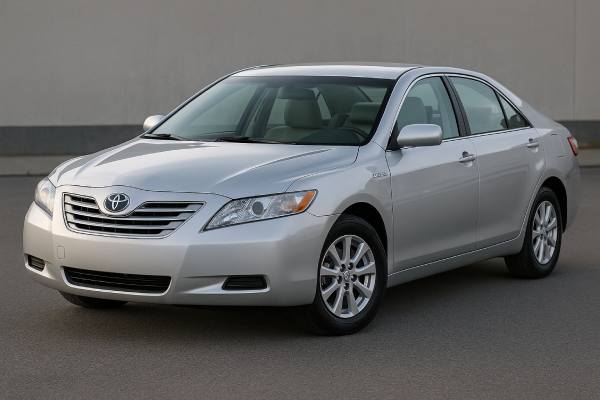
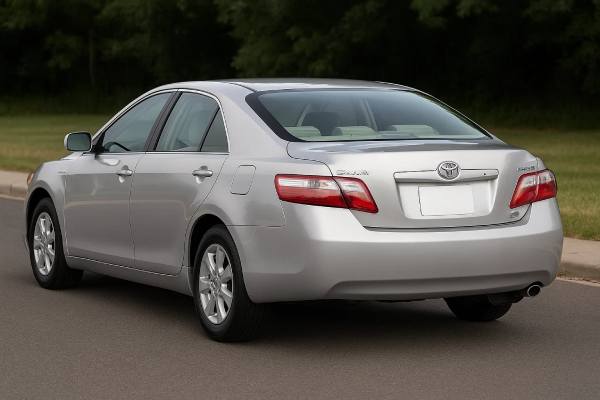
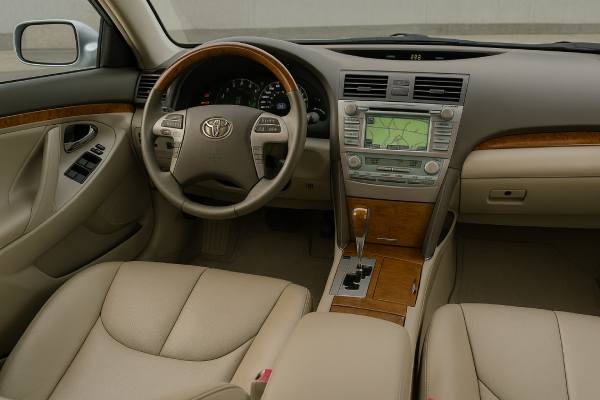
Toyota’s first Camry Hybrid for the North American market arrived for 2007 (launched in 2006) and immediately filled the space between the ultra-efficient Prius and the mainstream gasoline Camry. Built on the same XV40/ACV40 architecture, the hybrid (internal code AHV40) used Toyota’s Hybrid Synergy Drive paired with an Atkinson-cycle 2AZ-FXE 2.4-litre engine, for a combined system output of about 187 hp (140 kW). That meant this Camry could accelerate more briskly than the four-cylinder gasoline version while delivering city fuel economy that was, at the time, in a different league for a midsize sedan. For families, it felt like a normal Camry—quiet, roomy, safe—but with fewer fuel stops.
The engineering difference is substantial: high-voltage (HV) battery under/behind the rear seat, power-split eCVT transaxle, electric A/C compressor, electric water pump, DC–DC converter, and hybrid control computers. That brings hybrid-specific maintenance and inspection needs, but Toyota designed this generation for long service life. Today, the best buys are cars with documented coolant and inverter-cooling service, a healthy HV battery, and no hybrid warning lights. Runaway bargains often hide overdue hybrid work—so inspections matter.
Key Takeaways
- Full hybrid powertrain: 2AZ-FXE Atkinson 2.4l plus electric motor, ≈187 hp system output, eCVT, FWD.
- Real-world fuel economy often 34–38 mpg US (6.9–6.2 L/100 km) mixed—excellent for a 2007–2009 midsize sedan.
- Hybrid-specific watch items: HV battery age, inverter/electric water pump cooling, and readiness/ABS/VSC codes.
- Engine oil and filter: every 5,000 miles (8,000 km) or 6 months—hybrid operation does not remove the need for time-based service.
What’s inside
- Detailed overview
- Specifications and technical data
- Trims, options and safety
- Reliability, common issues and service actions
- Maintenance and buyer’s guide
- Driving and performance
- How the Camry Hybrid compares to rivals
Detailed overview
When Toyota added the hybrid system to the XV40 Camry, it did not simply copy-paste the Prius setup. The Camry is larger, heavier, and aimed at customers expecting stronger acceleration and more comfort. To meet that, Toyota used the 2AZ-FXE 2.4-litre engine running the Atkinson cycle (delayed intake valve closure for better efficiency) together with a more powerful electric motor/generator in the transaxle and a high-voltage nickel-metal hydride (NiMH) battery pack. The result was a total system output around 187 hp—noticeably more than the 158-hp gasoline Camry 2.4 of the same years.
Unlike the regular Camry, the hybrid uses an eCVT power-split transaxle (often referred to as an eCVT but built around a planetary gearset). There are no stepped gears; the hybrid control computer blends engine torque and electric motor torque to deliver the right ratio. That gives the car its characteristically smooth takeoff and the ability to run on electric power alone at low loads and low speeds. It also eliminates traditional automatic-transmission service items such as shift solenoids and torque-converter clutch wear, but it does add the need to use the correct Toyota hybrid transmission fluid and to keep the hybrid cooling and electrical systems in good condition.
Packaging changed slightly compared with gasoline Camrys. The HV battery pack sits behind/below the rear seat, so trunk volume is a bit smaller than a same-year gasoline Camry, and the rear seat often does not fold in the same way. Still, you get the same long wheelbase (2,775 mm / 109.3 in), wide cabin, and the quiet ride that made this generation successful. Standard equipment on the hybrid was also higher than on many four-cylinder gas trims: dual-zone automatic climate control (with electric compressor), keyless start on many cars, and more complete safety content.
From an ownership perspective, the AHV40 works best when the hybrid side is treated with the same seriousness as engine oil changes. The engine may run less often than in a pure-gasoline Camry—especially in stop-and-go—but that does not mean the oil or coolant can be ignored. Likewise, HV-battery life is a function of age, heat, and usage cycles. By 2025, every original 2007 battery is elderly. The good news is that the Camry Hybrid’s pack is accessible and rebuildable, and there is a large aftermarket and remanufactured-market support base thanks to shared Toyota/Lexus hybrid technology from the era.
In short: it is a real Camry first—quiet, comfortable, predictable—and a fuel-saver second. That combination is why very high-mileage examples still sell quickly if they have clean hybrid diagnostics.
Specifications and technical data
The tables below reflect a typical 2007–2009 North American Toyota Camry Hybrid (AHV40), FWD, eCVT, non-plug-in. Minor state or Canadian variations are normal. Always confirm exact data on the under-hood labels and the owner’s/service manuals for the VIN.
Powertrain and Efficiency
| Item | Specification |
|---|---|
| Hybrid system type | Toyota Hybrid Synergy Drive (full hybrid, power split) |
| Engine code | 2AZ-FXE |
| Engine cycle | Atkinson (late intake valve closure) |
| Engine configuration | Inline-4, aluminium block and head, DOHC, 16 valves, VVT-i |
| Displacement | 2.4 l (2,362 cc) |
| Bore × stroke | 88.5 × 96.0 mm (3.48 × 3.78 in) |
| Compression ratio | ≈12.5:1 (Atkinson) |
| Induction | Naturally aspirated |
| Fuel system | Sequential multi-port fuel injection |
| Engine-only power | ≈147 hp (110 kW) @ ~6,000 rpm (varies slightly by year) |
| Electric motor | Permanent-magnet synchronous (front, integrated in transaxle) |
| Electric motor output | ≈105 kW peak (varies), blended for system total |
| System total output | ≈187 hp (140 kW) |
| HV battery type | NiMH, nominal ~245 V |
| HV battery location | Behind/below rear seat |
| System voltage | ≈245 V |
| Combined fuel economy (period EPA) | ≈33–34 mpg US city, 34–35 mpg US highway, 34 mpg US combined (7.0–6.9 L/100 km) |
| Real-world mixed | 34–38 mpg US (6.9–6.2 L/100 km) with good tyres and warm weather |
| Emissions | SULEV/PZEV variants available |
| Aerodynamic Cd | ≈0.27–0.28 (hybrid-specific detailing) |
Transmission and Driveline / Hybrid System
| Item | Specification |
|---|---|
| Transmission | eCVT hybrid transaxle (planetary power split) |
| Drive type | Front-wheel drive |
| Final drive | Single-speed final reduction (check label for exact ratio) |
| Inverter / converter | Integrated with DC–DC converter for 12V system |
| A/C compressor | Electric, HV-driven, allows A/C during engine-off |
| Normal refuel time | Standard, 70 l tank in line with Camry range |
Chassis and Dimensions
| Item | Specification |
|---|---|
| Platform | XV40-based hybrid (AHV40) |
| Front suspension | MacPherson strut, coil spring, stabilizer bar |
| Rear suspension | Dual-link/strut-type, coil spring, stabilizer bar |
| Steering | Hydraulic or electro-hydraulic rack-and-pinion tuned for hybrid weight |
| Brakes | Front ventilated disc / rear solid disc, ABS, EBD, brake assist; regenerative braking integrated |
| Wheels/tyres | Typically 16-in alloys, low-rolling-resistance tyres, e.g. 215/60R16 |
| Length | ≈4,796 mm (188.8 in) |
| Width | ≈1,820 mm (71.7 in) |
| Height | ≈1,470 mm (57.9 in) |
| Wheelbase | 2,775 mm (109.3 in) |
| Ground clearance | ≈130–140 mm (5.1–5.5 in) |
| Turning circle | ≈11.0 m (36 ft) |
| Curb weight | ≈1,600–1,660 kg (3,527–3,660 lb), heavier than gasoline 2.4 because of HV battery and hybrid hardware |
| GVWR | ≈2,050–2,100 kg (4,519–4,630 lb) |
| Fuel tank | 70 l (18.5 US gal / 15.4 UK gal) |
| Cargo volume | Slightly reduced vs gasoline Camry due to HV battery; still practical sedan trunk |
Performance and Capability
| Metric | Value |
|---|---|
| 0–60 mph (0–97 km/h) | ≈8.3–8.7 s (quicker than 2.4 gasoline) |
| 0–100 km/h (0–62 mph) | ≈8.7–9.0 s |
| Top speed | Typical hybrid-limited passenger-car value |
| Braking 100–0 km/h | ≈40–43 m depending on tyres and regen blending |
| Towing | Generally not rated for heavy towing; light utility only |
| Payload | Within sedan norms; respect GVWR |
| Roof load | Follow OE crossbar/roof specification |
Fluids and Service Capacities
| System | Specification | Capacity (approx.) |
|---|---|---|
| Engine oil | 5W-30 (later 0W-20 acceptable on some updates), API SL/SM | 4.3–4.6 l (4.5–4.9 qt) |
| Engine coolant | Toyota Super Long Life (pink), engine loop | ~6.5–7.0 l (6.9–7.4 qt) |
| Inverter/hybrid coolant loop | Toyota SLLC, separate loop | Check reservoir; service per schedule |
| Hybrid transaxle fluid | Toyota WS (as specified for hybrid transaxle) | ~3.5–4.0 l (3.7–4.2 qt) |
| A/C refrigerant | R-134a | ~0.50–0.55 kg (18–19 oz), confirm on label |
| A/C compressor oil | ND-Oil 11/hybrid-approved PAG | ~120 ml |
| Key torque specs | Wheel nuts 103 Nm (76 lb-ft); engine drain plug ~40 Nm (30 lb-ft) |
Electrical / Hybrid
| Item | Specification |
|---|---|
| HV battery | NiMH, ~245 V, serviceable modules |
| DC–DC converter | 12 V support; check for cooling and codes |
| 12 V auxiliary battery | Trunk or engine bay depending on build; use correct AGM/vented type if specified |
| Spark plugs | Long-life iridium, 1.0–1.1 mm gap |
| Electric water pumps | Engine and inverter pumps are electric—keep coolant clean |
Safety and Driver Assistance
| Feature | AHV40 status |
|---|---|
| Dual front, side, curtain airbags | Standard or widely fitted |
| ABS, EBD, brake assist | Standard |
| Vehicle Stability Control (VSC) | Standard or widely available on hybrid |
| Traction control | Standard |
| LATCH child-seat anchors | Provided |
| Daytime running lights | Often present |
| Headlights | Halogen reflector—restore lenses for best performance |
Trims, options and safety
The Camry Hybrid did not follow the exact CE/LE/SE/XLE ladder of the gasoline cars. It was positioned near the better-equipped gasoline trims from the start, so even early 2007 cars feel reasonably premium.
Equipment highlights commonly found on 2007–2009 Camry Hybrid:
- Dual-zone automatic climate control (electric A/C compressor).
- Smart Key / push-button start on many units.
- Alloy wheels with LRR tyres.
- Multi-information display tuned to hybrid functions (energy flow, consumption).
- More complete safety spec than base gasoline trims.
Packages and options to recognise:
- Navigation/JBL audio package: check for correct operation, touchscreen responsiveness, and that the CD/DVD drive is working.
- Leather/sunroof package: inspect sunroof drains and headliner for water marks.
- VSC/traction (if not standard on very early builds): valuable for winter and resale.
Safety ratings and structure:
- This generation Camry Hybrid shares the main crash structure with the gasoline XV40, which was designed to meet mid-2000s frontal and side-impact requirements.
- Side curtain and front seat-mounted airbags are commonly present, giving good side-impact protection.
- Stability control was a priority feature on hybrid trims, reflecting Toyota’s view that hybrid buyers expected high active safety.
Child-seat and family usability:
- LATCH anchors are straightforward, rear door openings are wide, and the flat floor makes in/out easy.
- Trunk pass-through or fold functionality can be more limited because of the HV battery, so test-load strollers or long items.
Service implications for safety systems:
- Because the hybrid integrates regenerative braking with hydraulic braking, any work on the brakes should follow the hybrid brake bleed procedure (scan tool / service manual).
- Wheel-speed sensors, steering-angle sensors, and yaw-rate sensors feed both ABS and stability control. After suspension/steering work, a calibration may be required.
- SRS repairs should always be verified with a scan—do not rely only on warning lamps.
Reliability, common issues and service actions
Overall reliability is good, but a hybrid from 2006–2009 is now an ageing electronic system and must be inspected that way. Map problems by likelihood and cost:
Common / low-to-medium cost:
- 12 V battery weak or incorrect type used.
- Symptom: Multiple warning lights, intermittent no-ready, or hybrid system complaints.
- Remedy: Fit correct hybrid-rated 12 V battery, check DC–DC output, clear codes.
- Inverter or engine electric water pump tired.
- Symptom: Overheat warnings, reduced hybrid performance, DTCs for coolant flow.
- Remedy: Replace pump, flush hybrid/engine coolant loops with Toyota SLLC, bleed per manual.
- A/C performance drop.
- Symptom: Weak cooling even at idle (remember the compressor is electric so it should cool at idle).
- Remedy: Check cabin filter, refrigerant level, and compressor operation; always use hybrid-safe oil.
- Brake accumulator / brake actuator noise.
- Symptom: Pump runs frequently or codes for brake pressure.
- Remedy: Follow Toyota diagnostic tree; in some cases the actuator/accumulator assembly needs replacement—budget accordingly.
Occasional / medium-to-high cost:
- HV battery ageing.
- Symptom: Decreased EV-only operation, SOC swinging quickly, battery or hybrid warning light, reduced fuel economy.
- Causes: Age, heat, prolonged parking, uneven module balance.
- Remedy: Professional HV-battery test. Options include module balancing, replacing bad modules, full remanufactured pack, or new OEM pack. Pricing varies widely but expect it to be a negotiation point on any 2007–2009 car today.
- Hybrid cooling / inverter issues.
- Symptom: Hybrid system overheat under warm ambient temps or during long grades.
- Remedy: Confirm pump, coolant level, radiator/condenser cleanliness; update parts as per service bulletins where applicable.
- 2AZ-FXE oil consumption (less common than 2AZ-FE but still possible).
- Symptom: Oil level drops between 5,000-mile services.
- Remedy: PCV check, shorter intervals, use correct viscosity. If severe, internal repair.
Rare / high-severity:
- HV isolation faults (wiring, battery case moisture).
- Symptom: Hybrid system warning, limited operation.
- Remedy: Isolation test and targeted repair; check for water ingress in rear area.
- Inverter/converter internal failure.
- Symptom: Multiple hybrid DTCs, ready not possible.
- Remedy: Replace with correct hybrid part number; clear codes; ensure cooling system sound.
Recalls, TSBs, and extended coverage to verify:
- Accelerator pedal / floor-mat interference campaign era.
- Select HV/hybrid ECU calibration updates to improve drivability, engine-off/on transitions, or readiness.
- Airbag/SRS inflator campaigns affecting 2007–2009 Camry family.
- Brake system software updates to refine the handoff between regenerative and friction braking.
How to check completion:
- Use the VIN on the official recall portal for your market.
- Ask the seller for printed dealer history.
- Visually confirm revised floor-mat retainers and present hybrid/inverter labels.
Pre-purchase hybrid-specific checks to request:
- Hybrid system full scan (all ECUs) with key-on/ready.
- HV battery state-of-health report if available.
- Evidence of inverter and engine coolant replacement.
- Evidence of correct hybrid ATF service.
- Confirmation that the 12 V battery is the right type and not older than 5 years.
Maintenance and buyer’s guide
Hybrids run the engine less in city use, but that does not mean fluids last forever. Time-based intervals still matter, and hybrid components add their own loops.
Practical maintenance schedule:
- Engine oil and filter: Every 5,000 miles (8,000 km) or 6 months. Use 5W-30 or, if the manual for that year allows, 0W-20. Short trips demand time-based changes.
- Engine air filter: Inspect 15,000 miles (24,000 km), replace 30,000 miles (48,000 km).
- Cabin air filter: 15,000–30,000 miles (24,000–48,000 km). Hybrid A/C benefits from good airflow.
- Engine coolant (SLLC): First at 100,000 miles (160,000 km) / 8–10 years, then 50,000 miles (80,000 km) / 4–5 years. On a 2006–2009 car, do it now unless there is documentation.
- Inverter/hybrid coolant loop: Same interval as engine coolant—service it together.
- Spark plugs (iridium): 120,000 miles (193,000 km) or sooner if misfire-related codes appear.
- Hybrid transaxle fluid (Toyota WS): 30,000–60,000 miles (48,000–96,000 km) drain-and-fill is a good practice for longevity.
- Brake fluid: Every 2–3 years. Use proper hybrid brake-bleed procedure.
- Brake pads and rotors: Inspect at every tyre rotation; hybrids can rust rotors because regen does much of the slowing.
- Tyre rotation: 5,000–7,500 miles (8,000–12,000 km). Keep LRR tyres properly inflated to preserve fuel economy.
- Serpentine/aux belts and hoses: Inspect yearly after 60,000 miles.
- 12 V battery: Test annually after year 4; replace 5–7 year mark or at the first sign of low voltage.
- HV battery health check: Every 1–2 years on older cars, or before long trips.
Fluid and torque highlights:
- Engine oil: 4.3–4.6 l (4.5–4.9 qt); drain plug ~40 Nm (30 lb-ft).
- Hybrid transaxle: use Toyota WS; ~3.5–4.0 l.
- Coolant (both loops combined when serviced): plan for 7+ l and correct bleeding.
- Wheel nuts: 103 Nm (76 lb-ft).
- Tyre pressures: 32–35 psi (221–241 kPa), confirm on door label.
Buyer’s inspection checklist:
- Ready-up test: Car should go to READY quickly, no master warning, no hybrid battery icon complaining.
- Cold start/engine engagement: Engine should start and stop smoothly; excessive shaking indicates mount or misfire issues.
- Hybrid cooling: With scan tool or visually, confirm both coolant reservoirs are at the right level and circulating.
- Road test: Look for seamless blend between regen and friction braking, no noises from brake actuator.
- A/C test: Should cool even with engine off (because of electric compressor).
- Trunk/rear seat area: Check for signs of water entry near HV battery.
- Underbody: Inspect fuel and brake lines, rear crossmember, and front subframe for corrosion; these cars are now old enough for rust to matter.
- Service records: Prefer cars with recorded coolant changes, hybrid ATF changes, and recent 12 V battery.
Recommended to seek:
- 2008–2009 cars with documented hybrid cooling service and recent 12 V battery.
- Cars that lived in milder climates (better for HV battery life).
- Cars sold by original or long-term owners who can explain service decisions.
Negotiate down if:
- HV warning light present or was recently cleared.
- Inverter coolant not circulating.
- A/C inoperative (electric compressor is pricier than a belt-driven unit).
- Hybrid brake actuator noisy or setting codes.
- Tyres mismatched or not LRR—this affects real-world mpg.
Long-term durability outlook:
With fluids kept fresh and the HV battery either proven healthy or replaced with a quality unit, the AHV40 can realistically reach 200,000–250,000 miles (320,000–400,000 km). Hybrid-specific repairs cost more than on the gasoline-only Camry, but the core platform is the same, and parts availability is excellent.
Driving and performance
The hybrid Camry drives like a more relaxed, more responsive version of the 2.4 gasoline car.
Powertrain character. From rest, the electric motor provides instant torque, so the car steps off smartly. As speed builds or battery SOC drops, the 2AZ-FXE starts and blends in; because it is Atkinson, it is quieter and less “thrashy” than some contemporary four-cylinders. The eCVT keeps the engine in its efficient band, so you will sometimes hear higher revs than your road speed suggests—this is normal hybrid behaviour.
Ride, handling, NVH. Extra hybrid mass actually helps the Camry feel planted, and Toyota tuned the suspension accordingly. Ride is supple, body motions are well controlled, and wind/road noise are low for the era. Steering is light and accurate, which suits commuting. Brake feel is good for a mid-2000s hybrid: there is the usual initial regen feel, but the handoff to friction is well managed if components are healthy.
Real-world economy. In warm weather, with LRR tyres at spec and normal loads:
- City: 35–40 mpg US (6.7–5.9 L/100 km).
- Highway 65–70 mph (105–113 km/h): 33–35 mpg US (7.1–6.7 L/100 km).
- Mixed: typically 34–38 mpg US (6.9–6.2 L/100 km).
Cold climates, short trips, and high HVAC demand will reduce those numbers; the electric A/C can draw on the HV system when the engine is off, so owners who run constant A/C in city traffic should expect high-20s/low-30s mpg US.
Performance metrics that matter:
- 0–60 mph in the high-8s is perfectly adequate for merging.
- Passing power is strong at urban speeds because of electric assist.
- Braking distances depend heavily on tyre choice and brake condition—keep rotors clean to avoid rust-skim, since regen often does most of the slowing.
Load and towing. This Camry Hybrid is meant for people and luggage, not towing. If you must tow a very light trailer, service the hybrid cooling systems first, stay inside local ratings, and watch temperatures and SOC on long grades.
How the Camry Hybrid compares to rivals
Toyota Prius (2nd gen, 2004–2009)
- Prius is more efficient, especially in city work, and has a larger aftermarket for battery refurbishment.
- Camry Hybrid offers more space, more power, and a more traditional-sedan feel.
- For highway commuters who occasionally carry four adults, Camry wins.
Ford Fusion Hybrid (first-gen, 2010 MY arrival – slightly later)
- Fusion Hybrid arrived a bit after this Camry but is often cross-shopped used.
- Fusion’s hybrid system is competitive on economy, but early availability and parts familiarity favour Toyota.
- Camry interior and NVH generally feel more mature.
Nissan Altima Hybrid (2007–2011, licensed Toyota system)
- Uses Toyota’s hybrid tech under license, so conceptually similar.
- Rarer in the used market; parts/service familiarity can vary.
- Camry has the advantage of scale—more cars, more technicians who have seen the HV pack.
Honda Accord Hybrid (mid-2000s V6 IMA type)
- Different philosophy—Honda used an assist system, not a full power-split, so EV-only ability was limited.
- Camry Hybrid’s fuel economy is easier to realise in real traffic.
- Camry’s hybrid is also closer to Toyota’s mainstream design, which helps with long-term parts supply.
Against a gasoline Camry 2.4 of the same years
- Hybrid is quicker around town, quieter in traffic, and much better in city consumption.
- Gasoline car is simpler, with fewer high-voltage parts and a bigger trunk.
- If you drive mostly highway and want lowest complexity, the gasoline 2.4 is fine; if you do urban/suburban loops, the hybrid pays back.
References
- 2007 Camry Hybrid Owner’s Manual 2007 (Owner’s Manual)
- 2008 Camry Hybrid Owner’s Manual 2008 (Owner’s Manual)
- 2009 Camry Hybrid Owner’s Manual 2009 (Owner’s Manual)
- Gas Mileage of 2009 Toyota Camry Hybrid 2009 (Fuel Economy)
- 2009 Toyota Camry Hybrid 4 DR FWD 2009 (Safety Rating)
Disclaimer
This article is for informational purposes only and is not a substitute for professional inspection, diagnosis, or repair. Hybrid systems, torque values, fluids, and service intervals can vary by VIN, production date, emissions package, and market. Always confirm with the official Toyota service documentation and the owner’s manual supplied with the vehicle. If this guide was useful, please consider sharing it on Facebook or X/Twitter to support xcar’s work.