
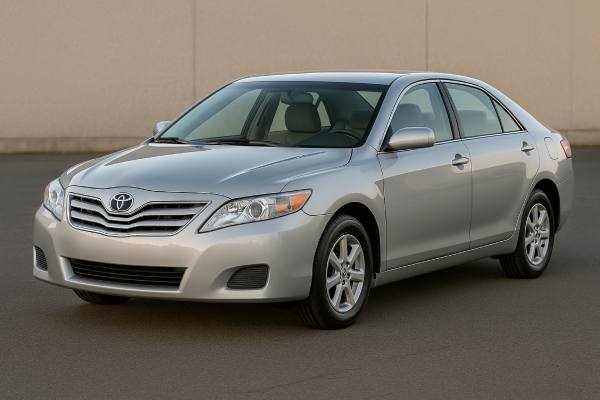
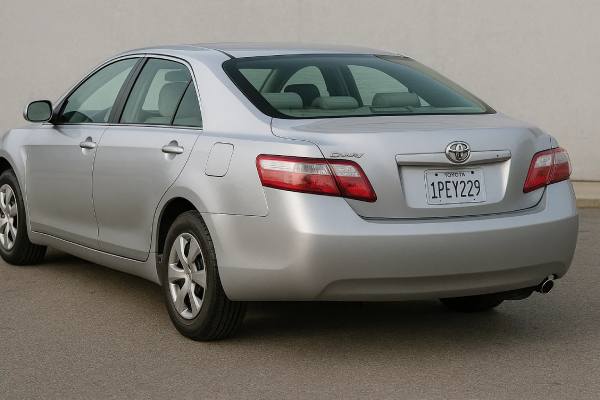
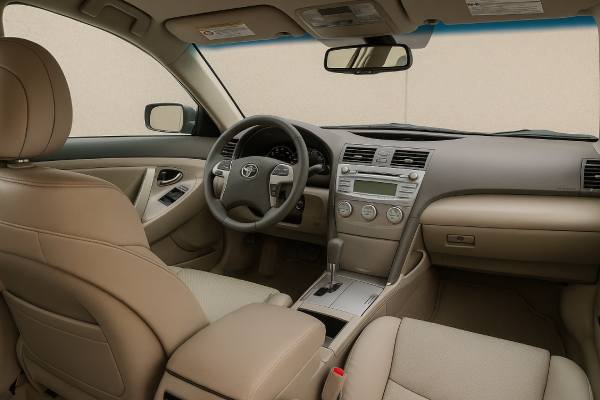
The 2010–2011 Toyota Camry with the 2AR-FE 2.5-litre four-cylinder marked a useful inflection point for the XV40/ASV40 generation. Toyota’s newer, chain-driven, Dual VVT-i engine replaced the older 2.4, bringing quieter cruising, a broader torque band, and lower running costs. Most cars pair it with a six-speed automatic (a six-speed manual was built in small numbers), and the chassis tune prioritizes comfort without feeling sloppy. Cabin space, trunk volume, and outward visibility remain standouts for everyday use. Safety equipment is comprehensive for the era, though active driver-assistance systems (automatic emergency braking, etc.) had not yet arrived in the segment. If you want a no-drama midsize sedan that just works, the 2.5-litre ASV40 is the low-risk, high-value pick—provided you check recalls and keep up with basic fluids and wear items.
At a Glance
- Smooth, durable 2AR-FE with timing chain and port injection; easy maintenance access.
- Spacious interior and 15.0 ft³ (425 L) trunk; quiet highway ride.
- Six-speed automatic is calm and efficient; rare six-speed manual exists for 2010–2011.
- Caveat: verify recall completion (e.g., floor-mat/pedal campaigns, early-2010 power-steering hose routing) and inspect for age-related seepage at water pump.
- Typical service: 0W-20 oil and filter every 10,000 miles / 12 months (severe use: 5,000 miles / 6 months).
Navigate this guide
- ASV40 Camry 2.5 Overview
- Camry 2AR-FE Specs and Data
- Trims, Options and Safety 2010–2011
- Reliability and Common Issues
- Maintenance and Buyer’s Guide
- Driving and Real-World Performance
- Camry 2.5 vs Competitors
ASV40 Camry 2.5 Overview
The 2010 refresh of the XV40-series Camry brought a new base engine, the all-aluminum 2AR-FE 2.5-litre inline-four. It uses Dual VVT-i (variable timing on both cams), a timing chain, and port fuel injection, which together yield quiet manners, strong mid-range, and fewer long-term maintenance risks than many direct-injection rivals. Output is 169 hp (126 kW) and 167 lb-ft (226 Nm) in most trims, with the SE grade receiving a slightly freer-breathing intake/exhaust tune rated at 179 hp and 171 lb-ft. The transmission lineup consists of a six-speed automatic with a manual-mode gate on all trims and a low-volume six-speed manual that enthusiasts still seek out for its simplicity and control.
The Camry’s mission here is effortlessness. Steering is light but accurate, the ride is well-damped over broken pavement, and the cabin is hushed on the highway. Ergonomics are straightforward; critical controls are big, logically placed, and backed by clear gauges. Space efficiency remains a selling point: adults fit comfortably in both rows, and the trunk’s 15.0 ft³ (425 L) capacity easily handles strollers or a family’s luggage.
Safety content is robust for the time: dual-stage front airbags, seat-mounted side airbags, full-length curtains, and a driver’s knee airbag were standard, along with ABS, Electronic Brake-force Distribution, Brake Assist, and stability/traction control. Ratings are strong in IIHS testing for this era. Note that 2011 marked a change to the U.S. government’s tougher New Car Assessment Program, under which many vehicles—including this Camry—saw star ratings decrease despite unchanged structures; that context matters when comparing cross-years.
Ownership economics are excellent. The engine’s 0W-20 oil specification enables 10,000-mile/12-month change intervals under normal service, and the cabin/cargo hardware ages well if kept clean. The short list of watch-outs skews toward age-related items—water pump seepage, accessory belt or pulley noise, strut mounts/bushings, and the occasional wheel bearing—plus a small number of recall campaigns that should be verified by VIN.
Camry 2AR-FE Specs and Data
Below are technical details specific to the 2010–2011 Camry 2.5-litre four-cylinder (non-hybrid). Figures are for typical North American trims; small variations occur by equipment.
Engine and Performance
| Item | Detail |
|---|---|
| Code | 2AR-FE |
| Layout & cylinders | Inline-4 (I-4), DOHC, 16 valves; Dual VVT-i |
| Bore × stroke | 90.0 × 98.0 mm (3.54 × 3.86 in) |
| Displacement | 2.5 L (2,494 cc) |
| Induction | Naturally aspirated |
| Fuel system | Sequential multi-port injection (SFI) |
| Compression ratio | 10.4:1 |
| Max power | 169 hp (126 kW) @ 6,000 rpm (SE: 179 hp (133 kW)) |
| Max torque | 226 Nm (167 lb-ft) @ 4,100 rpm (SE: 232 Nm / 171 lb-ft) |
| Timing drive | Chain (no scheduled replacement) |
| Emissions class | ULEV-II (U.S.) |
| EPA-rated economy (AT) | 22/31 mpg (city/hwy), 25 combined → 10.7/7.6 L/100 km, 9.4 L/100 km combined |
| EPA-rated economy (MT) | 22/32 mpg (city/hwy), 26 combined → 10.7/7.4 L/100 km, 9.0 L/100 km combined |
| Real-world highway @ 75 mph | ~7.8–8.4 L/100 km (30–28 mpg U.S.) depending on tires, load, weather |
| Aerodynamics | Cd ~0.27; frontal area: — |
Transmission and Driveline
| Item | Detail |
|---|---|
| Transmission | 6-speed automatic with manual mode (most common); rare 6-speed manual (2010–2011) |
| Type & code | Automatic: Aisin U760E; Manual: 6-MT (low-volume; code varies by market) |
| Gear ratios | Not published in owner-facing literature; consult service manual if you need exact ratios for competition or rebuild planning |
| Final drive | FWD; open differential |
| Refuel time | Typical petrol refuel to full: ~5 minutes |
Chassis and Dimensions
| Item | Detail |
|---|---|
| Suspension (front/rear) | MacPherson strut / dual-link strut |
| Steering | Electric power-assist rack-and-pinion |
| Brakes | 4-wheel discs; ABS, EBD, Brake Assist standard |
| Wheels/Tires (typical) | 215/60R16 (LE/XLE), 215/55R17 (SE) |
| Ground clearance | ~155 mm (6.1 in) |
| Length/Width/Height | ~4,810 / 1,820 / 1,470 mm (189.4 / 71.7 / 57.9 in) |
| Wheelbase | 2,775 mm (109.3 in) |
| Turning circle | ~11.0 m (36.1 ft) |
| Curb weight (approx range) | 1,445–1,510 kg (3,185–3,330 lb) |
| GVWR (typical) | ~1,960–2,020 kg (4,321–4,455 lb) |
| Fuel tank | ~70 L (18.5 U.S. gal / 15.4 U.K. gal) |
| Cargo volume (SAE) | 425 L (15.0 ft³) |
Performance and Capability
| Metric | Figure |
|---|---|
| 0–60 mph / 0–100 km/h | ~8.3–8.8 s (setup-dependent) |
| Top speed | ~190 km/h (118 mph), electronically limited |
| Braking 100–0 km/h (62–0 mph) | ~40–42 m (131–138 ft) on good tires |
| Towing capacity | Not factory-rated for North America; light utility towing generally discouraged |
Fluids and Service Capacities
| System | Specification | Capacity / Notes |
|---|---|---|
| Engine oil | SAE 0W-20, ILSAC GF-4/5 | ~4.4 L (4.7 U.S. qt) with filter; 10,000-mile / 12-month interval under normal use |
| Coolant | Toyota Super Long Life Coolant (SLLC), pink, 50/50 | ~6.5–7.5 L (6.9–7.9 U.S. qt) depending on equipment; replace per schedule |
| Automatic transmission | Toyota ATF WS | Drain-and-fill service quantity typically ~3.5–4.0 U.S. qt (full dry fill is higher); no dipstick |
| Manual transmission | API GL-4/GL-5 (consult label) | Service quantity varies; check fill-level plug |
| A/C refrigerant | R-134a | Charge quantity varies slightly by optioning (~0.50 kg typical); evacuate/charge by weight |
| Spark plugs | Iridium, 1.1 mm (0.043 in) gap | Replace ~120,000 miles (193,000 km) under normal use |
| Key torque values | Wheel lug nuts: 103 Nm (76 lb-ft) | Always torque wheels with a calibrated wrench |
Electrical
| Item | Detail |
|---|---|
| Alternator output | ~100–130 A (varies by trim/equipment) |
| 12V battery | Group size varies; maintenance-free; test annually after year 4 |
Safety and Driver Assistance
| Item | Detail |
|---|---|
| Airbags | Dual-stage front, front side, full-length curtains, driver knee |
| Stability systems | ABS, EBD, Brake Assist, Vehicle Stability Control (VSC) with TRAC |
| IIHS | “Good” in frontal offset and side impact for this generation; head restraints/seat sometimes rated lower in era-specific tests |
| NHTSA (2011) | Tested under the newer, tougher protocol; overall score lower than prior years—interpret within test-year context |
| ADAS | No factory AEB, ACC, or lane-keeping on 2010–2011 models |
Trims, Options and Safety 2010–2011
Trims (gas 2.5-litre): Base (Camry), LE, SE, XLE. All share the same basic powertrain; the SE gets the higher-output calibration (179 hp), firmer springs/dampers, slightly lower ride height, and 17-inch wheels. LE and XLE emphasize comfort and convenience—power driver seat, available alloys (LE), dual-zone climate and upgraded audio (XLE), and additional sound-deadening. Manual transmission availability was limited and found mainly on lower trims in 2010–2011; most cars are six-speed automatics.
Options and packages:
- Wheels/tyres: 16-inch steel (base/LE) with covers; 16-inch alloys optional on LE; 17-inch alloys standard on SE.
- Audio/infotainment: Base 6-speaker head unit; available JBL® premium audio (XLE).
- Seats/interior: Power driver seat common on LE and above; leather available on XLE; SE features sport seats and unique trim.
- Convenience: Moonroof, auto headlamps, Bluetooth® phone/audio on higher trims or option packages.
- Mechanical differences: SE receives unique suspension tuning and sometimes larger brake hardware depending on package; drivetrain gearing is otherwise shared.
Year-to-year notes:
- 2010: Introduction of the 2AR-FE 2.5-litre and six-speed transmissions; minor exterior/interior refresh.
- 2011: Carry-over for 2.5-litre trims; small tire and equipment changes elsewhere in the range, plus housekeeping updates to options and colorways.
Safety ratings and equipment:
- Passive safety: The Camry includes dual-stage front airbags, front seat-mounted side airbags, full-length side curtains, and a driver’s knee airbag. Seat structures and the body shell performed well in offset and side tests of the period.
- Active safety: ABS, EBD, and Brake Assist are standard, as are stability and traction control. Headlight technology is halogen; beam performance is adequate for the era.
- Child seats: LATCH anchors on the outboard rear positions are easy to access; the sedan body shape and door swing make installation straightforward.
- ADAS: Advanced driver-assistance systems (autonomous braking, adaptive cruise, lane keeping) were not equipped on 2010–2011 gas Camrys.
Quick identifiers (VIN/build clues):
- SE tune: Look for dual-exhaust finishers and 17-inch wheels; VIN/option code references vary but the higher-output rating appears on period window stickers.
- Manual transmission: Pedal box and shifter are obvious tells; these are rare in the used market.
- Package content: JBL speakers, moonroof, and leather seating are most often found on XLEs.
Reliability and Common Issues
The 2AR-FE Camry has an excellent overall durability record. Most age-related repairs are inexpensive, and truly systemic faults are rare. Organised by prevalence and severity:
Common, low-to-moderate cost
- Water pump seepage: Pink residue at the pump weep hole or crust at the thermostat housing. Cause: seal wear with age/heat cycles. Remedy: replace pump/gasket; refresh SLLC coolant and bleed air.
- Accessory belt noises / idler pulley wear: Chirp or squeak on cold starts. Cause: aged belt/pulley bearings. Remedy: belt and/or pulley replacement.
- Strut mounts/bushings and rear sway-bar links: Clunks over speed bumps, looseness at high mileage. Remedy: replace worn mounts/links; consider new dampers if mileage is high.
- Wheel bearings: Low growl changing with speed/steering input. Remedy: press-in hub/bearing assembly replacement.
Occasional, moderate cost
- Evaporative emissions leaks (EVAP small leak codes): Age-cracked hoses or purge/vent valves. Remedy: smoke test to locate; replace affected parts.
- Brake pulsation: Rotor thickness variation from heat/age. Remedy: quality pads/rotors; torque wheels properly (103 Nm/76 lb-ft).
Rare or conditional
- Oil consumption complaints: Much less common than on the older 2AZ-FE, but heavy idling/short-trip use can accelerate consumption. Remedy: consumption test; PCV and ring soak if needed; maintain 0W-20 intervals.
- Torque-converter shudder or shift flare (automatic): Usually linked to old ATF and driving profile. Remedy: software updates when applicable; staged drain-and-fills with Toyota WS; inspect engine/trans mounts.
Recalls / service actions to confirm by VIN
- Floor mat/pedal interference campaigns (early 2010s Toyota wide): Ensure proper pedal/floor-mat configuration and applied countermeasures.
- Early-2010 power-steering pressure hose routing (2.5-litre): On certain early-build 2010 cars, a crimped hose could contact a brake tube or pulley; routing/parts updates remedy this.
- Other campaign clean-up: Depending on build, check for small software updates and hardware replacements archived with the VIN.
Pre-purchase inspection requests
- Full service history, especially oil change documentation.
- Evidence that all open campaigns/recalls are closed (provide the VIN to a dealer).
- Cooling system pressure test; inspect water pump and radiator end-tanks.
- Suspension/steering play, strut mounts, and rear links.
- Brake thickness and rotor condition; verify no pulsation on the test drive.
- Highway test for transmission behavior (steady 60–75 mph, light throttle).
- Underbody corrosion check (subframes and seams) in rust-belt regions.
- HVAC performance and blend-door operation.
Maintenance and Buyer’s Guide
Practical maintenance schedule (time/distance, whichever comes first):
- Engine oil and filter: 0W-20 full-synthetic, every 10,000 miles / 12 months (normal) or 5,000 miles / 6 months (severe: short trips, extreme cold, dusty roads, heavy idling). Oil capacity ~4.7 qt (4.4 L) with filter.
- Engine air filter: Inspect 15,000 miles (24,000 km), replace ~30,000 miles (48,000 km) or sooner in dusty areas.
- Cabin air filter: 15,000–20,000 miles (24,000–32,000 km); more often if airflow is reduced.
- Spark plugs (iridium): ~120,000 miles (193,000 km). Confirm correct heat range and 1.1 mm gap.
- Coolant (SLLC, pink): First change at 100,000 miles / 10 years, then 50,000 miles / 5 years thereafter. Maintain a 50/50 premix.
- Automatic transmission (Toyota WS): “Inspect” per lifetime fill guidance; for longevity, a drain-and-fill every 60,000–90,000 miles is a sensible preventive measure. Use only WS-spec fluid.
- Manual transmission fluid: Inspect for level/condition at major services; replace ~60,000 miles if shifting feel degrades.
- Brake fluid: Replace every 3 years; inspect pads/rotors each tire rotation.
- Drive belt and hoses: Inspect at every oil change; replace the belt at first signs of cracking/noise.
- Wheel alignment and rotation: Rotate tires every 5,000–7,500 miles; check alignment annually or after pothole impacts.
- Timing drive: Chain—no scheduled replacement. Inspect chain noise/correlation if codes or rattle appear.
- 12-volt battery: Load-test annually starting in year 4; typical life is 4–6 years.
Fluids quick list and capacities:
- 0W-20 engine oil (ILSAC) — ~4.7 qt with filter.
- Toyota Super Long Life Coolant (pink) — ~6.5–7.5 L system total.
- Toyota ATF WS — service fill ~3.5–4.0 qt (automatic).
- R-134a refrigerant — charge by weight; typical total ~0.50 kg.
- Brake fluid — DOT 3/4; flush at 3 years.
Essential torque values (decision-making level):
- Wheel lug nuts: 103 Nm (76 lb-ft).
- Spark plugs: ~18–22 Nm (13–16 lb-ft) (snug + angle if using crush washers; verify plug spec).
Buyer’s guide highlights:
What to look for
- Cooling system health: Any pink crust around the water pump or at hose joints suggests seepage—budget a pump and fresh SLLC.
- Suspension quietness: A quiet knock over sharp bumps often points to sway-bar links; a creak/clunk on steering input can be a tired strut mount.
- Brake feel: Light steering-wheel shimmy on freeway braking hints at rotor variation; replacement is inexpensive.
- Transmission behavior: On automatics, confirm smooth upshifts and no shudder at light throttle between 35–50 mph. On manuals, check clutch take-up and synchros (cold and warm).
- Electrics: Window regulators and lock actuators generally hold up; verify all switches, A/C performance, and illumination.
Recommended trims/options
- LE 2.5 automatic: Sweet spot for comfort, cost, and equipment.
- SE 2.5 automatic: If you like tighter body control and the 179-hp tune; check that the sport dampers still feel controlled.
- XLE 2.5: Best for long-distance comfort; prioritize maintenance history over extras.
Years to avoid/seek
- Both 2010 and 2011 are strong; 2011 cars show better EPA label harmonization across the range, but mechanical differences are minor for the 2.5. Focus on condition, history, and tires rather than the calendar.
Long-term outlook
- With routine fluids and wear items, 200,000+ miles (320,000+ km) is a realistic, low-drama target. Rust, neglect, and poor tires are bigger threats than the core engine/transmission.
Driving and Real-World Performance
Ride, handling, NVH: The ASV40’s tuning favors calm progress. Straight-line stability is excellent, with minimal tramlining on 16-inch tires. Body motions are well-controlled over highway undulations, and the suspension dispatches cracked pavement without crash or rattle. Steering is light but accurate around center, with predictable build-up in corners. Brake feel is linear, and fade resistance is adequate for daily commuting; fresh pads/rotors and proper wheel torque do the most to keep things consistent.
Powertrain character: The 2AR-FE is quiet at idle and gets into its stride above 2,000 rpm, pulling cleanly to the 6,000-rpm power peak. Throttle response is natural and lag-free (no turbo to spool), and the six-speed automatic prioritizes low revs in cruising while responding briskly to deeper throttle with a clean multi-gear kickdown. The manual gearbox gives the car a more engaging character without turning it into a sports sedan; clutch effort is light, and ratios are widely spaced for economy.
Observed economy: In mixed suburban use, expect 8.0–9.5 L/100 km (29–25 mpg U.S.; 35–30 mpg U.K.). On a steady 60–65 mph (100–105 km/h) highway run in calm weather, 7.0–7.5 L/100 km (34–31 mpg U.S.) is realistic; at 70–75 mph (113–120 km/h), ~7.8–8.4 L/100 km (30–28 mpg U.S.) is typical. Winter blends, short trips, and roof-rack loads will move those numbers downward.
Key metrics (typical test setups):
- 0–60 mph (auto): ~8.6 s on 16-inch all-season tires; manual trims can be a couple of tenths quicker with an aggressive launch.
- 50–80 mph passing: Confident; the transmission drops two or three gears and the engine stays in the thick of its torque.
- 100–0 km/h braking: ~40–42 m (131–138 ft) on quality tires; longer stopping distances correlate strongly with worn pads and bargain-basement rubber.
- Snow/traction: FWD with stability/traction control is predictable; winter performance rises dramatically on real winter tyres. SE’s 17-inch package sharpens turn-in but can transmit more impact harshness.
Load/towing: Toyota did not rate these 2.5-litre trims for North American towing. With a full family and luggage, the Camry remains composed; braking confidence and heat management are fine at legal speeds, but stay ahead on pads and coolant service if you routinely travel mountainous routes in summer.
Camry 2.5 vs Competitors
Honda Accord 2.4 (2008–2012): The Accord feels a shade sportier, with firmer steering and a busier ride. Cabin space is comparable, though road noise can be higher on coarse surfaces. The Accord’s K24 is robust; however, some owners report more NVH and slightly higher parts prices than Toyota’s equivalents. If you prioritize steering feedback, the Honda wins; for quiet commuting and lower running costs, the Camry takes it.
Nissan Altima 2.5 (2007–2012): Lighter on its feet, the Altima’s steering and chassis balance are appealing. The Achilles’ heel is the CVT of this era, which can be reliable with meticulous fluid care but carries more risk—and less driving satisfaction—than the Camry’s conventional six-speed automatic. Cabin materials and aging plastics often trail Toyota’s.
Ford Fusion 2.5 (2010–2012): A comfortable, well-appointed alternative with pleasant highway manners. The 2.5 Duratec/6-speed combo is decent on fuel, and certain trims can match the Camry’s feature count. Long-term reliability is mixed in this vintage; pay attention to transmission service history and electronic gremlins.
Hyundai Sonata 2.4 (2011): The fluidic-sculpture Sonata reset design expectations in 2011 and delivered strong EPA numbers. Early build quality and engine-bearing issues on certain cars temper the value proposition. If you want modern styling and features per dollar, it’s compelling—just vet history and warranty work carefully.
Chevrolet Malibu 2.4 (2008–2012): Comfortable ride and tidy styling, but interior packaging and long-term durability typically lag the Camry. Transmission shift quality varies, and parts/repair frequency at high mileage can be higher.
Bottom line: For shoppers who rank quiet, space, and low ownership risk above on-the-limit handling, the 2010–2011 Camry 2.5 remains a benchmark. The SE’s firmer chassis and 179-hp tune add some flavor without sacrificing the core virtues.
References
- 2011 Toyota Camry Gets Fuel Economy Boost for V6 Engine 2010 (Press Release)
- Gas Mileage of 2011 Toyota Camry 2011 (EPA FuelEconomy.gov)
- 2010 Toyota Camry 4-door sedan 2010 (Safety Rating)
- Vehicle Detail Search – 2011 TOYOTA CAMRY 2011 (NHTSA Ratings/Recalls)
- Tech Tip T-TT-0005-10: Oil Viscosity Applicability and Change Interval Guide USA 2013 (TSB)
Disclaimer
This guide is for informational purposes and is not a substitute for professional diagnosis, repair, or official service procedures. Specifications, torque values, fluid capacities, and maintenance intervals can vary by VIN, production date, market, and equipment. Always confirm against your vehicle’s official owner’s/service documentation and follow all applicable safety procedures.
If this was helpful, consider sharing it with fellow owners on Facebook or X/Twitter—thanks for supporting xcar.