
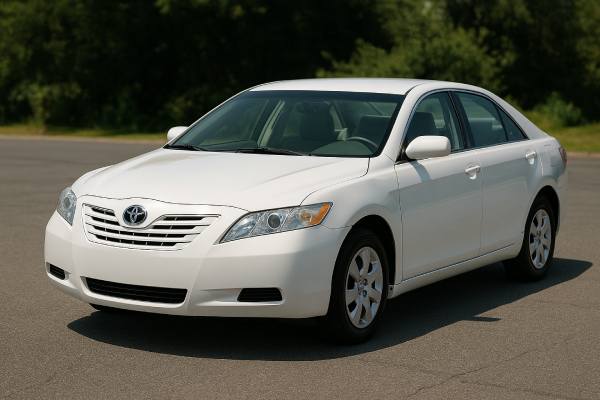
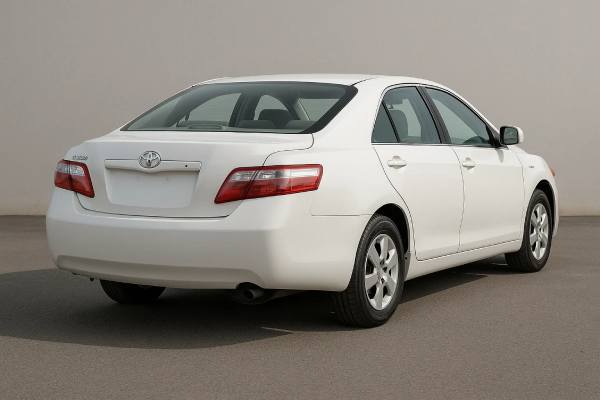
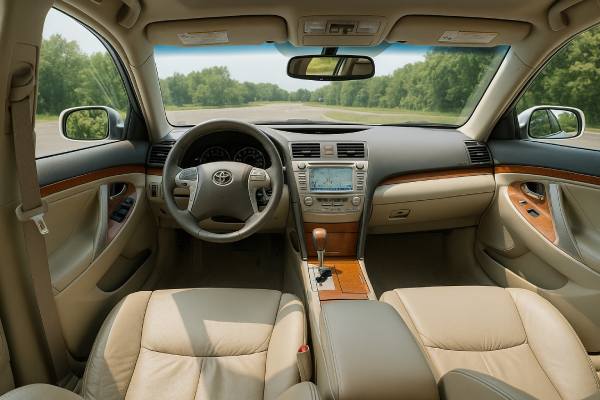
The GSV40-generation Toyota Camry with the 2GR-FE 3.5-liter V6 arrived as the “quick one” in a family known for quiet consistency. For shoppers today, it blends mature ride quality with genuine pace, low running costs, and a deep parts ecosystem. The all-aluminum V6 uses dual VVT-i valve timing, a timing chain, and port fuel injection—simple, robust ingredients that help this powertrain rack up high mileages with routine care. A standard six-speed automatic keeps revs down on the highway while delivering confident kickdown for passing. Inside, the XV40 platform brought a larger cabin, improved crash performance, and a trunk that stays useful even with a full family on board. Driver aids are basic by modern standards, but core safety hardware (ABS, stability and traction control on many cars, side curtains) is present and well-tuned. If you want an understated midsize sedan that will start every morning and still run hard onto an on-ramp, a maintained Camry V6 from this era remains an excellent value.
Fast Facts
- Strong, smooth V6: 268 hp (200 kW) with broad mid-range torque for easy merging and passing.
- Quiet, comfortable long-distance cruiser; cabin and suspension tuning reduce fatigue on rough highways.
- Parts, fluids, and service knowledge are abundant—maintenance costs stay predictably low.
- Watch for the early V6 external oil-hose campaign; confirm the all-metal line retrofit on any candidate.
- Typical oil service: every 5,000 miles / 6 months with 5W-30 (follow the vehicle’s maintenance guide).
Quick navigation
- V6 Camry 2006–2009 Overview
- Camry GSV40 Specs and Data
- Camry V6 Trims and Safety
- Reliability and Known Issues
- Maintenance and Buying Advice
- Driving and Real-World Economy
- Camry Versus Key Rivals
V6 Camry 2006–2009 Overview
Toyota’s GSV40-series Camry V6 (sold as 2007–2009 model years in North America, launched in 2006) pairs an aluminum 3.5-liter 2GR-FE with a six-speed automatic and front-wheel drive. The result is an everyday sedan that can legitimately feel quick. Peak output is 268 hp at 6,200 rpm and 336 Nm (248 lb-ft) at 4,700 rpm, but the more important trait is how the engine spreads torque: you get decisive throttle response from 2,000–5,000 rpm, where most commuting and passing happens. Because this V6 uses port fuel injection and a chain-driven valvetrain, owners avoid the carbon buildup and belt-replacement expenses that follow some alternatives. The automatic’s ratios keep the revs low at cruise, so the car is calm and efficient on long trips.
Chassis tuning aims for relaxed control rather than sport sedan sharpness, although SE-grade cars add firmer springs/dampers and larger wheels for quicker turn-in. Ride comfort stays a highlight across trims; wind and road noise are well muted for the class. Inside, the XV40 increases space, particularly rear legroom, with a trunk large enough for family duty. Controls are simple, sightlines are generous, and the cabin materials hold up if basic care is applied. Safety performance is solid thanks to the stiffer body structure and standard head-protecting curtains on most examples.
Ownership fits the Camry script: predictable reliability when maintained on time, near-universal serviceability, and excellent parts availability. Prospective buyers should verify completion of well-known service actions on early 2GR-FE oil plumbing and ensure transmission software updates are present. With those boxes checked—and with conservative fluids and tires—this Camry V6 still feels modern where it counts: instant start-ups, smooth torque, stable tracking, and real highway range.
Camry GSV40 Specs and Data
Below are North America-baseline figures for the 2006–2009 Camry V6 (GSV40) with the 2GR-FE. Minor variations by trim/year and equipment occur; always verify by VIN.
Engine and Performance (ICE-only)
| Item | Detail |
|---|---|
| Engine code | 2GR-FE (Dual VVT-i) |
| Layout & cylinders | 60° V6, DOHC, 4 valves/cyl |
| Bore × stroke | 94.0 × 83.0 mm (3.70 × 3.27 in) |
| Displacement | 3.5 L (3,456 cc) |
| Induction & fuel | Naturally aspirated; sequential multi-port fuel injection |
| Compression ratio | ~10.8:1 |
| Max power | 268 hp (200 kW) @ 6,200 rpm |
| Max torque | 336 Nm (248 lb-ft) @ 4,700 rpm |
| Timing drive | Chain (no scheduled replacement) |
| Rated economy (EPA) | ~19/28 mpg US city/hwy (12.4/8.4 L/100 km); ~23 mpg US combined |
| Real-world highway @ 120 km/h (75 mph) | ~8.7–9.4 L/100 km (27–25 mpg US / 32–30 mpg UK) |
| Aerodynamics | Cd ~0.28–0.29 |
Transmission and Driveline
| Item | Detail |
|---|---|
| Transmission | 6-speed automatic (U660E), gated selector with manual mode |
| Drive type | FWD |
| Final drive | Typically ~3.29–3.48 (varies by grade) |
| Gear ratios (typical U660E) | 1st 3.300 • 2nd 1.900 • 3rd 1.421 • 4th 1.000 • 5th 0.713 • 6th ~0.58 • Reverse 4.148 |
| Differential | Open |
| Refuel to full | ~5 minutes at a standard pump |
Chassis and Dimensions
| Item | Detail |
|---|---|
| Front / rear suspension | MacPherson strut / dual-link strut; anti-roll bars |
| Steering | Hydraulic power-assist, rack-and-pinion |
| Brakes | 4-wheel disc; front ventilated ~296 mm (11.7 in), rear solid ~281 mm (11.1 in) |
| Wheels/tires (typical) | LE/XLE: 16–17 in; SE: 17–18 in with performance tires |
| Ground clearance | ~155–160 mm (6.1–6.3 in) |
| Length × width × height | 4,805 × 1,820 × 1,460 mm (189.2 × 71.7 × 57.5 in) |
| Wheelbase | 2,775 mm (109.3 in) |
| Turning circle (curb-to-curb) | ~11.0 m (36.1 ft) |
| Curb weight (approx.) | ~1,540–1,615 kg (3,395–3,560 lb) depending on trim |
| Fuel tank | ~70 L (18.5 US gal / 15.4 UK gal) |
| Cargo volume (trunk) | ~425 L (15.0 ft³) SAE |
Performance and Capability
| Metric | Value |
|---|---|
| 0–60 mph / 0–100 km/h | ~5.8–6.1 s (typical road tests) |
| Top speed | ~220 km/h (≈137 mph), limited by gearing/tires |
| 100–0 km/h (62–0 mph) braking | ~38–40 m (125–131 ft) on quality tires |
| Towing | Light utility only (often 454 kg / 1,000 lb when equipped); consult local guidance |
| Payload | ~350–400 kg (770–880 lb), varies with options |
Fluids and Service Capacities
| System | Specification | Capacity (typical) |
|---|---|---|
| Engine oil | API/ILSAC 5W-30; quality synthetic accepted per guide | ~6.1 L (6.4 US qt) with filter |
| Engine coolant | Toyota Super Long Life Coolant (SLLC), pink; ~50/50 mix | ~8.9–9.4 L (9.4–10.0 US qt) total system |
| Automatic transmission | Toyota ATF WS | Drain & fill ~3.5–4.0 US qt; total ~6.7–7.0 L (7.1–7.4 US qt) |
| A/C refrigerant | R-134a | ~500–550 g (17.6–19.4 oz) |
| A/C compressor oil | ND-OIL 8 (PAG) | ~120 mL (≈4 fl oz) |
| Key torque values (selected) | Wheel lug nuts ~103 Nm (76 lb-ft); engine drain plug ~39 Nm (29 lb-ft); spark plugs ~18 Nm (13 lb-ft) | — |
Electrical
| Item | Detail |
|---|---|
| Alternator output | ~100–130 A (by equipment level) |
| 12V battery | Group 24F typical; ~60–70 Ah (≈550–700 CCA) |
| Spark plugs | Iridium (e.g., FK20HR11); gap ~1.0–1.1 mm (0.039–0.043 in) |
Safety and Driver Assistance
| Topic | Detail |
|---|---|
| Crash ratings (IIHS) | Moderate overlap front: Good; Side: Good; Roof strength: Good; Head restraints & seats: Marginal (varies by seat build date) |
| Headlight rating | Not formally rated in this era by IIHS for all trims |
| Active safety | ABS with EBD and Brake Assist standard; stability and traction control widely fitted (standardized after the facelift) |
| Child seats | Lower anchors and top tether provisions (verify hardware in rear outboard positions) |
Camry V6 Trims and Safety
Trim structure (North America): The V6 was offered primarily on LE V6, SE V6, and XLE V6 grades. Equipment levels overlap, but each trim has a distinct character:
- LE V6: The understated daily driver. Power features, cruise, cloth or optional leather, available sunroof, 16–17-inch wheels, and a comfort-oriented suspension.
- SE V6: The “driver’s” Camry. Firmer springs/dampers, thicker anti-roll bars, unique front/rear fascias, trunk lip spoiler, tighter steering feel, and 17–18-inch wheels. Seats have more lateral support; ride is tauter but still compliant.
- XLE V6: The quiet, plush choice. Softer suspension, sound-deadening focus, available JBL audio and navigation for the era, wood-tone interior accents, power seats, and automatic climate control. Wheels typically 16–17 in with touring-oriented tires.
Option highlights and identifiers:
- Wheels/tires: The fastest visual tell. SE cars often wear multi-spoke 17s or 18s; XLEs favor larger sidewalls and touring tread.
- Exterior cues: SE gets a sport grille and side skirts; LE stays plain; XLE may feature chrome accents and additional brightwork. Many V6 cars carry a discreet “V6” badge on the decklid—useful at a glance.
- VIN/build details: The engine family and plant are encoded in the VIN; the build label in the driver door reveals paint/trim codes and production month, which matters for items like seat design and certain service campaigns.
Audio/infotainment tiers: Base head units with AUX input, mid-level upgrades with better amplification and speakers, and top-line JBL on many XLEs and some SEs. Navigation appears on higher grades late in the run; Bluetooth phone integration becomes more common toward 2009.
Mechanical differences: The SE’s sport-tuned suspension slightly lowers body roll and quickens transient response. Brake hardware sizing is broadly shared, but pad compounds and wheel/tire packages change pedal feel and stopping consistency. Final-drive ratio and shift mapping can vary subtly by grade and calibration.
Year-to-year changes (high level):
- 2006/2007 (launch model year): New platform, 3.5 V6 with six-speed automatic introduced. Side curtain airbags widespread; stability control available on many cars.
- 2008: Feature packaging and audio options shuffled; minor trim updates.
- 2009: Additional equipment bundling; pre-facelift final year before the styling and powertrain refresh that arrived for the 2010 model year (sold in 2009 calendar year) and standardized stability control going forward.
Safety systems and driver aids: Anti-lock brakes with electronic brake-force distribution and Brake Assist were standard. Traction control and stability control were fitted on many 2007–2009 V6 cars and became ubiquitous after the refresh. The body structure, airbags (front, side torso, and head curtains), and seat design deliver strong crash results for the class. If you plan post-repair work (windshield, bumper covers, or steering/suspension), ensure alignment, steering angle, and yaw sensors are calibrated per factory procedures.
Reliability and Known Issues
The 2GR-FE V6 has an excellent long-term record when serviced on schedule. Below are the patterns owners and technicians most often encounter, organized by prevalence and cost impact.
Common (plan for it)
- External VVT-i oil hose (early design):
Symptoms: Sudden oil loss or visible leak near the front bank.
Cause: Early 2GR-FE used a rubber/metal hybrid hose; the rubber section can degrade.
Remedy: Replace with the all-metal line and new gaskets. Many vehicles were covered under special service campaigns; confirm completion on the candidate car. Cost is moderate if not covered, and the upgrade is permanent. - Water pump seep/leak (age/mileage):
Symptoms: Pink residue, slight coolant smell, or weep-hole staining; occasionally low coolant.
Cause: Aging seals/bearings.
Remedy: Replace the pump and drive belt; renew SLLC coolant. Cost is moderate; failure rarely escalates if caught early. - Front control-arm bushings, strut mounts (wear items):
Symptoms: Clunks over sharp bumps, vague initial steering, cupped tire wear.
Remedy: Replace bushings/mounts in pairs; align afterwards. Moderate cost; big improvement in feel.
Occasional (watch-list)
- Automatic transmission shift flare/harshness (calibration):
Symptoms: Light-throttle 2–3 or 3–4 flare, abrupt downshift.
Cause: Early software mapping or learned shift adaptation.
Remedy: Check for ECM/TCM calibration updates; fluid condition matters. A drain-and-fill with Toyota WS (correct temperature fill) plus a reflash typically resolves the complaint. - A/C performance degrade with age:
Symptoms: Weak cooling, cycling.
Cause: Low refrigerant from micro-leaks or a tired condenser fan.
Remedy: Leak check with dye or nitrogen, repair, and recharge to spec; confirm fans and cabin air filter are healthy.
Rare but notable
- Alternator wear (high-load cars):
Symptoms: Light battery warning at idle with accessories on.
Remedy: Test charging output; replace alternator with quality reman or new; inspect belt path. - Dashboard “sticky” surface (heat/UV):
Symptoms: Glossy, tacky dash surface and glare.
Remedy: Many cars received parts under customer support programs in later years; today replacement or a quality cover are practical options.
Recalls, campaigns, and verifications to run before purchase
- All-weather floor-mat / pedal interference recalls and related remedies: ensure the car received the updated pedal and floor-mat guidance; many vehicles also received brake-override software.
- VVT-i oil line special service campaigns: confirm the upgraded metal tube is installed (visual inspection plus paperwork).
- VIN check with the manufacturer portal: request a printout from a dealer or run your VIN through the official recall lookup to verify completion dates.
Pre-purchase inspection checklist
- Scan the powertrain and ABS modules for stored history codes.
- Inspect underbody for leaks (oil, ATF WS, SLLC).
- Check cold-start behavior and hot restarts; drive at light throttle to evaluate shift quality.
- Verify even tire wear and a straight steering wheel on flat roads.
- Confirm proper coolant color (pink SLLC) and level; look for water-pump weep.
- Test HVAC performance at idle and highway speeds.
- Check all keys/remotes and the spare tire/jack kit; ensure the trunk pass-through operates smoothly.
Maintenance and Buying Advice
Practical maintenance schedule (distance/time, whichever comes first)
- Engine oil & filter: every 5,000 miles / 6 months with 5W-30 meeting the vehicle’s ILSAC/API spec. Short-trip or hot-climate use benefits from shorter intervals.
- Engine air filter: inspect at 15,000; replace 30,000 miles / 3 years (earlier in dusty areas).
- Cabin air filter: 15,000–20,000 miles / annually; more often if you run lots of recirc.
- Coolant (SLLC, pink): first replacement around 100,000 miles / 10 years, then 50,000 miles / 5 years thereafter.
- Spark plugs (iridium): 120,000 miles / 12 years typical; replace as a set and torque correctly on a cold engine.
- Serpentine/aux belt: inspect at each oil change after 60,000; replace by condition or 90,000–100,000 miles.
- Automatic transmission (ATF WS): inspect fluid; a drain-and-fill every 60,000–90,000 miles preserves shift quality if you tow, idle in heat, or drive city routes. Use proper temp-based fill.
- Brake fluid: 2–3 years; flush if the cap sees frequent open air or if ABS/traction events are common (hilly commutes).
- Brake pads/rotors: inspect at every tire rotation; replace as a set on each axle.
- Alignment & tire rotation: rotate 5,000 miles (pair with oil service); align annually or after impacts/tire replacement.
- 12V battery: test every service after 4 years; typical life 4–6 years.
- Fuel filter: in-tank; no regular replacement unless pressure/flow concerns arise.
- Valve clearances: shimless bucket design; no scheduled adjustment—listen for cold-start tick and check if out of spec during major service.
Fluids and capacities to know before a DIY service
- Oil with filter: ~6.1 L (6.4 qt). Warm engine, replace drain-plug gasket, torque to ~39 Nm.
- Coolant total system: ~9 L; vacuum-fill recommended to avoid air pockets; bleed heater circuit thoroughly.
- ATF WS: treat service as condition-based; measure out-flow, refill equal volume, set level at specified fluid temperature with the check plug method.
Buyer’s guide—what to seek and what to avoid
- Seek: Documented oil services at ≤5,000-mile intervals; evidence of metal VVT-i oil line retrofit; transmission software updates; recent water-pump replacement with OEM or equivalent; quality tires with current date codes; clean, unspliced wiring in the front bumper (fog/camera accessories can be messy).
- Avoid or discount: Persistent transmission flare after a reflash and fresh fluid; significant oil residue around the timing cover (rare, but costly to reseal); mismatched tires (noise and ABS/VSC behavior can suffer); invasive aftermarket alarm/remote-start installs.
- Best bets: SE V6 for drivers who want firmer steering and body control; XLE V6 for quiet commuting and long trips. LE V6 is the value sweet spot if you plan suspension refreshes anyway.
Durability outlook
With timely fluids and a gentle warm-up routine, the 2GR-FE routinely exceeds 200,000–300,000 miles without opening the engine. Expect suspension rubber, water pumps, and radiators to age on calendar time more than mileage. The car’s simple port-injected design keeps fuel-system costs down and helps catalytic converters last when oil changes are on time.
Driving and Real-World Economy
Ride, handling, and noise: The Camry V6 favors a planted, quiet glide. LE and XLE trims isolate small bumps and expansion joints; road roar stays low even on coarse asphalt. The steering is light but accurate, and straight-ahead stability is excellent. SE’s firmer suspension and larger wheels trim body roll and sharpen initial turn-in; the trade-off is more impact feel over potholes. Brake modulation is easy to learn, with a progressive pedal that resists fade in normal use; high-speed stops improve noticeably with fresh fluid and premium pads.
Powertrain character: The 2GR-FE wakes up early—torque builds from low rpm and stays willing through the midrange. There’s no turbo to spool, so throttle response feels immediate when merging or slotting into a gap. The six-speed automatic is tuned for low revs in cruise; kickdown is decisive from 6th to 4th or 3rd with a firm pedal. Around town, gentle throttle can produce an occasional high-gear lug; the manual gate lets you hold lower gears on hilly routes or for engine braking.
Observed economy: Owners commonly report 19–22 mpg US (12.4–10.7 L/100 km) in mixed suburban use, 25–27 mpg US (9.4–8.7 L/100 km) on steady 70–75 mph highways, and low-to-mid-20s combined. Cold weather, snow tires, roof racks, and short trip cycles can trim those numbers by 10–20%. Fresh plugs, clean filters, and correct tire pressures restore much of the lost efficiency.
Performance metrics that matter: Expect 0–60 mph in ~6 seconds on decent pavement with quality all-season tires. 50–80 mph passing is quick enough that you rarely need a full kickdown. Braking from 100–0 km/h in ~38–40 m is typical for well-maintained examples; warped rotors are almost always a tire and torque-sequence story, not a design flaw.
Load and light towing: The Camry carries four adults and luggage with confidence. If you plan occasional small-trailer duty (garden runs, light single-axle), keep total trailer weight conservative and monitor ATF temps if you live in the mountains. For frequent towing, step up to a vehicle rated for the job.
Camry Versus Key Rivals
Honda Accord V6 (2008–2009): The J-series 3.5-liter makes similar peak power and pairs with a five-speed automatic. The Honda feels a touch more eager at high rpm and can be more involving to drive; road noise is higher, and real-world economy often trails the Camry V6 by a tick on steady highways. Maintenance costs and longevity are comparable; both are excellent.
Nissan Altima 3.5 (2007–2009): The VQ-series V6 is strong and rev-happy. Many Altimas of this era use a CVT—quick off the line but divisive in sound and feel. Camry’s six-speed torque-converter automatic is more traditional, quiet, and durable. Cabin space and ride comfort favor the Toyota; steering feel may favor the Nissan.
Hyundai Sonata V6 (2006–2008): The 3.3-liter Lambda is smooth and competent, with a value-packed feature set. The Camry leads in resale, parts depth, and long-term perception. If you prioritize equipment per dollar, the Hyundai is compelling; if you plan to keep a car past 150,000 miles, the Toyota’s track record is hard to beat.
Mazda6 V6 (2006–2008): Sportier chassis with communicative steering. Peak power is lower than Camry V6, and highway economy is typically a little worse. The Mazda’s smaller cabin and higher revs at cruise make it feel busier over distance; enthusiasts may still prefer its steering.
Ford Fusion V6 (2006–2009): Solid highway car with a robust feel, though output trails the Camry. Interior space is competitive. Long-term ownership costs can be slightly higher as mileages climb, depending on regional parts pricing and availability.
Bottom line: If you want quiet speed, low drama, and low running costs, the Camry V6 is the safe pick. If you favor crisp steering and a firmer ride over cabin hush, check SE V6 first—or consider an Accord or Mazda6 for a different flavor.
References
- Toyota Unveils All-new 2007 Camry and Camry Hybrid at Detroit Motor Show | Corporate | Global Newsroom | Toyota Motor Corporation Official Global Website 2006 (Press Release)
- Gas Mileage of 2007 Toyota Camry 2007 (EPA/DOE)
- Gas Mileage of 2009 Toyota Camry 2009 (EPA/DOE)
- 2007 Toyota Camry 2007 (Safety Rating)
- Microsoft Word – LSC 90K Extension – Region Dealer Approved 2012 (TSB / Campaign)
Disclaimer
This guide is for informational purposes and does not replace professional diagnosis or repair. Specifications, torque values, service intervals, and procedures can vary by VIN, build date, market, and installed equipment. Always verify details against your vehicle’s official owner’s manual, warranty and maintenance guide, and service documentation.
If you found this helpful, please consider sharing it with fellow enthusiasts on Facebook or X/Twitter to support xcar’s work.