
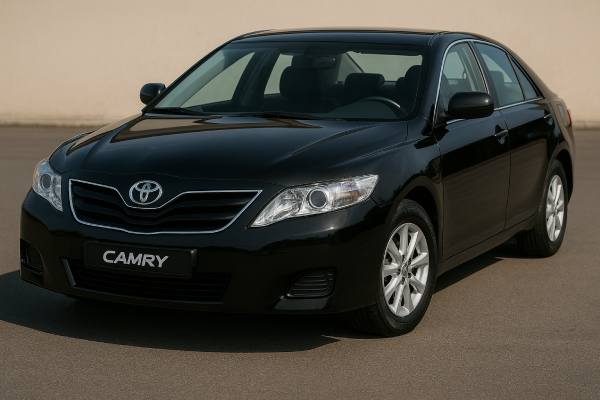
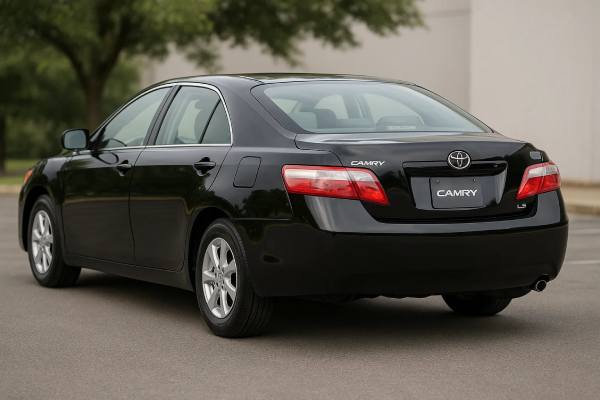
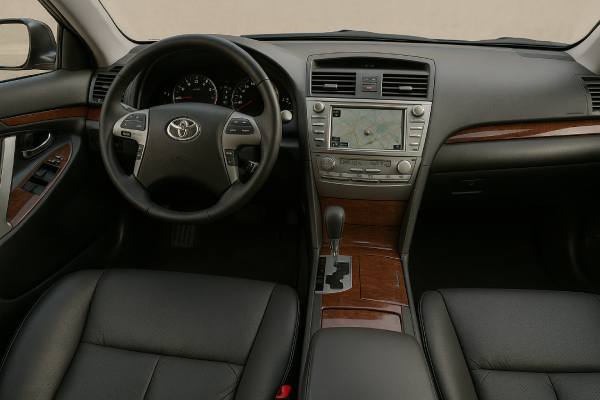
The 2010–2011 facelift of the GSV40 Toyota Camry kept the underlying strengths of the V6 model—quiet speed, low operating costs, and a roomy cabin—while polishing the details. The 2GR-FE 3.5-liter V6 remains the centerpiece: chain-driven cams with Dual VVT-i, durable port injection, and a broad spread of torque that turns everyday commutes into low-effort driving. Updates for 2011 included efficiency tweaks (notably lower-rolling-resistance tires and calibrations) that nudged highway economy upward. A six-speed automatic (U660E) keeps revs down at cruise but responds quickly for passing. Chassis tuning still targets comfort over edge, though the SE grade adds firmer suspension and larger wheels for crisper turn-in. Safety kit is comprehensive for the era, with stability control and curtain airbags widely standard by this point. Shopping used, the V6 Camry’s appeal is simple: it starts, it’s comfortable, it moves, and it rarely surprises you with expenses—provided you verify a few well-known service items and keep fluids fresh.
Key Takeaways
- Smooth, quick V6 with strong mid-range; effortless highway passing and low cabin noise.
- Excellent long-distance comfort; SE trim sharpens responses without ruining ride quality.
- Deep parts availability and straightforward service procedures keep running costs predictable.
- Confirm metal VVT-i oil line retrofit and transmission calibration updates before purchase.
- Typical oil service: 5,000 miles / 6 months with 5W-30, including filter.
What’s inside
- Facelift Camry V6 overview
- 2GR-FE specs and data
- Trims, options and safety 2010–2011
- Reliability and service actions
- Maintenance and buyers guide
- Driving impressions and performance
- Camry V6 versus rivals
Facelift Camry V6 overview
For 2010, Toyota refreshed the XV40-series Camry with revised front styling, interior trim tweaks, audio/connectivity updates, and—most important for daily use—widespread standardization of stability control and side-curtain airbags across trims. Under the hood, the 2GR-FE V6 continued unchanged in hardware, delivering 268 hp (200 kW) at 6,200 rpm and 336 Nm (248 lb-ft) at 4,700 rpm. The six-speed U660E automatic remains a good match: tall overdrives drop highway revs, yet a decisive kickdown gives quick access to the engine’s mid-range. In 2011, rolling-resistance and calibration improvements lifted official fuel-economy ratings for V6 models, reflecting the car’s quiet efficiency on longer trips.
The facelift did not try to turn the Camry into a sport sedan. Instead, tuning focuses on isolation, predictability, and low fatigue. LE and XLE trims ride with a supple, calm gait that takes the edge off broken pavement. SE adds firmer springs/dampers, a thicker rear anti-roll bar, specific wheel/tire packages, and unique fascias for a more planted feel in quick transitions. Steering is light but accurate, with stable on-center tracking that makes the car easy to place on highways. Braking hardware is conventional (vented front discs, solid rears) but reliable and consistent when paired with quality pads and fresh fluid.
Inside, the facelifted GSV40 remains one of the segment’s roomier options, offering generous rear legroom and a flat, usable trunk (about 15 ft³ / ~425 L). Switchgear is simple, sightlines are friendly, and long-term wear is favorable if basic care is applied. Later cars add conveniences like USB integration and improved audio options. The overall ownership profile is classic Camry: a quiet, capable sedan that excels at the things people do most—commuting, errands, and road trips—with minimal drama.
If you are comparing years, 2010 brings the exterior/interior refresh; 2011 subtly optimizes efficiency and packaging. Either way, this is the mature, fully developed end of the XV40 run before the all-new 2012 model launched.
2GR-FE specs and data
Below are baseline North American figures for 2010–2011 Camry V6 (GSV40). Minor variations by trim/equipment occur; verify by VIN for exact fitment and capacities.
Engine and Performance (ICE-only)
| Item | Detail |
|---|---|
| Engine code | 2GR-FE (Dual VVT-i) |
| Configuration | 60° V6, aluminum block/heads, DOHC, 4 valves/cyl |
| Bore × stroke | 94.0 × 83.0 mm (3.70 × 3.27 in) |
| Displacement | 3.5 L (3,456 cc) |
| Induction / fuel | Naturally aspirated; sequential multi-port injection |
| Compression ratio | ~10.8:1 |
| Max power | 268 hp (200 kW) @ 6,200 rpm |
| Max torque | 336 Nm (248 lb-ft) @ 4,700 rpm |
| Timing drive | Chain (no scheduled replacement) |
| Rated economy (EPA) | 2010 V6: ~19/28 mpg US (12.4/8.4 L/100 km); 2011 V6: ~20/29 mpg US (11.8/8.1 L/100 km) |
| Real-world highway @ 120 km/h (75 mph) | ~8.4–9.2 L/100 km (28–25 mpg US / 34–30 mpg UK) |
| Aerodynamics | Cd ~0.28–0.29 |
Transmission and Driveline
| Item | Detail |
|---|---|
| Transmission | 6-speed automatic (U660E) with gated manual mode |
| Drive type | FWD |
| Final drive | ~3.29–3.48 (varies by trim/year) |
| Gear ratios (typical) | 1st 3.300 • 2nd 1.900 • 3rd 1.421 • 4th 1.000 • 5th 0.713 • 6th ~0.582 • Rev 4.148 |
| Differential | Open |
| Refuel to full | ~5 minutes at a standard pump |
Chassis and Dimensions
| Item | Detail |
|---|---|
| Front / rear suspension | MacPherson strut / dual-link strut; anti-roll bars |
| Steering | Hydraulic power-assist, rack-and-pinion |
| Brakes | 4-wheel disc; front vented ~296 mm (11.7 in), rear solid ~281 mm (11.1 in) |
| Wheels/tires (typical) | LE/XLE: 16–17 in touring; SE: 17–18 in performance all-season |
| Ground clearance | ~155–160 mm (6.1–6.3 in) |
| Length × width × height | 4,805 × 1,820 × 1,460 mm (189.2 × 71.7 × 57.5 in) |
| Wheelbase | 2,775 mm (109.3 in) |
| Turning circle (curb-to-curb) | ~11.0 m (36.1 ft) |
| Curb weight (approx.) | ~1,545–1,625 kg (3,405–3,580 lb) |
| GVWR (typical) | ~2,040–2,100 kg (4,497–4,630 lb) |
| Fuel tank | ~70 L (18.5 US gal / 15.4 UK gal) |
| Cargo volume (trunk) | ~425 L (15.0 ft³) SAE |
Performance and Capability
| Metric | Value |
|---|---|
| 0–60 mph / 0–100 km/h | ~5.8–6.1 s (conditions/tires dependent) |
| Top speed | ~220 km/h (≈137 mph), tire-limited |
| 100–0 km/h (62–0 mph) | ~38–40 m (125–131 ft) on quality tires |
| Towing | Light utility only (often ~454 kg / 1,000 lb when equipped) |
| Payload | ~350–400 kg (770–880 lb), by options |
Fluids and Service Capacities
| System | Specification | Capacity (typical) |
|---|---|---|
| Engine oil | ILSAC/API 5W-30 (quality synthetic acceptable) | ~6.1 L (6.4 US qt) with filter |
| Engine coolant | Toyota Super Long Life Coolant (pink, premix) | ~9.0–9.4 L (9.5–10.0 US qt) total |
| Automatic transmission | Toyota ATF WS | Drain & fill ~3.5–4.0 US qt; total ~6.7–7.4 US qt |
| A/C refrigerant | R-134a | ~500–550 g (17.6–19.4 oz) |
| A/C compressor oil | ND-OIL 8 (PAG) | ~120 mL (≈4 fl oz) |
| Selected torque specs | Wheel lugs ~103 Nm (76 lb-ft); drain plug ~39 Nm (29 lb-ft); spark plugs ~18 Nm (13 lb-ft) | — |
Electrical
| Item | Detail |
|---|---|
| Alternator output | ~100–130 A (by equipment level) |
| 12V battery | Group 24F typical; ~60–70 Ah (≈550–700 CCA) |
| Spark plugs | Iridium (e.g., FK20HR11); gap ~1.0–1.1 mm (0.039–0.043 in) |
Safety and Driver Assistance
| Topic | Detail |
|---|---|
| Crash ratings (IIHS) | Ratings for 2007–2011 generation apply: Good in moderate-overlap front and side; roof strength and head restraints vary by seat build/year but generally score from Marginal to Good. |
| Headlight rating | Limited formal headlight scoring in this era; performance varies by trim/bulb. |
| Active safety | ABS with EBD and Brake Assist standard; stability/traction control widely standard by 2010–2011. |
| Child seats | Lower anchors and top tether points provided; verify fitment for bulky seats. |
Trims, options and safety 2010–2011
Trim walk (V6): LE V6, SE V6, XLE V6. All three share the same 2GR-FE output and six-speed automatic. Where they differ is personality and packaging.
- LE V6 — Quiet, sensible baseline. Power features, cruise control, cloth or optional leather, and 16–17-inch touring tires. Suspension tune prioritizes isolation, with soft-edged compliance over broken pavement.
- SE V6 — The driver-centric variant. Firmer springs/dampers, thicker bars, slightly quicker steering on center, and 17–18-inch wheels with grippier all-seasons. Exterior cues include mesh-style grille, sport fascias, trunk lip spoiler, and darker trim. Seats have more bolstering; the cabin rides a notch firmer but remains comfortable on long trips.
- XLE V6 — Comfort-first. Softer suspension, extra sound insulation, and available luxury touches: power seats with memory, dual-zone climate, sunroof, premium JBL audio, and wood-tone interior accents. Ride quality is the calmest of the trio.
Key options and identifiers
- Wheels/tires are the fastest visual tell: SEs wear larger, sportier designs; XLEs favor taller sidewalls for hush.
- Lighting and mirrors may vary by package; later cars add USB/AUX integration and available Bluetooth.
- VIN/build plate confirms production month and option bundles, which matters for seat frame variations and specific service campaigns.
2010 vs 2011 equipment notes
- 2010 introduces the facelift styling and updated interiors/audio; stability control and curtain airbags are widespread.
- 2011 rolls in efficiency optimizations (including lower rolling-resistance tires on many V6 builds) and minor packaging tweaks. Ratings rise a tick on paper; the driving character stays familiar.
Safety ratings and features
- Structure and restraint performance for this generation earned strong marks in major categories, with stability control and ABS/EBD/Brake Assist standard by this stage. LATCH anchor access is good; as with most midsize sedans, bulky rear-facing seats may require front-seat adjustment. If a windshield, bumper cover, or alignment was recently serviced, confirm any sensor/steering-angle calibrations per factory procedure. Brake-override logic appears on many cars post-campaign.
ADAS availability
- Advanced camera/radar features (AEB, ACC, lane-keep) were not typical in this era. The Camry relies on fundamental safety—predictable handling, strong passive protection, and well-tuned stability control.
Reliability and service actions
The 2GR-FE V6 and U660E automatic form a very durable pair when serviced on time. Below are the patterns and fixes most relevant to 2010–2011 buyers.
Common (plan and budget accordingly)
- External VVT-i oil supply hose (early design):
Symptoms: Sudden oil loss or visible leak at the front bank.
Cause: Early 2GR-FE used a rubber-section oil line that can degrade with heat/age.
Remedy: Verify the upgraded all-metal line is installed. Many vehicles were covered by service campaigns; ask for paperwork and visually confirm the hard line. The fix is permanent and inexpensive relative to the risk. - Water pump seepage:
Symptoms: Pink residue near pump weep hole, faint coolant odor, slow level drop.
Remedy: Replace pump and drive belt; refill with Toyota SLLC. Labor is moderate; catching it early prevents secondary issues. - Front control-arm bushings and strut mounts (wear):
Symptoms: Clunks over sharp bumps, vague initial steering, cupped tire wear.
Remedy: Replace in axle pairs; align afterward. Quality rubber restores steering precision.
Occasional (watch-list)
- Automatic transmission shift flare/harshness:
Symptoms: Light-throttle 2–3 or 3–4 flare, abrupt downshifts.
Cause: Early calibration or learned adaptation.
Remedy: Check for ECM/TCM calibration updates; refresh ATF WS via proper temperature-based level set. Most cars improve markedly with software plus a drain-and-fill. - A/C performance drift:
Symptoms: Weak cooling at idle or cycling.
Cause: Minor refrigerant loss or tired condenser fan.
Remedy: Leak test and recharge to weight; verify fans and replace the cabin filter.
Rare but notable
- Alternator fatigue (high electrical loads):
Symptoms: Charging light at idle with accessories on; dimming lamps.
Remedy: Output test; replace alternator with quality reman/new. - Sticky dash in hot climates:
Symptoms: Glossy, tacky dashboard with glare.
Remedy: Some cars received customer support replacements; otherwise, replacement or quality dash cover.
Recalls/campaigns to verify before purchase
- Pedal/floor-mat interference campaign and brake-override updates.
- VVT-i oil hose special service campaign completion (confirm the metal tube).
- Airbag-related field actions where applicable by VIN.
Run the VIN through the official recall portal and request a dealer printout of completed campaigns and calibration IDs.
Pre-purchase inspection—high-value checks
- Scan for stored powertrain/ABS codes and monitor live data on a hot drive.
- Inspect for leaks (engine oil, ATF WS, SLLC) and check coolant color/level.
- Evaluate shift quality at light throttle and steady 45–55 mph cruise.
- Confirm even tire wear, straight-tracking wheel, and recent alignment records.
- Test HVAC at idle and highway; verify all keys/remotes and trunk pass-through function.
Maintenance and buyers guide
Practical maintenance schedule (distance/time, whichever comes first)
- Engine oil & filter: 5,000 miles / 6 months, 5W-30 meeting the vehicle’s ILSAC/API specification. Short-trip, very hot, or dusty service benefits from shorter intervals.
- Engine air filter: Inspect at 15,000 miles; replace 30,000 miles / 3 years (earlier for dust).
- Cabin air filter: 15,000–20,000 miles / annually; more often if A/C output wanes.
- Coolant (Toyota SLLC, pink): First at 100,000 miles / 10 years, then 50,000 miles / 5 years.
- Spark plugs (iridium): 120,000 miles / 12 years. Replace as a set on a cold engine; torque correctly.
- Serpentine/aux belt: Inspect from 60,000 miles; replace by 90,000–100,000 miles or on condition.
- Automatic transmission (ATF WS): Condition-based. A drain-and-fill every 60,000–90,000 miles is prudent for mixed city/heat/tow use. Fill at the specified fluid temperature using the level check procedure.
- Brake fluid: Every 2–3 years; earlier with frequent ABS events or humid storage.
- Brake pads/rotors: Inspect at every rotation; replace axle-sets and bed pads properly.
- Tire rotation & alignment: Rotate 5,000 miles; align annually or after impacts/new tires.
- 12V battery: Test each service past year 4; typical life 4–6 years.
- Fuel filter: In-tank; service only with pressure/flow concerns.
- Valve clearances: Shimless buckets; no routine adjustment. Investigate abnormal tick/timing correlation codes.
DIY service notes and capacities
- Oil change: ~6.1 L (6.4 qt) with filter; replace drain-plug gasket; torque ~39 Nm (29 lb-ft).
- Cooling system: ~9 L; vacuum-fill preferred; bleed heater circuit.
- ATF WS: Measure outflow and refill the same volume; confirm level hot, at the spec temperature window.
Buyer’s guide—what to look for
- Paperwork: Regular 5,000-mile oil services; coolant replacement dates; transmission drain-and-fills; brake-fluid flushes.
- Campaign proof: Metal VVT-i oil line retrofit; pedal/ECM updates; any airbag recalls done.
- Test drive: From a cold start, listen for abnormal timing/aux belt noise; check shift quality at low throttle and freeway kickdowns; ensure straight tracking and quiet cruising at 70–75 mph.
- Undercarriage: Look for oil or SLLC crusting; inspect control-arm bushings, sway-bar links, and strut mounts.
- Electronics: Confirm all windows, locks, HVAC modes, backlighting, and steering-wheel controls; verify key fobs and immobilizer operation.
- Tires: Prefer a matched, recent-date-code set. Mismatches add noise and can confuse stability control on wet roads.
Durability outlook
With timely fluids and occasional suspension refreshes, this powertrain routinely exceeds 200,000–300,000 miles. The chain-driven valvetrain and port injection minimize major-service surprises. Expect to replace rubber components (mounts, bushings, hoses) on calendar time more than mileage.
Driving impressions and performance
Ride and handling
LE and XLE trims glide over rough surfaces with a calm, well-damped motion. The cabin stays impressively quiet at freeway speeds; wind and tire noise are modest for the class. SE firms things up noticeably—less roll, quicker response off center, and a more tied-down feel in fast sweepers—yet avoids the brittle ride that can plague some “sport” packages. Steering is light but precise, and the car tracks straight without constant correction.
Powertrain character
The 2GR-FE’s appeal is its effortless mid-range. There’s no turbo lag to plan around; throttle response is immediate, and the V6 pulls hard from 2,000 to 5,000 rpm. The U660E prefers low-rpm cruising, but a healthy pedal draws quick, clean downshifts (often 6th→4th or 3rd) for decisive passing. Around town, short-shifting into higher gears can feel slightly luggy on gentle throttle; the gated manual mode lets you hold 3rd or 4th on hilly routes or for engine braking.
Performance and stopping
On decent pavement with good all-seasons, expect 0–60 mph in roughly six seconds. Braking feel is progressive, with predictable modulation and consistent stops when pads/rotors and fluid are fresh. Replacing aged rubber components (particularly front control-arm bushings and upper strut mounts) tightens the initial steering response and improves mid-corner stability.
Efficiency in the real world
Owners commonly see 19–22 mpg US (12.4–10.7 L/100 km) in mixed suburban driving, 25–29 mpg US (9.4–8.1 L/100 km) on steady 70–75 mph highways, and low-to-mid 20s combined. Cold weather, snow tires, frequent short trips, and roof racks can trim economy by 10–20%. Keeping tires at placard pressure, replacing clogged filters, and using quality 5W-30 oil recovers much of that loss. The 2011 model’s efficiency bump on paper mirrors slight improvements you may notice on longer trips.
Load and light towing
The Camry V6 handles four adults plus luggage with ease. Light utility trailers (garden runs, small motorcycles) are feasible when equipped, but frequent towing isn’t its mission. If you plan summertime mountain grades with cargo, consider adding an auxiliary ATF cooler and shorten ATF service intervals.
Camry V6 versus rivals
Honda Accord V6 (2008–2012)
Similar peak power, a polished drivetrain, and a slightly more engaging steering feel. Ride is firmer and cabin noise a bit higher at speed. Real-world economy often trails the 2011 Camry V6 on long highway stretches. Long-term reliability is excellent for both.
Nissan Altima 3.5 (2010–2012)
The rev-happy VQ V6 is strong, but many examples pair it with a CVT. Some drivers like the seamless acceleration; others prefer the Camry’s conventional six-speed for sound/feel and durability. Cabin space and ride comfort lean Toyota; steering feel can favor Nissan.
Hyundai Sonata 2.0T (2011–2014)
Hyundai replaced its V6 with a turbo four making competitive power. It’s lighter on its feet and efficient, but sound/feel under heavy throttle differs from the Camry’s smooth V6 surge. Resale and perceived long-term durability often favor the Toyota, though a clean Sonata 2.0T can be great value.
Mazda6 V6 (2009–2013)
Sportier chassis and steering, smaller cabin, and a busier highway demeanor. Peak power trails the Camry; fuel economy tends to be slightly worse at 70–75 mph. Enthusiasts may still prefer its steering.
Ford Fusion Sport 3.5 (2010–2012)
Strong V6, available AWD, and a buttoned-down feel. Running costs can be higher as mileage climbs, depending on local parts pricing and availability. The Camry counters with a quieter cabin and typically better long-haul efficiency.
Verdict
If you want understated speed and minimal ownership drama, the facelift Camry V6 is the “easy choice.” If you prioritize sharper steering feedback over cabin hush, test an SE V6—or cross-shop Accord or Mazda6—for a different flavor.
References
- 2011 Toyota Camry Gets Fuel Economy Boost for V6 Engine 2010 (Press Release)
- Gas Mileage of 2011 Toyota Camry 2011 (EPA/DOE)
- Gas Mileage of 2010 Toyota Camry 2010 (EPA/DOE)
- 2011 Toyota Camry 2011 (Safety Rating)
- Vehicle Detail Search – 2011 TOYOTA CAMRY 2011 (Recall Database)
Disclaimer
This article is for informational purposes and is not a substitute for professional diagnosis or repair. Specifications, torque values, intervals, and procedures can vary by VIN, market, build date, and equipment. Always confirm details against your vehicle’s official owner’s manual, maintenance guide, service information, and recall records.
If this guide helped, please consider sharing it with other owners on Facebook or X/Twitter to support xcar’s work.