
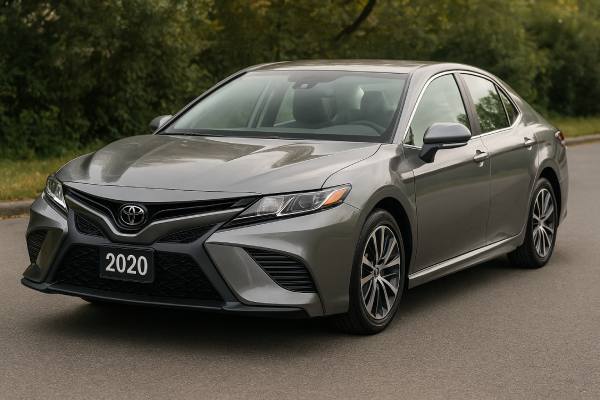
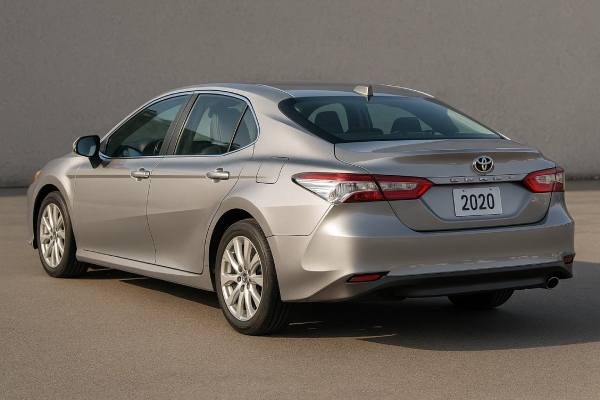
The 2020 Toyota Camry AWD (AXVA75) pairs Toyota’s 2.5-liter Dynamic Force four-cylinder with an on-demand, disconnecting rear axle to bring surefooted traction to a mainstream midsize sedan—without abandoning the Camry’s core strengths of durability and low ownership cost. The A25A-FKS engine emphasizes efficiency via high compression and dual injection, while the Direct-Shift 8-speed automatic targets smoothness over fuss. Toyota’s Dynamic Torque Control AWD can send up to half the engine’s torque rearward when slip occurs, then decouple to reduce parasitic loss when cruising. EPA ratings stay competitive, and most grades retain the quiet ride, roomy cabin, and straightforward controls owners expect. If you want snow-belt confidence without moving into a crossover, this one-year AWD run (introduced for 2020) is the sweet spot. Below, you will find hard numbers, maintenance guidance, common issues, buying tips, and how the Camry AWD stacks against its rivals.
At a Glance
- Confident winter traction with on-demand AWD; relaxed highway manners.
- Proven A25A-FKS 2.5 L engine emphasizes efficiency and low running cost.
- Spacious rear seat and 15.1 ft³ (428 L) trunk remain family-friendly.
- Watch for outstanding recalls/TSBs and ensure AWD fluid services in severe use.
- Oil and filter: every 10,000 mi/12 months (0W-16), or 5,000 mi/6 months severe.
Navigate this guide
- Camry AWD 2020 Overview
- Camry AWD 2.5 Specs
- Camry AWD Trims and Safety
- Reliability and Common Issues
- Maintenance and Buyer’s Guide
- Driving and Performance
- How Camry AWD Compares
Camry AWD 2020 Overview
The AXVA75-coded Camry AWD arrived for model year 2020 to answer a long-standing request from snow-belt shoppers: more traction without moving into an SUV. Toyota engineered AWD into its TNGA-K platform by adding a compact power-takeoff to the 8-speed automatic, a prop shaft, and a rear differential with an electromagnetic coupling. In normal driving the rear axle decouples to reduce drag; when the front tires begin to slip—or when the system anticipates low-grip conditions—it can send up to 50 percent of available torque rearward. This quick, largely transparent engagement is the central reason the AWD Camry feels natural in mixed-weather commuting.
Under the hood, the A25A-FKS 2.5-liter four-cylinder uses a high 13.0:1 compression ratio and Toyota’s D-4S (combined port/direct injection) with variable valve timing to produce 202 hp (151 kW) in LE/XLE AWD grades (SE/XSE tune adds freer-flowing exhaust and yields 205 hp). The calibration favors midrange torque and efficiency over high-rpm theatrics, which suits daily driving. Coupled with the Direct-Shift 8-speed, the powertrain is unobtrusive, with first and second geared for step-off and tall top cogs for quiet cruising.
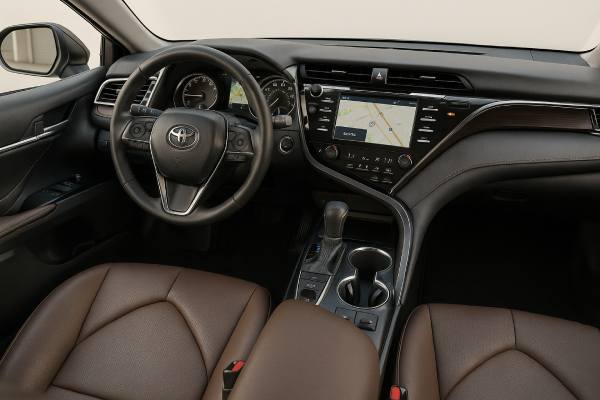
Space and ergonomics remain Camry staples: supportive front seats, adult-friendly rear room, large door openings, and clear controls. The trunk holds 15.1 ft³ (428 L), and split-fold rear seatbacks keep versatility high. Ride quality is tuned differently by grade—LE/XLE skew comfort; SE/XSE firm up the dampers and bushings—yet all retain solid composure over broken pavement. Ownership costs stay modest thanks to broad parts availability, extended factory maintenance (ToyotaCare), and long service intervals on spark plugs and coolant. The one-year 2020 AWD run also means straightforward shopping: look for a clean history, matching tires, and proof that recalls and campaigns are closed.
Camry AWD 2.5 Specs
Engine and Performance (ICE)
| Item | Specification |
|---|---|
| Code | A25A-FKS |
| Layout & valvetrain | Inline-4, DOHC, 16-valve; Dual VVT-i (VVT-iE on intake) |
| Displacement | 2.5 L (2,487 cc) |
| Induction & fuel | Naturally aspirated; D-4S direct + port injection |
| Compression ratio | 13.0:1 |
| Max power | 202 hp (151 kW) @ ~6,600 rpm (LE/XLE AWD) |
| Max torque | ~249 Nm (184 lb-ft) @ ~5,000 rpm |
| Timing drive | Chain |
| Rated efficiency (EPA) | 8.4 L/100 km combined (29 mpg US / 35 mpg UK) LE/SE AWD; 8.4 L/100 km combined (28 mpg US / 34 mpg UK) XLE/XSE AWD |
| Real-world highway @ 120 km/h | ~6.9–7.6 L/100 km (31–34 mpg US) depending on wheel/tire |
| Aerodynamics | Cd ~0.27–0.29 (grade dependent) |
Transmission and Driveline
| Item | Specification |
|---|---|
| Transmission | Direct-Shift 8-speed automatic |
| Drive type | On-demand AWD (Dynamic Torque Control) |
| Torque split | Up to 50% rear when required; rear axle decouples at cruise |
| Final drive ratio | ~3.00–3.30 (grade dependent) |
| Differential | Open front and rear; electronically controlled rear coupling |
| Refuel to full | ~5 minutes (unloaded pump flow) |
Chassis and Dimensions
| Item | Specification |
|---|---|
| Platform | TNGA-K |
| Suspension (front/rear) | MacPherson strut / Multi-link |
| Steering | Electric power assist; ~14–15:1 effective ratio |
| Brakes | 4-wheel discs; front ventilated ~305 mm (12.0 in), rear ~281 mm (11.1 in) |
| Wheels/Tires | 215/55R17 (LE); 235/45R18 (SE/XLE); 235/40R19 (XSE) |
| Ground clearance | ~145 mm (5.7 in) |
| Length / Width / Height | ~4,880 mm (192.1 in) / ~1,840 mm (72.4 in) / ~1,445 mm (56.9 in) |
| Wheelbase | 2,825 mm (111.2 in) |
| Turning circle | ~11.6 m (38.0 ft) curb-to-curb |
| Curb weight | ~1,570–1,640 kg (3,460–3,615 lb) depending on grade |
| Fuel tank | 60 L (15.8 US gal / 13.2 UK gal) |
| Cargo volume | 428 L (15.1 ft³) — SAE |
Performance and Capability
| Metric | Value |
|---|---|
| 0–100 km/h (0–62 mph) | ~8.0–8.5 s (grade/tire dependent) |
| Top speed | ~190 km/h (118 mph) governed |
| 100–0 km/h (62–0 mph) | ~36–40 m (118–131 ft) on all-season tires |
| Towing capacity | Not rated in U.S./Canada |
| Payload | ~380–430 kg (840–950 lb) typical sedan range |
| Roof load | ~45–68 kg (100–150 lb) with appropriate rack |
Fluids and Service Capacities (key items)
| System | Specification |
|---|---|
| Engine oil | Toyota Genuine 0W-16; ~4.5 L (4.8 US qt) w/filter |
| Coolant | Toyota Super Long Life (pink) 50/50; capacity varies by HVAC/trim |
| ATF | Toyota WS (World Standard); inspect—change if severe use |
| Rear differential | 75W-90 GL-5; inspect/change if severe use |
| A/C refrigerant | R-1234yf; charge varies by HVAC equipment |
| A/C compressor oil | ND-OIL 12 (R-1234yf compatible) |
Electrical
| Item | Specification |
|---|---|
| 12V battery | Group size common to midsize sedans; ~45–60 Ah (check fitment) |
| Alternator | High-output smart charging (idle-stop not equipped) |
| Spark plugs | Iridium; replacement ~120,000 mi (193,000 km) |
Safety and Driver Assistance
| Item | Summary |
|---|---|
| Crash ratings | IIHS Top Safety Pick/Top Safety Pick+ depending on headlights; “Good” in core crash tests |
| Headlights | Ratings vary by trim: Acceptable/Good with specific packages |
| ADAS suite | Toyota Safety Sense: Pre-Collision with Pedestrian Detection, Dynamic Radar Cruise Control, Lane Departure Alert with Steering Assist, Automatic High Beams; Blind Spot Monitor and Rear Cross-Traffic Alert widely available; rear auto braking available on higher trims |
Notes: Figures vary with grade, equipment, and tires. Always verify by VIN.
Camry AWD Trims and Safety
Trims and mechanical differences. For 2020, AWD was offered mainly on LE, SE, XLE, and XSE grades. LE targets comfort with 17-inch wheels and a softer damper tune; SE adds firmer suspension, distinct bump stops, and 18-inch tires for quicker response; XLE layers luxury features (leather, JBL audio availability) while keeping a comfort-biased chassis; XSE blends the SE’s chassis with 19-inch wheels and a dual-exhaust calibration. Power differs slightly: most AWD grades are rated at 202 hp, while XSE AWD gains a freer-flowing exhaust and publishes 205 hp. Across the range, the 8-speed automatic and AWD hardware are shared. Identifiers include “AWD” badging on the trunk, a raised trunk floor over the spare well to package the rear driveline, and a visible rear differential and half-shafts.
Option packages and tells. LE AWD commonly pairs a Convenience or Audio package (blind-spot monitoring, keyless entry, larger touchscreen). SE/XSE add SofTex or leather-trim interiors, paddle shifters, and sport styling. XLE/XSE can add a panoramic roof, JBL 9-speaker audio, bird’s-eye view camera, and larger driver-assist displays. Wheel/tire packages influence steering precision and fuel economy: 17-inch setups ride best and score the higher EPA combined (29 mpg), while 18/19-inch fitments trade a touch of economy for grip and appearance.
Safety ratings and structure. The 2020 Camry performs strongly in the IIHS battery of crashworthiness tests, earning “Good” in the major crash categories. Headlight ratings vary by trim and package—some configurations achieve “Good” and qualify for Top Safety Pick+; others are “Acceptable,” aligning with a Top Safety Pick outcome. Toyota’s Star Safety System (stability control, traction control, ABS with EBD and brake assist, and Smart Stop) is standard, as are 10 airbags and a backup camera. The body structure is TNGA-K with extensive high-strength steel, adhesive bonding, and rigid subframes that keep NVH in check even on coarse winter-worn pavement.
ADAS availability and calibration notes. Toyota Safety Sense includes a forward-collision system with pedestrian detection, lane departure alert with steering assist, dynamic radar cruise control, and automatic high beams. Blind Spot Monitor and Rear Cross-Traffic Alert are widely available; Rear Cross-Traffic Braking and a bird’s-eye monitor appear higher in the range. After windshield replacement, front radar removal, or front/rear collision repair, expect calibration steps for the camera/radar and parking sonar. A wheel alignment with a straight-ahead steering angle reset helps lane-keeping performance post-suspension work.
Year-to-year changes within 2020. Mid-cycle running changes focused on software updates (shift quality, infotainment stability) and option/package availability. The AWD hardware remained consistent through the 2020 model year.
Reliability and Common Issues
Overall, the A25A-FKS engine and TNGA-K chassis have proven robust in daily service. Still, an informed buyer should understand the few patterns and service actions observed around this model year:
Powertrain and driveline
- ECM/TCM calibration for shift feel (common / low severity). Early Direct-Shift 8-speed calibrations on some Toyota models could feel hesitant or busy at low speeds. For 2020 Camry AWD, updated software smooths low-speed shift timing and reduces hunting. Remedy: dealer reflash to the latest calibration; confirm with service records.
- Rear driveline noises (occasional / low–medium). A faint hum or thrum at 45–65 mph can stem from rear wheel bearings or tire cupping rather than the rear differential. Remedy: rotate tires, road-force balance, and inspect bearings. AWD alignment and tire rotation on-schedule are key.
Engine-related
- Fuel pump recall coverage varies by VIN (occasional / medium). Certain Toyota fuel pumps manufactured during a specific window were recalled. Many 2020 Camry VINs were excluded after investigation, others included; AWD status is not the deciding factor. Remedy: run a VIN recall check and ensure campaign completion if applicable.
- Engine block casting recall (rare / high). A small population of 2020 vehicles (including some Camry) were recalled for potentially defective engine block casting that could lead to coolant loss and engine damage. Remedy: verify by VIN; affected engines receive replacement under recall.
Chassis and body
- Corrosion hotspots (rare / low). The TNGA-K underbody uses extensive galvanization and coatings. In salt states, watch trailing-arm mounts and subframe fasteners; apply rustproofing if keeping the car long-term.
- Windshield camera/radar alignment (occasional / low). If lane keeping wanders after glass replacement, the camera aim may be off. Remedy: perform dynamic/static calibration with a proper target; confirm zero-point calibration after alignment.
Electrical and infotainment
- Head unit reboots / Bluetooth drops (occasional / low). Firmware updates improve stability and device compatibility. Remedy: confirm the latest audio firmware; many updates occur during normal service visits.
Pre-purchase checklist
- VIN recall report printed from official sources; ensure engine-related campaigns are closed.
- Service history with proof of engine oil changes (0W-16) and cabin/engine air filter replacements.
- AWD tires: all four should match brand/model and tread depth (AWD systems dislike mismatched circumferences).
- Underbody inspection: look for leaks at the PTU (front transfer), prop-shaft boots, and rear differential seepage.
- Brake and suspension wear: check pad thickness, rotor condition, and bushing/ball joint play—larger wheel packages can accelerate wear on rough roads.
- Calibration receipts if windshield or front bumper repairs were done.
Longevity outlook. With fluid care and software updates, 200,000+ miles (320,000+ km) is a reasonable expectation for the A25A-FKS/8-speed/AWD combination. Driveline components (rear bearings, prop-shaft support) typically age gracefully when tires are rotated on time and alignments kept true.
Maintenance and Buyer’s Guide
Core maintenance schedule (typical U.S./Canada use)
- Engine oil and filter: 10,000 miles / 12 months (0W-16), or 5,000 miles / 6 months in severe use (short trips, towing, extreme cold).
- Tire rotation and inspection: every 5,000–6,000 miles (8,000–10,000 km); AWD benefits from consistent rotation to keep circumferences matched.
- Cabin air filter: inspect 15,000 miles (24,000 km); replace 15,000–30,000 miles based on environment.
- Engine air filter: inspect 15,000; replace ~30,000 miles (48,000 km) or sooner in dusty areas.
- Brake fluid: replace every 3 years regardless of mileage.
- Coolant (Toyota Super Long Life): first replacement at 100,000 miles (160,000 km) or 10 years, then every 50,000 miles (80,000 km) or 5 years.
- Spark plugs (iridium): 120,000 miles (193,000 km).
- Automatic transmission fluid (Toyota WS): inspect condition; change 60,000–90,000 miles if severe service (mountain grades, hot climates, frequent stop-and-go).
- Rear differential gear oil (75W-90 GL-5): inspect; change ~60,000–90,000 miles if severe service.
- Alignment: check annually or if tire wear patterns appear.
- 12V battery: test annually after year 3; typical life 4–6 years.
Fluids quick-reference
- Engine oil: 0W-16 API SP/ILSAC GF-6; approx. 4.5 L (4.8 qt) with filter.
- Coolant: Toyota Super Long Life (pink) premix 50/50.
- ATF: Toyota WS.
- Rear diff: 75W-90 GL-5.
- Power steering: electric (no fluid).
- A/C: R-1234yf with ND-OIL 12.
Essential torques (decision-level)
- Wheel lug nuts: ~103 Nm (76 lb-ft).
- Engine oil drain plug: ~39 Nm (29 lb-ft).
- Spark plugs: ~18–22 Nm (13–16 lb-ft) on clean, dry threads (always confirm spec).
Buyer’s tips
- Best value grades: LE AWD (17-inch tires, best ride/efficiency) and SE AWD (sport seats, crisper steering) are the sweet spots for daily drivers. XLE AWD suits those who want full comfort features without the firmer SE/XSE chassis.
- What to seek: single-owner cars with full records, original window sticker or build sheet, and evidence of completed campaigns. Even tire wear across the axle pairs is a good sign of proper rotations and alignment.
- What to avoid: mismatched tires, delayed oil changes, or modified wheels with incorrect offset (which can induce tramlining and accelerate bearing wear).
- Long-term durability: expect low incident-rate powertrain repairs; budget for routine items (tires/brakes/fluids) and occasional alignment-related suspension components over 8–12 years of service.
Driving and Performance
Ride, handling, and NVH. The AWD Camry remains one of the calmest midsize sedans at highway speed. LE and XLE soak up expansion joints with a mature, damped feel, while SE/XSE add body control and a touch more road texture through the seat. The TNGA-K body’s stiffness helps the suspension work without squeaks or rattles, so even in cold-weather mornings, the cabin stays quiet. Wind noise is modest; the biggest NVH variable is tire choice—19-inch all-seasons can thump over sharp edges; 17-inch packages stay plushest.
Steering and braking. Electric-assist steering is light in parking and firms appropriately on the move; accuracy is good though feedback is filtered. Brake feel is confident with linear travel; fade resistance is more than sufficient for mountain drives on all-season tires. Pedal modulation is easy, which matters on slick surfaces where smooth inputs are rewarded.
Powertrain character. The A25A-FKS starts eagerly and idles with minimal vibration. Throttle response is clean off-idle; the 8-speed steps through the lower gears promptly and, in normal mode, upshifts early to keep the cabin quiet. Passing performance from 50–80 mph (80–129 km/h) is adequate; kickdown is decisive when you press through the detent. Sport mode holds gears longer and sharpens downshifts on grades. In snow, the AWD system engages imperceptibly—launching on a frosty incline feels drama-free, and mid-corner throttle adds composure rather than push.
Real-world efficiency. Expect 25–27 mpg US city (9.4–10.7 L/100 km), 34–36 mpg US highway (6.5–6.9 L/100 km) on 17–18-inch tires in mild weather; mixed driving typically lands in the 28–30 mpg US (7.8–8.4 L/100 km) range. Winter blends and snow tires drop highway numbers by 1–3 mpg. XLE/XSE with larger wheels often average 1 mpg lower than LE/SE.
Load and winter use. With four adults and cargo, the AWD’s extra traction helps on unplowed streets and slushy on-ramps. Stability control is tuned gently; it permits slight wheelspin to build momentum in deep snow before trimming power. If you routinely drive in sub-zero temps, budget for quality winter tires—the AWD system maximizes their advantage but can’t replace rubber compound.
Key metrics that shape the verdict
- 0–60 mph: mid-7s to high-7s depending on tire and pavement temperature.
- Highway noise at 70 mph: quiet for the class (engine under 2,000 rpm in 8th).
- Braking 60–0 mph: low-130s ft on all-seasons, better on summer rubber.
- Turning circle: ~38 ft keeps parking-lot agility intact.
How Camry AWD Compares
Against Nissan Altima AWD. The Altima’s available variable-compression turbo offers stronger punch, and its CVT keeps revs low, but long-term reliability and brake feel favor the Camry. Camry’s 8-speed shifts more naturally and the cabin feels sturdier over time. The Toyota also tends to retain value better in snow states.
Against Subaru Legacy. Standard AWD and a cushy ride make the Legacy a winter favorite, and EyeSight driver assistance is refined. The Camry counters with crisper steering, a more premium cabin in upper trims, and a livelier 8-speed. Fuel economy is similar; maintenance cost and resale often lean Toyota.
Against Honda Accord (FWD). The Accord doesn’t offer AWD (in this generation) but drives with class-leading chassis poise. If you must have AWD, the Camry wins by default; if you live where winters are mild, the Accord 1.5T/2.0T alternatives impress with performance. Toyota’s edge is lower long-term risk and a simpler ownership experience.
Bottom line. If your use case demands year-round traction without SUV height or thirst, the 2020 Camry AWD nails the brief: stable winter manners, restrained running cost, and the calm, durable feel that built the Camry’s reputation—now with driven rear wheels when you need them.
References
- Toyota Gains More Traction on the Road and in the Sedan Segment with the Launch of Camry and Avalon All-Wheel Drive Models 2019 (Press Release)
- 2020 Toyota Camry AWD LE/SE 2020 (EPA Ratings)
- 2020 Toyota Camry 2020 (Safety Rating)
- Vehicle Detail Search – 2020 TOYOTA CAMRY 4 DR AWD 2020 (Recall Database)
- Look up Safety Recalls & Service Campaigns by VIN 2020 (Recall Lookup)
Disclaimer
This article is for informational purposes and is not a substitute for professional diagnosis or repair. Specifications, torque values, fluid capacities, intervals, and procedures vary by VIN, market, trim, and equipment. Always verify against your vehicle’s official owner’s manual, warranty and maintenance guide, and service information.
If this guide helped, please consider sharing it with fellow owners on Facebook or X/Twitter to support xcar’s work.