


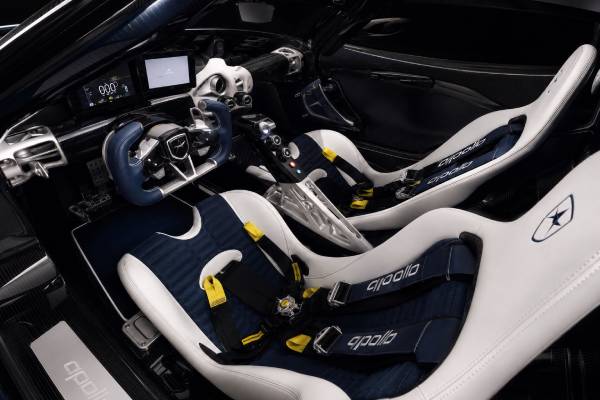
The Apollo EVO is a ten-car, track-only hypercar built around a naturally aspirated 6.3-liter V12, rear-wheel drive, a six-speed sequential gearbox, and an active-aerodynamic carbon-fiber body. Its headline output is 800 metric horsepower, but the more important point is how little filtration sits between the driver and the machine: there is no hybrid assistance, no road-car dual-clutch transmission, and no attempt to disguise the sounds or forces of circuit driving. Production moved beyond the long-running concept phase in 2026. Apollo delivered the first customer car, the “Caribbean Dragon,” in June and presented it publicly at the Goodwood Festival of Speed in July. With a dry weight of about 1,300 kg, claimed 0–100 km/h acceleration of 2.7 seconds, and aerodynamic load that can exceed the car’s own mass, the EVO is less a conventional exotic car than a privately commissioned racing machine. Ownership therefore depends as much on factory support, transport, track access, and disciplined maintenance as on the purchase price.
Table of Contents
- Production Status and Purpose
- EVO Specifications and Technical Data
- V12 Performance and Sequential Driveline
- Active Aero, Carbon Structure, and Chassis
- Track Operation and Driver Preparation
- Maintenance, Storage, and Technical Support
- Buying and Commissioning an Apollo EVO
Production Status and Purpose
The EVO is a production track car, not merely the dramatic show vehicle first displayed in 2021. Apollo began the ten-car customer program with a production specification priced from approximately €3 million before taxes, options, bespoke work, transport, and local costs.
The distinction matters because early descriptions of “Project EVO” circulated for years with provisional figures and renderings. The finished car retains the concept’s visual language, but it has a newly developed monocoque, revised lighting, an active rear wing, a completed cockpit, and a production-defined mechanical package. The first customer unit entered production before its June 2026 delivery and was then run at Goodwood, giving the program a clear start date for the 2026–present assignment.
Apollo positions the EVO as the track-only successor to the Intensa Emozione. That means it is designed around private circuit use rather than road homologation, commuting, touring range, luggage capacity, or normal dealership servicing. The owner is effectively buying three things at once:
- a highly limited physical car;
- a bespoke engineering and design commission;
- access to the specialist support needed to operate it safely.
Only ten examples are planned, and Apollo’s FORGE personalization program allows each one to differ substantially in color, trim, visible carbon, materials, and detail execution. The Caribbean Dragon illustrates the scale of that work: more than 75 painted carbon-fiber exterior pieces, an eight-layer finish, a blue-tinted carbon cockpit, and a one-piece 3D-printed titanium exhaust tailored to the car’s theme.
The result sits in the same broad ownership category as a Pagani Huayra R, McLaren Solus GT, Ferrari FXX program car, or Aston Martin Valkyrie AMR Pro, but it follows its own philosophy. The EVO favors a large naturally aspirated engine, pneumatic sequential shifting, hydraulic steering, rear-wheel drive, and visible mechanical structure. Its value is not based on setting a published lap record. It is based on rarity, sensory intensity, bespoke construction, and the unusual engineering decision to keep an 800 PS V12 free of electrification.
EVO Specifications and Technical Data
The Apollo EVO is an internal-combustion, rear-mid-engine, rear-wheel-drive track car. Its F140-family 6.3-liter V12 sends power through a six-speed sequential transaxle, while a carbon monocoque, carbon subframes, pushrod suspension, carbon-ceramic brakes, and active aerodynamics manage the forces generated by a roughly 1,300 kg dry vehicle.
| Specification | Value | Notes |
|---|---|---|
| Powertrain type | Naturally aspirated gasoline V12 | No hybrid assistance |
| Engine family | Ferrari-derived F140E family | Further developed for Apollo |
| Displacement | 6,262 cc (6.3 L) | Rear-mid-mounted |
| Maximum output | 800 PS (588 kW; about 789 bhp) | Manufacturer production specification |
| Maximum torque | 765 Nm (564 lb-ft) | Published peak figure |
| Maximum engine speed | 8,500 rpm | High-revving naturally aspirated character |
| Drive type | Rear-wheel drive | Mechanical, driver-focused layout |
| Specification | Value | Condition |
|---|---|---|
| Transmission | Six-speed sequential | Pneumatic paddle operation |
| 0–100 km/h | 2.7 seconds | Manufacturer claim |
| Top speed | 335 km/h (208 mph) | Manufacturer claim |
| Dry weight | Approximately 1,300 kg (2,866 lb) | Official corporate disclosure |
| Production | 10 customer cars | Bespoke limited series |
| Base price | Approximately €3,000,000 | Before taxes, fees, and personalization |
| Specification | Value | Engineering context |
|---|---|---|
| Primary structure | Full carbon-fiber monocoque | Carbon front and rear subframes and crash structures |
| Monocoque mass | 165 kg (364 lb) | Claimed 10% lighter than the IE tub |
| Stiffness change | 15% greater than the IE | Manufacturer comparison |
| Rear aerodynamic device | Hydraulically actuated active wing | Continuously changes angle and can act as an airbrake |
| Wing deployment | Under one second | Manufacturer claim |
| Maximum aerodynamic load | About 1,350 kg (2,976 lb) | Claimed peak downforce |
| Specification | Value | Configuration |
|---|---|---|
| Suspension | Double wishbones with pushrod actuation | Adjustable motorsport-type dampers |
| Steering | Hydraulic power assistance | Chosen for direct feedback |
| Standard front wheels | 20 × 10 inches | Forged aluminum, center-lock |
| Standard rear wheels | 21 × 13 inches | Forged aluminum, center-lock |
| Standard tires | Michelin Pilot Sport Cup 2 R | Track-focused road-pattern tire |
| Standard brakes | Carbon-ceramic discs, about 380 mm | Front and rear |
| Track package | Racing steel brakes and 18-inch slick-compatible wheels | Optional heavy-track-use configuration |
These are production claims rather than a complete workshop data set. Apollo has not released a public owner’s manual with oil grade, fluid capacities, wheel-center-lock torque, cold tire pressures, alignment targets, or component life limits. Those values must come from the documentation supplied with each chassis and may differ with the selected brake, wheel, tire, and track package.
V12 Performance and Sequential Driveline
The EVO’s strongest defining feature is not simply 800 PS; it is the way the V12 delivers that output without turbochargers or electric torque fill. The driver must use engine speed, gear selection, and throttle control rather than relying on a broad boosted torque plateau.
A 6.3-liter naturally aspirated V12 combines fast response with a long rise in power toward 8,500 rpm. On track, that changes the driving rhythm. Corner-exit torque arrives in close proportion to throttle opening, so small pedal movements are easier to read than they can be in a high-boost engine. The reward is precision, but the penalty for poor technique remains severe because 765 Nm still reaches only the rear tires.
The quoted 2.7-second 0–100 km/h time is impressive, yet standing-start acceleration is not the car’s main engineering purpose. The real advantage of the low dry mass and high output appears repeatedly: braking zones shorten, direction changes demand less energy, and every gear can deliver strong acceleration. Based on the published figures, the simple power-to-dry-weight ratio is about 615 PS per metric tonne. That calculation is useful for context but does not include fuel, driver, fluids, optional equipment, or aerodynamic drag.
The six-speed sequential transmission is fundamentally different from the dual-clutch units in most road hypercars. A sequential gearbox selects the next or previous ratio in order rather than allowing the driver to choose any gate. Pneumatic paddle actuation makes the shift fast, but the process can still feel and sound mechanical. It may require deliberate throttle technique at low speed, and it is not designed to creep smoothly through traffic.
That driveline has several practical consequences:
- The gearbox, shift actuator, air system, clutch, and differential should be treated as motorsport components with logged operating hours.
- Low-speed paddock use can produce more clutch heat than fast circuit running.
- Repeated standing launches may consume component life without adding much value to a track session.
- Correct oil temperature matters before using maximum rpm or shift load.
- Downshifts should be timed to avoid unnecessary rear-axle disturbance, even when the control system protects against an obvious mechanical over-rev.
The 335 km/h top-speed claim also needs context. The EVO is shaped to make large aerodynamic loads, not to minimize drag at all costs. Its active wing can flatten for a straight and rise for cornering or braking, but the body still carries extensive fins, channels, outlets, and cooling surfaces. A lower-drag road hypercar may reach a higher terminal speed with less power; the EVO spends some of its power budget pressing the tires into the track.
Active Aero, Carbon Structure, and Chassis
The EVO’s visual complexity is functional: the body manages cooling flow, pressure relief, stability, and downforce around a compact carbon structure. Its active rear wing is the clearest moving element, but the fixed surfaces and underbody are equally important to aerodynamic balance.
At a claimed peak of about 1,350 kg, the aerodynamic load exceeds the car’s stated dry mass. That does not mean the EVO can literally drive upside down in normal conditions. Downforce depends on speed, ride height, pitch, yaw, surface smoothness, wing position, and airflow attachment. It also acts through the tires and suspension, whose loads rise dramatically as speed increases.
The hydraulically operated wing can change angle in less than a second. In a lower-angle position, it reduces drag and helps straight-line speed. As its angle rises, it adds rear load for cornering. At maximum deployment it works as an airbrake, increasing drag while helping stabilize the rear axle under severe braking. The control strategy must coordinate with vehicle speed, brake demand, steering, and the rest of the aerodynamic platform; a wing fault is therefore a safety issue, not merely a cosmetic defect.
The new 165 kg monocoque is claimed to be both lighter and stiffer than the Intensa Emozione structure. Greater torsional stiffness gives engineers a more stable base for suspension tuning because the tub bends less under load. It also helps the aerodynamic platform: when the relationship among the floor, suspension, and road surface stays consistent, the car’s downforce balance is easier to predict.
Apollo’s “skeletonized” design continues inside. Carbon and topology-optimized aluminum structures remain visible instead of being hidden by conventional trim. Fixed bucket seats attach to the monocoque, while a sliding pedal box adapts the driving position. This is common race-car logic: keeping the seat fixed preserves a low, rigid installation and moves the lighter pedal assembly instead.
Pushrod-actuated double-wishbone suspension allows springs and dampers to sit inboard. The arrangement reduces unsprung mass, can improve aerodynamic packaging, and gives engineers freedom to select motion ratios and wheel-control geometry. It is also setup-sensitive. Ride height, corner weights, damper settings, anti-roll balance, and alignment interact with the aero map, so a casual adjustment can make the car slower or less stable even when it feels stiffer.
The standard 20-inch front and 21-inch rear wheels carry Michelin Pilot Sport Cup 2 R tires. For sustained circuit work, Apollo also offers 18-inch wheels for slicks and racing steel brakes. That option is not automatically “better.” Carbon-ceramic discs resist corrosion, save rotating mass, and work well in many track-day conditions. Steel racing brakes can offer more predictable consumable cost and easier inspection during intensive use, but they add weight and require their own pad, cooling, and bedding strategy.
Track Operation and Driver Preparation
The safe way to operate an EVO is to treat every event as a managed test session, not an unrestricted supercar day. The car’s speed, downforce, braking capacity, visibility, and replacement-part scarcity justify professional support and structured run plans.
Before the first fast lap, the team should confirm the exact setup supplied for that circuit. The checklist should cover wheel retention, tire condition, cold pressures, brake wear, fluid levels, body fasteners, aero movement, fire system status, harness dates, steering play, data logging, and any leak around the engine, gearbox, hydraulic system, or dampers. These checks need values from the chassis documentation, not generic internet specifications.
Driver fit is equally important. The pedal box, harness, head restraint, steering reach, and mirrors must suit the driver while wearing the intended helmet and suit. The driver should be able to apply full brake pressure without locking the knee, hold the steering wheel without straight arms, and reach every safety control while fully restrained.
A sensible first session follows a progression:
- Warm the engine, gearbox, brakes, and tires without using full throttle or maximum rpm.
- Check shift quality, steering center, brake-pedal feel, warning displays, and active-aero behavior.
- Build speed in braking zones before adding large cornering load.
- Review pressures, temperatures, wear, and logged data after a short run.
- Change only one major setup variable at a time.
Tire management deserves special attention. Cup 2 R tires can provide exceptional dry grip but are sensitive to temperature, pressure, age, storage, and heat cycles. Slicks are even more specialized. Neither should be judged solely by tread depth. A tire can look usable yet lose grip after repeated heat exposure or improper storage. Wet conditions require a separate tire and setup plan; a dry-focused tire on standing water can overwhelm even a skilled driver.
Noise limits may restrict where the EVO can run. A high-revving V12 and short, free-flowing exhaust can exceed drive-by or static limits at many circuits. Owners should confirm local testing rules before transporting the car and discuss any approved exhaust solution with Apollo rather than improvising a silencer that changes heat or back pressure.
Because the EVO is track-only, road registration should never be assumed. A few track cars obtain individual approval in some jurisdictions, but that does not make the model generally road legal. Lighting, emissions, crash compliance, pedestrian protection, tires, ground clearance, and noise can all affect eligibility. Transporting the car in an enclosed trailer or transporter is the normal operating model.
Maintenance, Storage, and Technical Support
EVO maintenance should be condition-based, event-based, and factory-directed. There is no responsible way to replace the supplied service documentation with a normal mileage schedule because track loads are measured in hours, temperatures, shifts, brake energy, and curb strikes rather than commuting distance.
A professional log should record engine hours, high-rpm time, shift count, clutch events, launches, tire heat cycles, brake wear, fuel used, warning messages, setup changes, and any off-track excursion. That history allows Apollo or its technical partner to identify trends before a small issue becomes an engine, gearbox, or structural failure.
After each event, the most valuable inspection areas include:
- tire cuts, pickup, flat spotting, and heat-cycle history;
- wheel damage and center-lock condition;
- carbon-ceramic or steel disc condition, pad thickness, and heat checking;
- underfloor and diffuser contact damage;
- suspension joints, pushrods, dampers, and upright play;
- hydraulic leaks and full active-wing travel;
- exhaust supports, heat shielding, and discoloration patterns;
- engine, gearbox, and differential fluid samples where the service program calls for them;
- carbon body and monocoque surfaces around jacking points and impact zones.
Carbon damage must be assessed differently from a dented metal panel. A curb strike can create delamination or internal cracking that is not obvious from the surface. Tap testing, ultrasound, or another non-destructive inspection method may be required. Drilling, sanding, heating, or bonding a structural area without an approved repair scheme can compromise the tub and its value.
Storage should control temperature, humidity, dust, battery condition, tire loading, and fluid leakage. The car should be cleaned without forcing water into exposed electronics, vents, center-lock assemblies, or the cockpit. Fuel strategy must follow Apollo’s instructions, especially during long layups, because modern gasoline can absorb moisture and degrade. The engine should not simply be started for a few minutes in storage; short idling may create condensation without bringing all fluids to proper operating temperature.
The 3D-printed titanium exhaust and active rear wing also deserve model-specific care. Exhaust color changes can be normal, but new contact marks, cracks, loose supports, or abnormal heat staining require investigation. The wing mechanism should be kept clean and checked through its full commanded range. Any warning, slow response, asymmetry, or hydraulic seepage should stop high-speed running until the cause is found.
Spare-parts planning is part of maintenance. With only ten cars, an owner should secure a documented supply route for wheels, body sections, glazing, lights, brake consumables, suspension components, sensors, and transmission parts. Some pieces may be repairable; others may require a new bespoke build. Insurance coverage should reflect replacement lead times and the cost of transporting the car to an approved repair center.
Buying and Commissioning an Apollo EVO
Buying an EVO is primarily a relationship and support decision. The car’s €3 million base price is only the entry point; the real commitment includes personalization, taxes, storage, transport, track staff, consumables, insurance, and access to approved technical service.
For a new allocation or factory-facilitated purchase, the commission should define exactly what is included. Buyers should clarify the specification freeze date, payment milestones, delivery location, acceptance process, track shakedown, warranty terms, crash-damage policy, software and data access, spare parts, tools, chargers or support equipment, and the number of included engineering days.
The visual specification can have technical effects. Exposed carbon, multilayer paint, tinted resin, machined aluminum, leather, and printed titanium all age differently. A highly elaborate finish may demand more careful repair after gravel damage or heat exposure. Owners planning frequent circuit use may want a protected, serviceable livery and a spare set of track body components rather than treating the first painted surface as untouchable artwork.
A secondary-market EVO will require deeper due diligence than a normal collector car. The buyer should inspect:
- factory identity and complete ownership provenance;
- original specification and every later modification;
- engine, gearbox, and chassis operating-hour logs;
- accident, curb-strike, and off-track history;
- non-destructive carbon inspection reports;
- current life status of safety equipment and major driveline parts;
- included wheels, tires, tools, spares, molds, and transport equipment;
- transferability of factory support, software access, and event services;
- import, tax, title, and track-use restrictions in the destination country.
A pre-purchase inspection should involve Apollo or a specialist accepted by Apollo. An apparently minor non-standard change can affect cooling, aero balance, wheel loads, brake temperature, or electronic calibration. The buyer also needs a realistic annual operating budget. Tires, brake components, fuel, transport, circuit rental, crew, insurance, and scheduled factory work can make the purchase price less important than the long-term support plan.
The EVO is a rational purchase only for a very specific owner: someone who values a naturally aspirated V12 and direct mechanical controls, accepts track-only logistics, wants extensive personalization, and is prepared to preserve a ten-car machine without turning it into a static object. For that owner, its greatest appeal is not a single acceleration figure. It is the rare chance to operate a modern carbon hypercar that deliberately rejects hybridization and road-car compromise while retaining direct factory involvement.
References
- Apollo 2026 (Manufacturer Model Page)
- DELIVERY OF THE FIRST PRODUCTION UNIT OF APOLLO EVO CUSTOMER CAR 2026 (Official Corporate Announcement)
- The wild Apollo Evo looks unlike any other hypercar | GRR 2026
- Apollo EVO Is the Wildest V-12 Track-Only Hypercar Yet 2026
- The New Apollo EVO Breaks Cover, Customer Vehicle Number 1 Already in Production 2026
- Fins! Flaps! Flicks! Get Ready, World, the Apollo Has Landed! 2026
Disclaimer
This article is for informational purposes and is not a substitute for professional diagnosis, inspection, setup, or repair. Specifications, torque values, component life limits, service intervals, and procedures can vary by chassis, market, equipment, and track package. Verify every technical value against the official documentation supplied for the vehicle and use Apollo-approved personnel for safety-critical work.
Please share this article on Facebook, X/Twitter, or another platform if it helped you; sharing supports our work.