
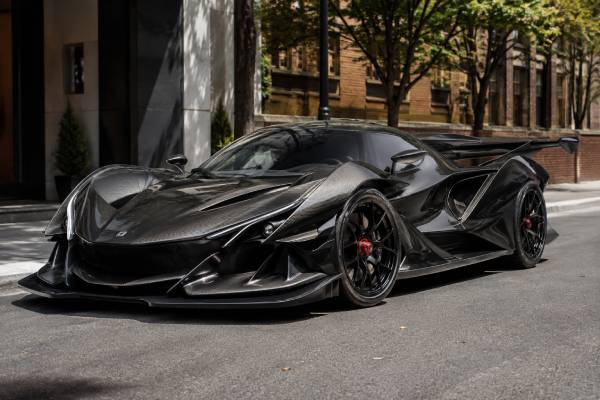
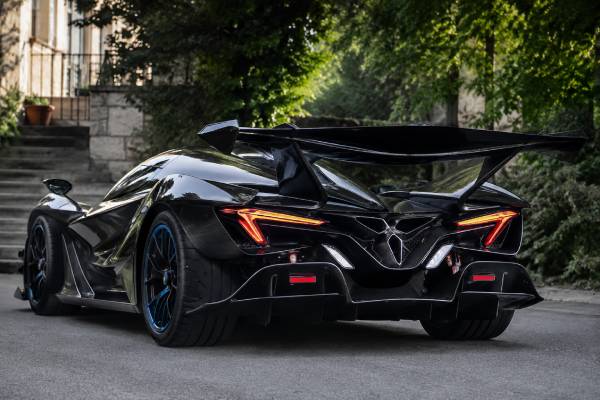
The Apollo Intensa Emozione is a ten-unit V12 hypercar created to feel closer to a late-1990s GT1 racing machine than a polished modern grand tourer. Its name means “intense emotion,” and the engineering follows that brief: a naturally aspirated 6.3-liter engine, a six-speed sequential gearbox, hydraulic steering, rear-wheel drive, a carbon monocoque, and enough aerodynamic load to exceed the car’s published 1,250 kg weight at high speed. Unveiled in 2017, the production version entered assembly in 2019 with HWA AG involved in final dynamics development and vehicle completion. This guide covers the 2019–2023 production era specified for the article, including the technical layout, driving character, specialist maintenance, and the checks that matter when one of the ten cars changes hands. The IE is sometimes described like a road-legal exotic, but ownership is closer to managing a bespoke competition car: provenance, factory support, setup records, structural inspection, and access to rare parts matter more than ordinary mileage or service stamps.
Table of Contents
- Why the Intensa Emozione Matters
- What Ownership Is Really Like
- Intensa Emozione Technical Specifications
- How the F140 V12 and Hewland Gearbox Work Together
- Aerodynamics, Suspension, and Braking Engineering
- Preservation, Service, and Track Care
- Buyer Due Diligence for One of Ten Cars
Why the Intensa Emozione Matters
The IE matters because it re-established Apollo as a builder of complete hypercars and set the technical direction later developed by the EVO. It did so with an unusually uncompromised combination of naturally aspirated power, very low mass, high downforce, and deliberately theatrical design.
Apollo emerged from the company associated with the original Gumpert Apollo, but the Intensa Emozione was not a simple continuation of that turbocharged road car. It was a fresh program shaped by chief designer Jowyn Wong and developed with specialist partners. Manifattura Automobili Torino contributed to the project’s realization, Autotecnica Motori worked on the engine, Capricorn produced the carbon structure, and HWA AG became the key partner for final dynamic development and production completion in Affalterbach.
That specialist network remains important for service, parts, and authentication.
The production run was capped at ten customer cars, each individually commissioned. The original European base price was about €2.3 million before options and local costs. Color names such as Golden Dragon, Purple Dragon, Ocean Dragon, and Black Dragon helped establish the cars as individual collector objects rather than interchangeable examples of one model.
The IE arrived as turbocharging, hybrid assistance, and dual-clutch gearboxes were becoming normal. Apollo instead emphasized a high-revving V12, a racing-style transmission, and hydraulic steering.
For the 2019–2023 scope, it is useful to distinguish three dates:
- 2017: public unveiling and early specification claims;
- 2018: technical partnership with HWA for final dynamic development;
- 2019 onward: production-car assembly and customer deliveries.
Some online specifications still mix prototype and production information. The safest approach is to prioritize Apollo’s current model page, HWA’s corporate records, and consistent production-era technical data. Figures that were only projected at launch should be identified as claims rather than independent test results.
What Ownership Is Really Like
An IE can be usable on selected roads in jurisdictions where an individual car has been registered, but it should be treated primarily as a track-focused, low-volume machine. Registration status, insurance, emissions compliance, noise rules, and permitted use can differ from one chassis and country to another.
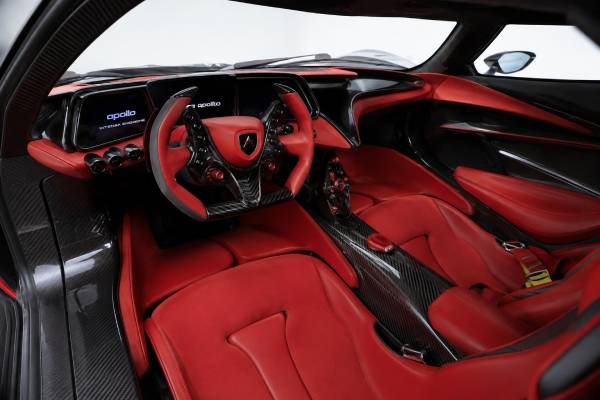
The cockpit makes that purpose clear. Occupants sit low inside a carbon structure with fixed racing-style seats, harnesses, compact controls, and limited space for ordinary belongings. Entry through the upward-opening doors requires flexibility, and the wide body, long tail, low nose, and restricted rearward view demand care in any confined area.
Ground clearance can be adjusted, but the lowest track setting is unsuitable for normal ramps, road crowns, loading angles, and speed humps. Even with the suspension raised, the front splitter, floor edges, diffuser, and exposed carbon remain vulnerable. A spotter and loading ramps with a shallow approach are sensible whenever the car enters an enclosed transporter.
The sequential gearbox also changes low-speed behavior. It is not a smooth road-car automatic. Moving away requires clutch control, and prolonged creeping can generate heat. The electro-pneumatic paddle system is happiest when the car is driven with clear inputs and enough speed for the transmission, engine, and brakes to reach their working temperatures.
Noise is another practical limit. A 6.3-liter V12 turning toward 9,000 rpm can exceed static or drive-by limits at many circuits. An owner should confirm the circuit’s testing method, measurement distance, and permitted decibel level before transport. Any quieter exhaust arrangement must be approved because changes can affect heat management, back pressure, calibration, and bodywork temperatures.
The IE also needs professional event support. A normal supercar owner may arrive, check tire pressures, and drive. An IE benefits from a technician who knows its jacking points, center-lock wheels, pneumatic shift system, adjustable suspension, carbon brakes, data systems, and body fasteners. The same technician can inspect the car between runs and stop a session if a pressure trend, warning, leak, or vibration suggests a developing fault.
Insurance must explicitly address circuit use, approved drivers, transport, and carbon-structure damage. With only ten cars, repair cost may be driven by tooling and manufacturing lead time rather than the visible size of a damaged part.
The IE is therefore most rewarding when the owner accepts its operating model. It is not merely a sculpture that happens to run, nor is it a practical road car with aggressive styling. It is a small-series engineering object that needs planning before every serious use.
Intensa Emozione Technical Specifications
The Intensa Emozione is a gasoline-only, rear-mid-engine, rear-wheel-drive hypercar. Its 6,262 cc F140-family V12 works with a Hewland sequential transmission, while a carbon monocoque and pushrod suspension support a body designed for extremely high aerodynamic load.
| Specification | Value | Context |
|---|---|---|
| Covered production era | 2019–2023 | Assignment scope |
| Production quantity | 10 customer cars | Individually commissioned |
| Body style | Two-door, two-seat coupe | Upward-opening doors |
| Engine position | Rear-mid, longitudinal | Mounted behind the cabin |
| Drive type | Rear-wheel drive | Mechanical limited-slip differential |
| Original base price | Approximately €2,300,000 | Before options and taxes |
| Specification | Value | Notes |
|---|---|---|
| Engine family | Ferrari-derived F140 V12 | Developed for Apollo with specialist partners |
| Displacement | 6,262 cc (6.3 L) | Naturally aspirated |
| Cylinder angle | 65 degrees | Aluminum-alloy block and heads |
| Bore × stroke | 94.0 × 75.2 mm | Oversquare, high-revving geometry |
| Valvetrain | DOHC, four valves per cylinder | 48 valves total |
| Maximum output | 780 PS (574 kW; about 769 bhp) | At 8,500 rpm |
| Maximum torque | 760 Nm (561 lb-ft) | At 6,000 rpm |
| Maximum engine speed | 9,000 rpm | Published redline |
| Transmission | Hewland six-speed sequential | Electro-pneumatic paddle shift |
| Specification | Value | Condition |
|---|---|---|
| 0–100 km/h | 2.7 seconds | Manufacturer claim |
| Top speed | Approximately 335 km/h (208 mph) | Published production-era figure |
| Vehicle weight | 1,250 kg (2,756 lb) | Published model specification |
| Weight distribution | 45% front / 55% rear | Published static distribution |
| Maximum downforce | 1,350 kg (2,976 lb) | Claimed at 300 km/h (186 mph) |
| Power-to-weight | About 624 PS per tonne | Calculated from published output and weight |
| Specification | Value | Notes |
|---|---|---|
| Primary structure | Carbon-fiber monocoque | Carbon crash structures and body panels |
| Monocoque mass | 105 kg (231 lb) | Published bare-tub figure |
| Structural standard | LMP2-level rigidity claim | No internal roll cage required by the design claim |
| Length | 5,066 mm (199.4 in) | Production specification |
| Width | 1,995 mm (78.5 in) | Body width |
| Height | 1,130 mm (44.5 in) | Normal published dimension |
| Wheelbase | 2,700 mm (106.3 in) | Published chassis dimension |
| Specification | Value | Configuration |
|---|---|---|
| Suspension | Double wishbone with pushrod and rocker actuation | Front and rear |
| Dampers | Three-way adjustable Bilstein | Front and rear |
| Steering | Hydraulic rack-and-pinion | Front axle |
| Brakes | 380 × 34 mm carbon-ceramic discs | Six-piston front and four-piston rear calipers |
| Wheel diameter | 20 inches front; 21 inches rear | Staggered fitment |
| Road tires | 265/35 R20 front; 325/30 R21 rear | Michelin Pilot Sport Cup 2 |
Detailed fluid capacities, center-lock torque, alignment settings, tire pressures, and component life limits are omitted because they must come from the documentation for the exact chassis and wheel package.
How the F140 V12 and Hewland Gearbox Work Together
The IE’s powertrain rewards revs and decisive inputs rather than effortless low-speed torque. Its V12 makes peak torque at 6,000 rpm and reaches maximum power at 8,500 rpm, so the useful performance band sits much higher than in a turbocharged road car.
The F140-family architecture began in Ferrari applications, but the IE engine should not be treated as a standard Ferrari service unit. Apollo’s version was developed and calibrated for a different intake, exhaust, cooling system, installation angle, duty cycle, gearbox, and vehicle mass. Autotecnica Motori and HWA were involved in turning the base architecture into an Apollo-specific powertrain.
Its 94.0 mm bore and 75.2 mm stroke form an oversquare layout that supports high-rpm breathing. Even so, operation near 9,000 rpm places heavy demands on lubrication, cooling, the valvetrain, and exhaust system.
The absence of turbochargers removes boost delay and much of the extra exhaust-side plumbing. Throttle response is immediate, and engine sound rises in a clean progression rather than being softened by turbines. The trade-off is that maximum acceleration requires the driver to keep the engine in its upper range. Selecting the wrong gear on corner exit costs more time than it would in an engine with a broad plateau of boosted torque.
The Hewland six-speed sequential transaxle translates that character into the driving experience. Pulling a paddle requests the next ratio through an electro-pneumatic system. The shift is quick and forceful, with less interruption than a traditional H-pattern manual but more mechanical sensation than a luxury-car automatic.
A sequential box brings its own operating rules:
- Gear engagement at low speed should be deliberate rather than rushed.
- The clutch should not be slipped for long periods during loading or paddock movement.
- Air pressure and actuator function must be checked before a session.
- Gearbox temperature should be built progressively.
- Shift counts and abnormal engagements should be logged.
- The driver must avoid using downshifts as a substitute for braking.
The differential, supplied through Pankl Racing Systems, must manage 760 Nm through the rear axle while preserving turn-in and traction. Setup choices around preload, locking behavior, rear tire condition, and suspension balance can change whether the car feels progressive or abrupt at corner exit. Those settings belong in the hands of a technician familiar with the chassis rather than an owner applying generic race-car advice.
Repeated launch demonstrations add clutch, gearbox, driveline, and tire stress. The IE is better understood through its sustained circuit response than through one acceleration claim.
Aerodynamics, Suspension, and Braking Engineering
The IE’s extreme appearance is inseparable from its aerodynamic function. Large tunnels, dive planes, vents, wheel-arch relief, a deep diffuser, and a fixed rear wing create a pressure system intended to produce up to 1,350 kg of downforce at 300 km/h.
That number requires careful interpretation. Downforce rises roughly with the square of speed, so the car does not create its maximum load in a slow corner. It also depends on ride height, pitch, yaw, body sealing, tire diameter, and whether the airflow remains attached. A small change in front ride height or a damaged floor edge can alter the balance even when the total load still feels enormous.
The carbon monocoque gives the aero and suspension a stiff reference structure. Apollo states that the 105 kg tub reaches the rigidity level expected of an LMP2 prototype without needing an internal roll cage. A stiff tub allows the springs, anti-roll bars, and dampers to control wheel movement instead of wasting part of their motion twisting the chassis.
The pushrod-and-rocker suspension places spring and damper hardware inboard, helping packaging and airflow. Three-way adjustable Bilstein dampers and adjustable anti-roll bars provide broad setup control.
These adjustments are powerful but interdependent. Adding front roll stiffness may sharpen steering response yet reduce grip at the inside front tire. Lowering the car may increase downforce until the floor stalls or contacts the track. Increasing rear damping may improve one transition while making power delivery harsher over bumps. Setup work should therefore begin with the factory baseline for the exact circuit, tire, fuel load, driver, and weather.
The IE’s hydraulic steering is a major part of its identity. Hydraulic assistance can pass more texture and load change to the driver than an aggressively filtered electric system. At the same time, steering weight is not a direct measure of grip. High downforce, wide tires, alignment, caster, and hydraulic pressure all influence what the driver feels.
Brembo carbon-ceramic discs measure 380 × 34 mm at both axles, with six-piston front and four-piston rear calipers. The matching disc diameter does not mean front and rear braking effort is equal; caliper piston area, pad shape, hydraulic pressure, tire load, aero balance, and electronic controls determine the actual distribution.
Carbon-ceramic brakes can offer low rotating mass, resistance to corrosion, and strong high-temperature performance. They also require correct bedding, warm-up, pad compatibility, and inspection. Surface appearance alone is not enough to assess remaining life. Disc mass, thickness, oxidation, edge condition, heat history, and manufacturer limits all matter.
The road-pattern Michelin Cup 2 setup uses 20-inch front and 21-inch rear wheels. Period technical information also describes an 18-inch slick package for circuit use. Switching between them changes tire diameter, sidewall behavior, grip, braking load, ride height, aero platform, and possibly calibration. A wheel-and-tire change should therefore be treated as a full setup change, not a cosmetic swap.
Preservation, Service, and Track Care
The best maintenance strategy for an IE is built around time, heat, load, and inspection findings rather than mileage alone. A car that travels only a few hundred kilometers can still consume tires, clutch life, brakes, fluids, and structural inspection hours during hard circuit use.
Each chassis should have a permanent operating record. That file should contain engine hours, time above defined rpm thresholds, gearbox shifts, launches, tire heat cycles, brake measurements, fluid changes, setup sheets, warning logs, track conditions, and every off-course event. Photographs of the floor, splitter, diffuser, wheel wells, and suspension after each event create a useful visual baseline.
Before running, technicians should confirm:
- approved fuel and enough volume for the planned session;
- engine, gearbox, differential, hydraulic, coolant, and brake-fluid levels;
- battery condition and stable starting voltage;
- pneumatic shift pressure and clean gear selection;
- tire age, heat-cycle count, cold pressures, and valve condition;
- center-lock installation using the chassis-specific procedure;
- disc and pad condition against documented limits;
- suspension fasteners, rod ends, dampers, and steering free play;
- body fasteners, floor edges, diffuser mounts, and cooling openings;
- fire system, harnesses, helmet clearance, and emergency controls.
Warm-up should be staged. The driver can generate tire and brake temperature while keeping engine speed and gearbox load moderate. Full-throttle running on cold oil is avoidable risk, and aggressive tire weaving may add little heat while loading suspension and bodywork. A short first run followed by a leak and temperature inspection is more useful than immediately completing a long session.
After running, the car needs a controlled cool-down rather than prolonged stationary heat soak. Brakes should not remain clamped while extremely hot, and the engine bay should be inspected for unusual staining, smells, loose heat shielding, or contact around the exposed intake and exhaust areas.
Carbon-fiber inspection deserves special discipline. Scrapes on a replaceable floor panel may be straightforward, but an impact near a suspension pickup, seat mount, door aperture, or monocoque joint can require ultrasound or another non-destructive method. Cosmetic refinishing must not hide structural evidence before it is documented.
Long-term storage should keep the car dry, clean, and protected from ultraviolet light and large temperature swings. Tires should be stored within the manufacturer’s temperature guidance and protected from ozone sources. The car may need approved supports or periodic repositioning to avoid flat spotting, depending on Apollo’s instructions. Fuel condition, battery maintenance, fire-bottle service dates, seals, and flexible hoses remain relevant even when the car is not used.
A short engine start every few weeks is not automatically beneficial. If the oil, coolant, exhaust, and gearbox do not reach stable operating temperature, brief idling can add moisture and fuel dilution. Follow the factory storage procedure instead of applying habits learned from ordinary collector cars.
Because public service documentation is limited, owners should preserve direct access to Apollo, HWA, or an approved specialist. A local workshop may be excellent with Ferrari engines or race cars yet still lack the IE’s calibration files, repair drawings, carbon data, shift-system knowledge, or component limits.
Buyer Due Diligence for One of Ten Cars
A prospective IE buyer should prioritize identity, provenance, structural condition, and support eligibility before color, mileage, or public reputation. With only ten customer cars, every example has an individual history and specification that materially affects value.
The first step is confirming the chassis directly with Apollo. The buyer should obtain the build record, original commission, delivery documents, ownership chain, paint and carbon specification, engine and gearbox identifiers, included equipment, and any factory-recorded repairs or upgrades. Public nicknames are useful for recognition but do not replace chassis documentation.
A complete technical file should include setup sheets and event records. Low odometer mileage can be misleading because track use may add intense operating hours without much distance. A car transported to private sessions could have relatively few road kilometers but many high-load shifts, brake cycles, and tire changes.
The pre-purchase inspection should cover at least five areas.
1. Carbon structure and body
Inspect the monocoque, crash structures, suspension pickups, underfloor, diffuser, splitter, door hinges, and jacking points. Look for repairs, paint masking, mismatched weave, resin discoloration, crushed cores, or unexplained panel gaps. Use non-destructive testing where impact history or visual evidence justifies it.
2. Engine and cooling system
Review cold-start behavior, oil-pressure history, fluid analysis, compression or leak-down data where approved, cooling performance, sensor faults, and evidence of overheating. Confirm that any engine work was completed with the correct Apollo-specific parts and calibration rather than treating the unit as a standard donor engine.
3. Gearbox, clutch, and shift system
Check engagement quality, shift logs, clutch wear data, actuator pressure, air leaks, gearbox oil analysis, and records of missed shifts or repairs. Confirm the remaining life assumptions used by the servicing specialist.
4. Brakes, wheels, and suspension
Measure the carbon-ceramic discs according to the approved method, inspect calipers and pads, verify wheel condition, and confirm center-lock hardware history. Examine rod ends, uprights, dampers, springs, anti-roll components, and steering for play or impact damage.
5. Software, tools, spares, and support
Confirm that diagnostic access, data logging, setup software, special tools, transport equipment, spare wheels, body pieces, and service contacts transfer with the sale. A car without factory-recognized support can be harder to operate and may be less valuable even when its cosmetic condition is excellent.
Market value depends on specification, provenance, operating hours, factory condition, and included spares—not only the original €2.3 million base price.
The right IE is not necessarily the least-used example. A regularly exercised car maintained by the correct team may be a safer purchase than a static car with old tires, dormant seals, incomplete records, and no recent systems check. The goal is documented care, not simply a small odometer number.
For the correct buyer, the Intensa Emozione offers something increasingly uncommon: a high-revving V12, genuine racing-style transmission, low mass, hydraulic steering, and extreme fixed aerodynamics in a road-registerable-by-exception collector form. Its ownership burden is substantial, but so is its distinction. Few modern cars combine this level of visual drama with a mechanical package that asks the driver to participate rather than merely select a mode.
References
- Apollo 2026 (Manufacturer Model Page)
- Apollo Automobil partners wit HWA AG 2018 (Technical Partnership)
- HWA AG CELEBRATES 25TH ANNIVERSARY 2023
- Apollo Automobili Reveals Intensa Emozione in Italy 2017
- V-12-powered Apollo Intensa Emozione supercar revealed 2017
- 2019 Apollo Intensa Emozione Specifications – Ultimatecarpage.com 2020
Disclaimer
This article is for informational purposes and does not replace professional diagnosis, inspection, setup, or repair. Specifications, torque values, service intervals, component limits, and procedures can differ by VIN, market, equipment, and later factory updates. Verify all work against the official documentation supplied with the exact car and use qualified Apollo-approved specialists for safety-critical service.
Please share this article on Facebook, X/Twitter, or another platform if you found it useful; your support helps us continue producing detailed guides.