


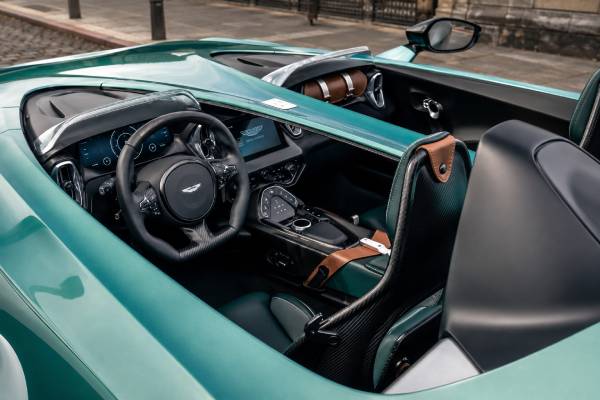
The 2021 Aston Martin V12 Speedster is an 88-car, roofless and windscreen-free two-seater created by Q by Aston Martin. It combines a 700 hp twin-turbo 5.2-litre V12 and eight-speed automatic transmission with bonded-aluminium architecture derived from the Vantage and DBS Superleggera, then covers that structure with an almost entirely carbon-fibre body. Its two separate cockpit openings, central spine, rear humps, and centrally exiting exhaust make the experience closer to a road-legal speedboat or competition barchetta than a conventional convertible.
Owning one requires more planning than the headline performance figures suggest. Weather exposure, eye protection, cockpit security, luggage, transport, tyre age, battery care, and correct storage all shape whether the car is genuinely usable. Buyers must also distinguish the standard bespoke commissions from the F/A-18-inspired launch treatment and the later DBR1 Specification. This guide explains the confirmed technical layout, special design choices, driving conditions, preservation needs, inspection process, and buying priorities for the single 2021 model-year V12 Speedster.
Table of Contents
- What Makes the V12 Speedster Different
- V12 Speedster Technical Specifications
- Mixed-Platform Engineering
- Open-Cockpit Design and Special Themes
- Planning a Real Drive
- Care, Service, and Weather Protection
- Inspection and Purchase Decisions
What Makes the V12 Speedster Different
The V12 Speedster is not a DBS with its roof removed. Aston Martin developed a unique open body and cockpit around selected Vantage and DBS Superleggera architecture, with no windscreen, no conventional glovebox, no folding top, and no way to seal the occupants from weather.
The project moved from concept to production in a little over a year and was announced in March 2020. Aston Martin limited it to 88 examples, quoted a starting price of £765,000 including UK VAT, and planned deliveries for the first quarter of 2021. The assignment’s single 2021 model year therefore reflects the intended customer delivery period rather than a multi-year mainstream production cycle.
Its purpose was sensory rather than numerical. The V12 could have powered a faster enclosed coupé, but the Speedster deliberately removes the physical barrier between occupants and airflow, engine sound, exhaust pulses, temperature, and road debris. That makes clothing and route selection part of the vehicle’s operating system in a way they are not for a normal sports car.
The body’s two cockpit openings are separated by a structural-looking central spine. Behind each occupant is a raised fairing, with storage beneath the rear humps. Ahead of the passenger, a removable leather bag takes the place of a fixed glovebox. These choices turn practical objects into visible design elements while keeping the cabin sparse.
The launch car’s aircraft theme also needs clarification. Aston Martin displayed an F/A-18-inspired conceptual specification in Skyfall Silver with satin-black details and red interior accents. It showed what Q could deliver, but it was not the only possible production appearance. Customers could commission other colours and materials.
Aston Martin later presented a DBR1 Specification inspired by the 1959 Le Mans-winning race car. That theme used Aston Martin Racing Green, Clubsport White graphics, satin-silver anodised details, Conker leather, Viridian Green textile, and period-influenced helmet graphics. A car described as “DBR1 Specification” should carry documentary and physical evidence for the full factory treatment, not merely green paint.
The model’s identity is therefore layered: every example is a V12 Speedster; each was built through a highly bespoke programme; some follow recognisable themes; and individual commissions can differ. Buyers should describe the specific car rather than assuming all 88 are configured alike.
V12 Speedster Technical Specifications
The V12 Speedster is an ICE vehicle using petrol only. Its front-mid-mounted twin-turbo V12 drives the rear wheels through a ZF eight-speed automatic and limited-slip differential, while adaptive suspension and carbon-ceramic brakes support the low, open two-seat body.
| Specification | Factory value | Layout note |
|---|---|---|
| Engine | 5.2-litre all-alloy V12 | Front-mid mounted, quad cam, 48 valves |
| Induction | Twin turbochargers | Petrol |
| Maximum power | 700 hp | Manufacturer estimate at launch |
| Maximum torque | 753 Nm | Manufacturer estimate at launch |
| Transmission | ZF eight-speed automatic | Rear-wheel drive |
| Differential | Limited slip | Mechanical traction at the rear axle |
| Exhaust | Bespoke stainless-steel system | Central outlets within the rear diffuser |
| Measure | Value | Qualification |
|---|---|---|
| 0–100 km/h | 3.5 seconds | Manufacturer estimate |
| Maximum speed | 300 km/h (186 mph) | Electronically limited estimate |
| Seating | Two separate open cockpits | No windscreen or roof |
| Production limit | 88 examples | Hand-built limited edition |
| System | Specification |
|---|---|
| Platform | Bonded-aluminium architecture using Vantage and DBS Superleggera elements |
| Body | Almost entirely carbon fibre |
| Front suspension | Independent double wishbones with coil springs |
| Rear suspension | Independent multi-link layout with coil springs |
| Dampers | Adaptive |
| Drive modes | Sport, Sport+, and Track |
| Component | Specification |
|---|---|
| Wheels | 21-inch forged centre-lock alloy wheels |
| Front brakes | 410 mm carbon-ceramic discs |
| Rear brakes | 360 mm carbon-ceramic discs |
| Tyre selection | Vehicle-specific high-performance fitment shown on the individual build record |
| Feature | Factory arrangement |
|---|---|
| Weather enclosure | No roof and no windscreen |
| Passenger storage | Removable leather bag in place of a glovebox |
| Additional luggage space | Compartments beneath the rear humps |
| Cabin materials | Satin carbon fibre, leather, aluminium, chrome, technical textile, and 3D-printed rubber |
| Personalisation | Q by Aston Martin colours, trims, and theme packages |
The launch performance numbers were presented as estimates, so they should remain labelled that way. Individual tyre specification, paint, trim, luggage, and theme details should come from the car’s own order and build records rather than a generic description.
Mixed-Platform Engineering
The V12 Speedster’s engineering is a deliberate blend of proven systems and unique packaging. Aston Martin used elements from two series-production architectures to shorten development time, then retuned them around the open body, different mass distribution, aero exposure, and special mission.
The bonded-aluminium platform provides the basic structural foundation. Vantage-related elements support compactness and agility, while DBS Superleggera components help accommodate the large V12 and its cooling requirements. The combination does not mean parts can be substituted casually across models. Mountings, calibration, body interfaces, wiring, cooling ducts, exhaust routing, and software can be Speedster-specific.
The V12 sits front-mid, with much of its mass behind the front axle line. Two turbochargers help produce 700 hp and 753 Nm, yet the car’s sound was treated as a primary design output. Engineers developed a stainless-steel exhaust that terminates centrally in the diffuser surface, placing the outlets close to the occupants and visually emphasizing the rear’s technical shape.
The ZF automatic suits the car’s role better than a heavy-clutch manual or abrupt automated manual. It can manage urban manoeuvring and permit the driver to keep both hands engaged against strong airflow. Paddle control still allows deliberate gear selection, especially when setting up a corner or controlling engine braking.
Suspension uses double wishbones at the front and a multi-link layout at the rear, with adaptive damping modes. Sport is the road baseline, Sport+ increases control for faster use, and Track is intended for smoother, controlled environments. The correct mode cannot compensate for cold tyres, damaged wheels, poor alignment, or unsuitable road surfaces.
Centre-lock wheels reduce visual complexity and reinforce the racing theme, but they impose strict service procedure. Correct tools, locking direction, contact preparation, torque method, and post-service checks are essential. A tyre shop unfamiliar with high-value centre-lock systems should not learn on the car.
The carbon-ceramic brakes are sized for repeated high-energy stops. They offer heat capacity and lower unsprung mass, but condition assessment differs from iron discs. An inspector should check impact damage, heat history, edge condition, surface state, pad compatibility, and manufacturer measurement criteria. Cosmetic appearance alone does not determine remaining service life.
Because the body is almost entirely carbon fibre, transport and lifting matter. Load paths, jack points, removable undertrays, and tie-down methods must follow official guidance. A seemingly minor mistake with a lift arm or strap can damage a panel or structure that is difficult to replace in matching weave and finish.
Open-Cockpit Design and Special Themes
The absence of glass is not a styling detail; it governs how the car feels, how it is equipped, and how it must be preserved. Airflow reaches the occupants directly, while the body uses fairings and cockpit shapes rather than a screen to manage turbulence.
At ordinary road speed, insects, grit, dust, light rain, and small debris become immediate concerns. At higher speed, loose objects can leave the cabin and noise can overwhelm normal conversation. Eye protection should be impact-rated and securely fitted. A road-approved helmet may be appropriate depending on jurisdiction, route, and speed, but a helmet’s aerodynamic lift and noise should be evaluated before long use.
The interior balances exposed technical materials with traditional craftsmanship. Satin structural carbon contrasts with leather and bright metal, while 3D-printed rubber adds a deliberately industrial surface. The passenger bag is both storage and trim; losing it leaves a conspicuous gap and removes part of the original commission.
The F/A-18 concept used aircraft-inspired graphics, warning labels, dark hardware, and vivid red accents. A car ordered in a related treatment may differ from the launch display, so documentary comparison is necessary. Do not use press photographs as proof that every aircraft-themed production car had every visible detail.
The DBR1 Specification takes the opposite historical reference. Aston Martin connected it to the DBR1 that won the 1959 Nürburgring 1000 km and Le Mans. Racing Green paint, white roundels and pinstriping, satin-silver components, Conker leather, Viridian Green textile, and silver switchgear created a more classical appearance. Special driver and passenger helmets were part of the presentation and can materially affect completeness.
Other commissions may be entirely unique. A buyer should inventory paint name, livery, exposed-carbon finish, grille treatment, wheel colour, brake calipers, seat trim, cockpit textiles, embroidery, storage bags, helmets, covers, keys, charger, books, and any display material. Q documentation can reveal details that are easy to overlook.
Carbon finish is especially vulnerable to careless cosmetic work. Sharp edges, exposed weave, matte or satin areas, painted carbon, decals, and graphics may require different products and polishing methods. Machine polishing across a graphic edge or applying a glossy coating to a specified satin component can permanently change the appearance.
The design’s greatest success is that the two occupants feel separated yet share the same machine. Each cockpit has its own visual enclosure, but the central spine, engine, transmission, and body bind them together. That architecture is central to originality; aftermarket wind deflectors or screens may improve comfort but should be reversible, structurally harmless, and documented.
Planning a Real Drive
A successful V12 Speedster journey starts with route and weather planning. The car can be used on public roads, but its lack of weather protection makes conditions that are trivial in a coupé potentially unsafe or damaging.
Check precipitation probability, temperature, wind strength, airborne dust, and road treatment. Avoid standing water because spray can enter the cockpit and electronics, while reduced visibility becomes more serious without a wiping system. Freshly gritted roads, construction zones, and insect-heavy evening routes can quickly mark paint, carbon, helmets, and eyewear.
Secure everything before departure. The passenger bag, phone, documents, gloves, eyewear case, and small objects must be closed or tethered. Use the storage beneath the rear humps for suitable items and verify each latch. Do not place loose camera equipment in the cockpit merely because the car’s appearance invites filming.
Clothing should be close-fitting, warm enough for wind chill, and free of long straps. Hearing protection can reduce fatigue while preserving important vehicle sounds. Eye protection should remain clear across temperature changes and resist fogging. Sunscreen and hydration matter on long drives because the occupants have no shade.
Warm the car progressively. Confirm tyre pressures, wheel security, fluid levels, battery state, and warning-free diagnostics before setting out. Use moderate throttle and braking until tyres, engine, transmission, and brakes reach stable temperature. The V12’s torque can overwhelm cold rear tyres even on a dry road.
Airflow changes with speed and occupant height. A short familiarisation drive helps determine head position, helmet stability, buffeting, mirror use, and communication. Track use should begin with conservative speeds because open-cockpit airflow can alter concentration and fatigue before chassis limits are reached.
The centre spine and rear humps complicate rearward awareness. Use mirrors and any fitted camera system, but verify camera lens cleanliness before leaving. When parking, choose wide spaces away from sprinklers, trees, pedestrian traffic, and vehicles that may throw dust or open doors into the body.
Carry a contingency plan. Know where covered parking, enclosed transport, and a secure storage location are available. A lightweight temporary cockpit cover may protect a stationary car if it is an approved accessory, but it does not make the Speedster weatherproof or safe to drive in rain.
After the drive, allow heat to dissipate in a ventilated area, inspect for chips or debris, remove insects promptly with carbon- and paint-safe methods, dry any moisture, and connect the approved battery conditioner. Record unusual warnings, noises, or impacts while they are fresh.
Care, Service, and Weather Protection
Maintenance must cover the familiar V12 drivetrain and the unusual exposure created by the body. The car should receive VIN-specific Aston Martin service rather than a generic Vantage or DBS schedule, even where major assemblies are related.
Time-based fluid changes remain important at low mileage. Engine oil, coolant, brake fluid, transmission fluid, differential lubricant, air-conditioning refrigerant, and filters age according to chemistry and environment. Exact intervals and materials must come from current official documentation for the individual vehicle.
Battery health deserves continuous attention. Limited-use Aston Martins can develop low-voltage faults that affect modules, latches, cameras, alarms, and start authorization. Use the specified conditioner, test battery capacity periodically, and investigate abnormal drain rather than repeatedly resetting warnings.
Weather protection begins with storage. The ideal space is dry, secure, ventilated, temperature-stable, and free from roof leaks or sprinkler overspray. Humidity control should prevent both condensation and excessive leather dryness. A fitted breathable cover must be clean before installation so it does not grind dust into paint or carbon.
If the cockpit becomes wet, do not close the car under a cover and hope it dries. Remove standing water with approved methods, open storage compartments, inspect seams and electrical areas, use controlled ventilation, and have the vehicle checked if water reached switches, connectors, or modules. Avoid aggressive heat that can shrink leather or damage adhesive bonds.
Interior care should treat each material separately. Leather cleaner may be unsuitable for technical textile or 3D-printed rubber; glossy protectant can ruin satin carbon; metal polish can change anodised finishes. Retain a product log and test in hidden areas.
Centre-lock wheels and carbon-ceramic brakes require specialist handling during tyre work. Record wheel torque procedure and tyre date codes. Avoid acidic wheel cleaner, high-pressure spray directly at seals or electrical connectors, and tyre dressings that can contaminate braking surfaces.
A dormant car needs a deliberate recommissioning. Assess fuel age, inspect for leaks and pests, scan electronics, test the battery, service fluids as required, verify tyres, and operate the roofless car only after confirming dry conditions. Short idle sessions are not a substitute for a complete warm operating cycle.
Because replacement body and trim pieces are bespoke, minor damage prevention has exceptional value. Use an enclosed low-angle transporter, photograph condition and accessories, specify wheel-strapping methods, and ensure sufficient cockpit and door clearance. Include helmets, bags, covers, and loose items on the transport inventory.
Inspection and Purchase Decisions
The best V12 Speedster is the car whose identity, bespoke specification, condition, accessories, service history, and legal status are all easy to prove. A low odometer is useful only when the car has also been stored and maintained correctly.
Obtain the VIN, build specification, original order, Q correspondence, invoice, registration papers, delivery photographs, and service file before inspection. Establish whether the car follows the F/A-18 concept, DBR1 Specification, another factory theme, or an individual commission. Match every claimed detail to the records.
A complete inventory should include keys, owner literature, charger, covers, removable passenger bag, rear-compartment items, helmets where supplied, tools, and event or delivery material. Loose accessories can be expensive or impossible to reproduce exactly, and a newly made replacement is not equivalent to an original documented item.
Mechanical inspection should cover cold start, hot restart, diagnostic faults, turbo and intake systems, cooling, transmission behaviour, differential, dampers, steering, brakes, tyres, wheel locks, exhaust valves, cameras, lighting, latches, and every cockpit control. Test drive conditions must be safe and dry.
The body inspection should identify paintwork, carbon repair, edge damage, underbody scrapes, transport marks, wheel chips, and water exposure. Look closely around the front splitter, side edges, rear diffuser, cockpit rims, central spine, storage lids, and wheel arches. If an impact is suspected, use a composite specialist rather than relying on paint readings.
Confirm registration and road-use rules in the destination country. Lack of a windscreen can affect helmet, eye-protection, inspection, lighting, or equipment requirements. Import eligibility and registration in one jurisdiction do not guarantee the same result elsewhere.
Ownership budgeting should include:
- enclosed transport and weather contingency;
- secure climate-controlled storage;
- timed Aston Martin servicing;
- high-performance tyres and centre-lock service;
- carbon-ceramic brake assessment;
- insurance agreed for a rare open special;
- cosmetic work by carbon and Q-finish specialists;
- preservation of bags, helmets, covers, and documents.
Do not assume that visible theme recognition guarantees value. A factory-documented unique commission can be as important as a DBR1-themed car, while an inaccurately recreated livery may weaken confidence. Condition and evidence should lead the comparison.
The Speedster’s appeal is unusually specific. It sacrifices weather protection, security, quietness, and conventional practicality to make the driver feel the V12, air, and road more directly. For the right owner, those compromises are the point. For the wrong owner, they turn the car into a difficult static object. A thorough pre-purchase process should establish not only whether the example is authentic and healthy, but whether the buyer has the storage, transport, climate, and routes needed to use it as intended.
References
- V12 Speedster | Aston Martin 2026 (Model Archive)
- Aston Martin V12 Speedster: A puristic limited edition for the most demanding drivers – 2020 (Launch and Technical Data)
- Aston Martin V12 Speedster – DBR1 Specification – 2021 (Factory Theme)
- OPENING SOON: THE LIMITED EDITION ASTON MARTIN V12 SPEEDSTER – 2020 (Programme Announcement)
- Q by Aston Martin | Bespoke Car Personalisation | Aston Martin UK 2026 (Personalisation)
- Aston Martin Luxury Car Servicing | Aston Martin (UK) | Aston Martin UK 2026 (Owner Support)
Disclaimer
This guide is informational and cannot replace VIN-specific owner documentation, professional inspection, local road-law advice, or approved repair procedures. Confirm equipment, service intervals, wheel procedures, fluids, and weather-use limitations with Aston Martin for the individual Speedster. Please share the article on Facebook, X/Twitter, or another platform when it may help an owner protect one of these unusual cars.