

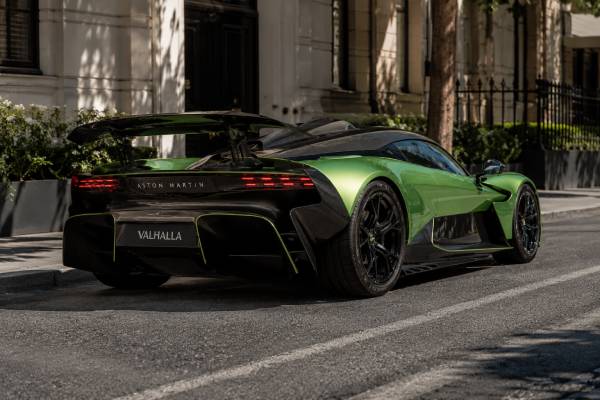
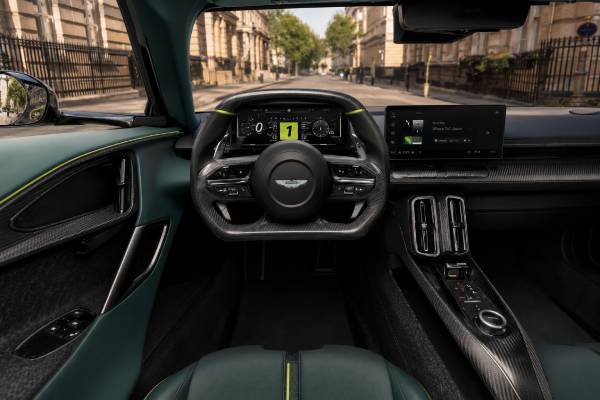
The 2025–2026 Aston Martin Valhalla is the company’s first series-production mid-engined plug-in hybrid and its first production model with dedicated electric-only driving. A bespoke 4.0-litre flat-plane-crank twin-turbo V8 works with three electric motors to produce 1,079 PS, equivalent to 1,064 hp, and 1,100 Nm. Two motors drive and torque-vector the front axle; a third sits inside the eight-speed dual-clutch transmission at the rear. The result is all-wheel drive, a claimed 2.5-second 0–100 km/h time, and a 217 mph maximum speed.
Valhalla is also a production reality rather than a delayed concept. Aston Martin reported 102 further deliveries during the first quarter of 2026 and expects continued deliveries through the year, within a 999-car limit. Ownership therefore involves current-car questions that older collector guides do not: high-voltage battery care, charge-port use, software, dielectric cooling, brake-by-wire, active aerodynamics, torque-vectoring calibration, and approved-service access. This guide explains the final production specification, system operation, road and track preparation, maintenance, delivery inspection, and buying strategy.
Table of Contents
- From Concept to Customer Deliveries
- Valhalla Hybrid Specifications
- How the Three-Motor System Works
- Carbon Chassis and Active Aerodynamics
- Road, Charging, and Track Use
- Hybrid Maintenance and Long-Term Care
- Delivery Inspection and Buying Strategy
From Concept to Customer Deliveries
The production Valhalla is substantially different from the early concept shown under the same name. Buyers should use final 2025–2026 documentation and ignore concept-era V6, two-motor, output, weight, and timing figures when evaluating a customer car.
The original programme evolved through several powertrain and design phases. The final specification uses a flat-plane-crank, dry-sump 4.0-litre twin-turbo V8 related to the M178 LS2 family, three electric motors, an eight-speed DCT, and a carbon monocoque developed with Aston Martin Performance Technologies. The shift increased combined output, added a rear transmission motor, and gave the front axle independent torque vectoring.
Aston Martin published the complete technical specification in December 2024 and showed final validation work in March 2025. Production was due to begin in the second quarter of 2025. Later corporate reporting confirms that deliveries did occur: the company’s first-quarter 2026 results cited 102 additional Valhalla deliveries and stated that current orders extended into the fourth quarter of 2026.
That timeline is important for used-car descriptions. A car may be called a 2025 model because of its build or certification date but delivered and first registered in 2026. A prospective buyer should record build date, model year, market certification, handover date, warranty start, software level, and first registration separately.
The limit remains 999 units worldwide. That is much larger than the One-77 or V12 Speedster runs, but still small enough that colour, Q content, wheel package, market specification, and delivery sequence can influence desirability. The production limit should not be confused with annual volume or the number delivered by a particular reporting date.
Valhalla also represents several Aston Martin firsts at once:
- first series-production mid-engined road car;
- first production PHEV;
- first dedicated production electric-driving mode;
- first use of this bespoke flat-plane-crank V8 specification;
- first use of the new hybridised eight-speed DCT;
- first twin-motor front electric drive unit with active torque vectoring.
Those firsts increase both interest and technical dependence on trained support. A buyer should identify a Valhalla Approved Service Centre before purchase, especially when the car will live far from its supplying dealer. Transport, high-voltage authorization, software access, and parts logistics should be planned before a warning light appears.
Valhalla Hybrid Specifications
Valhalla is a PHEV: it has a petrol engine, three traction motors, a high-voltage battery, an external charge port, and an official electric-only mode. The front motors provide EV drive and torque vectoring, while the V8 and transmission-integrated motor drive the rear axle through an eight-speed DCT.
| Specification | Published value | System role |
|---|---|---|
| Engine | 4.0-litre twin-turbo V8 | Mid-mounted, hot-V, flat-plane crank, dry sump |
| Engine output | 828 PS | Highest-output V8 specified by Aston Martin for the model |
| Electric motors | Three | Two front-axle motors; one integrated into rear DCT |
| Motor contribution | 251 PS | Official combined contribution from the three motors |
| Combined output | 1,079 PS / 1,064 hp | Manufacturer-specified system output |
| Combined torque | 1,100 Nm | Manufacturer-specified system torque |
| Drivetrain | All-wheel drive | Electric front axle; hybrid rear axle |
| Transmission | Eight-speed dual-clutch | Integrated rear motor, e-reverse, electronic rear differential |
| Measure | Official value | Qualification |
|---|---|---|
| High-voltage battery | 6.1 kWh / 150 kW / 400 V | Current published battery specification |
| Battery cells | 560 | Dielectric liquid cooling |
| EV range | 14 km | Front-motor drive only |
| EV maximum speed | 140 km/h (80 mph) | Electronically limited |
| 0–100 km/h | 2.5 seconds | Manufacturer figure |
| Maximum speed | 350 km/h (217 mph) | Electronically limited |
| Drive modes | Pure EV, Sport, Sport+, and Race | Sport is selected at start-up |
| Area | Specification |
|---|---|
| Passenger structure | Carbon-fibre monocoque with aluminium front and rear subframes |
| Lower tub mass | 74.2 kg |
| Dry lightweight mass | 1,655 kg |
| Front suspension | Pushrod layout with inboard springs and dampers |
| Rear suspension | Five-link arrangement |
| Dampers | Bilstein DTX adaptive units |
| Steering | Electric power assistance |
| Front lift | Factory nose-lift system |
| Component | Factory specification |
|---|---|
| Downforce | More than 600 kg from 240 km/h to 350 km/h in Race mode |
| Active aero | Hidden front wing and 255 mm-rising rear wing; DRS and air-brake functions |
| Aero response | Front and rear devices react within 0.5 seconds |
| Standard wheels | 20-inch front / 21-inch rear forged aluminium |
| Standard tyres | Michelin Pilot Sport S 5 AML; 285/30 ZR20 front, 335/30 ZR21 rear |
| Optional wheels | Magnesium package with Michelin Pilot Sport Cup 2 tyres; 12 kg unsprung-mass saving |
| Brakes | 410 mm front / 390 mm rear carbon-ceramic discs |
| Brake control | Integrated brake-by-wire with regenerative braking |
| Feature | Specification |
|---|---|
| Driving position | Low Formula 1-inspired hip-to-heel layout with fixed carbon seats |
| Displays | 10.25-inch driver display and 10.25-inch central touchscreen |
| Rearward view | Full digital display mirror and rear camera |
| Parking support | 3D surround view and front/rear sensors |
| Driver assistance | AEB, adaptive cruise, lane support, traffic-sign recognition, and driver attention functions |
| Body access | Dihedral doors with roof cut-outs |
Aston Martin’s current public specification still labels WLTP fuel-consumption and CO₂ values as undergoing homologation. Those figures should not be estimated from battery capacity, EV range, or engine data; use the certificate and market documentation supplied with the individual car.
How the Three-Motor System Works
The three motors do different jobs, so Valhalla cannot be understood by treating “electric assistance” as one undivided system. The front pair drive the front wheels independently, while the rear motor supports the V8 through the DCT.
The front electric drive unit contains two radial-flux permanent-magnet motors. Independent control allows the car to send different torque to the left and right front wheels, helping rotation into a corner, reducing understeer, managing oversteer, and improving exit traction. In Pure EV mode, these motors alone move the car, making Valhalla temporarily front-wheel drive.
The front unit also provides reverse. Because electric motors can rotate backward, the DCT does not need a mechanical reverse gear. That saves mass and packaging space. A reverse failure could therefore involve high-voltage drive, software, controls, or the front EDU rather than a conventional gearset.
The third motor is integrated into the rear transmission. It starts the V8, fills torque while the turbochargers and gear changes respond, assists propulsion, and contributes to regeneration. The DCT sends combustion and rear-motor power through an electronically controlled rear differential.
Aston Martin specifies 828 PS from the engine, 251 PS from the three motors, and 1,079 PS combined. Those values should not be added or rearranged to infer individual motor output. Hybrid peak power depends on operating speed, battery state, voltage, temperature, and control limits; the official combined figure is the correct one.
The high-performance battery is designed for rapid power delivery and absorption rather than long electric commuting. Its 14 km EV range is useful for quiet departures, emissions-controlled areas, or the final part of a journey, but it is not the main purpose of the system. As state of charge falls, the car automatically moves from Pure EV to Sport.
Dielectric coolant circulates through the pack and directly manages the temperature of 560 cells. The fluid is electrically non-conductive, which supports close thermal control under repeated acceleration and regeneration. A separate chiller can use the air-conditioning refrigerant circuit to cool battery coolant, linking battery performance to the health of the climate-control system.
Integrated Vehicle Dynamics Control coordinates the motors, V8, DCT, rear differential, braking, steering, dampers, and active aerodynamics. A fault in one system can therefore reduce capability elsewhere without a traditional mechanical failure. Diagnostic work must read the vehicle as a network and preserve freeze-frame data before codes are cleared.
For the driver, the complexity should feel simple. Sport combines the V8 and hybrid system for normal road use; Sport+ increases response; Race deploys the active aero and track calibration. The safest approach is to let the intended modes manage the car rather than attempting to outsmart thermal or state-of-charge limits.
Carbon Chassis and Active Aerodynamics
Valhalla creates high-speed stability through a stiff carbon structure, underbody airflow, and active devices rather than an oversized fixed wing. The system reaches more than 600 kg of downforce at 240 km/h and then controls wing angle to maintain that load to maximum speed.
Aston Martin Performance Technologies developed the monocoque using resin-transfer moulding for the lower tub and autoclave methods for upper structures. The 74.2 kg lower section is only one part of the safety cell; it should not be confused with complete chassis or vehicle mass. Aluminium subframes carry the suspension and powertrain at each end.
Pushrod front suspension moves springs and dampers inboard. This helps airflow through the wheel arch, creates space for the front motors and cooling system, and permits a lower body surface ahead of the windscreen. A five-link rear layout packages around the V8, DCT, motor, exhausts, and diffuser.
The front active wing is hidden behind the grille. In Race mode it works with the rear T-wing, which rises by 255 mm. Both can change angle in roughly half a second. Under braking, the rear device acts as an air brake while the front system adjusts the centre of pressure to preserve stability. DRS reduces drag when conditions permit.
Much of the remaining downforce comes from the floor, venturi tunnels, diffuser, air dam, wheel-arch extraction, side vanes, and vortex generators. This means underbody condition is a performance and safety issue. A scrape that seems hidden can alter a surface, fastener, seal, or sensor involved in airflow.
Cooling architecture is equally integrated. The roof scoop supplies the engine and charge-air coolers; side bodywork feeds oil coolers; radiators and bypass paths change pressure and drag. Leaves, rubber debris, protective film, poorly fitted mesh, or cosmetic modifications can affect cooling even when exterior appearance seems unchanged.
Inspection after a curb strike or off-track excursion should include the carbon splitter, floor, air dam, front wing, actuator linkages, wheel-arch surfaces, side vanes, diffuser, rear wing, hydraulic circuits, sensors, and mounting points. Do not judge the car only by visible paint damage.
Magnesium wheels offer a meaningful unsprung-mass reduction but need correct handling and corrosion inspection. Their Cup 2 tyres increase dry-track capability while reducing cold and wet margins. The standard forged wheels with Pilot Sport S 5 AML tyres are the more versatile road package.
The brake-by-wire system blends regeneration and carbon-ceramic friction braking. Pedal feel is electronically shaped, while active aero can add deceleration at high speed. A consistent pedal does not eliminate the need to inspect discs, pads, hydraulic fluid, actuators, wheel-speed sensors, and calibration.
Road, Charging, and Track Use
Valhalla is designed to function on normal roads, but its performance systems require preparation. Charging, tyre choice, ride height, mode, battery temperature, and route conditions all affect the experience.
Before a road journey, inspect tyres and wheels, look beneath the splitter, confirm charge-port closure, check fluid and warning status, and let the car complete its startup sequence. Sport is the default. Pure EV can be selected for a quiet departure, but the available range depends on temperature, accessory load, battery state, and driving style.
Use only compatible, correctly installed charging equipment and the market-specific cable supplied or approved for the car. The charge-port area shares the side-access body treatment with the fuel filler, so check seals, latches, pins, cable strain, and water or debris. Aston Martin does not need an invented peak charging figure to make the system useful; follow the vehicle display and owner guide for expected sessions.
The small battery should still be managed thoughtfully. Do not leave the car for long periods at an extreme state of charge unless official storage guidance specifies it. High-voltage and 12-volt systems serve different functions: a charged traction battery does not guarantee that the 12-volt network can wake modules, unlock the car, or close contactors.
Front lift should be used before steep ramps and lowered once clear. The active aero and floor are engineered to close tolerances, so avoid automatic washes, unverified lifts, tall speed humps, and loose road debris. A spotter is appropriate for trailers and unfamiliar garages.
For track use, begin with an approved centre familiar with Valhalla. Confirm insurance, noise rules, charging access, recovery procedure, tyre package, wheel torque, brake condition, fluid condition, alignment, software status, and diagnostic baseline. Remove loose cabin items and understand how the doors will be opened if the car stops near a barrier.
Race mode deploys the aerodynamic system and selects the most aggressive integrated calibration. Build speed progressively so tyres, brakes, battery, engine, transmission, and driver reach temperature together. More than 600 kg of downforce occurs at speeds that require a professional circuit and substantial runoff; public roads cannot demonstrate the system safely.
Monitor battery and powertrain temperature, brake warnings, tyre pressure, active-aero status, and energy deployment. Hybrid performance may change as systems protect themselves. Reduced output after repeated laps can be normal thermal management, but warning messages or inconsistent behaviour should be saved and diagnosed.
After a circuit session, cool the car according to factory guidance, avoid applying the parking brake against excessively hot components if instructed otherwise, inspect tyres and wheels, examine the floor and aero surfaces, scan for faults, and record consumable measurements. A post-track report protects warranty discussions and future provenance.
Hybrid Maintenance and Long-Term Care
Valhalla maintenance belongs with trained high-voltage technicians and approved diagnostic systems. The owner’s role is to manage charging, storage, cleanliness, tyre condition, warnings, and service timing—not to open orange-cabled components or improvise isolation procedures.
The car has several thermal systems serving the engine, charge air, battery, motors, transmission, electronics, and cabin. Leaks or low performance can appear as reduced power, charging limits, climate-control issues, or warnings rather than a simple puddle. Inspect fluid levels and underbody only as the owner guide permits, and record any residue before cleaning it.
Dielectric battery coolant is specialised. It must not be mixed with ordinary engine coolant or replaced using generic equipment. Contamination can alter electrical properties and heat transfer. Service should verify fluid condition, circuit integrity, pumps, chillers, sensors, and software-controlled valves.
The 12-volt battery remains critical because it powers control modules and initiates high-voltage operation. Use the approved maintainer for storage, keep software and telematics awake only as intended, and investigate abnormal discharge. Repeated jump-starting can create faults or damage if the correct procedure is not followed.
Software is part of the service history. Record campaign updates, module versions, calibrations, battery-management changes, aero-control updates, and dealer actions. An update can alter charging, warning thresholds, mode behaviour, or diagnostics without changing hardware. Before buying, confirm that open campaigns are completed for the VIN.
Carbon-ceramic brakes and regenerative blending should be checked together. Long periods of light regenerative use can leave friction surfaces underused, while track work can consume pads and heat discs rapidly. Follow the manufacturer’s bedding and inspection criteria and avoid chemicals that contaminate carbon-ceramic surfaces.
Tyres require frequent age, pressure, tread, sidewall, and heat-cycle checks. The magnesium and forged packages use different intent and tyre families. Do not mix packages or substitute dimensions based on appearance. Reset pressure monitoring only after confirming actual cold pressure.
Storage should be dry, secure, ventilated, and accessible to approved charging and battery-conditioning equipment. Keep rodents away from cooling ducts and high-voltage harnesses. Avoid sealing a hot or damp car under an impermeable cover. Periodically inspect charge-port seals, aero gaps, coolant residue, tyre deformation, and low-voltage status.
After collision, flooding, underbody impact, or severe overheating, treat the high-voltage system as potentially hazardous even when the car still drives. Use trained recovery personnel, tell them the vehicle is a PHEV, and follow the emergency-response information. Do not store a damaged car in a normal building until battery risk has been assessed.
Delivery Inspection and Buying Strategy
A Valhalla purchase should verify physical condition and digital state at the same time. Newness does not eliminate transport damage, configuration errors, software campaigns, battery imbalance, or documentation gaps.
For a new delivery, compare the car with the signed order and final build specification. Confirm paint, exposed-carbon treatment, Q content, wheel and tyre package, brake-caliper finish, interior materials, seat fit, optional audio, charging cables, market equipment, keys, books, covers, and emergency items. Photograph the car before protective film is removed and again after preparation.
Inspect the underside on an approved lift. Look at the splitter, floor, aero devices, diffuser, jacking areas, cooling openings, wheel faces, tyre sidewalls, carbon edges, and transport tie-down evidence. Verify active-wing operation, front lift, charge port, fuel flap, doors, cameras, digital mirror, displays, ADAS, climate control, and every drive mode permitted during handover.
Request a handover report containing:
- VIN and build specification.
- Model year, build date, and warranty start.
- Software and campaign status.
- High-voltage and 12-volt battery condition.
- Diagnostic scan with no unexplained faults.
- Wheel, tyre, brake, and underbody inspection.
- Charging-equipment inventory and demonstration.
- Owner-account, app, key, and connectivity setup.
For a used car, add charge history where available, battery-health data supported by Aston Martin diagnostics, track-use records, paintwork, underbody incidents, tyre heat cycles, brake measurements, software changes, and transferability of warranty or service plans. Marketing screenshots are not a substitute for a VIN-linked report.
Confirm service geography. A Valhalla Approved Service Centre may be distant, and routine work can require enclosed transport. Ask who can isolate the high-voltage system, repair carbon structure, calibrate ADAS, service active aero, support the DCT, and obtain tyres. Put realistic transport time and cost into the ownership budget.
Market value will reflect more than the 999-unit cap. Early and late build, colour, Q specification, wheel package, mileage, regional certification, tax status, track history, and delivery timing all matter. Avoid paying a premium for concept-era claims or unverified rarity within the run.
The best buyer profile is someone who wants to use the technology and can support it. Valhalla’s short EV range, four drive modes, active aero, torque vectoring, and high-power battery only make sense when the systems remain charged, updated, exercised, and inspected. Treating the car as a disconnected display object can create low-voltage, seal, fluid, tyre, and software problems.
Valhalla’s achievement is integration. Its V8, motors, battery, DCT, differentials, brake-by-wire, suspension, and wings act as one coordinated machine. A sound purchase verifies that integration from documents through diagnostics, while sound ownership preserves it with approved service and purposeful use.
References
- Valhalla | Hybrid Supercar | Aston Martin 2026 (Current Model Specifications)
- Valhalla Brochure 2025 (Factory Brochure)
- Valhalla: The ultimate drivers supercar – 2024 (Technical Overview)
- Valhalla: The ultimate driver’s supercar in final validation testing phase – 2025 (Validation and Production Timing)
- First quarter results for the three months ended 31 March 2026 2026 (Delivery Status)
- Owner’s Guides | Car Ownership | Aston Martin (UK) | Aston Martin UK 2026 (Owner Documentation)
Disclaimer
This article is informational and does not replace high-voltage training, official diagnostics, homologation documents, track instruction, or VIN-specific service guidance. Verify market equipment, software, battery procedures, charging hardware, fluids, and safety steps with an approved Aston Martin centre. Please share this guide on Facebook, X/Twitter, or another platform when it can help owners approach high-performance hybrids responsibly.