
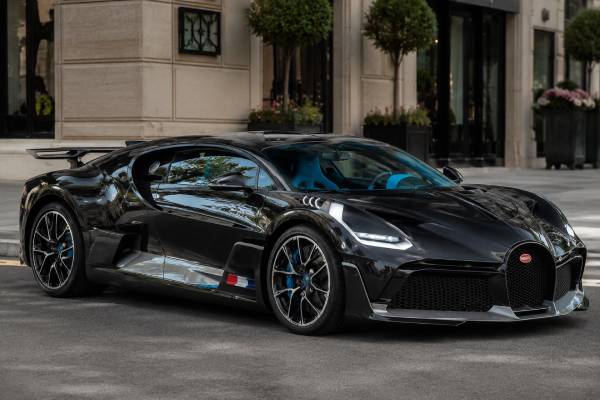
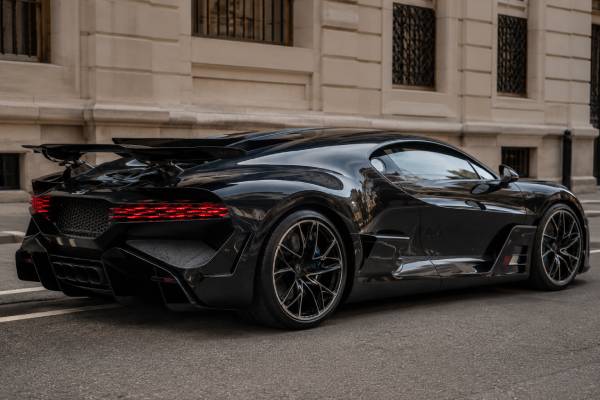
The Bugatti Divo is not simply a Chiron with a different body. It is Bugatti’s modern coachbuilt cornering car: a 40-unit, W16-powered hypercar designed to trade some top-speed theatre for sharper response, more downforce, stronger visual drama, and a more focused road-and-track personality. Built around the 8.0-liter quad-turbo W16, seven-speed dual-clutch transmission, carbon-fiber structure, and all-wheel-drive foundation of the Chiron family, the Divo keeps the famous 1500 PS output but reshapes the mission. Its 380 km/h limited top speed is lower than the Chiron’s maximum-speed configuration, yet its greater downforce, lighter details, revised aero, and more aggressive chassis setup make it the more intense car in corners. For collectors, the Divo matters because it marks Bugatti’s return to modern coachbuilding: rare, highly personalized, factory-built, and tied directly to Molsheim’s heritage.
Table of Contents
- What Makes the Divo More Than a Chiron
- W16 Specs, Chassis, and Performance Data
- Production Rarity and Factory Identity
- Coachbuilt Aero Design and Special Details
- How the Divo Drives at Speed
- Maintenance Realities for a W16 Hypercar
- Buying a Divo Without Getting It Wrong
What Makes the Divo More Than a Chiron
The Divo is Bugatti’s handling-focused, coachbuilt interpretation of the Chiron platform. It uses the familiar 8.0-liter quad-turbo W16 and all-wheel-drive layout, but its purpose is different: more cornering grip, more aero authority, and a more dramatic limited-series identity.
Bugatti named the car after Albert Divo, the French racing driver who won the Targa Florio twice for Bugatti in the 1920s. That name matters because the Divo was created around corners, not just top speed. The Chiron became famous for immense power and high-speed stability; the Divo takes that foundation and asks a different question: how much sharper can a road-legal Bugatti feel when the body, aero, chassis tuning, cooling, and weight-saving details all support lateral performance?
The Divo was revealed in 2018 and delivered to customers from 2020 into 2021. Production was limited to 40 cars, and the model was sold to existing Bugatti clients before broad public availability. That makes the Divo both a car and a collector event. It sits between the regular Chiron line and later Bugatti special projects such as the Centodieci and Bolide, showing how Bugatti could use one core engineering base to create very different emotional experiences.
Its reputation today rests on three main points:
- It is one of the clearest examples of Bugatti’s modern coachbuilding strategy.
- It keeps the 1500 PS W16 formula but focuses on downforce and cornering.
- It is rare enough that condition, provenance, specification, and factory documentation matter as much as mileage.
The Divo also arrived at a key moment for hypercars. Electrification, hybrid systems, and software-heavy performance were becoming more common, yet the Divo remained proudly mechanical in character: huge combustion engine, quad turbochargers, all-wheel drive, carbon structure, active thermal management, and aerodynamics shaped around real airflow needs. It is modern, but it still feels connected to the old idea of a flagship engine defining a car’s personality.
For readers comparing Bugatti models, the easiest way to understand the Divo is this: the Chiron is the grand, devastatingly fast hypersport car; the Chiron Sport sharpens that formula; the Divo makes the sharpness the main event. It is still luxurious and usable by hypercar standards, but it is less about quiet excess and more about pressure, response, sound, grip, and presence.
W16 Specs, Chassis, and Performance Data
The Divo’s core numbers are extreme, but the most important detail is how Bugatti used familiar Chiron hardware for a different result. The power stayed at 1500 PS, while the aero and chassis package shifted the car toward higher cornering confidence and stronger track-road focus.
| Category | Specification |
|---|---|
| Model years covered | 2020–2021 customer-delivery era |
| Engine | 8.0-liter quad-turbocharged W16 |
| Displacement | 7993 cc |
| Maximum power | 1500 PS / 1103 kW / about 1479 hp |
| Maximum torque | 1600 Nm |
| Transmission | 7-speed dual-clutch automatic |
| Drivetrain | Permanent all-wheel drive |
| Body style | 2-door coupé |
| Structure | Carbon-fiber hypercar architecture related to the Chiron |
| Top speed | 380 km/h / 236 mph, electronically limited |
| 0–100 km/h | About 2.4 seconds |
| Fuel capacity | 100 liters |
The W16 is the Divo’s centerpiece. It is not a small, high-revving racing engine; it is a massive, force-fed power unit built for huge torque and sustained high-speed load. Four turbochargers allow the engine to deliver enormous thrust without the narrow, peaky behavior of a smaller racing motor. In simple terms, the Divo does not need to be worked hard to feel violent. The torque arrives early and stays strong across a broad rev range.
| Measurement | Figure |
|---|---|
| Length | About 4640–4641 mm |
| Width | About 2018 mm |
| Height | 1212 mm |
| Wheelbase | 2711 mm |
| Kerb weight | About 1960 kg, with homologation figures varying by source and configuration |
The Divo’s performance is not best understood by top speed alone. In fact, its top speed is intentionally lower than a maximum-speed Chiron configuration because its aero setup creates more drag and more load. That extra load helps the car feel more planted when cornering at speed. Bugatti’s claimed advantage around the Nardò handling circuit was a major part of the Divo story: the car was presented as meaningfully quicker than the Chiron in a setting where cornering balance mattered.
The chassis changes are equally important. The Divo uses stiffer suspension tuning, more aggressive wheel alignment, and handling-focused calibration. Greater negative camber helps the tires work harder during cornering, while the aero package adds stability and confidence at speed. The result is a car that still weighs roughly two metric tons but behaves with more urgency than its size suggests.
Fuel use is severe, as expected from a quad-turbo W16. Official-style figures around the Chiron/Divo technical package show very high combined fuel consumption and CO2 output. In practice, most Divo owners will not measure the car by economy. They will care more about correct fuel quality, battery maintenance, tire condition, service history, and whether the car has been stored and exercised properly.
Production Rarity and Factory Identity
The Divo’s collector value starts with its 40-car production run. Every example is part of a very small factory-built series, and each car’s specification, delivery history, service record, and originality can make a major difference.
Bugatti did not position the Divo as a normal catalog model. It was offered as a highly limited car for an existing client base, with a price far above a standard Chiron. That matters because the original buyers were not simply choosing a faster specification. They were buying into a factory coachbuilding idea: a car with its own bodywork, character, name, and place in Bugatti history.
The Divo was assembled in Molsheim alongside the Chiron family, but the exterior panels and aero concept gave it a separate identity. Buyers could personalize paint, exposed carbon fiber, interior trim, stitching, color splits, and detail finishes through Bugatti’s normal high-end commissioning process. Because of that, no serious buyer should treat all Divos as interchangeable. Two cars may have the same mechanical base but very different collector appeal.
Key identity points include:
- Confirmed factory build record and delivery documentation.
- Original paint and carbon-fiber specification.
- Interior color split, embroidery, and trim details.
- Service stamps and invoices from Bugatti-authorized care.
- Matching accessories, books, keys, battery equipment, covers, and factory items.
- Any special commissioning story tied to the first owner.
There were no major mechanical variants in the normal sense. The Divo was already the variant: a limited, cornering-focused coachbuilt model based on the Chiron platform. That makes authenticity checks different from those on older cars. Instead of searching for engine-code differences or trim-level packages, buyers should focus on whether the car’s specification matches factory records and whether any later cosmetic changes were approved, documented, and reversible.
Delivery timing also matters. Customer deliveries began in 2020, and the run ended in 2021. Cars from this era may still have low mileage, but low mileage alone does not prove ideal condition. A hypercar can suffer from long static storage if fluids, tires, seals, batteries, and electronic systems are not maintained. On a Divo, a carefully serviced 1200-mile car may be healthier than a 90-mile car that sat without correct care.
Because the Divo was sold in tiny numbers, public market data is thin. Asking prices can be more about opportunity than ordinary depreciation. Provenance, color taste, tax location, import status, and whether the car is already registered in the buyer’s market can all shift value. The best examples are usually the ones with complete documentation, tasteful specification, no accident history, no questionable modifications, and continued relationship with Bugatti service channels.
Coachbuilt Aero Design and Special Details
The Divo looks different because it works differently. Its body was shaped to move more air through cooling paths, create more downforce, and give the car a stronger cornering identity than the Chiron.
The front end is more aggressive, with larger openings, a deeper splitter, and stronger visual separation between airflow zones. The goal is not only drama. A W16 Bugatti produces enormous heat, and a car capable of sustained high-speed running needs careful cooling for the engine, charge air, brakes, gearbox, and surrounding electronics. The Divo’s front surfaces help feed and manage those systems while creating a more planted front axle feel.
The roof-mounted NACA duct is one of the car’s signature features. It channels airflow over the upper body toward the rear, where the fixed wing and rear bodywork use it to support downforce and stability. The central fin, rear wing, diffuser treatment, and venting around the rear section make the car look closer to a road-going endurance prototype than a luxury grand tourer.
The rear wing is much wider than the Chiron’s retractable wing and forms a major part of the Divo’s visual identity. Unlike a top-speed-focused shape, the Divo’s rear aero accepts drag as the price of grip. That is why the car’s top speed is limited to 380 km/h. On paper, that number is lower than some Chiron figures. On a fast road or circuit, the benefit is a car that feels more secure when loaded laterally.
Other special details include:
- Quad exhaust outlets with a more theatrical rear presentation.
- New headlight and taillight designs that separate the Divo visually from the Chiron.
- Front wheel-arch vents that help pressure relief and brake cooling.
- Reduced sound insulation compared with more comfort-focused Bugatti models.
- Carbon-fiber details used for weight reduction and visual intensity.
- A cabin trimmed to feel sportier without abandoning luxury.
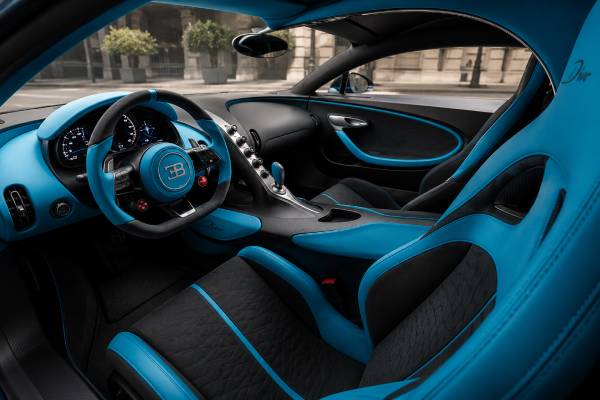
The interior follows the Chiron’s basic architecture, but the Divo changes the mood. Alcantara, contrast color accents, carbon trim, and a more performance-led atmosphere make it feel less like a luxury capsule and more like a tool for very fast driving. It is not stripped like a race car, and it does not pretend to be light in the way a small track special is light. Instead, it removes enough softness to make the car feel more focused while keeping the sense of occasion expected from a modern Bugatti.
Design influence is often linked to classic Bugatti forms and modern concepts, but the Divo’s biggest achievement is cohesion. It does not look like an aftermarket body kit. The cooling, lighting, roof duct, rear wing, exhaust, and stance all speak the same language: more airflow, more cornering intent, and more visual tension. That is why the Divo remains one of the more distinctive Chiron-based cars.
How the Divo Drives at Speed
The Divo’s driving character is defined by huge W16 thrust matched with greater aero confidence. It is still a heavy, luxurious, all-wheel-drive hypercar, but it reacts with more edge than a standard Chiron.
Acceleration is the first shock. The Divo’s 0–100 km/h time of about 2.4 seconds only tells part of the story. More impressive is the way the engine keeps pulling after the first launch. The W16 does not deliver one quick hit and fade; it produces a long, dense wave of torque. On the road, that means small throttle inputs can create serious speed almost immediately. On track, it means the driver must manage weight transfer, tire temperature, and braking zones with respect.
The seven-speed dual-clutch transmission is built to handle enormous torque. It is not meant to feel delicate or playful like a small manual gearbox. Its job is to keep the W16 on boost, shift quickly, and protect the drivetrain. In automatic modes, it supports the car’s grand-touring side. In more aggressive driving, it gives the engine a relentless quality: gear, boost, pull, repeat.
Steering and chassis response are where the Divo separates itself from the standard Chiron experience. More aggressive camber and a handling-focused setup make the front end feel more committed. The car still cannot hide its mass completely, but it carries that mass with unusual control. Good tires, correct pressures, and proper temperature are critical. A cold or aged tire can make even the best chassis feel blunt, and on a car this powerful, tire condition is a safety issue, not a detail.
Braking performance depends heavily on carbon-ceramic brake condition and temperature. These brakes are designed for extreme speed and repeated load, but they are expensive and must be inspected carefully. A buyer or driver should pay attention to disc wear, pad life, surface condition, vibration, and whether the car has seen hard track use. Carbon-ceramic brakes can last a long time in gentle road use, but misuse, debris damage, or repeated high-energy stops can turn them into a major cost.
Ride quality is firm but not crude. The Divo is more focused than a standard Chiron, yet it still comes from Bugatti’s world, where high-speed stability and luxury matter. Around town, its width, low nose, heat, limited sightlines, and attention-drawing presence make it demanding. On open roads, the car feels calmer because airflow, cooling, and chassis load start to work in their natural range.
The Divo is best understood as a fast-road and private-track hypercar, not a racing car. It has road equipment, a luxury cabin, emissions compliance for its markets, and the comfort expected by Bugatti clients. But its personality rewards a driver who understands speed discipline. The car can reach illegal speeds in seconds, and its full performance belongs only in controlled environments.
Maintenance Realities for a W16 Hypercar
Divo ownership is less about ordinary reliability and more about correct stewardship. A well-kept Divo needs specialist service, controlled storage, documented inspections, and a budget that matches a rare W16 Bugatti.
The W16 engine is robust in concept but complex in execution. Four turbochargers, intense heat management, a dense mid-engine layout, and high-performance cooling systems make access and diagnosis specialist work. Routine maintenance is not routine in the normal-car sense. Even basic inspection can require trained technicians, model-specific equipment, and careful handling of carbon-fiber body panels.
The largest ownership concerns are usually not simple engine failure. They are the systems around the engine and chassis:
- Heat management: radiators, intercoolers, coolant hoses, fans, and airflow paths must stay healthy.
- Turbocharger support systems: boost control, lubrication, heat shielding, and sensors need expert diagnosis.
- Transmission and driveline: the dual-clutch gearbox and all-wheel-drive system must be serviced correctly.
- Carbon-ceramic brakes: disc condition, pad wear, and surface damage can have major cost implications.
- Tires: age, storage, speed rating, fitment, and heat cycling matter more than tread depth alone.
- Suspension and lift systems: hydraulic or adaptive components can be expensive if neglected.
- Electronics: control modules, infotainment, sensors, and battery-related faults can appear on low-use cars.
- Carbon bodywork: small cosmetic damage can become a large repair because of materials and paint matching.
Battery care is especially important. Modern hypercars do not like being left unattended without proper conditioning. Low voltage can create warning lights, module communication issues, and confusing fault histories. A Divo should be kept on the correct maintainer, stored in a stable environment, and driven or exercised according to specialist guidance.
Tire age is another major issue. A low-mileage Divo may still need tires if the date codes are old or if the rubber has been heat-cycled, flat-spotted, or stored poorly. Because the car is capable of extreme speed, tire decisions must be conservative. This is not a place to save money.
Service history should be complete and boring. The ideal file includes annual or mileage-based service records, brake and tire reports, battery history, campaign or software-update confirmation, and invoices from Bugatti-authorized or factory-connected service providers. Missing records do not always mean a bad car, but they create risk and reduce buyer confidence.
Originality also matters. Some owners may be tempted to add paint protection film, ceramic coating, exhaust changes, visual tinting, or small personalization updates. Paint protection film is common and often sensible if installed well and documented. Mechanical or electronic modifications are a different matter. On a 40-unit Bugatti, non-factory changes can hurt value, complicate warranty or service support, and create questions during resale.
For maintenance planning, the best rule is simple: buy the car only if you can maintain it as Bugatti intended. The purchase price is only the entry point. The real test is whether the owner can support tires, transport, insurance, climate-controlled storage, authorized inspections, and unexpected specialist work without compromise.
Buying a Divo Without Getting It Wrong
The safest Divo purchase is the car with the clearest story. Specification, provenance, service continuity, condition, and factory documentation should matter more than chasing the lowest asking price.
A serious buyer should begin with identity. Confirm the car’s chassis details, original selling market, first delivery, factory specification, and any later changes. The car should match its build record in paint, carbon finish, trim, stitching, wheels, and interior details. If anything has changed, ask who did the work, why it was done, and whether it can be reversed.
| Area | What to Check | Why It Matters |
|---|---|---|
| Factory documentation | Build sheet, delivery file, service book, accessories | Confirms authenticity and supports collector value |
| Service history | Authorized maintenance, software updates, inspection reports | Shows whether the car was actively cared for |
| Carbon bodywork | Panel gaps, underside, splitter, diffuser, wing, paint protection film | Carbon repairs and paint matching can be costly |
| Tires and brakes | Date codes, wear, heat cycles, carbon-ceramic disc condition | Directly affects safety and near-term cost |
| Storage quality | Climate control, battery maintainer use, fluid care | Low mileage does not protect a poorly stored car |
| Legal status | Registration, taxes, import documents, market compliance | Cross-border sales can be complex and expensive |
Mileage should be judged carefully. Ultra-low mileage can help collectability, but it can also signal long static periods. A car that has been serviced on time, stored correctly, and driven enough to keep systems healthy may be more attractive than a delivery-mileage car with weak documentation.
Specification taste is personal, but the market often rewards coherent, factory-original choices. Exposed carbon, historically meaningful colors, strong contrast details, and tasteful interior combinations can help desirability. Extremely unusual specifications can be valuable to the right buyer, but they may narrow the audience later.
A proper inspection should include:
- Factory or Bugatti-authorized diagnostic scan.
- Full body and underside inspection on appropriate equipment.
- Tire age and brake condition report.
- Review of service invoices and campaign status.
- Confirmation of accessories, keys, books, charger, covers, and tools.
- Legal review of title, taxes, import status, and registration eligibility.
- Paint meter and paint-protection-film review by a specialist familiar with carbon cars.
Buyers should also understand market liquidity. A Divo is valuable, but it is not liquid in the way a mainstream collectible 911 or Ferrari V8 might be. The buyer pool is small, transactions can be private, and price depends heavily on timing. Selling quickly may require a discount; waiting for the right buyer may preserve value.
The Divo is best for a collector who wants one of the most visually distinct W16 Bugattis and understands that its appeal is not only speed. A Chiron Super Sport may be the better choice for top-speed mythology. A Chiron Pur Sport may offer a more direct comparison as a handling-focused Chiron-series model. But the Divo has something different: a 40-car coachbuilt identity, a named historical link, and a body that makes its mission obvious before the engine even starts.
References
- Bugatti Divo 2018 (Manufacturer Model Page)
- Bugatti Divo. Technische Daten. (BU_Chiron-TS-Overview_Update_180815.indd – 180815_technische_daten_bugatti_divo.pdf). 2018 (Technical Specifications) ([Wikipedia][1])
- Bugatti One-Ups Itself With Its New Divo Supercar 2018 (Performance and Launch Report) ([WIRED][2])
- Meet the €5m, 236mph Bugatti Divo 2018 (Launch and Engineering Report)
- Last Bugatti Divo Leaves Molsheim Looking As Stunning As Ever 2021 (Production Completion Report) ([Wikipedia][3])
Disclaimer
This article is for informational purposes only and is not a substitute for professional diagnosis, inspection, valuation, maintenance, or repair advice. Specifications, torque values, service intervals, procedures, equipment, emissions data, and market details can vary by VIN, market, production timing, and individual vehicle configuration. Always verify critical information against official Bugatti service documentation, factory records, and a qualified Bugatti specialist.
If this guide helped you, please consider sharing it on Facebook, X/Twitter, or your favorite car community to support our work.