
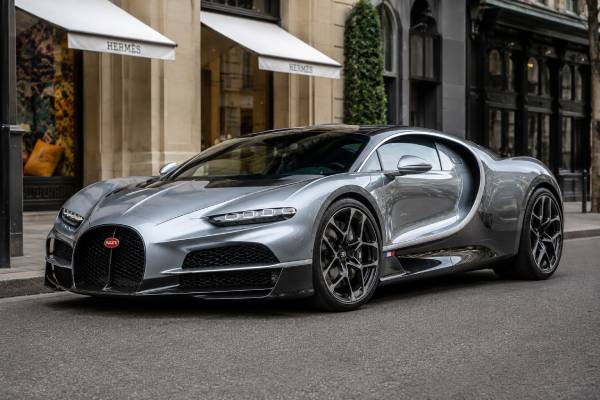
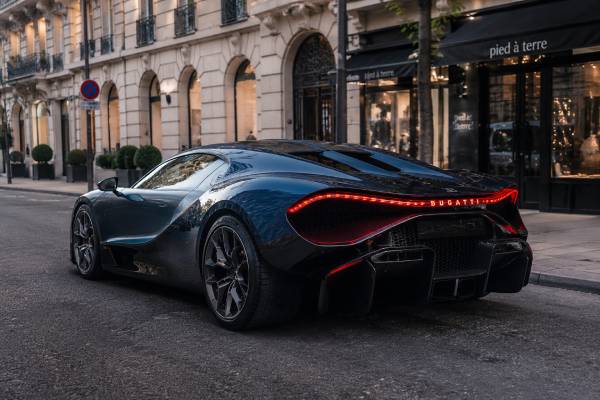
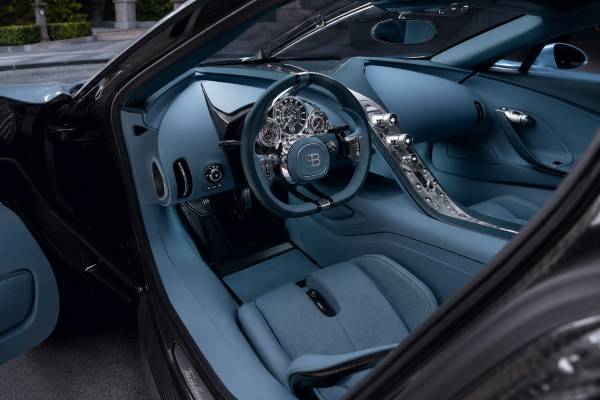
The Bugatti Tourbillon is not simply the Chiron’s replacement with a hybrid system added. It is a clean-sheet Bugatti built around an 8.3-liter naturally aspirated V16, three electric motors, an 800V battery system, a new carbon-composite structure, and a cabin designed to feel mechanical rather than screen-led. Limited to 250 examples and scheduled for customer deliveries from 2026, it marks the start of Bugatti’s post-W16 era while keeping the brand’s old priorities: extreme speed, dramatic engineering, hand-built luxury, and rarity. The most important thing to understand is that the Tourbillon uses electrification to sharpen response, traction, and usable performance, not to make the car feel like an electric appliance. Its 1,800 hp output, analog watch-inspired instruments, structural battery packaging, and bespoke tire development make it one of the most ambitious road-car programs of the decade.
Table of Contents
- What the Tourbillon Means for Bugatti
- V16 Hybrid Specs and Core Data
- Production, Options, and Identification
- Design, Engineering, and Special Details
- How the Tourbillon Should Drive
- Maintenance Risks and Ownership Reality
- Buying Advice for Serious Clients
What the Tourbillon Means for Bugatti
The Tourbillon is Bugatti’s new flagship hypercar and the first modern core Bugatti to move beyond the W16 formula. It matters because it keeps the brand’s mechanical drama alive while entering the hybrid era with a new V16 rather than downsizing, turbocharging, or going fully electric.
The Veyron proved that a road car could combine luxury, stability, and four-figure horsepower. The Chiron refined that idea with more power, more polish, and a broader family of specialized versions. The Tourbillon changes the formula more deeply. It replaces the 8.0-liter quad-turbo W16 with an 8.3-liter naturally aspirated V16 developed with Cosworth, then adds three electric motors to create a total system output of 1,800 hp.
That decision is important. Bugatti could have made a fully electric flagship, or it could have heavily reworked the W16 again. Instead, the company chose a more difficult route: a high-revving combustion engine with electric torque fill and all-wheel-drive control. The result is meant to feel more emotional than the Chiron at high rpm, while the electric system handles the instant response and low-speed flexibility that turbocharged engines usually need boost to deliver.
The name also signals a shift. Veyron and Chiron were named after racing drivers. Tourbillon comes from watchmaking, where a tourbillon is a complex mechanism associated with precision, craft, and mechanical beauty. That idea runs through the car. The interior avoids a permanently dominant touchscreen. The instrument cluster is analog, mechanical in character, and made with the help of Swiss watchmaking specialists. Bugatti wants the cabin to age like a fine watch, not like an old phone.
The Tourbillon also keeps the brand’s Molsheim identity. Production is limited to 250 cars, hand assembly is planned at the Bugatti Atelier, and the starting price is in the several-million-euro range before taxes, personalization, and market-specific costs. In practical terms, this is a car for existing Bugatti clients, major collectors, and buyers who can support long-term factory service, storage, insurance, and transport.
Its reputation is still being formed because customer cars are only beginning with the 2026 production era. Early judgment should focus less on lap-time comparison and more on what the car represents: Bugatti trying to make electrification feel theatrical, physical, and lasting.
V16 Hybrid Specs and Core Data
The key specification is simple: an 8.3-liter naturally aspirated V16 works with three electric motors for a combined 1,800 hp. The important detail is how the system is packaged, because the battery, front e-axle, rear motor, carbon structure, brake-by-wire system, and bespoke tires all support the same performance target.
| Item | Specification |
|---|---|
| Model | Bugatti Tourbillon |
| Production era | 2026–present |
| Body style | Two-seat hypercar coupe |
| Combustion engine | 8.3-liter naturally aspirated V16 |
| Engine partner | Cosworth-assisted development |
| Combustion-engine output | 1,000 hp |
| Electric motors | Three total: two on the front e-axle and one at the rear axle |
| Electric output | 800 hp combined |
| Total system output | 1,800 hp |
| Battery | 25 kWh oil-cooled 800V battery |
| Electric range | More than 60 km / 37 miles, factory-stated usable electric range |
| Transmission | New-generation 8-speed dual-clutch gearbox |
| Drivetrain | All-wheel drive with torque vectoring |
| Engine redline | 9,000 rpm |
| Engine weight | 252 kg |
The combustion engine is the emotional center of the car. A naturally aspirated V16 is unusual in any era, and especially unusual in a modern emissions, noise, and hybrid-control environment. Bugatti’s choice of a 9,000 rpm redline gives the car a different character from the Chiron, whose W16 produced immense thrust through turbocharging. The Tourbillon should build sound and urgency as revs rise, while the motors fill the gaps that a large naturally aspirated engine might otherwise leave at low speed.
The electric hardware is not just an economy feature. The two front motors allow precise control of the front axle, while the rear motor supports the V16 and gearbox. This matters for traction, torque vectoring, launch behavior, corner-exit stability, and low-grip calibration. The 25 kWh battery sits in the central tunnel and behind the occupants, where it helps packaging and structure rather than simply occupying spare space.
| Area | Tourbillon detail |
|---|---|
| Core structure | Next-generation T800 carbon composite |
| Battery packaging | Integrated into the central structural layout |
| Suspension | New multi-link system front and rear |
| Suspension material | Forged aluminum with 3D-printed aluminum components |
| Suspension weight saving | 45% lighter than Chiron suspension, factory-stated |
| Brakes | Carbon-ceramic system with bespoke brake-by-wire control |
| Front tires | 285/35 R20 Michelin Pilot Sport Cup 2, bespoke development |
| Rear tires | 345/30 R21 Michelin Pilot Sport Cup 2, bespoke development |
| Aerodynamics | Active rear wing, long rear diffuser, integrated crash concept |
Performance, Braking, Dimensions, and Weight
The Tourbillon’s published performance numbers show why Bugatti treated the car as a full platform reset, not a facelift of the Chiron. The V16 hybrid system gives it the instant response of electric drive, the high-rpm character of a naturally aspirated combustion engine, and the aerodynamic stability needed for speeds well above 400 km/h.
| Category | Figure | Notes |
|---|---|---|
| Top speed | 445 km/h / 277 mph | Electronically limited maximum speed |
| 0–100 km/h | 2.0 seconds | Published acceleration claim |
| 0–200 km/h | Under 5.0 seconds | Published acceleration claim |
| 0–300 km/h | Under 10.0 seconds | Published acceleration claim |
| 0–400 km/h | About 25 seconds | Use “about” unless final factory homologation data states otherwise |
| Braking system | Carbon-ceramic brakes with brake-by-wire control | Blended with the hybrid control system |
| Aerodynamic braking aid | Active rear wing airbrake | Deploys for stability under hard deceleration |
| Published stopping distance | No official figure yet | Avoid quoting 100–0 km/h or 60–0 mph braking distances until Bugatti or instrumented testing publishes them |
| Length | 4,671 mm / 183.9 in | Reported technical dimension |
| Width | 2,051 mm / 80.7 in | Reported technical dimension |
| Height | 1,189 mm / 46.8 in | Reported technical dimension |
| Wheelbase | 2,740 mm / 107.9 in | Reported technical dimension |
| Weight | 1,995 kg / 4,398 lb | Reported curb-weight figure; final market documentation should be checked by VIN |
Bugatti has also stated that the Tourbillon is not yet subject to final European fuel-consumption disclosure rules because type approval has not been granted. That means buyers and readers should treat some production data as provisional until market-specific homologation, owner documentation, and service literature are released.
Production, Options, and Identification
The Tourbillon is limited to 250 examples, with hand assembly planned in Molsheim after the final W16-era Bugatti models. Identification will matter because each car is likely to be highly personalized, and originality will depend on matching the car’s build record, factory options, materials, and later service history.
Bugatti clients rarely buy a standard specification in the normal sense. Paint, exposed carbon, interior materials, stitching, metal finishes, instrument-cluster decoration, wheel finishes, brake details, and luggage can all become part of the car’s identity. With the Tourbillon, the instrument cluster adds a new layer of personalization because the analog assembly can use different decorative finishes and materials inspired by haute horlogerie.
A serious buyer should separate three things:
- The base car: the 8.3-liter V16 hybrid Tourbillon coupe built in the limited 250-car run.
- Factory personalization: paint, carbon finish, cabin leather, trim metals, cluster details, luggage, and exterior accents ordered with the car.
- Post-delivery changes: any later refinishing, trim changes, protective film, software updates, tire changes, or service replacements.
The most desirable cars will likely be those with complete factory documentation, tasteful and coherent specifications, and continuous service through Bugatti-authorized channels. Very unusual specifications can be valuable when they are beautiful, well-documented, and factory-executed. They can also narrow the buyer pool if the color or interior theme is too personal.
Because the model is new, long-term market ranking is not settled. Early cars may attract attention because they mark the start of the V16 hybrid era. Later cars may benefit from small production refinements. Special editions or formally named derivatives, if Bugatti creates them, could change the hierarchy. Until then, the safest collector view is to value condition, provenance, factory originality, and specification quality over speculation.
Authentication should focus on:
- factory order sheet and final build specification
- VIN, production number, and market documentation
- factory paint and exposed-carbon records
- instrument-cluster personalization records
- battery and hybrid-system service records
- software update history
- tire specification and age
- brake condition reports
- protective-film installation records
- Bugatti dealer or factory service invoices
The Tourbillon is not a car where a generic pre-purchase inspection is enough. A buyer needs Bugatti-specific diagnostic access, hybrid-system knowledge, factory documentation review, and confirmation that the car has not been stored in a way that harms tires, battery health, seals, or hydraulic systems.
Design, Engineering, and Special Details
The Tourbillon’s design is built around speed, cooling, and mechanical theatre. It looks recognizably like a Bugatti, but the proportions, air management, doors, cockpit, and rear structure show how much changed from the Chiron.
The exterior keeps four major Bugatti cues: the horseshoe grille, the central spine, the Bugatti line along the side profile, and the two-tone body tradition. The lower roofline and tighter cabin volume help the car look wider and more planted. The flying front fenders guide air under the headlights and toward the side intakes, while the front cooling layout directs air through the bonnet area and helps generate downforce.
Aerodynamics are unusually integrated. The rear wing is not simply a styling flourish or a constant high-speed support device. Bugatti designed the body so the wing can remain submerged during top-speed running, while still deploying for downforce at lower speeds and acting as an airbrake during deceleration. The long diffuser begins far forward, rising from behind the cabin, and its structure is tied into the rear crash concept. This saves weight and helps the rear of the car remain open and visually dramatic.
The doors are electrically actuated dihedral doors. They add theatre, but they also help access because the car is low and wide. Owners can open and close them using the key fob, exterior controls, or cabin controls, depending on the situation.
The interior may be the most distinctive part of the car. Many modern hypercars rely on large screens, but Bugatti deliberately avoids making a screen the visual centerpiece. The instrument cluster is analog, skeletonized, and developed with Swiss watchmaking expertise. It uses hundreds of parts, titanium, sapphire, ruby-like bearing jewels, and tight mechanical tolerances. The steering wheel has a fixed central hub, so the rim rotates around the cluster and the instruments remain visible through steering inputs.
This is more than decoration. Bugatti is trying to solve a long-term design problem: digital interfaces age quickly. A large screen that looks advanced in 2026 may look dated in 2046. A finely made analog cluster has a better chance of feeling special decades later.
The center console continues the mechanical theme. Crystal glass and machined aluminum expose switch mechanisms and the pull-to-start ritual. A hidden screen can deploy when needed for vehicle data, camera views, and connectivity, but it stays out of sight when not in use. The seats are fixed low to the structure, while the pedal box moves electrically to fit the driver. This saves height and weight while preserving adjustability.
The engineering theme is similar: make the complex feel intentional. The battery is structural, the front e-axle fits into limited space, the suspension uses advanced aluminum construction, and the brake-by-wire system must blend regeneration with carbon-ceramic foundation braking. None of these choices are simple, but they support the same goal: a lighter, more responsive, more timeless Bugatti.
How the Tourbillon Should Drive
The Tourbillon should feel sharper, more immediate, and more naturally vocal than the Chiron, while remaining stable enough for very high-speed use. The V16 supplies the sound and high-rpm drama; the electric motors supply instant response, torque fill, front-axle control, and traction.
At low speed, the electric side of the powertrain should make the car easier to place than its headline output suggests. The front motors can help pull the car cleanly out of corners, while the rear motor supports the V16 through the gearbox. In normal driving, the 25 kWh battery also allows electric operation for short trips, quiet exits, or restricted urban areas. That does not make the Tourbillon an economy car; it makes it more usable.
Under hard acceleration, the main sensation should be continuous force. A turbocharged engine often has a clear boost character. The Tourbillon’s naturally aspirated engine should build in a more linear and emotional way, while the motors cover the immediate hit. The 9,000 rpm redline should give the car a more exotic sound signature than the W16 cars, especially near the top of the tachometer.
The driving modes are important because 1,800 hp cannot be managed by mechanical grip alone. In Comfort mode, the control systems are expected to prioritize reassurance, traction, and stability. In Sport mode, the car should become more neutral and expressive. In Track mode, the systems can allow more freedom, more rearward torque bias, and more slip while still coordinating all-wheel drive, traction control, stability control, steering, braking, and hybrid response.
Bugatti’s cold-weather testing shows how much work goes into this calibration. Ice, packed snow, slush, and changing asphalt grip force the ABS, ESC, brake-by-wire system, torque vectoring, and climate control to work in conditions far removed from a dry test track. That matters because a hypercar with this much power must feel predictable before it feels exciting.
The bespoke Michelin tire program is another major part of the driving experience. Tires define steering feel, breakaway behavior, braking confidence, ride comfort, high-speed stability, and heat sensitivity. Bugatti and Michelin did not simply adapt an off-the-shelf tire. They developed and tested specific front and rear tire sets for the Tourbillon, using simulation, objective measurement, and driver feedback before selecting the final specification.
On the road, expect tire temperature to matter. A car with wide Michelin Pilot Sport Cup 2 tires will not feel the same on a cold morning as it does after proper warming. Owners who drive the car hard should understand pressure, age, heat cycles, and surface conditions. Track use will be possible, but the Tourbillon is not a simple track-day tool. It is a very complex road hypercar whose braking, cooling, battery, tire, and software systems all need to be in their correct operating windows.
The brake pedal will be one of the most interesting details. Because the system blends regenerative braking with carbon-ceramic brakes through brake-by-wire control, the challenge is not stopping power alone. The challenge is natural pedal feel. The best version of this system will make the driver forget how much electronic blending happens underneath.
Maintenance Risks and Ownership Reality
Tourbillon ownership will depend on factory-level care, correct storage, hybrid-system management, tire discipline, and specialist diagnostics. It is too new for a mature reliability record, so the honest approach is to focus on known risk areas for this specific type of car rather than pretending there is long-term owner data.
The V16 is new, naturally aspirated, extremely high value, and tightly packaged. That means routine care will likely be less about simple oil changes and more about temperature control, leak checks, software checks, inspection access, and preserving factory tolerances. Any unusual noise, vibration, warning message, cooling issue, or oil-system concern should be treated seriously and handled through Bugatti-authorized service.
The hybrid system adds another ownership layer. Battery health, cooling performance, high-voltage insulation, inverter condition, e-motor operation, regenerative braking behavior, and software calibration all matter. Long storage without correct charging and maintenance routines can be harmful. Buyers should confirm the correct factory storage procedure for the battery and follow it exactly.
The transmission is also critical. The new 8-speed dual-clutch gearbox has to handle the combustion engine, rear electric motor integration, launch events, heat, and extreme torque delivery. Smooth low-speed behavior, clean shifts, no warning lights, and current software are essential. Launch-control use, track work, and repeated high-speed events should be documented because they affect wear and inspection priorities.
Key maintenance and inspection areas include:
- High-voltage battery condition: state of health, charging history, cooling performance, fault codes, and storage compliance.
- Electric motors and inverters: noise, temperature behavior, diagnostic faults, torque delivery, and software updates.
- V16 engine: oil leaks, cooling integrity, intake and exhaust condition, vibration, misfire data, and service history.
- Dual-clutch gearbox: shift quality, clutch data, heat history, and launch-event records where available.
- Carbon-ceramic brakes: disc thickness, surface condition, chips, cracks, pad condition, and brake-by-wire calibration.
- Tires: correct bespoke specification, production date, heat cycles, storage flat-spotting, and pressure history.
- Suspension and lift systems: leaks, sensor faults, bushing condition, ride-height behavior, and damper calibration.
- Cooling systems: engine, battery, inverter, gearbox, and cabin HVAC performance.
- Body and carbon structure: underside damage, diffuser condition, jacking damage, panel alignment, and repair records.
- Interior mechanisms: door actuation, moving pedal box, hidden screen deployment, switchgear, and instrument-cluster operation.
Parts availability will be factory-controlled. That is good for authenticity but not for speed or cost. A minor trim item, unique switch, wheel, tire, or body piece may require long lead times. A major hybrid, brake, gearbox, or carbon-structure issue could require factory involvement.
Software is now part of maintenance. The Tourbillon’s control systems define how the car drives, stops, charges, cools, and protects itself. A car that missed updates may not behave like one maintained to the latest factory standard. Buyers should ask for software campaign records just as carefully as they ask for oil-service invoices.
Warranty and extended coverage will be especially important. Even wealthy owners should care because warranty coverage is not only about money; it is also about factory support, diagnostic clarity, and resale confidence. A Tourbillon outside factory coverage, without a complete service history, will be harder to sell and riskier to own.
Buying Advice for Serious Clients
The best Tourbillon to buy is the one with the strongest factory provenance, the cleanest service record, the best specification, and the most careful storage history. Mileage matters, but condition, documentation, and factory support matter more.
A new allocation is the cleanest path if available. It allows the buyer to create the specification, establish the relationship with the dealer or factory, and receive the car with full documentation from day one. The risk is time, final price after options, and the pressure to choose a specification that will still look right decades from now.
A nearly new car may offer faster access, but it must be checked with great care. Early resale premiums can tempt buyers into moving quickly. Do not skip verification. Confirm the seller’s title, tax position, market compliance, warranty transfer, service status, battery condition, and whether any factory restrictions apply.
The strongest specifications will likely share a few traits:
| Priority | Why it matters |
|---|---|
| Complete factory documentation | Protects authenticity, resale value, and service confidence |
| Bugatti-authorized service history | Confirms correct diagnostics, updates, and maintenance procedures |
| Battery and software records | Essential for any high-value plug-in hybrid hypercar |
| Correct bespoke tires | Affects safety, handling, originality, and inspection results |
| Coherent specification | Broadens collector appeal and reduces resale friction |
| Clean carbon and underside inspection | Repairs can be complex, expensive, and value-sensitive |
| Warranty transferability | Factory coverage supports confidence and future liquidity |
Avoid cars with unclear storage, missing service records, incorrect tires, unexplained warning lights, non-factory repairs, damaged carbon, or undocumented software status. Also be careful with cars that have been used mainly for display but not maintained correctly. Very low mileage is not automatically good if the battery, seals, tires, and fluids suffered from poor storage.
For collectors, the Tourbillon’s long-term appeal rests on three pillars. First, it is the first Bugatti of the new V16 hybrid era. Second, it is limited to 250 cars. Third, it makes a strong philosophical statement by combining electrification with a naturally aspirated, high-revving engine and analog cabin craft. Those qualities should help it remain historically important even as future hypercars become faster.
For drivers, the question is different. You should buy a Tourbillon only if you want the responsibility of using it properly. That means warming it correctly, maintaining tire condition, keeping the battery healthy, servicing it through the right network, and accepting that transport, insurance, storage, and scheduled inspections are part of the experience.
The safest buying process is:
- Confirm allocation, title, market eligibility, and seller authority.
- Review the factory build sheet and personalization records.
- Verify warranty, service-plan terms, and transfer conditions.
- Arrange a Bugatti-authorized inspection with hybrid diagnostics.
- Check battery health, tire age, brake condition, software status, and underside condition.
- Confirm all keys, charging equipment, luggage, books, tools, and accessories.
- Document transport, storage, insurance, and first service before delivery.
The Tourbillon is not the easiest hypercar to explain on paper, and that is part of its appeal. It is not chasing simplicity. It is chasing a particular kind of lasting mechanical spectacle: a V16 that revs to 9,000 rpm, three motors that make the car more immediate, a cabin that treats instruments like jewelry, and a structure built around speed, weight, cooling, and beauty. For the right buyer, that combination is exactly why it matters.
References
- The Bugatti Tourbillon: an automotive icon ‘Pour l’éternité’ – Bugatti Newsroom 2024 (Manufacturer Press Release) ([Bugatti Newsroom][1])
- Mastering the cold: Testing the Tourbillon in snowy Sweden – Bugatti Newsroom 2026 (Manufacturer Development Release) ([Bugatti Newsroom][2])
- Point of Contact – Tourbillon Tire Development – Bugatti Newsroom 2026 (Manufacturer Development Release) ([Bugatti Newsroom][3])
- Masterpiece within a masterpiece: Bringing haute horlogerie to the Bugatti Tourbillon – Bugatti Newsroom 2026 (Manufacturer Development Release) ([Bugatti Newsroom][4])
Disclaimer
This article is for informational purposes only and is not a substitute for professional diagnosis, inspection, repair, valuation, or factory service advice. Specifications, torque values, service intervals, software procedures, warranty terms, and repair methods can vary by VIN, market, equipment, production update, and official service documentation. Always verify details through Bugatti, an authorized Bugatti service partner, and the official documents for the specific car.
If this guide helped you, please share it on Facebook, X/Twitter, or your favorite automotive community to support our work.