
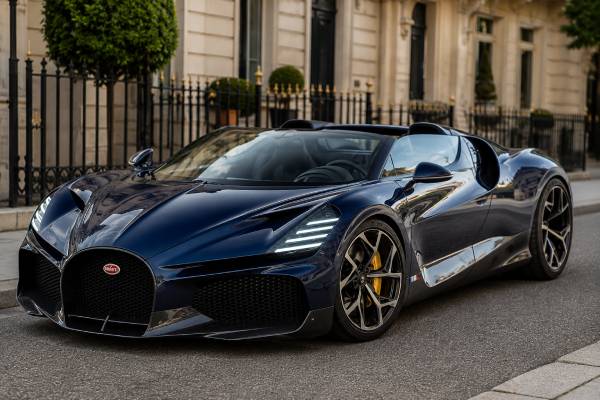
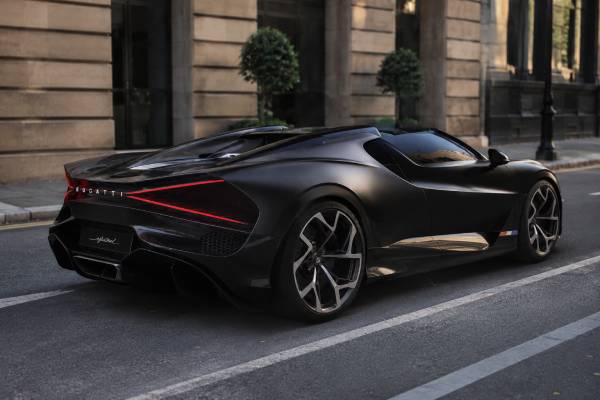
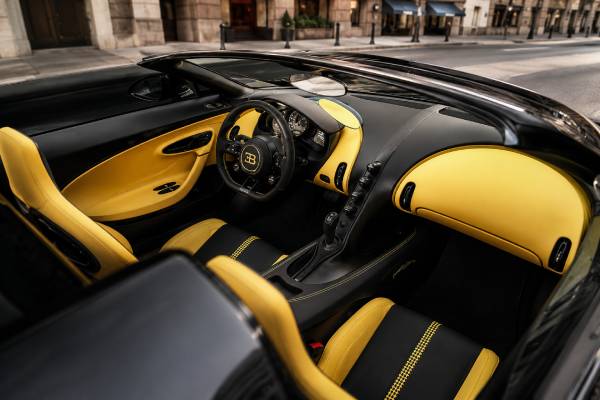
The Bugatti W16 Mistral is the open-top farewell to one of the most famous engines ever fitted to a road car. It takes the 8.0-liter quad-turbo W16 formula that powered Bugatti’s modern era and turns it into a roofless, ultra-limited roadster built for collectors who want sound, rarity, speed, and ceremony in one car. This is not simply a Chiron with the roof removed. Bugatti reworked the body structure, airflow, cooling paths, cockpit details, and rollover protection so the Mistral could keep the strength and performance expected from a 1,600 PS hypercar while giving the driver a more direct connection to the engine. With only 99 examples planned, sold before ordinary buyers could walk into a showroom, the W16 Mistral sits in a rare space: part engineering showcase, part final chapter, and part collectible object.
Table of Contents
- Why the W16 Mistral Matters
- W16 Mistral Specifications and Hardware
- Production, Options, and Identification
- Open-Top Engineering and Design Details
- What the W16 Mistral Feels Like
- Maintenance Risks and Ownership Reality
- Buying a W16 Mistral Wisely
Why the W16 Mistral Matters
The W16 Mistral matters because it closes Bugatti’s roadgoing W16 era with the most emotional body style Bugatti could choose: an open-top roadster. It is a collector-grade final statement, not a high-volume model, and its importance comes as much from timing as from speed.
Bugatti’s modern identity was rebuilt around the W16 engine. The Veyron made the layout famous in the 2000s, the Chiron refined it into a more polished and faster hypercar, and limited models such as the Divo, Centodieci, Chiron Super Sport, and La Voiture Noire showed how flexible the platform could be. The Mistral is different because it turns the same basic idea into a roofless car at the end of the engine’s life.
The car was revealed in 2022, but its buying and ownership story belongs strongly to the 2025-present collector market. By this period, the W16 had become more than a performance figure. It had become a historic mechanical signature: sixteen cylinders, four turbochargers, permanent all-wheel drive, huge cooling demand, and a level of engineering excess that few future cars are likely to repeat.
Bugatti did not position the Mistral as a casual convertible. The company described it as a bespoke roadster with a reengineered body, a distinct design language, and a goal of preserving the performance and quality expected from the brand’s fastest closed cars. That matters because open cars face a hard engineering problem. Removing a fixed roof can reduce stiffness, change airflow, increase noise, complicate safety structures, and disturb cooling. On a car with this much power, those are not small details.
The Mistral also reconnects Bugatti with its long roadster history. Bugatti’s prewar catalog included elegant open cars, and the Mistral’s design references the Type 57 Roadster Grand Raid. That inspiration is not just visual nostalgia. It helps explain the car’s character: long, dramatic, expensive, handcrafted, and more about occasion than lap-time purity.
Today, the W16 Mistral is best understood in three ways:
- As the last roadgoing expression of Bugatti’s W16-powered era.
- As an open-top companion to the Chiron Super Sport powertrain concept.
- As a limited-production collectible where specification, provenance, and delivery condition will matter as much as mileage.
For enthusiasts, it is a fascinating technical object. For buyers, it is a rare asset with serious ownership obligations. For Bugatti, it is a bridge between the W16 age and the next generation of electrified hypercar engineering.
W16 Mistral Specifications and Hardware
The useful specification headline is simple: the W16 Mistral uses a 7,993 cc quad-turbo W16 engine rated at 1,177 kW, or 1,600 PS, with 1,600 Nm of torque and permanent all-wheel drive. In normal horsepower terms, 1,600 PS is about 1,578 mechanical horsepower, though the car is often casually described as a 1,600 hp Bugatti.
| Item | Specification |
|---|---|
| Engine | 8.0-liter W16 |
| Displacement | 7,993 cc |
| Induction | Four turbochargers with Bugatti two-stage turbocharging and water-air intercooling |
| Valvetrain | Four valves per cylinder |
| Output | 1,177 kW / 1,600 PS at 7,050 rpm |
| Torque | 1,600 Nm from 2,250 rpm to 7,000 rpm |
| Transmission | 7-speed DSG dual-clutch gearbox |
| Drivetrain | Permanent all-wheel drive |
| Front power distribution | Controlled front-axle longitudinal differential |
| Rear power distribution | Rear-axle differential with controlled inter-wheel lock |
The performance numbers explain why the car sits in the extreme end of road-car engineering. Bugatti lists 0-100 km/h in 2.4 seconds, 0-200 km/h in 5.6 seconds, 0-300 km/h in 12.1 seconds, and 0-400 km/h in about 29.0 seconds. The official production top-speed mode figure is 420 km/h, while EB, Autobahn, and Handling modes limit the car to 380 km/h.
| Metric | Figure |
|---|---|
| 0-100 km/h | 2.4 seconds |
| 0-200 km/h | 5.6 seconds |
| 0-300 km/h | 12.1 seconds |
| 0-400 km/h | Approximately 29.0 seconds |
| Maximum speed in Top Speed mode | 420 km/h / 273 mph |
| Maximum speed in EB, Autobahn, or Handling mode | 380 km/h / 236 mph |
The chassis hardware is equally serious. The Mistral uses double-wishbone suspension front and rear, carbon-ceramic braking hardware, staggered wheels, and very wide Michelin BG2 tires. Its tire sizes show how much the car depends on contact patch and tire condition: 285/30 ZR20 at the front and 355/25 ZR21 at the rear.
| Area | Specification |
|---|---|
| Suspension | Double-wishbone front and rear |
| Front wheels | 10J x 20 |
| Rear wheels | 13.5J x 21 |
| Front tires | 285/30 R20 ZR (Y) BG2 |
| Rear tires | 355/25 R21 ZR (Y) BG2 |
| Front brake discs | 420 mm |
| Rear brake discs | 400 mm |
| Brake calipers | 8 pistons front / 6 pistons rear |
The Mistral is large, low, and heavy by ordinary sports-car standards, but its weight is not unusual for a W16 Bugatti. The official DIN empty weight is 2,040 kg. The wheelbase is 2,711 mm, and the fuel tank holds 97 liters. Its length is 4,694 mm, while the width without mirrors is 2,034 mm and with mirrors is 2,188 mm.
That size affects the ownership experience. The car needs wide roads, careful parking, trained loading procedures, and enough space around the bodywork to protect carbon-fiber surfaces. The front lift setting is not a convenience feature; it is part of keeping the nose and underbody safe during real use.
Production, Options, and Identification
The key production fact is that Bugatti planned only 99 W16 Mistral examples, and the run was sold out early. That makes the car less like a normal model line and more like a numbered allocation program where each build’s specification and paperwork become central to value.
The Mistral was priced from 5 million euros net when announced, before taxes, local duties, registration costs, and customization. For many cars, that would be the most important buying detail. For a Mistral, it is only the starting point. Bugatti clients usually personalize paint, leather, stitching, wheels, exposed carbon, cabin details, and individual design themes through factory consultation. Two Mistrals can therefore have the same mechanical specification but very different collector appeal.
Identification should focus on factory documentation rather than surface appearance alone. A correct Mistral should have paperwork confirming its chassis identity, original allocation, delivery specification, country or market configuration, warranty status, service plan, software update history, and any later factory-approved work. Because these cars are likely to move privately, buyers should insist on a complete file before discussing price.
Important identification and value factors include:
- Original factory order sheet and final build specification.
- Exterior paint, exposed carbon, and special finish documentation.
- Interior leather, stitching, trim, and personalized details.
- Confirmation that all accessories, roof components, keys, manuals, chargers, and tools remain with the car.
- Service records from Bugatti-authorized facilities.
- Transport, storage, and delivery inspection records.
- Mileage pattern, especially whether the car was driven, displayed, stored, or used for events.
There is no broad range of mechanical variants in the normal sense. The Mistral’s appeal comes from individual configuration, rarity, and condition, not from choosing between base, S, track, or lightweight trims. That makes authenticity and taste more important than ordinary trim-level research.
Factory options should be judged carefully. A restrained heritage color scheme can age beautifully, but an intensely personal commission may appeal strongly to one buyer and less to another. On a 99-car Bugatti, however, unusual does not automatically mean undesirable. If the specification has a clear story, strong execution, and factory confirmation, it may become part of the car’s identity.
For collectors, the safest Mistral is not always the lowest-mileage car. A car stored without use can suffer from battery, tire, seal, fluid, and calibration issues. A lightly used car with documented maintenance, correct storage, and a clean delivery history may be easier to own than a delivery-mile car that has sat unattended.
Open-Top Engineering and Design Details
The Mistral’s special engineering is about making an open car behave like a true Bugatti, not about making a roofless Chiron as quickly as possible. Its body, airflow, intake placement, rollover structures, lighting, and cooling paths were all shaped around the demands of the W16 engine and high-speed open-top stability.
The biggest challenge is structure. A fixed roof usually helps a car resist bending and twisting. Remove it, and the remaining body must carry loads through the sills, bulkheads, windshield structure, rear body, and carbon-fiber tub. Bugatti described the Mistral as using a reengineered and reshaped monocoque rather than simply cutting the roof from an existing car. That difference matters because stiffness affects steering precision, suspension consistency, noise, vibration, and long-term fit.
Cooling is another defining theme. The W16 engine produces enormous heat, and the Mistral changes how air moves around the car. The side oil-cooler intakes are separated from the engine air intakes. The roof-mounted scoops behind the occupants feed the engine and also create much of the car’s visual drama. Because the driver sits ahead of those intakes, the sound of air, turbochargers, and combustion becomes a major part of the experience.
The front design is not decoration. The vertically stacked headlights include a four-light signature that hints at the four turbochargers and all-wheel drive. More importantly, the headlight shaping helps guide air through the light area and out through the wheel arch, reducing drag and managing pressure. The horseshoe grille is deeper and wider, giving the high-temperature radiator a more direct feed.
At the rear, the X-shaped taillight theme does more than make the car instantly recognizable at night. The open areas around the X help vent cooling air from the side oil-cooler paths. This is classic Bugatti thinking: make the visual signature serve an engineering job.
Inside, the Mistral takes the Chiron cockpit idea and adds roadster-specific ceremony. The layout is familiar enough to feel like a modern Bugatti, but the details matter: woven leather on the doors, milled aluminum, titanium elements, soft leather, and a gear shifter with wood and amber. The Rembrandt Bugatti dancing elephant motif in the shifter connects the car to the Type 41 Royale and the family’s artistic history.
The roof solution is also central to the car’s identity. It is not a casual everyday convertible with a large folding mechanism. Buyers should think of the Mistral as a roadster first: the roof is part of weather protection and ownership logistics, but the car’s core experience happens open to the air. That affects storage, travel planning, noise expectations, and inspection priorities.
The result is a car with two personalities. Visually, it is elegant and heritage-led. Technically, it is a cooling, stiffness, and airflow exercise wrapped in carbon fiber. Emotionally, it is built to make the W16 feel closer to the driver than it does in a closed Bugatti.
What the W16 Mistral Feels Like
The W16 Mistral should feel less isolated than a closed Chiron-derived car because the engine breathes and sounds directly behind the occupants. The numbers are extreme, but the defining sensation is likely the combination of huge torque, open-air noise, all-wheel-drive traction, and the rare feeling of sitting in a roofless car that can still operate at hypercar speed.
Acceleration is the easiest part to understand and the hardest part to experience fully. The car reaches 100 km/h in 2.4 seconds, but that figure does not capture the main event. The W16’s character is about sustained acceleration. Many fast cars feel dramatic from rest and then fade. The Mistral keeps pulling through speeds where ordinary performance cars have already run out of power, gearing, road, or courage.
The torque curve is central to that feeling. With 1,600 Nm available across a wide band, the car does not need to be worked like a small, high-revving engine. It surges. The dual-clutch gearbox supports that with fast, controlled shifts, while permanent all-wheel drive turns vast torque into forward motion rather than tire smoke. Launch control and tire temperature still matter, but the system is designed to make performance repeatable for trained drivers under the right conditions.
The steering and chassis should feel more stable than playful. This is a wide, powerful, expensive roadster built to carry speed with composure. It is not a lightweight back-road toy. The best way to understand it is as a grand hypercar: immensely fast, highly engineered, and more about precision and confidence than about sliding around tight roads.
The drive modes change the car’s usable character. Lift mode protects the body at low speed. EB mode suits normal driving. Autobahn and Handling modes change ride height and controlled systems for faster use. Top Speed mode lowers the car further and unlocks the highest official speed setting. These modes are not gimmicks; they manage steering, dampers, stability control, traction control, inter-wheel locking, ride height, and the aerodynamic attitude of the car.
Braking feel is another ownership-critical area. Carbon-ceramic brakes can be powerful and durable, but they are expensive and sensitive to misuse, impact damage, uneven heating, and poor inspection. Around town, they may not feel as warm or progressive as conventional brakes. At speed, they are part of the safety system that makes the car credible.
The open cockpit changes comfort. Wind noise, road noise, intake sound, and exhaust resonance become part of the charm. For some drivers, that is the point. For others, long-distance comfort may be better in a closed Chiron. The Mistral rewards the owner who wants the W16 as a sensory experience, not only a number.
Daily usability is relative. The car can cruise, idle, and move through normal traffic better than its specification suggests, but it is still extremely wide, low, valuable, and attention-grabbing. City driving requires patience. Mountain roads demand caution because of width and sightlines. High-speed use belongs only in legal, controlled, tire-approved environments with expert support.
Maintenance Risks and Ownership Reality
The W16 Mistral should be maintained as a factory-supported exotic, not as a normal used performance car. Its main risks are not ordinary high-mileage problems; they are heat, age, storage, tires, carbon-ceramic brake condition, hydraulic and electronic systems, roof hardware, software status, and the cost of specialized labor.
Because production is tiny, public reliability data will be limited. There will not be thousands of owner reports, independent repair guides, or cheap parts networks. The correct approach is to treat Bugatti-authorized documentation and VIN-specific service history as the source of truth.
The engine itself is a masterpiece, but it is complex. Sixteen cylinders, four turbochargers, multiple cooling circuits, high-performance intercooling, and a densely packaged engine bay mean access is difficult and heat management is vital. Any coolant, oil, induction, or turbocharger issue should be investigated by specialists immediately.
Areas that deserve close attention include:
- Tire age, tire type, and approval for high-speed use.
- Carbon-ceramic brake disc condition, pad life, and heat history.
- Lift system function and ride-height behavior in all modes.
- Cooling system condition, including radiators, ducts, fans, and hoses.
- Battery health, charging routine, and low-voltage electronic stability.
- Transmission shift quality at low speed, under load, and during deceleration.
- Differential and all-wheel-drive behavior during tight maneuvers.
- Roof fit, seals, storage condition, and wind-noise behavior.
- Software updates, diagnostic logs, and any factory service campaigns.
- Interior electronics, displays, switches, and climate-control function.
Storage matters more than many new owners expect. A Mistral should live in a climate-controlled space on a proper battery maintainer, with tire care, periodic checks, correct fluids, and protection from moisture and sunlight. A car that sits on old tires, stale fuel, and a weak battery can develop expensive issues even with almost no mileage.
Carbon-fiber bodywork also changes the repair conversation. Paint damage, exposed-carbon scratches, stone chips, and underside contact are not simple cosmetic concerns. Matching finishes and restoring factory-level quality may require factory-approved work. Buyers should inspect the nose, lower side surfaces, rear diffuser area, wheel faces, and door openings with special care.
The removable roof adds roadster-specific maintenance. Seals must be clean and properly seated. Mounting points should be undamaged. Any roof storage bag, stand, or related accessory should remain with the car. Water leaks, wind noise, and fit issues can be difficult to solve if parts are missing or the car has been handled carelessly.
Originality versus upgrades is simple here: keep the car original unless Bugatti approves the work. Aftermarket exhausts, wheel changes, software tuning, non-approved tires, or cosmetic modifications can reduce value and create warranty or service complications. On a 99-unit final-W16 roadster, factory correctness is part of the car’s worth.
Buying a W16 Mistral Wisely
The smartest way to buy a W16 Mistral is to buy the story, documents, condition, and factory support before you buy the color. Since all examples were allocated early, most buyers will be dealing with private sales, brokered transactions, or collector-to-collector opportunities rather than normal dealer inventory.
Start with provenance. The seller should be able to show the original build identity, order details, delivery history, service records, and ownership chain. A vague description such as “one of 99” is not enough. Every Mistral is one of 99. The question is which one, how it was specified, how it was stored, and whether every part of its history is clean.
Then evaluate the specification. Some buyers will want heritage colors and restrained interiors. Others will want exposed carbon, bold paint, or a one-off Sur Mesure theme. The best specification is not always the loudest. It is the one that looks intentional, is documented by Bugatti, and suits the car’s final-W16 significance.
A pre-purchase inspection should be performed through Bugatti-authorized channels or by specialists accepted by Bugatti and the buyer’s advisors. This is not the place for a generic supercar inspection. The inspection should include diagnostic scans, service campaign checks, brake and tire assessment, roof inspection, underbody review, paint-depth and carbon-fiber evaluation where appropriate, and confirmation of all accessories.
| Check | Why it matters |
|---|---|
| Factory build sheet | Confirms original colors, materials, options, and personalization |
| Service history | Shows whether the car stayed inside the correct maintenance network |
| Tire age and type | Critical for safety, value, and any high-speed use |
| Brake condition | Carbon-ceramic replacement or repair can be a major cost driver |
| Roof parts and seals | Missing or damaged roadster-specific parts may be hard to replace |
| Software and campaigns | Ensures the car is current and properly supported |
| Storage records | Low mileage does not guarantee healthy fluids, tires, seals, or battery condition |
| Tax and import advice | Cross-border hypercar purchases can create major legal and financial complications |
Budgeting should include more than the purchase price. Insurance, secure storage, enclosed transport, factory service, tires, detailing, registration, taxes, and professional management can add significant annual cost. Owners who plan to drive the car should also budget for consumables and cosmetic preservation. Owners who plan to store it should budget for correct preservation, not neglect.
Mileage should be judged in context. Delivery mileage may appeal to collectors, but a completely unused car can still need recommissioning. A carefully used car with proper service may be a better driving purchase. For investment-focused buyers, the strongest examples will likely combine rare specification, complete documentation, low but believable mileage, and no stories.
The biggest mistake is treating the Mistral like a speculative object only. It is collectible, but it is also a machine. Machines need use, inspection, and care. A buyer who understands both sides will make better decisions than someone chasing the lowest odometer reading or the loudest paint.
For most enthusiasts, the W16 Mistral will remain something to study rather than own. That does not reduce its importance. It marks the end of a rare engineering philosophy: a road car powered by a huge sixteen-cylinder engine, four turbochargers, permanent all-wheel drive, and a level of mechanical extravagance that feels increasingly unlikely in the future. As a buying proposition, it is expensive and demanding. As a Bugatti, it is a fitting final open-air tribute to the W16.
References
- Bugatti W16 Mistral: The ultimate roadster – Bugatti Newsroom 2022 (Manufacturer Press Release) ([Bugatti Newsroom][1])
- Technical specifications BUGATTI W16 MISTRAL 07.2025 2025 (Technical Specifications)
- The rigorous quality assessment behind every W16 Mistral – Bugatti Newsroom 2025 (Manufacturer Press Release) ([Bugatti Newsroom][2])
Disclaimer
This article is for informational purposes only and is not a substitute for professional diagnosis, repair, inspection, valuation, or legal advice. Specifications, torque values, maintenance intervals, procedures, software status, tire approvals, campaign requirements, and equipment can vary by VIN, market, and individual build. Always verify details against official Bugatti service documentation and a qualified Bugatti-authorized specialist before buying, servicing, repairing, importing, or driving a W16 Mistral.
If this guide helped you, please share it on Facebook, X/Twitter, or your favorite enthusiast community to support our work.