
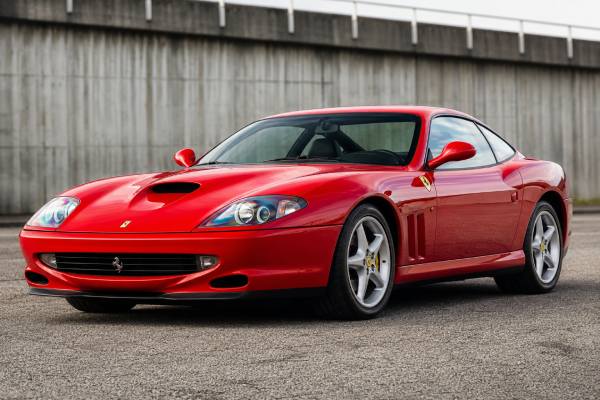
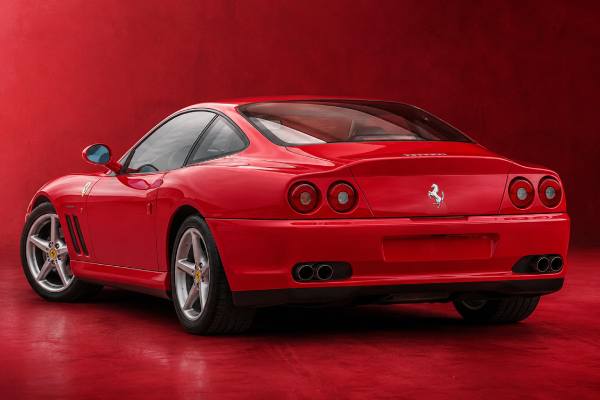
The Ferrari 550 Maranello (F133) brought Ferrari’s two-seat V12 flagship back to a front-engine layout after more than two decades of mid-engine Berlinetta Boxer and Testarossa descendants. Built from 1996 through 2001 as the closed-roof Maranello coupe, it used the naturally aspirated F133A 5.5-liter V12, a six-speed gated manual transaxle, rear-wheel drive, and a grand-touring body shaped by Pininfarina.
Its appeal is not only speed, though 485 hp, a 199 mph top speed, and a 0–100 km/h time of about 4.4 seconds made it one of the fastest road cars of its era. The deeper reason people still search for the 550 is that it sits at a rare intersection: old-school analog Ferrari character, modern enough usability, front-engine V12 balance, and real collector status without the complexity of later paddle-shift and electronic-heavy models. It is a serious performance car, but also a usable long-distance GT with luggage space, air conditioning, leather trim, and a calmer personality than many mid-engine Ferraris.
Quick Take
The Ferrari 550 Maranello is valued because it combines a front-mounted naturally aspirated V12, a gated six-speed manual, Pininfarina restraint, and genuine high-speed grand-touring ability in one coherent package. Its main caution is that it is still an aging exotic, not a simple classic: timing-belt history, cooling-system health, suspension electronics, sticky interior trim, wheel-recall status, accident repair quality, and documentation matter more than headline mileage alone. The best cars are original, regularly serviced, properly documented, and inspected by a Ferrari specialist before purchase.
Table of Contents
- Model History and Collector Significance
- F133A V12, Chassis, and Specifications
- Production, Variants, and Factory Options
- Design, Engineering, and Special Features
- Driving Experience and Performance
- Reliability, Maintenance, and Restoration
- Market Value and Buying Guide
Model History and Collector Significance
The 550 Maranello matters because it restored Ferrari’s classic two-seat front-engine V12 formula for the modern era. Before it, Ferrari’s top two-seat 12-cylinder road cars had spent years behind the driver, from the 365 GT4 BB through the 512 BB, Testarossa, 512 TR, and F512 M.
Ferrari did not simply make a nostalgic Daytona revival. The 550 was a strategic reset. It put the engine in front, the gearbox at the rear, and the driver between a long hood and a short rear deck, but it was engineered as a contemporary grand tourer rather than a retro exercise. That combination made it easier to drive, easier to place on the road, and more practical than the wide mid-engine flagships it replaced.
The model name follows Ferrari convention. “550” refers to the approximate 5.5-liter displacement, while “Maranello” connects the car directly to Ferrari’s home town and factory. The internal type code is F133, and the coupe’s engine is commonly identified as F133A.
The 550 arrived at a time when Ferrari was modernizing rapidly. The F355 had shown how much refinement could be added without losing excitement. The 456 GT had already proven that a front-engine V12 transaxle could work in a modern Ferrari 2+2. The 550 took that idea and focused it into a two-seat flagship with more direct sporting intent.
Its historical role is unusually strong for a car built in the late 1990s. It connects the 365 GTB/4 Daytona tradition to later front-engine Ferrari V12s such as the 575M Maranello, 599 GTB Fiorano, F12berlinetta, 812 Superfast, and 12Cilindri. In that sense, the 550 is the foundation of Ferrari’s modern front-engine V12 super-GT line.
The car also has a motorsport shadow, even though the road-going 550 was not launched as a homologation special. Private racing versions, especially the 550-GTS and 550 GT1 projects, later became successful in international GT racing. Those competition cars were heavily developed, but they strengthened the road car’s reputation by proving that the basic front-engine V12 platform could be turned into a serious racing machine.
Collectors value the 550 for several reasons:
- It was manual-only from the factory in coupe form.
- It uses a naturally aspirated V12 without hybrid assistance or turbocharging.
- It has relatively restrained Pininfarina styling.
- It was produced in meaningful but not excessive numbers.
- It is modern enough for regular use but old enough to feel mechanical.
- It belongs to the last generation before Ferrari’s F1-style paddle gearboxes became dominant.
The 550’s reputation today is less about poster-car drama and more about depth. It rewards drivers who want balance, sound, steering feel, and long-distance usability. It also appeals to buyers who want a collectible Ferrari that can still be driven without treating every mile as a museum-grade event.
F133A V12, Chassis, and Specifications
The 550 Maranello’s core specification is simple and serious: a 5.5-liter naturally aspirated V12 in front, a six-speed manual transaxle at the rear, and rear-wheel drive. That layout gives the car its long-hood proportions and its balanced, planted driving feel.
| Category | Specification |
|---|---|
| Model | Ferrari 550 Maranello |
| Internal type | F133 |
| Production period | 1996–2001 for the Maranello coupe |
| Body style | Two-seat berlinetta coupe |
| Engine code | F133A |
| Engine layout | Front longitudinal 65-degree V12 |
| Displacement | 5,474 cc |
| Bore x stroke | 88 mm x 75 mm |
| Valvetrain | Dual overhead camshafts, four valves per cylinder |
| Induction | Naturally aspirated, variable-length intake system |
| Fuel management | Bosch Motronic engine management |
| Maximum power | 485 hp at 7,000 rpm |
| Maximum torque | About 569 Nm at 5,000 rpm |
| Transmission | Six-speed gated manual transaxle |
| Drive | Rear-wheel drive with limited-slip differential |
| Top speed | 320 km/h, or about 199 mph |
| 0–100 km/h | About 4.4 seconds |
| Wheelbase | 2,500 mm |
| Length | 4,550 mm |
| Width | 1,935 mm |
| Height | 1,277 mm |
| Fuel capacity | About 114 liters |
The engine is one of the 550’s defining strengths. It is not a peaky racing unit that only works near the redline. It has serious midrange torque, a smooth climb through the rev range, and a hard-edged top end when extended. The 65-degree V12 architecture gives it a distinctive Ferrari sound without the harsher feel of some high-strung smaller engines.
The transaxle layout is just as important as the engine. By placing the gearbox and differential at the rear, Ferrari improved weight distribution compared with a conventional front-engine layout. The result is a car that does not feel nose-heavy in the way its long hood might suggest. It has the stance of a grand tourer but the balance of a serious sports car.
The chassis uses a steel tubular structure with aluminum body panels. This was not a carbon-tub hypercar approach, but it was a proven Ferrari method that allowed strength, repairability, and hand-finished body construction. Suspension is independent at all four corners with double wishbones, coil springs, anti-roll bars, and electronically controlled damping.
The brakes are large ventilated steel discs with ABS. They are powerful for road use, but buyers expecting modern carbon-ceramic resistance to repeated track abuse need to adjust expectations. The 550 was built as a very fast road GT, not a stripped track car.
Factory wheel and tire specifications can vary by tire brand and market documentation. Many cars are seen with 18-inch five-spoke wheels and wide performance tires, with rear tires substantially wider than the fronts. Early cars also raise an important wheel-material issue discussed later in the maintenance and buying sections.
The official performance figures still read strongly today. A top speed near 199 mph made the 550 one of the great high-speed GTs of the 1990s. More important, it could sustain speed with stability, cooling capacity, and comfort. That is the difference between a car that can touch a number once and a car built to live at serious pace.
Production, Variants, and Factory Options
The main 550 Maranello coupe was built in just over 3,000 examples, making it rare enough to be collectible but not so rare that the market only sees one or two cars at a time. For buyers, the important distinction is between the standard coupe, special specifications such as the World Speed Record edition, and the related but separate 550 Barchetta Pininfarina.
The closed-roof 550 Maranello is the car covered here. It was sold as a two-seat V12 coupe with a six-speed manual gearbox. Unlike the later 575M Maranello, the 550 coupe did not offer Ferrari’s F1 automated manual transmission. That manual-only identity is now one of its biggest collector strengths.
The 550 Barchetta Pininfarina arrived later as an open car built to celebrate Pininfarina’s anniversary. It shares much of the basic mechanical character but uses a different open body concept and is far rarer. It should not be treated as a normal convertible version of the coupe. The Barchetta has its own market, its own inspection issues, and its own collectability.
The World Speed Record edition is the most talked-about special 550 coupe. It was created after a 550 set endurance speed records in 1998, including average-speed records over long distances and one hour. The commemorative road cars are often described as 33 examples and are more valuable than ordinary 550s when documentation is correct.
Important factory or period-correct equipment can include:
- Fiorano Handling Package, with sharper suspension tuning.
- Carbon racing-style seats on selected cars.
- Scuderia Ferrari fender shields.
- Daytona-style seat inserts.
- Modular or alternative wheel designs depending on market and period.
- Leather parcel shelf and extended leather details.
- Contrast stitching, special carpets, and luggage sets.
- Sports exhausts, where factory or dealer documented.
- Becker audio and period infotainment equipment.
The Fiorano Handling Package deserves special attention. It can add desirability because it sharpens the car’s responses, but not every buyer wants the firmer ride. Some sellers may claim Fiorano specification loosely, so a buyer should verify it through build records, original order information, dealer documents, or Ferrari Classiche-style documentation where available.
Originality is a major value factor. A tasteful exhaust or reversible stereo update may not ruin a driver-quality 550, but major body modifications, incorrect wheels, non-original interior retrims, missing books, or unclear service history can reduce confidence. The 550’s understated design also means poor modifications tend to stand out.
Matching engine and chassis identity is important, but the 550 is not an early 1960s Ferrari where every casting number drives the entire value. Still, serious buyers should confirm VIN, engine number where accessible, gearbox information if documented, paint color, trim color, and factory options. The best cars usually come with books, tools, service invoices, ownership records, and evidence of regular care.
Design, Engineering, and Special Features
The 550 Maranello’s design works because it is calm, proportioned, and functional rather than theatrical. Pininfarina gave it the visual language of a classic front-engine Ferrari without turning it into a copy of the Daytona.
The long hood, low nose, side vents, rear haunches, and compact tail all serve the car’s identity. It looks powerful but not exaggerated. Compared with the Testarossa and 512 TR, the 550 is less dramatic in photographs but often more elegant in person. It has width and presence, yet the details are cleaner.
The body’s central hood intake is one of its signature features. It is not just decoration; it forms part of the car’s cooling and airflow character. The side vents also help break up the large front fenders and visually connect the 550 to earlier Ferrari GTs.
Aerodynamics were designed for stability at very high speed. The 550 does not rely on huge wings. Instead, its shape, underbody management, and balanced proportions aim for a stable GT feel near 200 mph. That fits the car’s mission: fast, planted, and usable rather than visually aggressive.
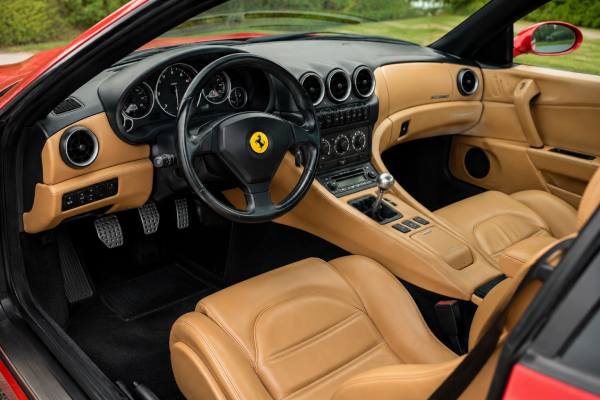
The cockpit is one of the reasons the 550 remains appealing. The driver sits low behind a clear instrument cluster, with a metal gated shifter on the center tunnel and a traditional three-pedal layout. The cabin is leather-rich, simple by modern standards, and far less screen-dominated than later Ferraris.
The special features are not gimmicks. They are mechanical and sensory:
- The open-gate shifter gives each gear change a deliberate, metallic action.
- The front V12 produces a layered sound: smooth at low rpm, harder and more urgent as it revs.
- The rear transaxle helps the car rotate more naturally than many front-engine cars.
- The adaptive damping gives the car a broader comfort range than a fixed-rate setup.
- The two-seat GT layout offers more luggage usefulness than a mid-engine Ferrari.
Engineering choices also make the 550 easier to live with than older exotic cars. The engine does not need to be removed for routine belt service in the way some mid-engine Ferraris do. Access is still specialist work, but the front-engine layout helps. The car has real cooling capacity, a substantial fuel tank, effective climate control, and better long-distance manners than its exotic badge might suggest.
That said, the 550 is still a hand-built Ferrari of the 1990s. The charm comes with age-related issues: leather shrinkage, sticky interior coatings, electrical gremlins, worn suspension parts, and the need for experienced maintenance. Its simplicity is relative, not absolute.
Driving Experience and Performance
The 550 Maranello feels fast in a mature, elastic way rather than a nervous one. Its defining driving trait is the combination of V12 torque, manual control, and stable chassis balance.
At low speeds, the car feels wider and heavier than a small mid-engine Ferrari, but it is not clumsy. The clutch is substantial without being impossible, and the gearbox rewards patience until warm. Like many gated Ferraris, the shift action becomes better once the fluids have temperature in them. Rushing a cold second-gear shift is not how the car likes to be treated.
Once moving, the engine dominates the experience. It pulls cleanly from modest revs and builds with a smooth, expensive-feeling surge. The torque makes the car easy to drive quickly without constant downshifts, but the upper half of the rev range is where the Ferrari character fully appears. The sound hardens, the response sharpens, and the car feels smaller than its dimensions suggest.
Steering is one of the 550’s strengths. It has more weight and texture than many later electric-assisted systems, but it is not brutally heavy. On a flowing road, the car gives the driver time to work with it. The front end is more trustworthy than the long hood might imply, and the rear transaxle layout helps the car feel balanced on corner entry and exit.
The ride is firm but usable. A well-maintained 550 can cover distance with surprising comfort. A tired one can feel loose, crashy, or vague, which is why suspension condition is so important during inspection. Dampers, bushings, mounts, tires, and alignment can completely change the way the car feels.
Braking performance is strong for fast road driving. For track use, expectations should be realistic. Steel brakes, heavy curb weight, and expensive consumables mean the 550 is happiest as a road GT with occasional spirited use, not as a modern track-day weapon. Heat management, pad choice, fluid condition, and rotor condition matter if the car is driven hard.
Compared with later Ferraris, the 550 feels more analog and less filtered. It does not have lightning-fast dual-clutch shifts, modern traction systems, or a steering-wheel manettino full of modes. That is the point. The driver manages the gearbox, the throttle, and the car’s weight transfer directly.
Usability is better than many expect. Visibility is good by exotic-car standards, the cabin is not impossibly cramped, and the luggage area makes weekend travel realistic. City driving is possible, but the car prefers open roads. Heat, traffic, clutch wear, and low-speed cooling should always be respected.
A good 550 feels cohesive. A neglected one can feel expensive and disappointing. The difference usually comes down to maintenance, tires, suspension health, and whether the car has been driven enough to stay exercised.
Reliability, Maintenance, and Restoration
The 550 Maranello can be a robust Ferrari when maintained correctly, but deferred maintenance is the biggest ownership risk. Buyers should think less in terms of ordinary reliability ratings and more in terms of age, service discipline, and specialist inspection.
The F133A V12 has a strong reputation when serviced properly. It is not fragile by exotic standards, but it depends on correct timing-belt service, clean fluids, healthy cooling, good ignition components, and regular use. Cars that sit for years can develop problems that low mileage does not reveal.
Timing belts are the headline service item. Factory maintenance schedules list belt replacement by mileage, and many specialists also apply time-based intervals because age matters as much as distance on a low-mile exotic. A recent belt service is useful, but the invoice should show what was actually replaced: belts, tensioners, bearings, seals where needed, cam-cover gaskets if leaking, accessory belts, and related hardware.
Common ownership areas to inspect include:
- Timing-belt age and quality of the last major service.
- Cam-cover, front-seal, and other oil leaks.
- Cooling hoses, radiator condition, fans, and thermostat operation.
- Engine mounts and gearbox mounts.
- Clutch wear, release bearing behavior, and hydraulic system health.
- Differential and transaxle leaks or noises.
- Suspension bushings, ball joints, dampers, and actuator function.
- Steering rack leaks or play.
- Brake rotor condition, pad age, fluid history, and caliper health.
- Fuel hoses, vapor lines, and fuel pump-related age issues.
- Battery condition and charging-system stability.
- Sticky interior plastics and shrinking leather.
- Window regulators, switches, climate control, and warning lights.
The 550’s electronically adjustable dampers can be a cost point. Warning lights, failed actuators, tired dampers, or poor-quality replacements can all affect value and driving quality. A proper diagnostic check is important.
The interior is another common restoration area. Like many Ferraris of the period, the 550 can suffer from sticky switchgear and soft-touch coating deterioration. Leather dashboards may shrink or pull near vents if exposed to heat and sun. A high-quality interior correction is possible, but poor retrimming can hurt originality.
The wheel issue is important for early cars. Some 550s were affected by a recall involving magnesium wheel bolt inserts that could crack, with replacement aluminum wheels and correct bolts forming the remedy. A buyer should confirm whether an affected U.S.-market car has had the recall completed and whether the car still wears correct, safe wheels and hardware.
| Area | Why it matters | What to look for |
|---|---|---|
| Timing belts | Critical V12 service item | Recent documented service with tensioners and related parts |
| Cooling system | Heat damages expensive components | Fresh hoses, clean radiators, working fans, stable temperature |
| Clutch and hydraulics | Manual driveline parts are costly | Smooth engagement, no slip, no hydraulic leaks |
| Suspension | Defines the car’s handling quality | Healthy dampers, bushings, actuators, and alignment |
| Brakes | Heavy, fast GT needs strong brakes | Rotor thickness, pad condition, fluid age, caliper leaks |
| Interior trim | Affects value and restoration cost | Sticky switches, leather shrinkage, cracked trim, poor retrims |
| Documentation | Separates good cars from risky ones | Books, tools, invoices, ownership records, recall proof |
Restoration is possible but should not be underestimated. Mechanical work requires Ferrari knowledge, correct diagnostic equipment, and access to parts. Cosmetic restoration can be just as costly because paintwork, leather, original trim, wheels, and glass all affect collector value.
The best ownership approach is preventive. A 550 that is driven regularly, warmed properly, maintained on schedule, and stored with a battery conditioner is often less troublesome than a very low-mile car that has spent years static.
Market Value and Buying Guide
The 550 Maranello has moved from used exotic to established collector Ferrari. Values now depend heavily on condition, mileage, color, originality, service history, factory specification, and documentation.
The broad market has been stronger than it was a decade ago because buyers increasingly value analog front-engine V12 Ferraris with manual gearboxes. The 550 benefits from being manual-only in coupe form, while later 575M manual cars are much rarer and often priced differently. That gives the 550 a clear identity: it is the more original, cleaner, more purely analog Maranello.
Current public sales data shows that ordinary driver-quality examples can trade far below exceptional low-mile, rare-color, or special-spec cars. Top-tier cars, World Speed Record editions, and especially well-documented examples can bring a significant premium. Poor cars can look tempting because the entry price is lower, but they may require major spending to become right.
Value is driven by:
- Original paint or high-quality documented paintwork.
- Factory color combination.
- Low but believable mileage.
- Regular use rather than long storage.
- Complete major-service history.
- Books, tools, tire inflator, keys, and original accessories.
- Verified factory options.
- Correct wheels and recall status.
- Clean accident history.
- Interior condition.
- Ferrari specialist inspection report.
- Provenance or long-term ownership.
Colors matter, but not always in a simple way. Rosso Corsa is classic and liquid. Dark blue, silver, grey, black, and unusual period colors can be highly desirable when paired with the right interior. Loud or unusual combinations may either help or narrow the buyer pool depending on taste and documentation.
A practical buyer checklist should include:
- Confirm identity: VIN, engine details where documented, market version, and title status.
- Review records: look for continuous invoices, not just a stamped book.
- Verify belt service: date, mileage, parts used, and shop reputation.
- Check recall completion: especially wheel-related records on affected cars.
- Inspect bodywork: panel gaps, paint depth, undertray damage, front-end repairs, corrosion at fasteners and hidden seams.
- Test all electronics: windows, locks, HVAC, warning lights, damper controls, seat functions, lights, and instruments.
- Road test properly: cold start, warm idle, clutch feel, gearbox shift quality, braking, steering, suspension noise, and temperature stability.
- Perform specialist diagnostics: stored faults can reveal issues not visible on the dashboard.
- Check compression and leak-down if history is weak or the car has been inactive.
- Price the car after inspection, not before.
Cars to seek are usually original, documented, and exercised. A 550 with moderate mileage, excellent records, fresh major service, clean paintwork, and sorted suspension can be a better buy than a lower-mile car with old belts, dry seals, sticky interior, and unknown history.
Cars to avoid include examples with missing records, unexplained repainting, persistent warning lights, poor aftermarket modifications, vague import history, mismatched wheels, neglected interiors, overheating behavior, or sellers who resist inspection. A cheap 550 can become expensive very quickly.
Long-term collectability looks strong because the car has the right ingredients: V12, manual gearbox, Pininfarina design, front-engine flagship status, and a clear place in Ferrari history. It is not the rarest Ferrari, but it is one of the most complete modern-classic Ferrari GTs. For many buyers, that completeness is exactly the point.
References
- Ferrari 550 Maranello (1996) – Ferrari.com 1996 (Manufacturer Specification)
- Vehicle Detail Search – 1999 FERRARI 550 MARANELLO | NHTSA 2026 (Recall Database)
- FERRARI 550 MARANELLO OWNER’S MANUAL Pdf Download | ManualsLib 1997 (Owner’s Manual)
- 10/11/98: EMBARGOED UNTIL 12:01 A.M. OCTOBER 11, 1998 1998 (EPA Fuel Economy)
- Ferrari 550 Maranello Market – CLASSIC.COM 2026 (Market Data)
Disclaimer
This article is for informational purposes only and is not a substitute for professional diagnosis, repair, inspection, or valuation. Specifications, torque values, maintenance intervals, service procedures, recall applicability, and parts can vary by VIN, market, production date, and equipment. Always verify details against official Ferrari service documentation and consult a qualified Ferrari specialist before buying, servicing, or restoring a 550 Maranello.
If this guide helped, please consider sharing it on Facebook, X/Twitter, or your preferred car community to support our work.