
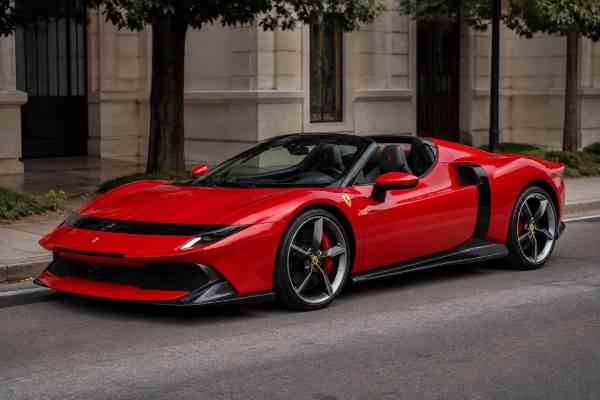
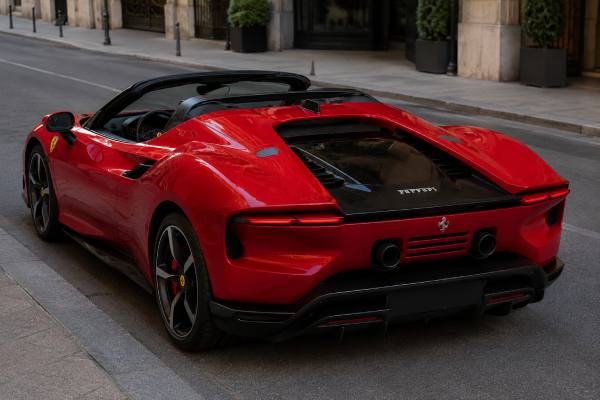
The Ferrari 849 Testarossa Spider is the open-top version of Ferrari’s new plug-in hybrid flagship, replacing the SF90 Spider with more power, sharper electronics, and a name that reaches deep into Maranello history. It is not a retro remake of the 1980s Testarossa. It is a modern mid-rear-engined Ferrari spider built around a reworked F154FC twin-turbo V8, three electric motors, all-wheel drive, active aerodynamics, and a retractable hard top.
Quick Take
The 849 Testarossa Spider’s strongest appeal is that it combines Ferrari’s most powerful open-air road-car formula with real roof-down drama: 1050 cv from a 4.0-liter hybrid V8 system, electric front-axle torque vectoring, and a folding metal roof that turns it from coupé-like to open-air supercar in seconds. Its ownership identity is closer to a technical flagship than a simple collectible roadster, so the main caution is complexity: hybrid battery health, carbon-ceramic brakes, software updates, expensive options, and specialist servicing will matter as much as mileage. For buyers, the key factor is not just getting an allocation, but choosing a specification that remains desirable without creating future originality, warranty, or resale risk.
Table of Contents
- Why the 849 Testarossa Spider Matters
- F154FC Hybrid V8 Specs and Chassis
- Production, Versions, and Key Options
- Design, Aero, Roof, and Technology
- How the 849 Testarossa Spider Drives
- Maintenance, Reliability, and Ownership Risks
- Market Value and Buying Advice
Why the 849 Testarossa Spider Matters
The 849 Testarossa Spider matters because it moves Ferrari’s open-top flagship beyond the SF90 Spider while keeping the same broad idea: a mid-rear V8, plug-in hybrid assistance, electric front drive, and extreme performance that can still be used on the road. It is Ferrari’s most serious series-production spider for buyers who want top-level speed without stepping into ultra-limited halo-car territory.
The name is the first thing people notice, and it carries weight. “Testarossa” originally referred to red-painted cylinder heads on Ferrari racing engines, then became famous through cars such as the 250 Testa Rossa and later the 1980s Testarossa road car. On the 849, the name is more about Ferrari heritage than visual imitation. There are no side strakes copied from the 1980s car and no flat-12 engine. Instead, the 849 Testarossa Spider uses the name to signal a major performance and engineering step.
The Spider replaces the SF90 Spider in Ferrari’s range. That context is important because the SF90 was already a landmark car: Ferrari’s first regular-production plug-in hybrid supercar, with a V8 and three electric motors. The 849 keeps that architecture but upgrades the engine, aerodynamics, chassis control systems, cooling, interior interface, and design language. In simple terms, it is not a clean-sheet departure. It is a heavily developed successor aimed at making the SF90 formula faster, more precise, and more emotionally complete.
The “849” name is also technical. The “8” refers to the eight-cylinder engine, while “49” reflects the approximate displacement of each cylinder in cubic centimeters. That makes the badge more descriptive than it first appears. It points directly to the 3990 cc V8 at the center of the car.
As a model-line statement, the 849 Testarossa Spider sits near the top of Ferrari’s open-air road-car range. It is not a relaxed grand tourer like a front-engined convertible, and it is not a raw track special with number plates. Its purpose is to blend very high performance with enough refinement, roof practicality, and electronic support to make the car usable beyond perfect roads and closed circuits.
For collectors, the car’s long-term importance will depend on three things. First is its role as the SF90 Spider’s direct successor. Second is its place in Ferrari’s hybrid era, before high-performance electrification becomes routine. Third is how the market responds to the Testarossa name on a modern V8 PHEV. Some buyers will love the historical link. Others may feel the badge deserved a more visually nostalgic car. That debate may actually help the car stay memorable.
For enthusiasts, the appeal is more immediate. The Spider offers the same 1050 cv total output as the coupé, but with the extra sensory layer of an open roof. In a car this fast, that matters. The sound, wind, heat, and mechanical presence are part of the experience, especially because modern hybrid supercars can otherwise feel highly filtered.
F154FC Hybrid V8 Specs and Chassis
The 849 Testarossa Spider’s key technical story is its F154FC 4.0-liter twin-turbo V8 paired with three electric motors for a total system output of 1050 cv. The Spider carries more weight than the coupé because of the retractable hard top and related structure, but it keeps the same headline output and all-wheel-drive hybrid layout.
| Category | Specification |
|---|---|
| Model code | F173M |
| Engine code | F154FC |
| Engine type | Mid-rear 90-degree twin-turbo V8, dry sump |
| Displacement | 3990 cc |
| Internal-combustion output | 830 cv at 7500 rpm |
| Internal-combustion torque | 842 Nm at 6500 rpm |
| Hybrid system | Three electric motors, high-voltage battery, inverter |
| Electric motor output | 220 cv total |
| Total system output | 1050 cv |
| Transmission | 8-speed dual-clutch automatic |
| Drivetrain | Hybrid all-wheel drive with front electric axle |
The F154FC is not merely the older Ferrari V8 with more boost. Ferrari revised the turbocharging system, cylinder heads, engine block, exhaust manifolds, intake system, valve train, and fuel rail. The result is a V8 that produces 830 cv before electric assistance, which is a huge figure for a road-car V8 of this displacement.
The hybrid layout follows the pattern established by the SF90. Two electric motors sit at the front axle and provide front-wheel drive when required. This allows the car to act as an all-wheel-drive supercar under acceleration and corner exit, while also giving the control systems fine authority over torque distribution. A third electric motor sits at the rear and works with the engine and gearbox. In road use, the benefit is not only peak power. The electric motors help fill response, sharpen launches, and stabilize the car when grip is changing quickly.
The battery is used for short electric-only driving and performance assistance. The 849 Testarossa Spider is not a plug-in hybrid in the economy-car sense. Its electric range is useful for quiet starts, city zones, and low-speed use, but the system’s main purpose is performance and control.
| Item | Ferrari 849 Testarossa Spider |
|---|---|
| Length | 4718 mm |
| Width | 2304 mm |
| Height | 1225 mm |
| Wheelbase | 2650 mm |
| Dry weight | 1660 kg with optional lightweight content |
| Weight distribution | 45% front / 55% rear |
| Top speed | Over 330 km/h |
| 0–100 km/h | Under 2.3 seconds |
| 0–200 km/h | 6.5 seconds |
| 100–0 km/h braking | 28.5 meters |
| Fiorano lap time | 1 minute 18.100 seconds |
The chassis is built around Ferrari’s modern mid-engine hybrid platform, with a structure designed to support both high mechanical loads and the packaging needs of the battery, front motors, cooling system, and retractable hard top. The Spider’s weight penalty over the coupé is unavoidable, but Ferrari offsets it with high output, active systems, and careful aerodynamic work.
The tire sizes are wide and performance-focused, with 20-inch wheels and a notably large rear contact patch. The braking system uses carbon-ceramic hardware and advanced electronic control, including brake-by-wire and ABS Evo. For a buyer, that means the brakes should be judged not only by disc thickness and pad life, but also by pedal feel, system calibration, and whether the car has had the correct software updates.
Production, Versions, and Key Options
The 849 Testarossa family consists of the coupé and the Spider, with Assetto Fiorano available for buyers who want a sharper, more track-focused specification. The Spider is the version for buyers who want the same hybrid flagship powertrain with the added cost, weight, and desirability of a retractable hard top.
Production is scheduled from 2026, with early deliveries beginning in Europe before wider global rollout. Ferrari has not positioned the 849 Testarossa Spider as a numbered limited edition. That matters for collectors: value will likely depend less on a fixed production cap and more on allocation, specification, condition, mileage, documentation, and whether later special versions appear.
Coupé versus Spider
The Spider keeps the same 1050 cv hybrid powertrain as the coupé, but the retractable hard top changes the car’s character. The roof adds weight and complexity, yet it also makes the car more versatile. With the roof up, it behaves more like a closed car than a traditional soft-top spider. With the roof down, it delivers the open-air sensory experience many Ferrari buyers want.
The Spider’s biggest differences are:
- Retractable hard top instead of fixed roof
- Higher dry weight than the coupé
- Slightly slower 0–200 km/h and Fiorano figures than the coupé
- Stronger lifestyle and emotional appeal for road use
- Potentially stronger desirability in markets where open-top Ferraris are favored
Assetto Fiorano
Assetto Fiorano is the important performance option. It is intended for buyers who expect to drive hard on circuit or want the most focused version for long-term desirability. It generally brings weight-saving content, more aggressive aerodynamic pieces, and track-oriented tuning. On cars like this, the package can be valuable, but it is not always the best choice for every owner.
For a mostly road-driven Spider, Assetto Fiorano can make the car feel more serious than necessary. Stiffer suspension, more exposed materials, and track-focused tires may reduce comfort and increase sensitivity to road surfaces. For collectors, however, the package may be highly desirable if paired with the right color, carbon options, racing seats, and documented low mileage.
Personalization and specification risk
Ferrari buyers can personalize heavily, and the 849 Testarossa Spider will likely be ordered with a wide spread of paint, carbon fiber, wheel, interior, seat, audio, and trim choices. That is part of the appeal, but it also creates risk.
A future buyer will usually prefer a car that looks special without being too personal. Unusual colors can be valuable when tasteful and rare, but difficult combinations may narrow the resale audience. Expensive carbon options can help desirability, especially exterior carbon and engine-bay carbon, but they should be checked carefully for damage. Interior choices matter too: racing seats, contrast stitching, leather and Alcantara combinations, and heritage-inspired colors may age better than trendy specifications.
Good ordering priorities include:
- Desirable exterior color with strong Ferrari identity
- Well-matched interior trim
- Carbon-ceramic brakes in excellent condition
- Clear warranty and service-plan documentation
- Sensible carbon exterior and interior options
- Lift system if available and needed for local roads
- Avoidance of overly personal color clashes
Factory documentation will be important. A buyer should keep the original order sheet, window sticker or market equivalent, service invoices, software-update records, warranty documents, manuals, charging equipment, spare keys, and all accessories. In a complex modern Ferrari, paperwork is not a formality. It is part of the car’s value.
Design, Aero, Roof, and Technology
The 849 Testarossa Spider’s design is functional first: the body is shaped around cooling, downforce, roof packaging, and hybrid hardware. Its drama comes less from retro decoration and more from the contrast between sharp modern surfaces, a low mid-engine stance, and a roof system that keeps the car usable.
Ferrari’s Styling Centre gave the 849 a more geometric look than the SF90. The inspiration from 1970s sports prototypes is more relevant than the 1980s Testarossa connection. The surfaces are broad and technical, with a strong rear treatment and carefully managed airflow. This is why the car does not simply wear old Testarossa cues. Ferrari appears to be using the name as a bridge between racing history and current technology, not as a styling template.
Aerodynamics are central to the car. The 849 Testarossa Spider generates up to 415 kg of downforce at 250 km/h, a major figure for an open-top road car. That downforce is not created by one obvious wing alone. It comes from the underbody, active rear spoiler, rear architecture, cooling flows, and body channels working together. The goal is stability at speed without making the car unusable on the road.
Cooling is equally important. A 1050 cv PHEV supercar has several thermal problems at once: engine heat, turbocharger heat, battery temperature, inverter load, brake heat, and cabin comfort. The side intakes, rear openings, underbody, and active aero pieces are part of that thermal strategy. Buyers should understand that blocked ducts, damaged undertrays, poorly repaired carbon parts, or aftermarket changes can affect more than appearance.
Retractable hard top
The retractable hard top is the Spider’s defining feature. It opens or closes in about 14 seconds and can operate at speeds up to 45 km/h. That makes it far more useful than a roof that requires stopping completely. For real driving, it means the owner can respond quickly to weather, traffic, or a change from city streets to open road.
The roof also shapes the ownership experience. A folding metal hard top gives better isolation than a fabric roof, but it adds hydraulic or electric mechanisms, seals, sensors, hinges, drains, and alignment points. These parts must be inspected carefully as the cars age. Any uneven panel gaps, warning lights, slow roof movement, water leaks, or wind noise should be treated seriously.
Cockpit and controls
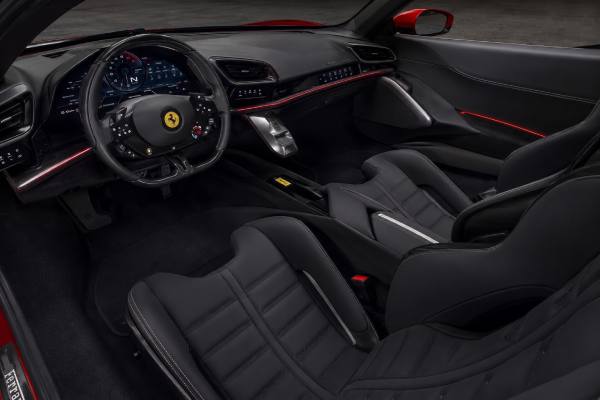
The interior is more driver-focused than decorative. The central “sail” layout and gear-selector area echo Ferrari’s recent design direction, while the steering wheel brings back more physical control elements than some earlier touch-heavy systems. That matters because very fast cars need controls the driver can trust without looking down for too long.
The cabin will still be technology-heavy. Hybrid modes, Manettino settings, infotainment, driver displays, lift controls, and performance screens all depend on software and sensors. A used 849 Testarossa Spider should therefore be checked with proper diagnostic equipment, not only driven around the block.
The special character of the Spider comes from the mix of control and exposure. With the roof down, the driver hears more turbo sound, tire noise, airflow, and mechanical texture. In many modern supercars, that extra sensory connection is the reason to buy the open model.
How the 849 Testarossa Spider Drives
The 849 Testarossa Spider should feel brutally fast, but its real achievement is how much of that speed is managed by the hybrid system and chassis electronics. It is not simply a rear-drive V8 supercar with extra power; it is a torque-managed, software-assisted, all-wheel-drive Ferrari that uses electrification to make huge performance easier to access.
Acceleration is the headline experience. The V8 provides the top-end character and combustion drama, while the electric motors add immediate response and front-axle traction. From low speeds, the car should feel more instant than a conventional turbocharged V8. At higher speeds, the engine’s 830 cv output becomes the main event, supported by hybrid boost.
The gearbox is Ferrari’s 8-speed dual-clutch unit. In normal use, it should shift cleanly and quickly, with enough smoothness for traffic. Under hard driving, it gives the sharp shift behavior expected from a modern Ferrari. Buyers coming from older single-clutch Ferraris will find it far easier to use. Buyers coming from naturally aspirated classics may find it less mechanical but vastly faster.
The steering should be quick and highly responsive, as expected from modern Ferrari mid-engine cars. The front electric axle and torque-vectoring functions influence how the car puts power down out of corners. Instead of relying only on rear tires, the 849 can pull itself out of bends with the front motors while the rear V8 power builds. This can make the car feel almost impossibly effective, especially on corner exit.
Braking is another key part of the experience. Carbon-ceramic brakes provide huge stopping power, while ABS Evo and brake-by-wire control help stability and consistency. Some drivers prefer the direct feel of older hydraulic systems, so anyone buying the car should test pedal feel in multiple modes and speeds. The system should feel consistent, not grabby, vague, or uneven.
Drive modes will change the car’s personality. In electric mode, it can move quietly for short trips. In hybrid and performance modes, the system decides how to blend engine and electric power. In more aggressive settings, the car focuses on maximum response, battery deployment, and track performance. Tire temperature will matter. A 1050 cv hybrid Ferrari on cold high-performance tires is still a serious machine, regardless of how advanced the electronics are.
As a road car, the Spider will likely feel more emotional than the coupé at moderate speeds because the roof opens the cabin to sound and airflow. That is important because cars this fast cannot be fully exploited on public roads for more than brief moments. The open-top experience gives the owner more sensation without needing to drive at absurd speeds.
On track, the Spider will be extremely capable but not quite as pure as the coupé. The extra weight and roof structure affect lap time and feel. Still, the official Fiorano figure shows that it is a serious performance car, not a boulevard version. Owners who plan regular circuit use should pay close attention to tires, brakes, alignment, cooling, and warranty terms.
Maintenance, Reliability, and Ownership Risks
The 849 Testarossa Spider is too new for a mature reliability record, so the best ownership approach is preventive, documentation-heavy, and dealer- or specialist-led. The main risks are not old-fashioned engine neglect alone; they include hybrid-system condition, software calibration, roof operation, carbon-ceramic brake wear, tire age, and damage to aerodynamic or cooling components.
The F154FC V8 is part of Ferrari’s well-known twin-turbo V8 family, but this version is highly developed. More power, larger turbochargers, high thermal load, and hybrid integration mean service quality matters. Oil changes, coolant condition, turbocharger heat management, and correct diagnostic checks should never be treated casually. A low-mileage car that has skipped time-based servicing is not automatically better than a regularly used, correctly maintained example.
The hybrid system needs special attention. Battery condition, charging behavior, warning lights, inverter performance, and electric motor operation should be checked through official diagnostics. Because the car is a plug-in hybrid, buyers should also confirm that charging equipment is complete and that the car accepts charge normally. A car that has been stored poorly may need more careful inspection than its mileage suggests.
Carbon-ceramic brakes can last a long time in normal road use, but they are very expensive when damaged or worn. Track use changes the equation. Heat cycling, pad material, gravel damage, and careless wheel cleaning can all affect brake condition. A pre-purchase inspection should measure and evaluate the discs properly rather than relying on appearance alone.
The retractable hard top adds its own checklist:
- Roof opens and closes smoothly
- No warning messages
- Seals are even and undamaged
- No water marks inside the cabin or luggage areas
- Panel gaps are symmetrical
- No unusual wind noise with the roof closed
- Drain paths are clear
- Roof mechanism has not been forced or repaired poorly
Tires are another major cost and safety factor. The 849 Testarossa Spider depends on very high-performance tires, and tire age matters even when tread remains. Old tires can make the car nervous, reduce braking performance, and interfere with the effectiveness of the stability systems. Correct tire type and Ferrari-approved specification should be confirmed.
Electronics and software will be central to ownership. The car’s control systems include advanced traction control, side-slip management, electronic differential logic, brake control, hybrid deployment, and the FIVE estimator. These systems depend on accurate sensor input and current software. A car with unresolved fault codes, aftermarket tuning, or non-standard electronic changes should be approached very cautiously.
Common inspection priorities should include:
- Full Ferrari service history
- Warranty and extended-warranty eligibility
- Hybrid battery diagnostic report
- Brake disc and pad condition
- Tire date codes and correct specification
- Roof function and leak inspection
- Front-lift system operation if fitted
- Underbody and diffuser damage
- Cooling duct and radiator condition
- Software update status
- Evidence of track use
- Paint-protection-film quality and hidden paint issues
Restoration is not the right word for a new 849 Testarossa Spider, but future repair complexity will be high. Carbon components, hybrid parts, roof mechanisms, and calibrated electronics make accident repair especially sensitive. A minor cosmetic incident can become a major value issue if the repair affects structure, sensors, cooling, or factory paint originality.
Owners should resist poorly supported modifications. Exhaust changes, ECU tuning, hybrid-system tampering, wheel changes, or lowering kits can harm warranty coverage, drivability, thermal management, and resale value. For a car this complex, originality is usually the safer long-term strategy.
Market Value and Buying Advice
The 849 Testarossa Spider’s market is allocation-driven, not bargain-driven. Early cars will likely trade around new-car access, specification, delivery timing, and buyer relationships with Ferrari dealers rather than normal used-car depreciation patterns.
The European launch price was about €500,000 for the Spider before options and local taxes. In some markets, especially where import duties and luxury taxes are high, the real delivered price can be far higher. Options can add a large amount, particularly carbon fiber, special paint, interior materials, racing seats, forged or carbon wheels, lift systems, and personalization through Ferrari’s Tailor Made program.
Because the model is new, there is no deep auction history yet. Early asking prices may not reflect real completed transactions. Some listings may represent allocations, incoming cars, or speculative positions rather than delivered used examples. Buyers should separate three different markets:
| Market type | What it means | Main risk |
|---|---|---|
| Factory allocation | A new car ordered through an authorized Ferrari dealer | Limited availability and long wait times |
| Incoming or delivery-mile car | A very early car offered near delivery | Premium pricing and unclear transfer rules |
| Used low-mileage car | A delivered car with first-owner mileage | Spec quality, warranty status, and hidden use history |
The most desirable cars will likely combine strong colors, tasteful options, clear documentation, low but believable mileage, no accident history, and continued Ferrari warranty coverage. Assetto Fiorano may help long-term desirability, especially for collectors who want the most focused configuration, but it is not automatically best for every buyer. A beautifully specified standard Spider may be easier to enjoy and easier to resell than a harshly configured track-focused car in a difficult color.
A serious buyer should seek:
- Original factory order sheet and full option list
- Confirmed warranty start date and coverage
- Evidence of all scheduled services
- Battery and hybrid-system diagnostic report
- No accident or paintwork concerns
- Clean roof operation
- Undamaged carbon trim and underbody aero
- Correct tires with fresh date codes
- No aftermarket tuning or electrical changes
- Complete books, keys, charger, tools, and accessories
Cars to avoid include heavily personalized specifications with limited appeal, cars advertised without clear ownership status, cars that have been tracked without supporting maintenance records, and any example with unresolved warning lights. Also avoid cars with unclear import history, missing charging equipment, or cosmetic repairs that cannot be documented by a Ferrari-approved repairer.
For long-term collectability, the 849 Testarossa Spider has several strengths. It carries a famous Ferrari name, uses a record-level hybrid V8 powertrain, replaces a landmark model, and offers open-air usability. Its risks are also clear: it is complex, not numbered as a limited edition, and may eventually be followed by more extreme or special versions. That means the safest collector strategy is to buy the right car, keep it original, maintain it perfectly, and preserve every document from day one.
For an enthusiast owner, the best reason to buy is simpler. The 849 Testarossa Spider offers a combination that will not feel ordinary for a long time: roof-down Ferrari theater, 1050 cv hybrid acceleration, a highly developed V8, and electronics that make extreme performance usable. The right example should be bought as a machine to experience, not only as a market position.
References
- Ferrari 849 Testarossa Spider – Ferrari.com 2026 (Manufacturer Specifications)
- 849 Testarossa Spider 2025 (Manufacturer Press Release)
- 849 Testarossa 2025 (Manufacturer Technical Release)
- Ferrari evokes spirit of 1980s with new 849 Testarossa hybrid 2025 (Market and Launch Context)
- 2027 Ferrari 849 Testarossa Review, Pricing, and Specs 2026 (Pricing and Market Context)
Disclaimer
This article is for informational purposes only and is not a substitute for professional diagnosis, repair, inspection, or valuation. Specifications, torque values, service intervals, software procedures, hybrid-system checks, and repair methods can vary by VIN, market, model year, equipment, and factory updates. Always verify details against the official Ferrari service documentation for the exact vehicle and consult an authorized Ferrari dealer or qualified specialist before purchase or maintenance.
If this guide helped you, please consider sharing it on Facebook, X/Twitter, or your favorite car community to support our work.